



This post has been unlocked through a generous grant from the Lilly Endowment for the Association of Religion Data Archives (ARDA). The graphs you see here use data that is publicly available for download and analysis through link(s) provided in the text below.
There’s an old saying that bounces around from time to time: “Change is hard. Not changing is harder.” It’s often invoked by counselors helping clients alter their behavior, particularly regarding substance abuse. But outside that specific context, the opposite is often true. In fact, the strongest force in the world of social science is inertia. What’s the strongest predictor of where someone will live? It’s where they were born. The strongest predictor of one’s partisanship? The political affiliation of their parents.
And if one were to guess a random person’s current religion, the answer is almost always the same: whatever religion they were raised in. We stick with what we know.
The Political Takeover: Why Ideology, Not Faith, Drives the Culture War

No term takes me back to my graduate school days like the “Culture War.” And for good reason: it was one of the biggest methodological debates in political science. Two camps emerged—one argued that polarization had completely infiltrated American society. It wasn’t just a phenomenon of the chattering class, but it was also clearly evident among rank an…
The share of Americans who indicate that their current religious tradition is the one in which they were raised is 66%. Most people living in the United States will die with the same faith into which they were born, and that’s been true for decades. But how people switch and why they switch may be changing.
Let’s first tackle the first part of that question: what does religious switching look like in American religion? The alluvial diagram below maps the flow of Americans from their childhood faith to their current one, based on the 2023-24 Pew Religious Landscape Survey (hosted on the ARDA). The color of each band represents a person’s childhood tradition, and the thickness represents how many people travel a particular path.
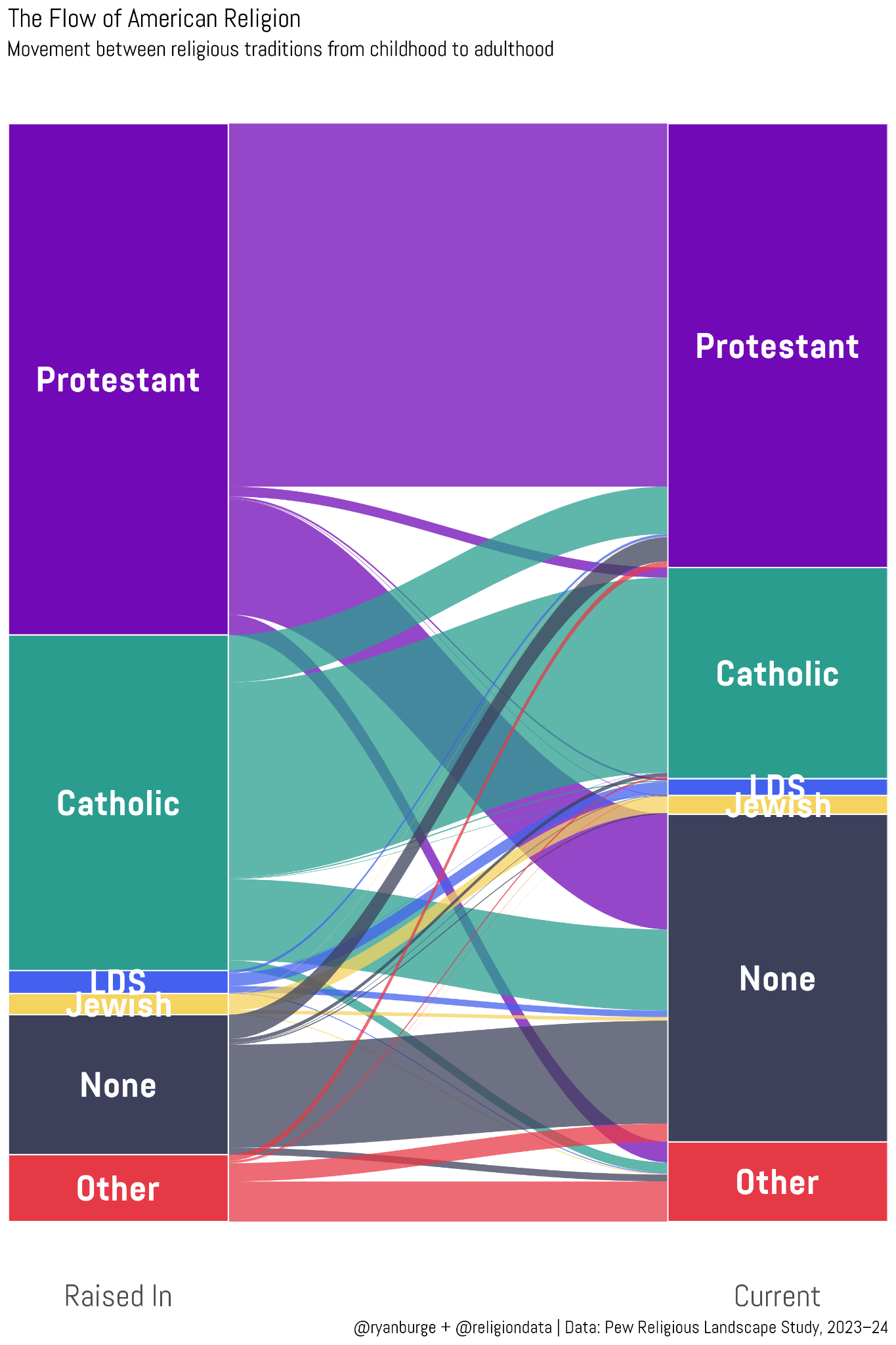
The thickest bands tell the clearest story. The vast majority of folks who were raised Protestant stay in that same faith tradition throughout their lives, and the same is true for Catholics and smaller faith traditions. But notice the size of the blocks on the left compared to the right. More people were raised Protestant than are currently Protestant. Catholics show an even steeper drop.
The one group that clearly bucks this trend is the “nones.” Their bar on the right-hand side is over twice as large as the bar on the left. The non-religious have far more inflows than outflows, which is how they have grown to roughly a quarter to a third of the American population.
Switching happens, of course, but it’s certainly not the norm. In fact, about six in ten current nones came from Christian backgrounds—roughly a third from Protestant traditions and a quarter from Catholic ones.
Which groups are best at keeping their own, and which ones have a high rate of defection? It’s easier to get a handle on that by calculating retention rate, which is simply the share of each tradition whose childhood faith matches their current religious affiliation.
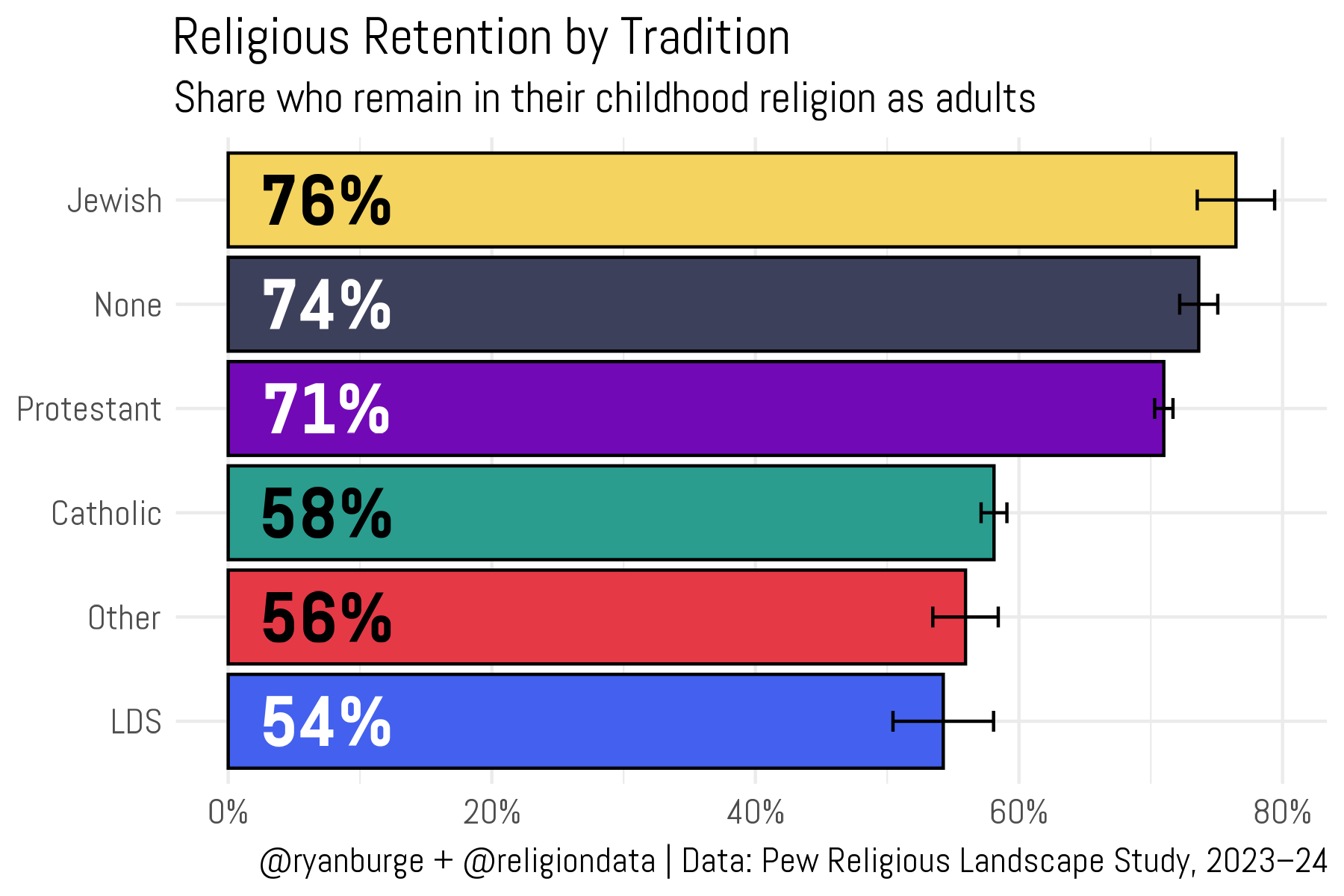
Jews lead the way here. About three-quarters of people who were raised in a Jewish household still claim Judaism as their present religion. The non-religious are statistically in the same spot: three-quarters of Americans who were raised with no faith tradition are still nones into adulthood. Couple that with the data from earlier indicating that 60% of current nones are Christian defectors, and you can quickly ascertain why the non-religious have exploded in size over the last three decades.
The Latter-day Saints had the lowest retention of any group—just over half—which should send alarm bells through church headquarters in Salt Lake City.
Let’s go one layer down now, by checking how retention rates have shifted based on the birth decade of the respondent.
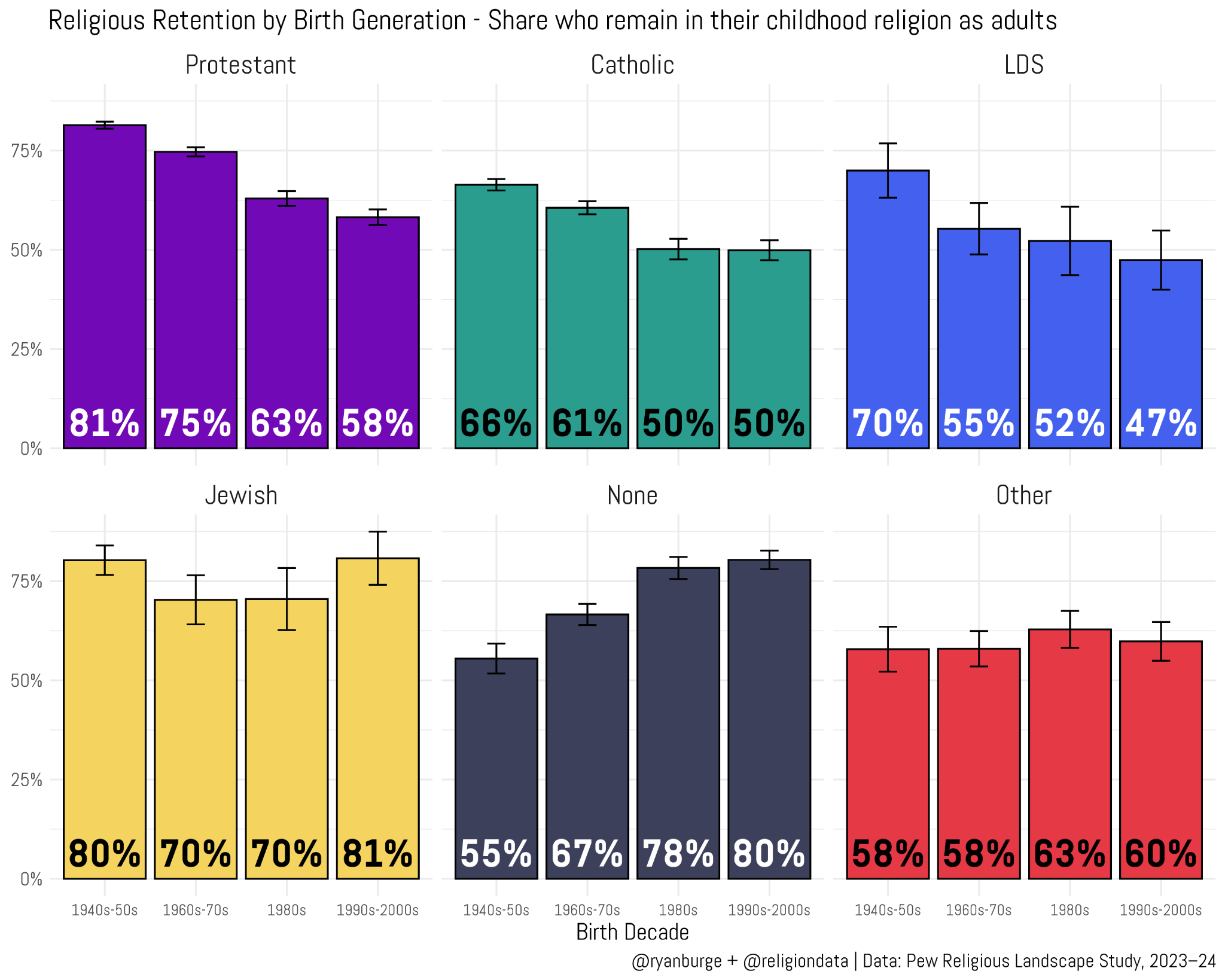
For both Protestants and Catholics, retention has taken a nosedive among younger adults compared to their parents or grandparents. Among people born before 1980 and raised in a Protestant household, 75–80% still identify as Protestant. Catholic retention among that age group is noticeably lower (60–65%). However, defection among younger adults raised in those faiths has accelerated sharply. Now, half of young people raised Catholic are no longer Catholic; among Protestants, it’s closer to 40%.
The trend for the nones stands alone. Among the oldest Americans raised without religion, almost half found their way into a faith community as adults. Today, 80% of young adults raised as nones are still nones. For comparison, Amish retention has been estimated at 85%. The “none” identity is incredibly sticky now.
So we’ve spent some time poking around the “what” question. It’s time to pivot to the “why” question, and I want to zoom in on a single explanation for religious switching: politics. In 2002, Michael Hout and Claude Fischer published an article in the American Sociological Review titled Why More Americans Have No Religious Preference: Politics and Generations. For anyone who works in this field, this is considered canonical reading.
The abstract describes the conceit of the piece: “The increase in ‘no religion’ responses was confined to political moderates and liberals; the religious preferences of political conservatives did not change. This political part of the increase in the ‘nones’ can be viewed as a symbolic statement against the Religious Right.”
In other words: politics caused people to drop out of the church. Let me provide an updated version of the graph that appears on page 181 of that piece using data from the General Social Survey through 2024.
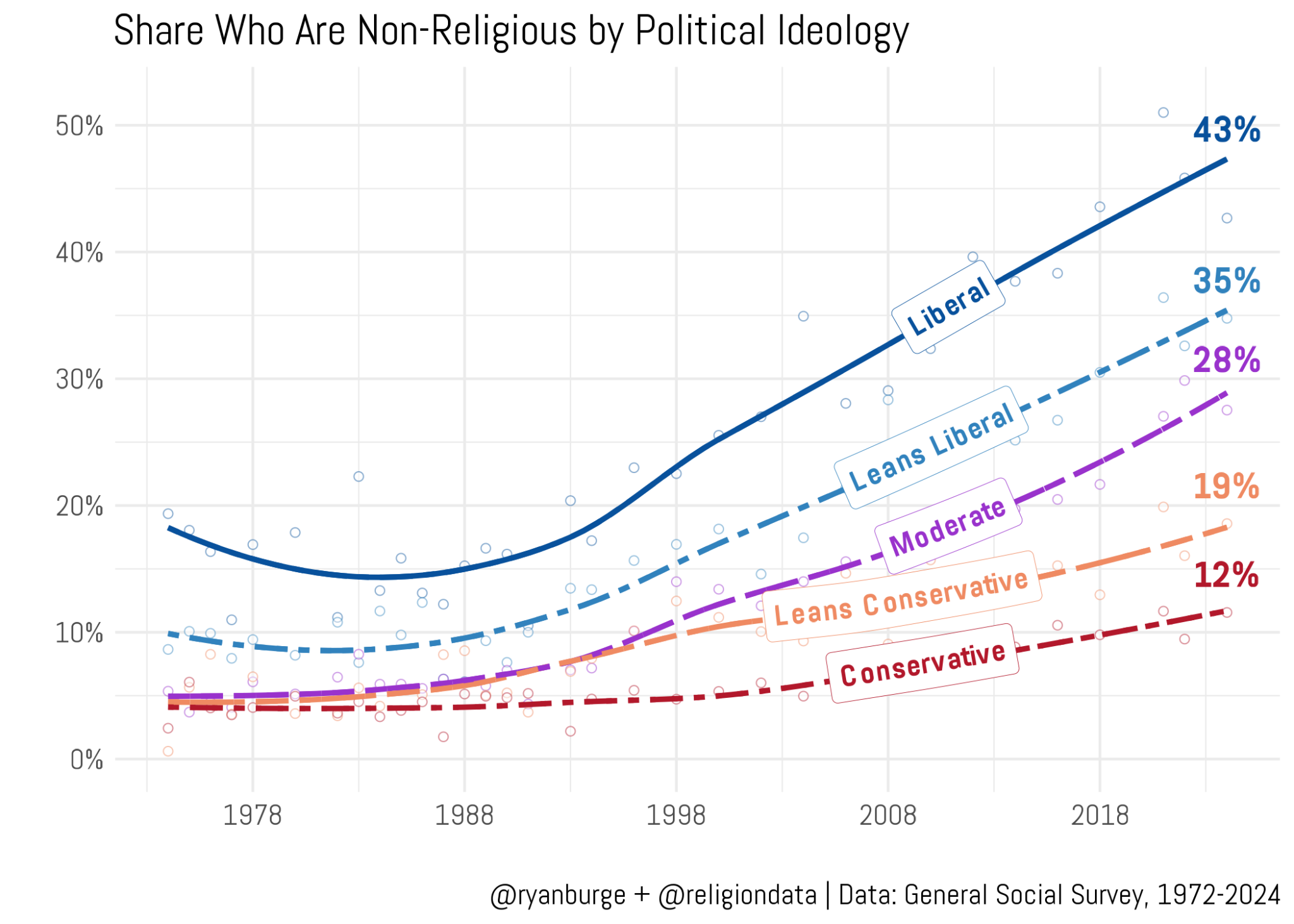
That result is about as clean as it gets in the world of social science. In the late 1990s, about 15% of liberals were nones compared to 5% of conservatives—a clear divide, but not an impassable chasm. That’s no longer true. Now, 43% of ideological liberals say they have no religious affiliation compared to just 12% of conservatives. A ten-point gap has tripled in size, and there’s no evidence these trend lines will converge anytime soon.
Does that thesis bear out with the switching data? I had a simple hypothesis to test: are people who grew up Protestant or Catholic but became non-religious more left-leaning than those who stayed in that same tradition?
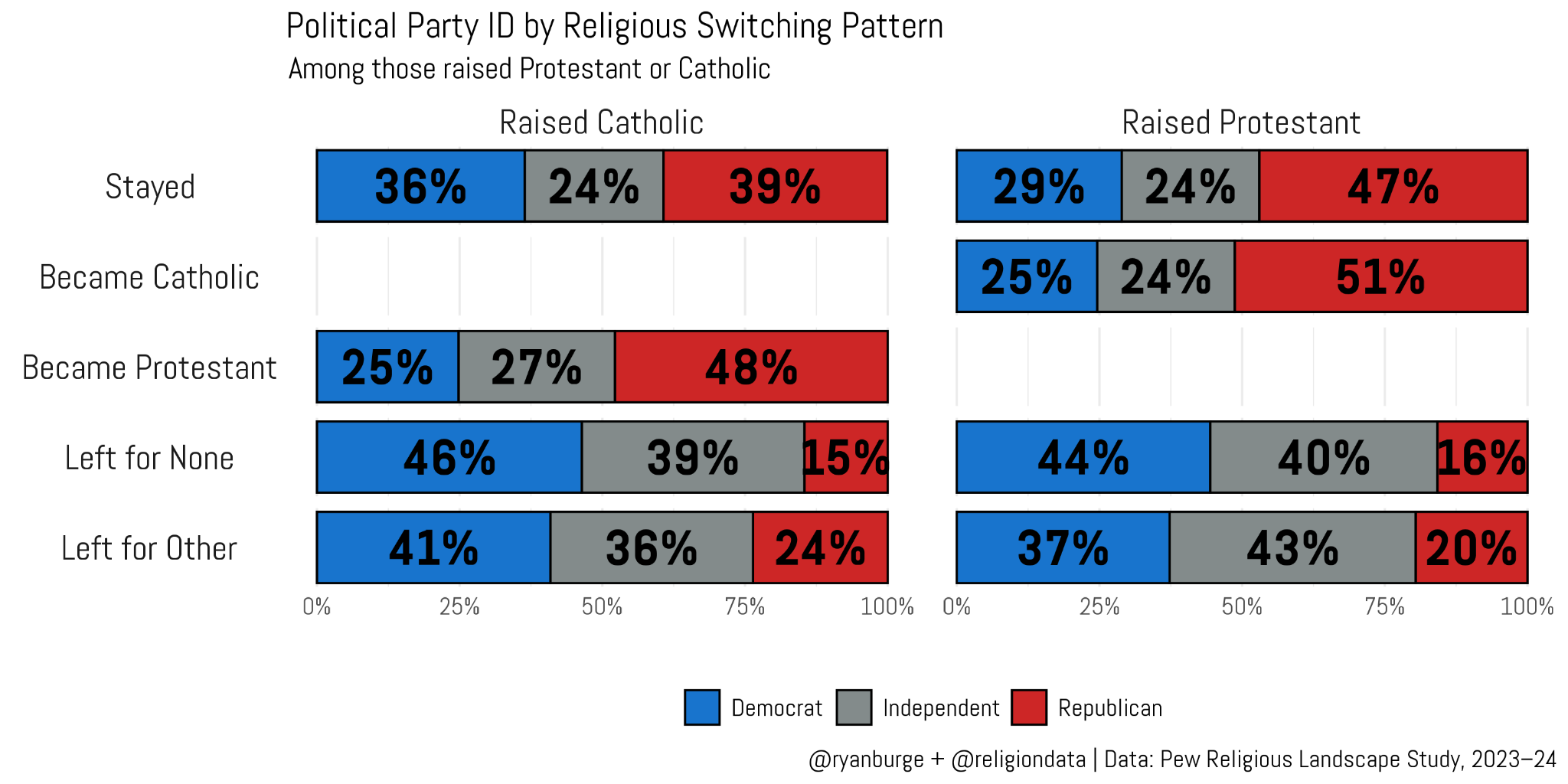
Among Catholic “stayers,” 39% are Republicans and 36% are Democrats. For Protestants who stuck around, those numbers are 47% and 29%, respectively. But among those who switched from Protestant to Catholic or Catholic to Protestant, a clear pattern emerges: switchers inside Christianity are consistently the most Republican of any subgroup examined here.
But what about people who left Catholicism or Protestantism to become non-religious? Among the Catholic-to-none sample, 46% say they are Democrats and only 15% are Republicans. For Protestant-to-nones, it was basically the same: 44% and 16%, respectively. This is strong evidence that politics is wrapped up in why some people leave Christianity to become secular.
However, are people who defected from Christian groups more left-leaning than folks who have been nones their entire lives?
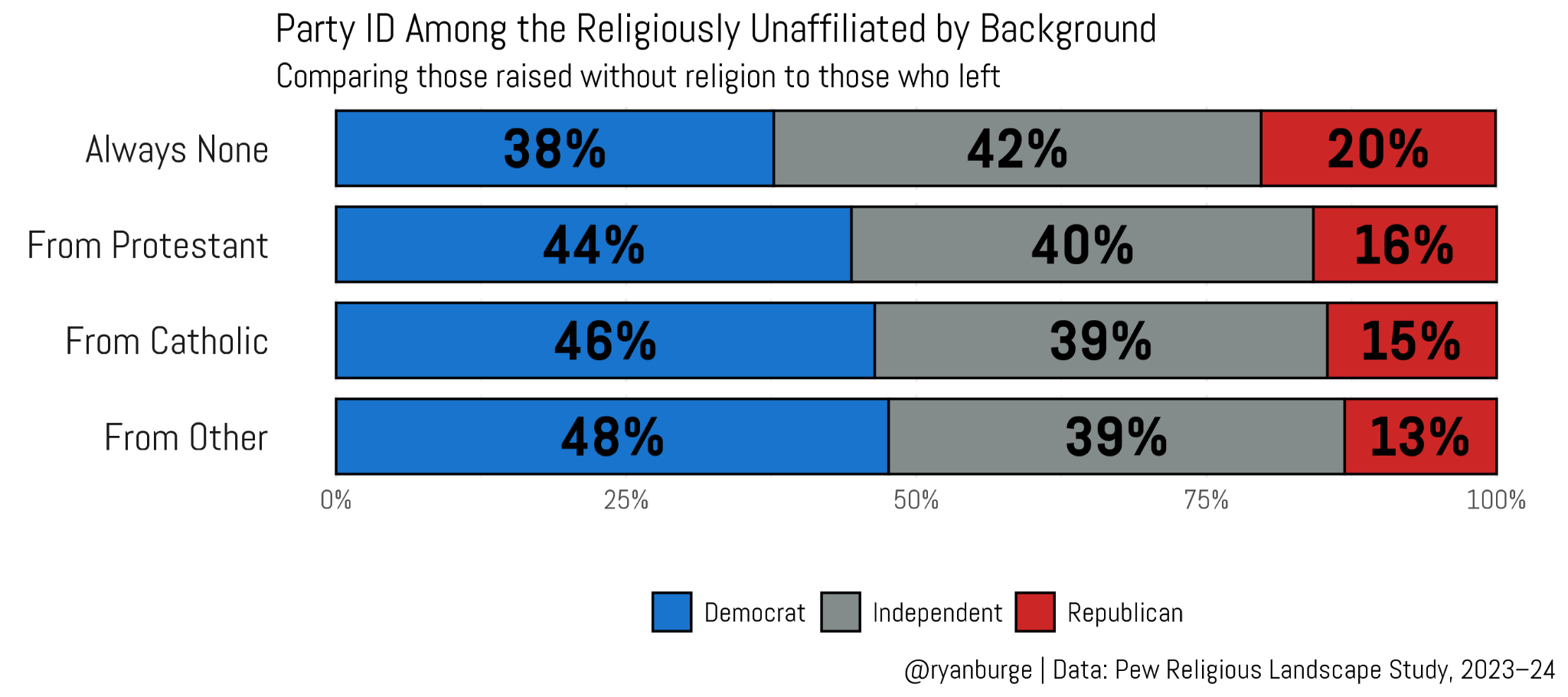
And here’s where I had a “holy cow” moment. The types of nones who are the least Democratic are those who have been non-religious their entire lives. Only 38% say they are Democrats, 42% identify as politically Independent, and 20% align with the GOP. In contrast, among ex-Christians who become nones, roughly 45% say they are Democrats—seven points higher than the “always nones.”
This is fascinating because it suggests a mismatch between what drives people to leave Protestantism or Catholicism and what it means to have never been religious at all. People who actively exit a faith tradition aren’t just drifting; they’re making a decision, and that decision appears correlated with a particular political worldview. Leaving a church isn’t religiously neutral; for many people, it seems to be a political act.
The “always nones” tell a different story. They weren’t pushed out of anything; they simply never had a religious identity to begin with. Without that experience of exit, there’s no corresponding political signal. They’re secular by default rather than conviction, and their politics reflect that—more Independent, less reliably Democratic, and harder to categorize.
Let me lay one more variable on top of this: age. I wanted to test whether politically motivated exit was widespread among older Americans while younger cohorts are switching for reasons that extend beyond the ballot box.
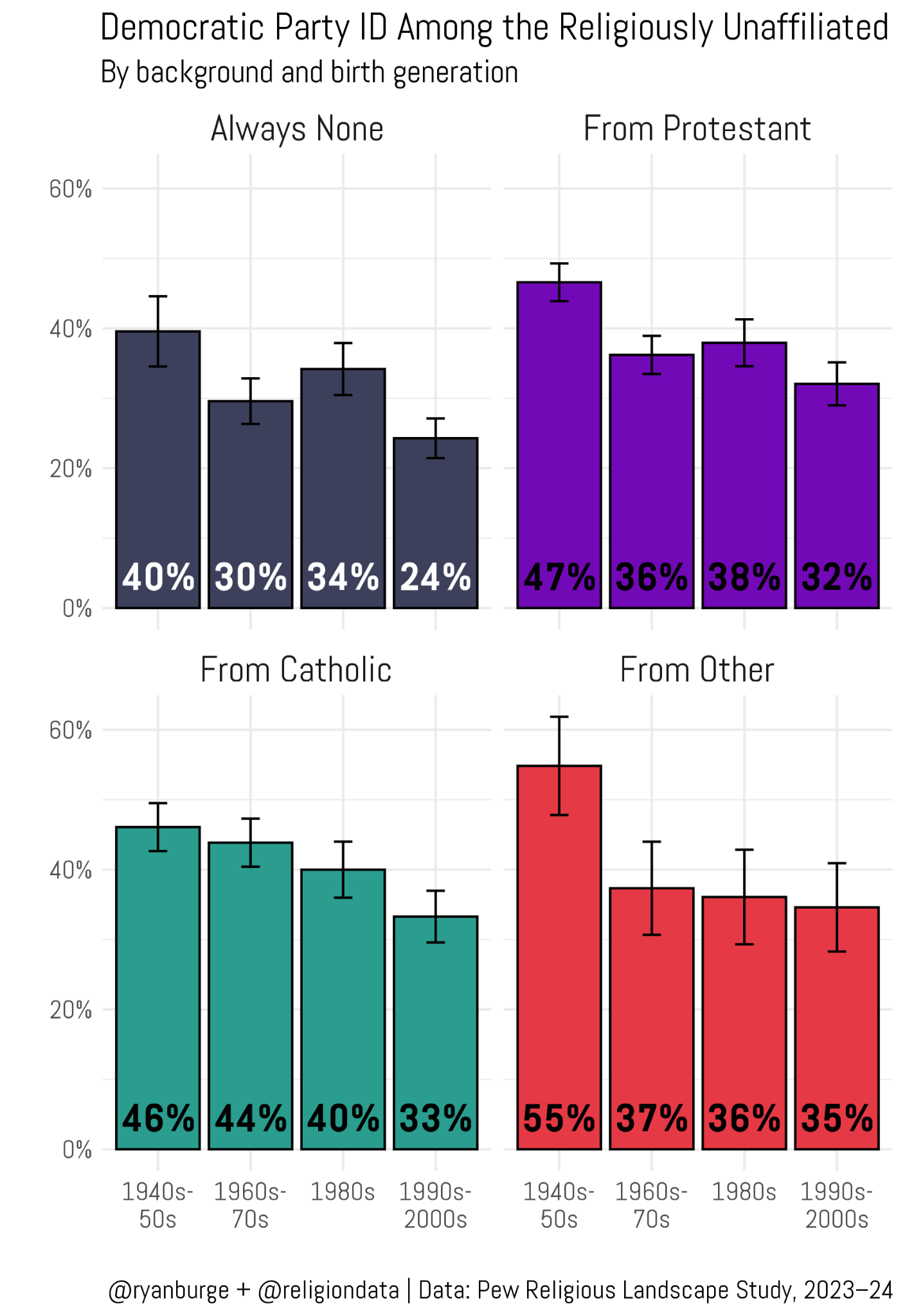
Among the youngest birth cohorts of “always nones” (those born 1990–2004), just a quarter identify as Democrats. For always nones from the Baby Boomer generation, 40% say they are Democrats. Protestant-to-none and Catholic-to-none defectors exhibit the exact same trend line. Among the youngest adults who left their faith behind, only about a third identify as Democrats. For Christian-to-none defectors in their retirement years, a bit less than half say they are Democrats.
This is where Hout and Fischer’s argument becomes both confirmed and complicated. Looking at the older cohorts, they were right. Among Baby Boomers who left Protestantism or Catholicism, nearly half identify as Democrats. These are people whose exits tracked closely with the culture war battles of the 1980s and 1990s. For them, leaving the church and voting Democratic were part of the same identity package.
Are Liberal Christians More Politically Engaged than Conservative One?

I like tweets like the one below, because I honestly don’t know if the statement is true or not. But I think I can try to bring some data to bear and that could be helpful.
But among those born in the 1990s and 2000s who left Christianity behind, only about a third identify as Democrats. The political premium that came with religious exit has nearly vanished. These younger “dechurchers” don’t look like political refugees; they look more like people who simply stopped going—gradually, quietly, without it meaning much ideologically one way or the other.
Hout and Fischer weren’t wrong; they were describing a real mechanism operating in a specific historical moment. What they couldn’t have anticipated is that mass secularization would eventually normalize religious exit to the point where it no longer carries a strong political signature. When leaving religion is something a third of your generation does, it stops being a statement and starts being a default.
The story of the nones, in other words, has changed. The first wave left with conviction. The second wave just drifted out the door.
Code for this post can be found here.
Ryan P. Burge is a professor of practice at the Danforth Center on Religion and Politics at Washington University.

My only problem w all these charts is that Mainline and Evangelical are lumped together as Protestants, though they are quite distinct in many ways. I have a feeling that one of the biggest shifts from the last 30 years is from Mainline to Evangelical.
Wonder how some of our congregational Rabbis would look at the data. While our Jewish retention is admirably high, at least as identity, our participation within an American Jewish ecosystem has not done as well. We don't become Nones but we change synagogues and we let our memberships lapse right after the consumer elements of a synagogue are no longer needed.
If there is a parallel, and I think there is, it seems to distill to how well people feel they are treated when they are there. For us it's how well do you like the Rabbi, are there cliques that exclude you, or other lapses of bonding social capital. Our transfer point was in the mid-1970s when shunning of interfaith families became part of the policy for our largest Jewish subdivision which shrunk Conservative synagogues and expanded Reform ones.
For the Christians, both Protestant and Catholic, the reckoning may have been initially political. A preacher declaring congregants unworthy because of their personal values puts people on the exit ramps. Churches depend on that type of bonding social capital. Go someplace else? Only if the religion has a form of bridging social capital, which it may not.
Ryan's essay has two forms of people leaving, though. Defectors who express dissatisfaction as the earlier group and consumers who assess the value of their experience, which also falters. My limited Jewish ecosystem may have better default options for the value seekers. We have advocacy groups, Jewish social agencies, and other forums that make no ideological demands of the people who check the box "Just Jewish" when asked their affiliations. The younger folks disaffiliating from their Christian world many not have as many alternate capture options.