


One time I was listening to this podcast (remember podcasts?) about how “creators” think about their craft. The host was interviewing this young guy who made short videos for TikTok and Facebook Reels and all that. He asked the guy how much he thought about failure. And he basically responded, “not that much because people will quickly forget a video that doesn’t catch on. But they will always remember those handful of videos that caught fire.” I feel that deeply as a dude who writes 104 posts per year. Most of them do okay, but are quickly forgotten by both the readers and myself.
But every once in a while, I pull together some analysis that just strikes a nerve. That happened back in July when I ran a deep dive into the statistical reality facing the Archdiocese of Detroit. I titled the post, “Built for a Church That No Longer Exists.” It will end up being one of the five most read things on my newsletter this year.
If you didn’t catch it the first time, please go back and read it now. But here’s a quick summary. The Archdiocese of Detroit has a new Archbishop who has initiated a process to help maintain the institutional viability of the Archdiocese for the next couple of decades. That’s a fancy way of saying that they need to close a bunch of churches because the books don’t balance. Well, anyway, I wrote this little sentence near the end of the piece:
“And like I wrote earlier, if there’s some enthusiasm for this macro-level analysis, I plan on getting deep into the weeds of the problems facing many of these parishes.”
And I’m a man of my word, so here we go. I don’t think this is my last pass at this data, because I haven’t even dug deeply into the parish level statistics, but I just became obsessed with trying to figure out this basic question: How do religious organizations decline? I know it sounds simple and I think we can all basically trace the outline of such a phenomenon. But I wanted to get into the nitty gritty of it all. So this is my attempt at cutting through the platitudes and vagaries and really just describing decline in a very precise way.
So let me just “set the field” with a couple of graphs because you come along on a journey to try and sort out what in the world happened to the Archdiocese of Detroit.
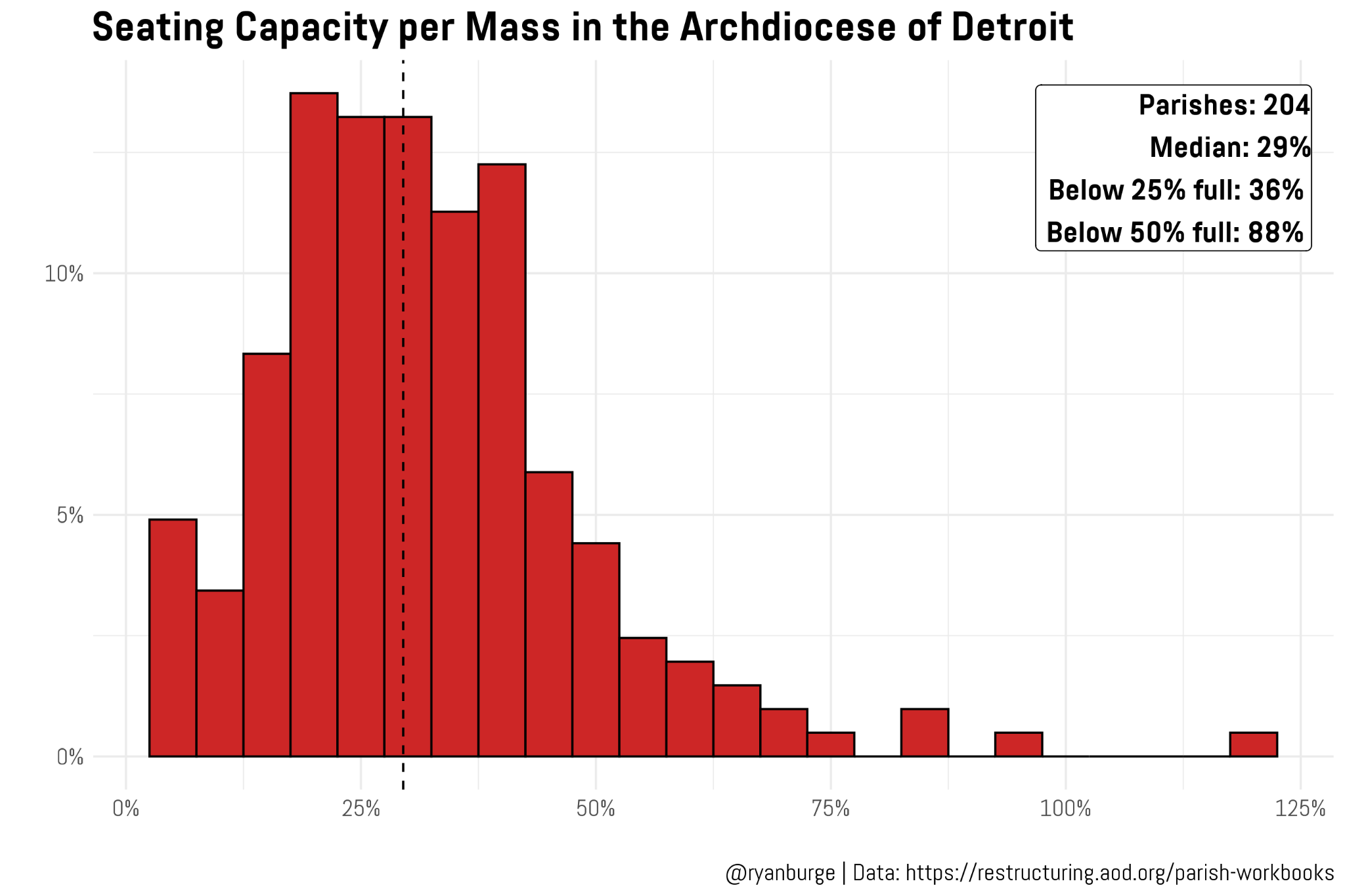
Really, the most important metric in this whole enterprise is seating capacity per Mass. It’s simply a gauge of how many butts are in seats when all the Saints gather during corporate worship. There’s actually a fun debate among religious leaders about how full you want your sanctuary to be on Sunday morning. The answer is definitely not 100%. If people walk in and see no place to sit down, some of them are going to walk out. Or even if it’s only middle seats, that can be a turnoff for some of them.
But the answer is not 29% of capacity, either. That’s exactly what the median number is for the average Mass held in the Archdiocese of Detroit. If you attend Mass at one of them, there can be no one sitting to both your right and your left – lots of empty pews to be found. Across the 204 parishes, 36% of them are filling up a quarter of their Sunday morning real estate, and nearly nine in ten of them are operating at less than 50% capacity.
You don’t need me to tell you this but humor me for a minute. This is a big problem for churches! I know this because my church closed. When I became their pastor in 2006 we had 50 people in a sanctuary that comfortably sat 300. It already felt bad. You can imagine how much worse it was when we were down to 10 on an average Sunday. But not only does it throw off the vibes of corporate worship, it also makes it hard to pay the bills. Big buildings with small budgets are a deadly combination. It doesn’t matter if there are 30 or 300 in that space – the gas bill to heat it in February is basically the same.
Now, there are ways to bump up that capacity at each Mass. Just have fewer services, right? This is not something that my church could do, by the way. We had one service. And it was at <5% capacity. But a larger Catholic parish could just say, “Hey, let’s get rid of that Saturday night Mass and do it all on Sunday morning.”
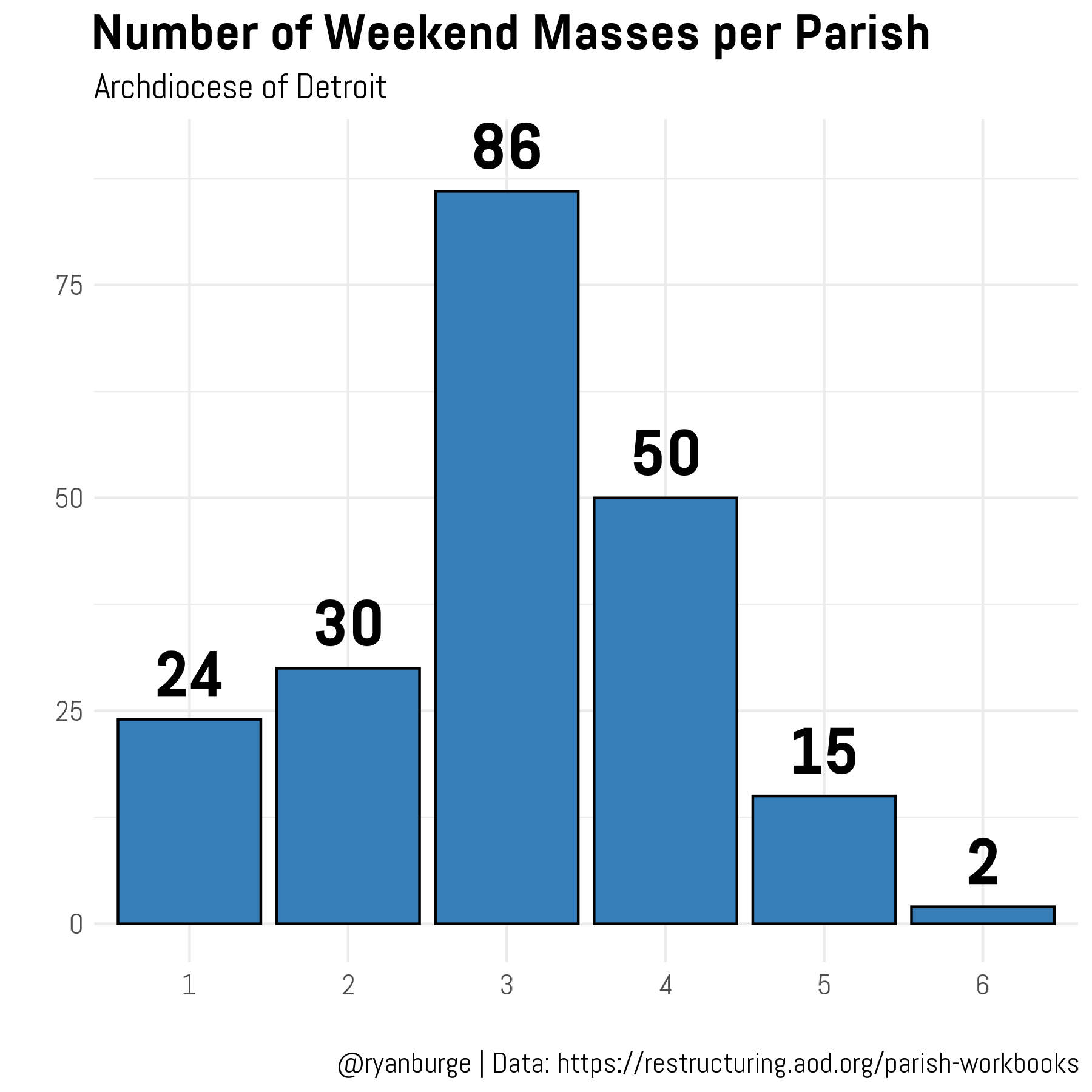
But that doesn’t look like it was a widespread trend in this data. In fact, just a bit more than 10% of all the parishes in the Archdiocese had cut back to a single Mass, while another 30 were only conducting two Sunday services. The median parish was still conducting three weekend services and there were nearly seventy parishes who had at least four Masses each weekend.
Now, I come from a Protestant background. So the idea that just 10% of these parishes cut down to one service seems odd to me. In fact, I can say with a whole lot of certainty that the average Protestant church only has one service on Sunday morning. But the culture of Catholicism is different. The Saturday night Mass is a widespread phenomenon. If a Catholic moved to a new city, they would just assume that the Church would gather on either Saturday night or Sunday morning and you could pick the service that fit your schedule the best.
So, keep this finding in mind, because it’s going to become central to the discussion a bit further down.
Alright, now here is where I started wading through United States Census data. I geocoded the addresses of every single parish in the Archdiocese, I then linked the longitude and latitude to a physical address, and then I linked that up with tract-level statistics about all kinds of stuff – income, foreign-born population, racial composition. I was scouring obscure spreadsheets, looking for anything that I could sink my teeth into. You name it and I was going to bring it into my analysis.
Let me just start by showing you two scatterplots. The one on the left is the median household income of that parish’s neighborhood and the one on the right is the foreign-born population.