


Sometimes the doom scrolling really does pay off. I hate to admit it, but flicking through thousands of social media posts a week is a way that I can find interesting stories to write about for Graphs about Religion. And, that’s exactly what happened a few months ago. On my Google Discover feed, I see this headline, “Detroit Catholic archdiocese restructures as Mass attendance drops 40%.” It’s a story from the Detroit Free Press about the future of Catholicism in what was once one of the most thriving metropolitan areas in the United States. I read stories like this on a regular basis, by the way. I usually skim the article quickly and then move on to the next thing.
But not this time. I noticed a single line in the article that caught my eye,
“As part of the process, the Detroit archdiocese released information online in March about parish finances and attendance data in workbooks that provide a detailed look at the conditions of churches, showing how some are doing well with revenue while others struggle.”
Jackpot. It’s time to get to work.
The Archdiocese of Detroit has pulled together a really impressive website about the process that the Church is undertaking over the next couple of years. They have a relatively new Archbishop - Edward Weisenburger. He was installed as the leader of the Detroit archdiocese in March of 2025. My read of the situation is that he was primarily chosen to secure the organizational and financial future of the Archdiocese. That’s the goal of this discernment process.
Catholic Mass Attendance Has Fallen by Half

I was born and raised Southern Baptist. Gave my life to Jesus at 15. Got baptized in a pair of white pajamas. Then, I went to a Free Methodist college. Got a job at an American Baptist Church and have been serving in the ABCUSA for more than twenty years. I will be elected to the
The real treasure trove for me is a series of workbooks for the 224 parishes that exist in Eastern Michigan. They are organized across 15 different planning areas and they are posted for anyone to download on this page. The PDF files are awesome because they provide unprecedented access into what is happening at the parish level across hundreds of churches in Michigan.
So here’s my plan. This post is going to just introduce you all to the 30,000 foot view of the Archdiocese of Detroit based on the metrics provided in these workbooks. If this article does well, I plan on writing a series of reports about Mass attendance, sacramental activities, and the finances of these 200+ parishes for my paid subscribers. I think there’s just so much to learn about what is happening in American Christianity through the granular study of this one Archdiocese.
First, I need to frame the rest of this discussion around a misconception that I had about what’s happening in the Detroit area. I, like many of you, have read dozens of stories about how the Detroit metro area was undergoing a population collapse. I mean, the city of Detroit went bankrupt. And that, statistically speaking, WAS the case for a long time. Between 1950 and 2010, the population of Detroit declined by 61%. But now there’s a new reality - metro Detroit has actually experienced some modest growth in the last fifteen years.
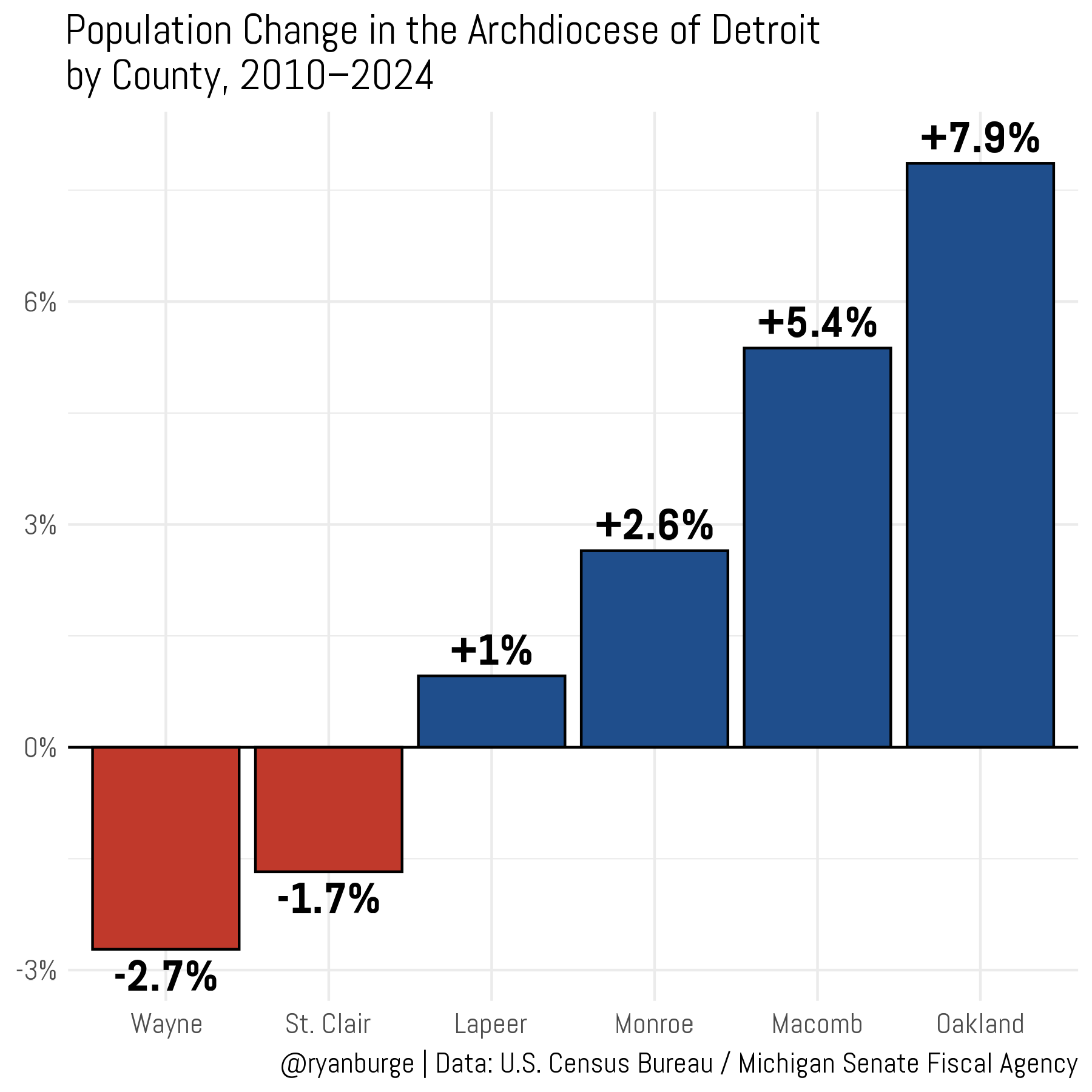
The six counties that make up the Archdiocese of Detroit grew by 2.2% between 2010 and 2024 — modest, but not certainly decline. Wayne County did lose residents, dropping about 49,000 people over fourteen years, but that’s a far cry from the hollowing-out narrative that defined Detroit a decade ago. The region has stabilized.
But there are counties in the suburbs of Detroit that have experienced solid growth recently. Oakland and Macomb counties are north of the city center and have seen increases in population of 7.9% and 5.4% respectively. Monroe county is just to the south of downtown, and it’s up 2.6% during this same time frame.
The crisis facing the Archdiocese of Detroit isn’t really about what’s happened in the last decade — it’s about an institution still reckoning with the massive population exodus of the mid-to-late 20th century. The infrastructure, the parish footprint, the number of churches — all of it was built for a city and a Catholic population that no longer exists at that scale. The most recent Mass attendance data makes clear that the reckoning isn’t over.
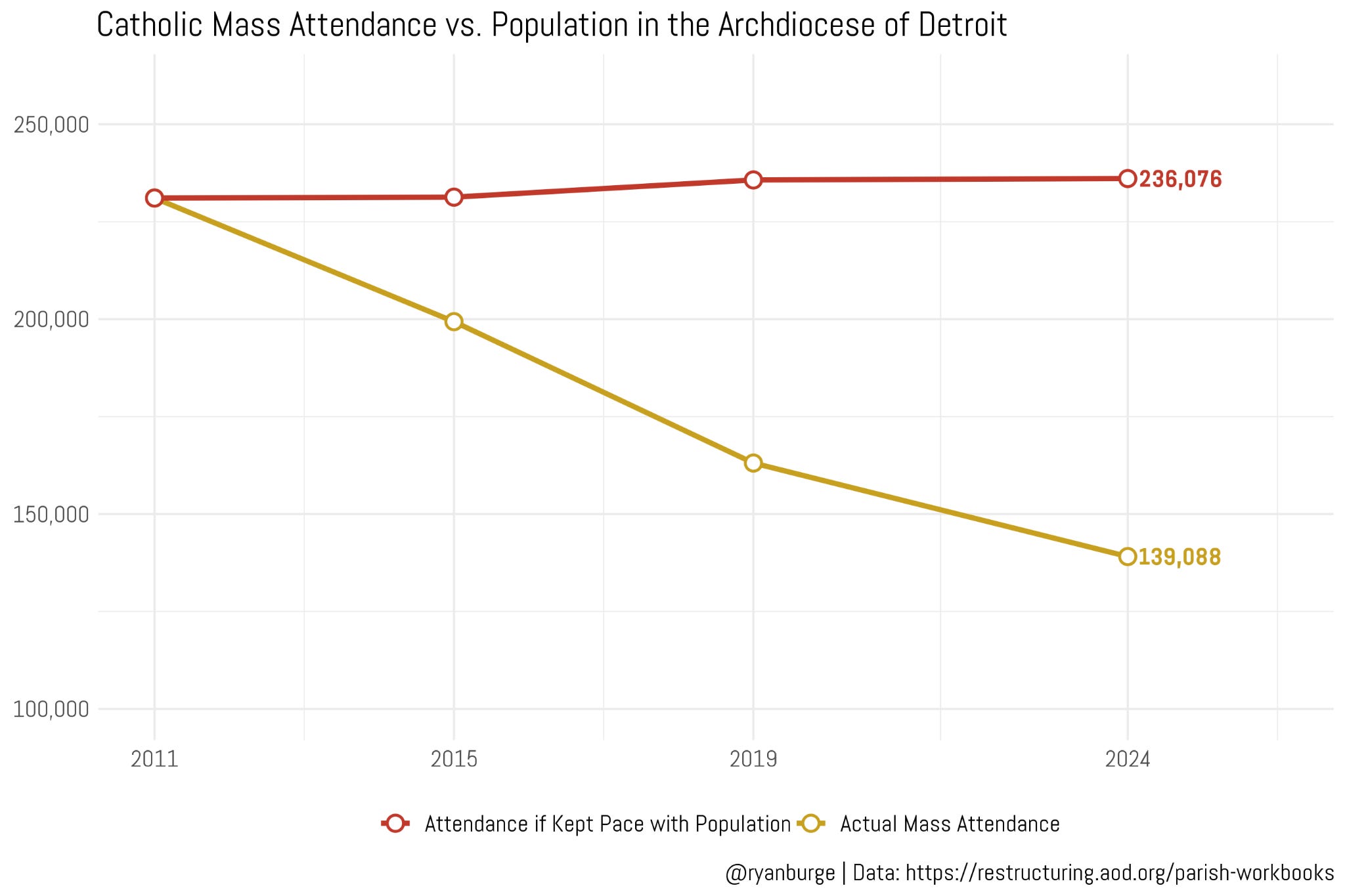
In 2011, the average weekend Mass attendance in the Archdiocese was about 231,000 people. That dropped below 200,000 by 2015, it declined to 163,000 by 2019. The most recent data that these workbooks provide is from 2024, when Mass attendance was just under 140,000. According to their own reports, the Catholic Church in Detroit is recording an attendance decline of 4% per year.
The PDFs contain this data nugget as well, “At the current rate of decline, one-third of today’s Mass attending Catholics will no longer be attending within the next decade.” That means that Mass attendance will drop below 100,000 by 2035.
If Mass attendance had simply kept pace with population growth since 2011, roughly 236,000 Catholics would show up to a Detroit-area parish this weekend. The actual number is 139,000 — about 40% lower. The archdiocese is currently filling about 29% of its available pew space on a given weekend. If current trends hold, that number could slip below 20% within a few years. That’s a church with an empty building problem.
That’s a common theme when looking through this data and reading the Archbishop’s letter: there’s too much capacity in the system. The average Catholic Church is not the right size to meet the needs of the congregations. There’s no simpler way to say it. They built these houses of worship to accommodate thousands of “butts in seats” every weekend. And now they have a huge problem with maintaining these buildings.
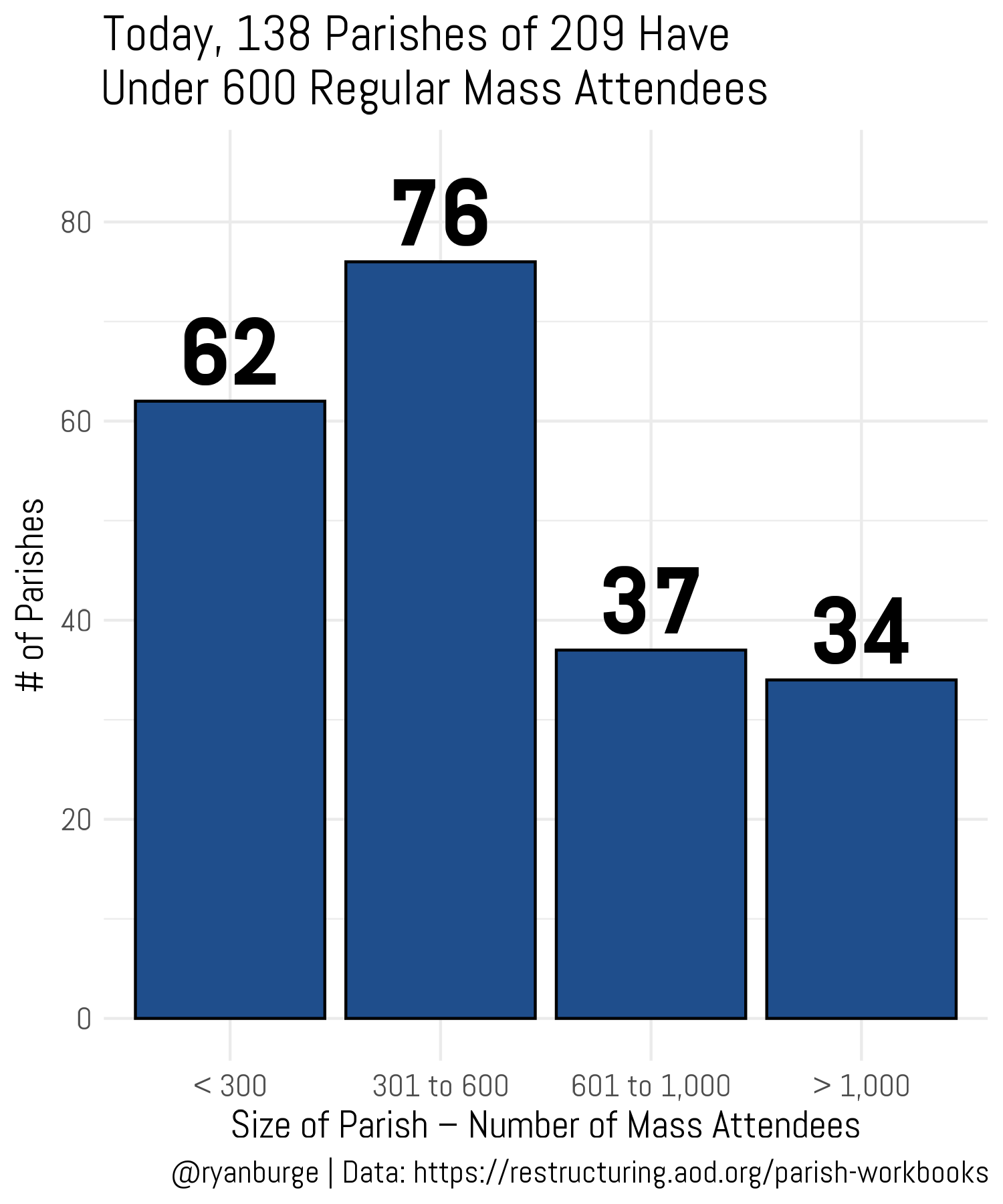
Their own data says that the average parish has under 600 regular Mass attendees. They have 62 parishes where weekend attendance is less than 300 and another 76 parishes where 300-600 folks show up on an average weekend. In contrast, 34 parishes have a Mass attendance that is north of 1,000 people.
For the Protestants that are reading this, these numbers seem huge, right? The median attendance in the Protestant world is about 70 folks on a Sunday. Catholics have always had fewer parishes with more people in the pews. That model requires huge sanctuaries. The median capacity of a parish in Detroit was about 650 people. I am going to guess that the average Protestant church could probably accommodate 300.
But here’s the number that should be keeping archdiocesan leadership up at night: the median parish fills about one-third of its seats at a typical Mass. Two out of every three chairs are empty. These buildings were designed for a Catholic population that no longer shows up — and no amount of consolidation changes that math if attendance keeps falling.
That causes two problems. One is logistical. Maintaining a huge building with a massive sanctuary is a money pit (ask me how I know). The heating bills in the cold Detroit winters for a room that has 75 foot ceilings has to be astronomical. And let’s not even discuss the maintenance and upkeep of buildings that are 80-100 years old. Boiler replacements can easily run into the six figures.
The other problem is less tangible - it feels really bad to be in a huge space that’s only 25-35% full. Again, ask me how I know. When my church got below 30 people we actually stopped worshipping in the sanctuary and moved to a larger classroom in the educational wing. You can get a sense of that in this NBC Documentary which contains some footage of our worship service back in 2019.
These aren’t easy problems to solve. These houses of worship are just being used for less…worship.
You can see that clearly by analyzing sacramental activities. The Catholic Church is very good at recording a bunch of metrics outside of Mass attendance. This report includes five key statistics: infant baptisms, first communions, confirmations, marriages, and funerals . The workbooks included data on these activities in both 2000 and 2024.
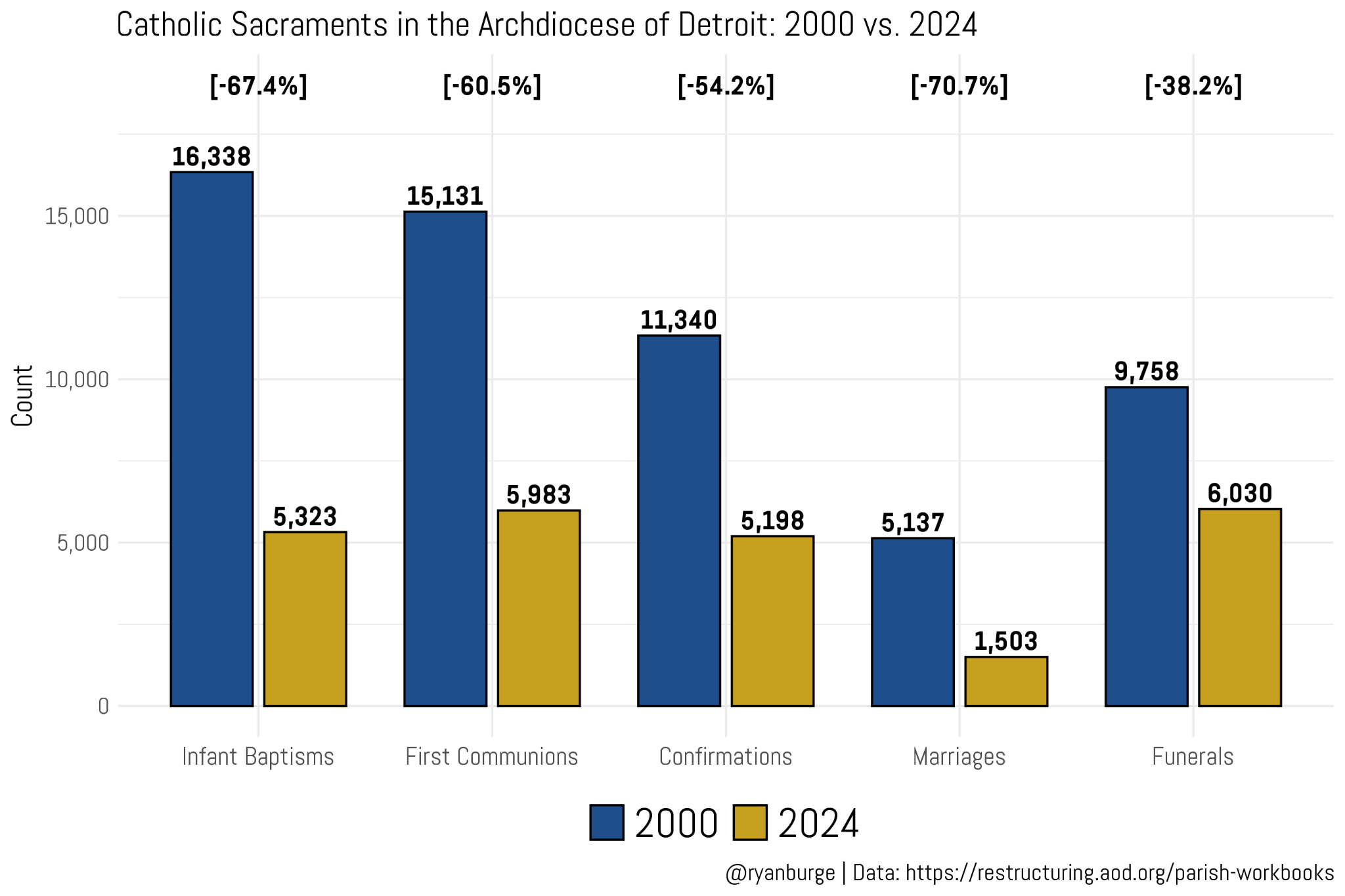
The percentage declines are noted above each bar. None of them are good. I write often about the basic math of religious retention — a church needs to be adding members faster than it’s losing them. Baptisms and confirmations have to outpace funerals. In Detroit, every one of those trend lines is moving in the wrong direction.
Think of Catholic membership like a pipeline. Infant baptism is the top of the funnel — if you don’t capture people there, you’re looking at a smaller committed Catholic population in 20 to 30 years. In Detroit, infant baptisms are down 67% since 2000. It follows logically that first communions are down 61% and confirmations down 54%. The pipeline isn’t just leaking, it’s running dry at the source.
What’s striking, though, is that those three numbers have converged. In 2000, infant baptisms, first communions, and confirmations formed a clear funnel — each step smaller than the last, with about 5,000 fewer confirmations than baptisms. In 2024, all three sit in a tight band between 5,000 and 6,000. The funnel hasn’t disappeared; it’s just gotten much smaller. Fewer people are entering at the top, but a higher share are making it through to confirmation. The pipeline is narrower but less leaky.
But notice which figure has declined the least? It’s funerals, by a long shot. Only down 38%. In 2024, there were 6,030 funerals conducted by priests in the Archdiocese. The number of first communions? It was only 5,983. It doesn’t take a fancy demographic model to convey this simple fact: that’s a very bad trajectory.
And what may be an even more pressing problem, as highlighted by the workbooks, is the age distribution of priests in the Archdiocese.
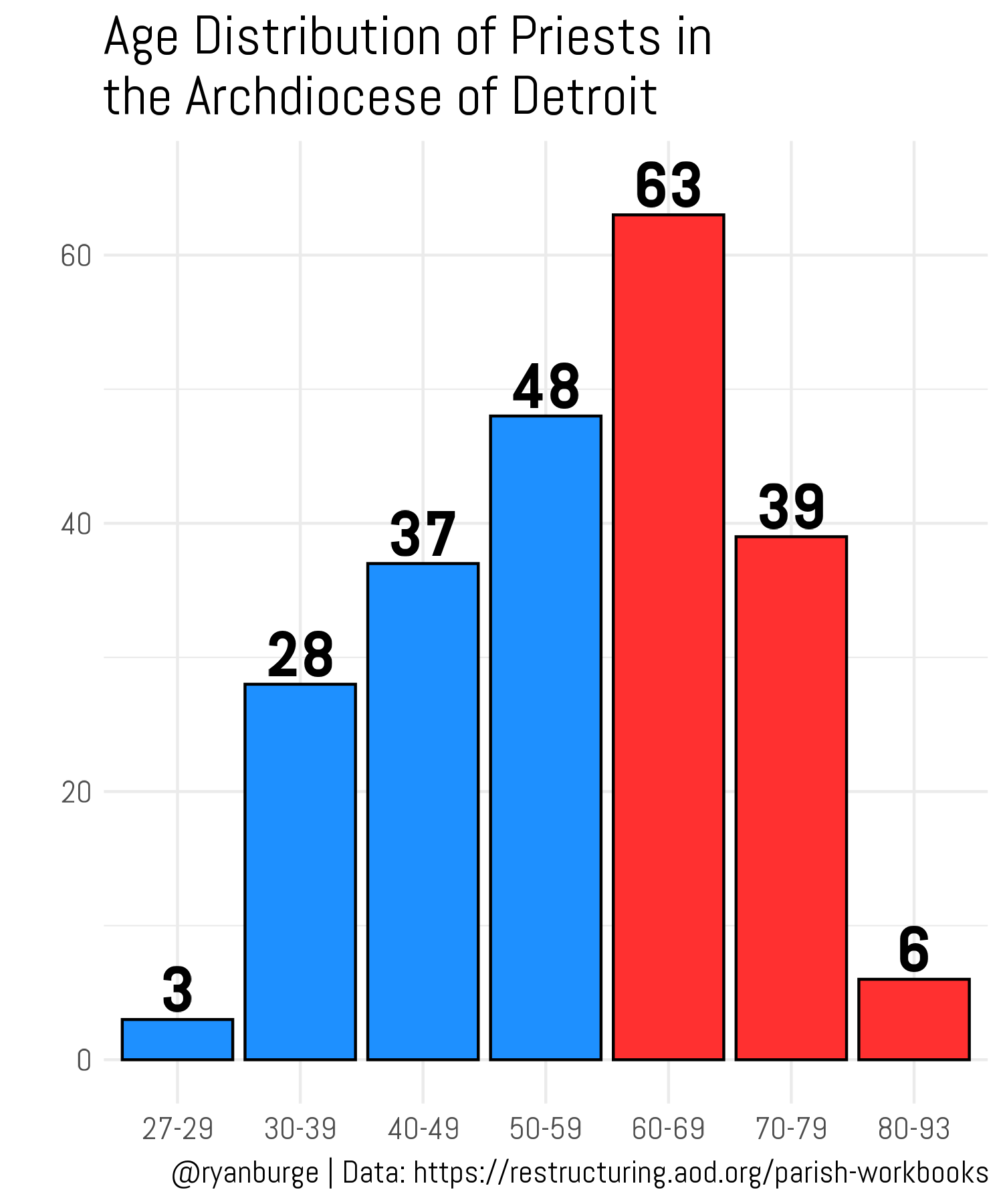
The Archdiocese of Detroit has 224 active priests serving its parishes. Three of them are under 30. Six are over 80. Just 14% are under 40, and nearly half have already passed their 60th birthday. The age cliff is coming fast — and it’s steeper than it looks, because the Catholic Church requires priests to step back from parish ministry at 70 and assume senior status at 80. The median Detroit priest is already on the back half of his active ministry. There is no cavalry coming.
The report included this projection model which estimated the number of priests in the next decade or so.
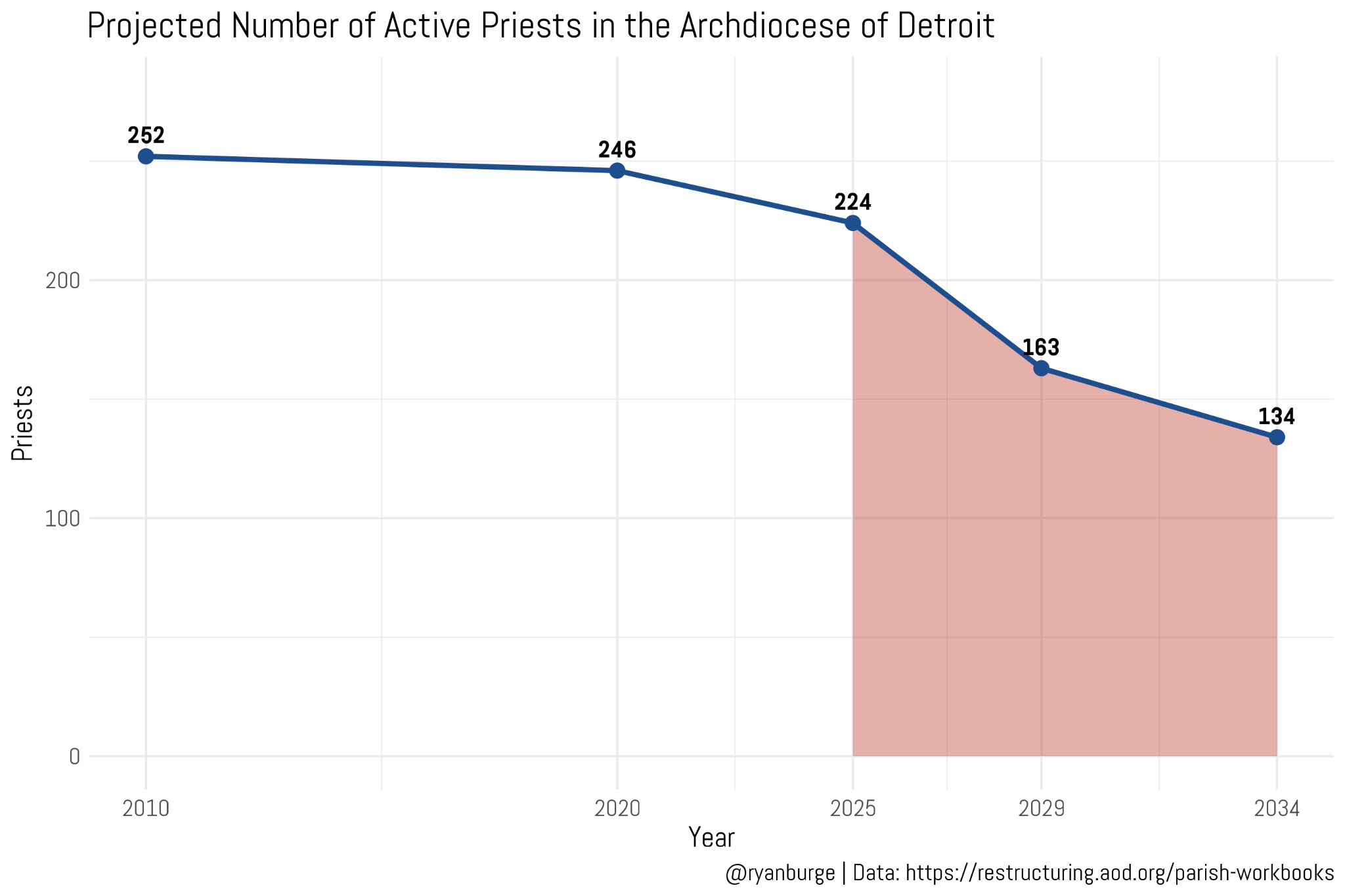
In 2024, the Archdiocese of Detroit had 224 parishes and 224 active priests — a ratio that sounds reasonable on paper. But the distribution tells a different story. Thirty-four parishes draw over 1,000 people to Mass on a typical weekend, and 71 see at least 600. A 1:1 priest-to-parish ratio assumes every parish is roughly the same size. They aren’t.
The trajectory makes it worse. The archdiocese’s own projections show the active priest count falling to 134 by 2034 — not in a generation, but in ten years. That’s a loss of nearly 40% of current clergy. With 224 parishes and 134 priests, roughly half of Detroit’s parishes will have no resident priest within a decade.
Catholicism by Generation

Sometimes, an important high-level finding warrants some additional reflection. I have several of these rolling around in my head at any given point. The one I wanted to zero in on is from a post that ran over a year ago on this Substack. Simply put—Catholic Mass attendance is way down.
And I haven’t even touched on some of the other problems in the report. There’s one parish in the diocese where only 18% of those who attend Mass there live with the parish boundaries. In other words - the building doesn’t match the neighborhood anymore.
I applaud Archbishop Weisenburger’s courage and initiative to face these realities head on. I say this all the time: it’s pretty easy to lead an organization when it’s growing. Hiring new people, planning the construction of new buildings, and expanding programs is a lot of fun. You know what’s not so fun? Consolidating resources, closing parishes, and ending ministries.
But it must be done. The ledger doesn’t balance in the Archdiocese of Detroit (and in many other metro areas, as well).
And like I wrote earlier, if there’s some enthusiasm for this macro-level analysis, I plan on getting deep into the weeds of the problems facing many of these parishes. I have already scraped these reports for trends in baptisms, attendance and financial health.
It’s my best chance to trace religious decline in a meticulous way. I look forward to the challenge. And my prayers are with the over 900,000 Catholics who make up the Archdiocese of Detroit.
Code for this post can be found here.
Ryan P. Burge is a professor of practice at the Danforth Center on Religion and Politics at Washington University.

Ryan, you write, "And like I wrote earlier, if there’s some enthusiasm for this macro-level analysis, I plan on getting deep into the weeds of the problems facing many of these parishes."
So, this is me expressing my enthusiasm for this additional analysis as a paid subscriber, please and thank you.
The Cincinnati Archdiocese has posted similar data following consolidation at https://pathway.catholicaoc.org/parish-vitality-report/year-in-review/