


I grew up very evangelical in a very evangelical time. A Southern Baptist born in 1982 and raised in a family where going to church wasn’t just something you did a couple of times per year, it was a regular rhythm of the week. It just so happened that evangelicalism hit its numerical peak in the United States in the mid-1990s, right when young, impressionable Ryan was entering a youth group for the first time. I am pretty sure I spent time at First Baptist Church of Salem, Illinois three days a week during my high school years. I was at Sunday morning and Sunday night worship. I went to youth group during the week and I often was part of a Bible study as well.
The Bible was such an integral part of my upbringing that it’s hard to describe. We did Bible quizzing drills and scripture verse memorization. By the time I got my driver’s license, I had a pretty good grasp on the meta-narrative laid out in the 66 books that make up the Old and New Testaments. I had Bibles from all kinds of translations, too. Of course the old stalwart was the New International Version (NIV), but I also had the ESV and the NRSV on my bookshelf. I even remember getting several copies of Eugene Peterson’s The Message Bible as swag at a conference I attended.
You don’t know what’s weird until you see your life through someone else’s eyes, though. I distinctly remember that I had one of my friends come by my house when I was a junior in high school. He walked into my room and the first thing he encountered was my book shelf. It had a full row of Bibles. He looked at me with the most puzzled expression on his face and said, “Why do you have SO MANY BIBLES?” I was completely dumbfounded by this question. I knew my buddy was a Christian, a Catholic more specifically, so I just didn’t know where he was coming from.
I asked him how many Bibles he had. His answer was simple, “I have one and it was given to me by my grandma when I had my First Communion.” I just didn’t even know what to say to that. Protestants (and more specifically evangelicals) love the Bible. They are instructed to read it daily, to memorize the words, and to constantly wrestle with it throughout their lives. Other traditions just don’t have that same emphasis.
This is where a very smart theologian would go into a discussion of Sola Scriptura and authority and all that. You won’t get that from me. You get graphs. So, let me show you the genesis of this entire post and how it got me thinking very carefully about how Catholics think about the Bible compared to Protestants.
It all started (as it usually does) with a graph. It’s the one below. It was for another post where I basically make the claim that there are two “camps” in Christianity. Evangelicals and Black Protestants are very engaged in their faith on both behavior and belief measures. Mainline Protestants and Catholics are in the other camp. They just don’t believe or behave as much as their cousins.
I wanted to make it plain that even if you compare the most active mainliners/Catholics with the most engaged evangelicals/Black Protestants, there are still big gaps on belief.
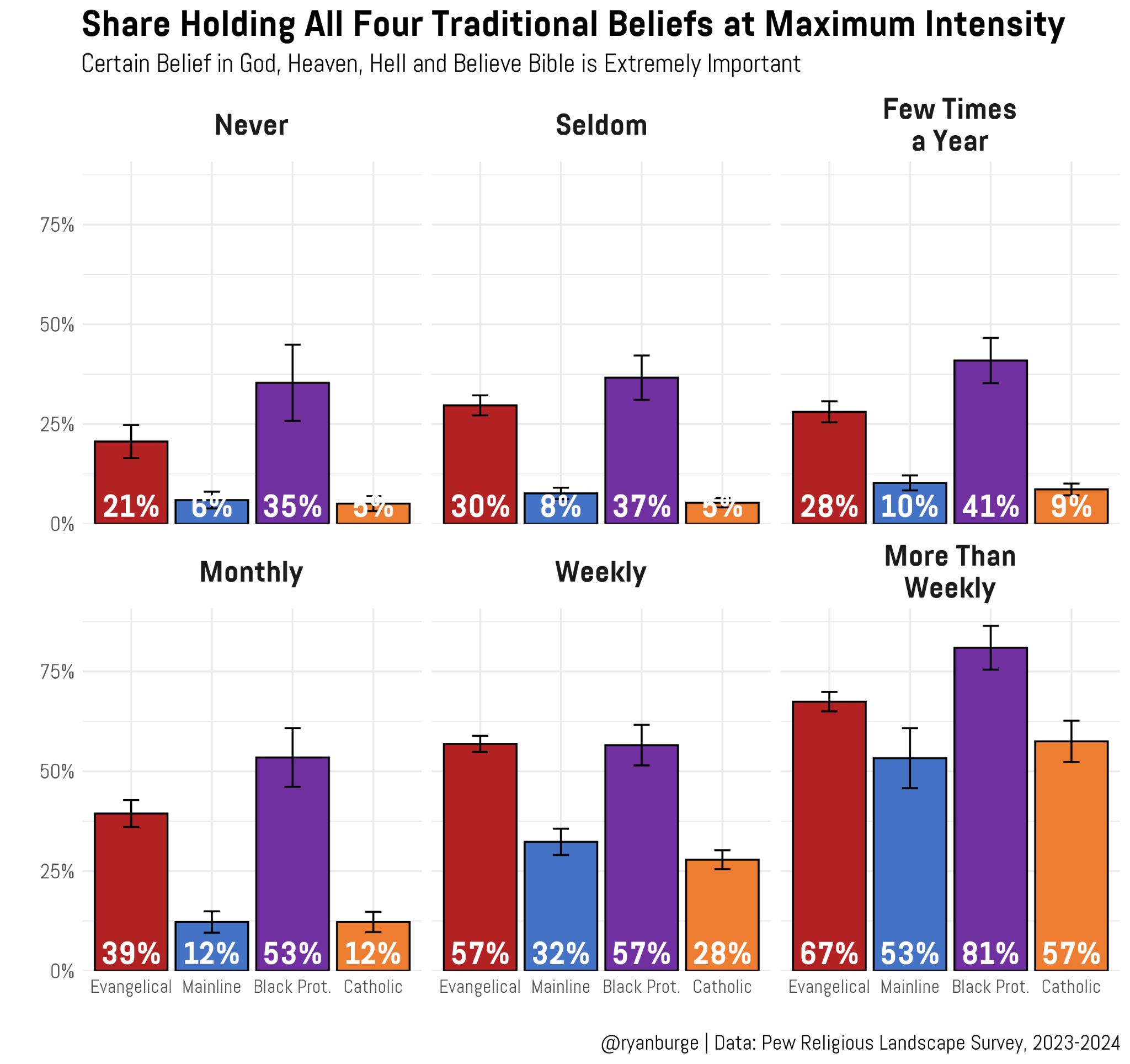
This graph visualizes the share of each tradition that believes in God with total certainty, believes in both Heaven and Hell and also says that the Bible is extremely important to them at each level of attendance. In essence, I was trying to parse out if the belief gap was really just an attendance gap and when I control for that, the differences fade away.
As you can tell, that’s not at all what happens. Among weekly attending evangelicals and Black Protestants, 57% hit a perfect score on all four of the belief items. That was basically twice the rate as their mainline and Catholic counterparts. Even when you restrict the sample who attend multiple times per week, the gap persists.
But then I got to thinking about the construction of my belief index. Remember it had four items: belief in God, heaven, hell and then another question about the importance of the Bible. Maybe that last question is sort of biased against Catholics because they don’t make the Bible as central as evangelicals, for instance.
So, I reran the analysis but just dropped that last question and made the index only three items.
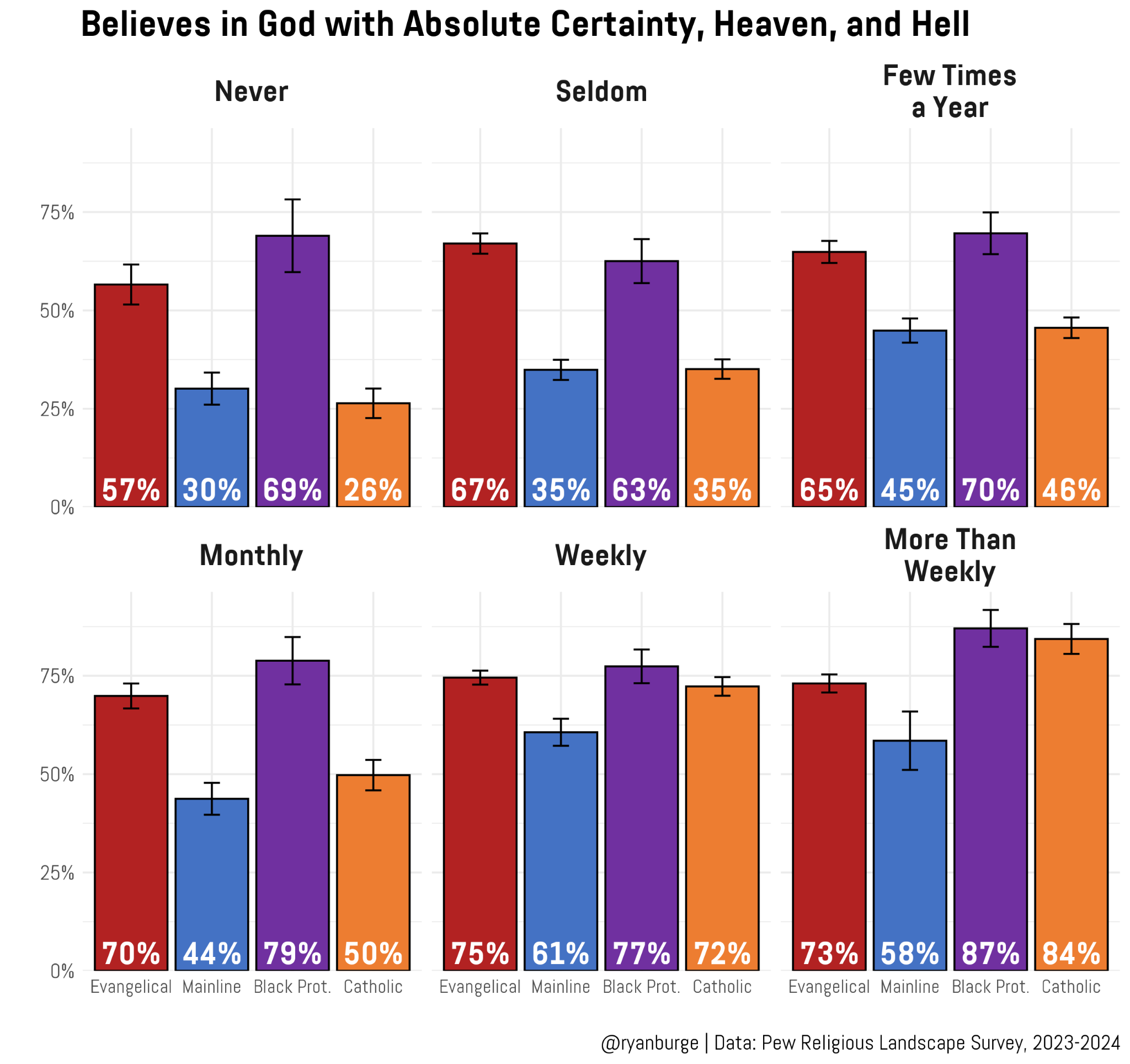
And guess what? The gap between Catholics and evangelicals/Black Protestants disappears among those who attend church at least once a week. In the first graph, just 28% of weekly attending Catholics were maximally religious on the four item test. When I dropped the importance of the Bible, that share shot up to 72%.
I think we can all assume that Bible importance rises with religious attendance, right? I felt like I needed to test that before I went any further.
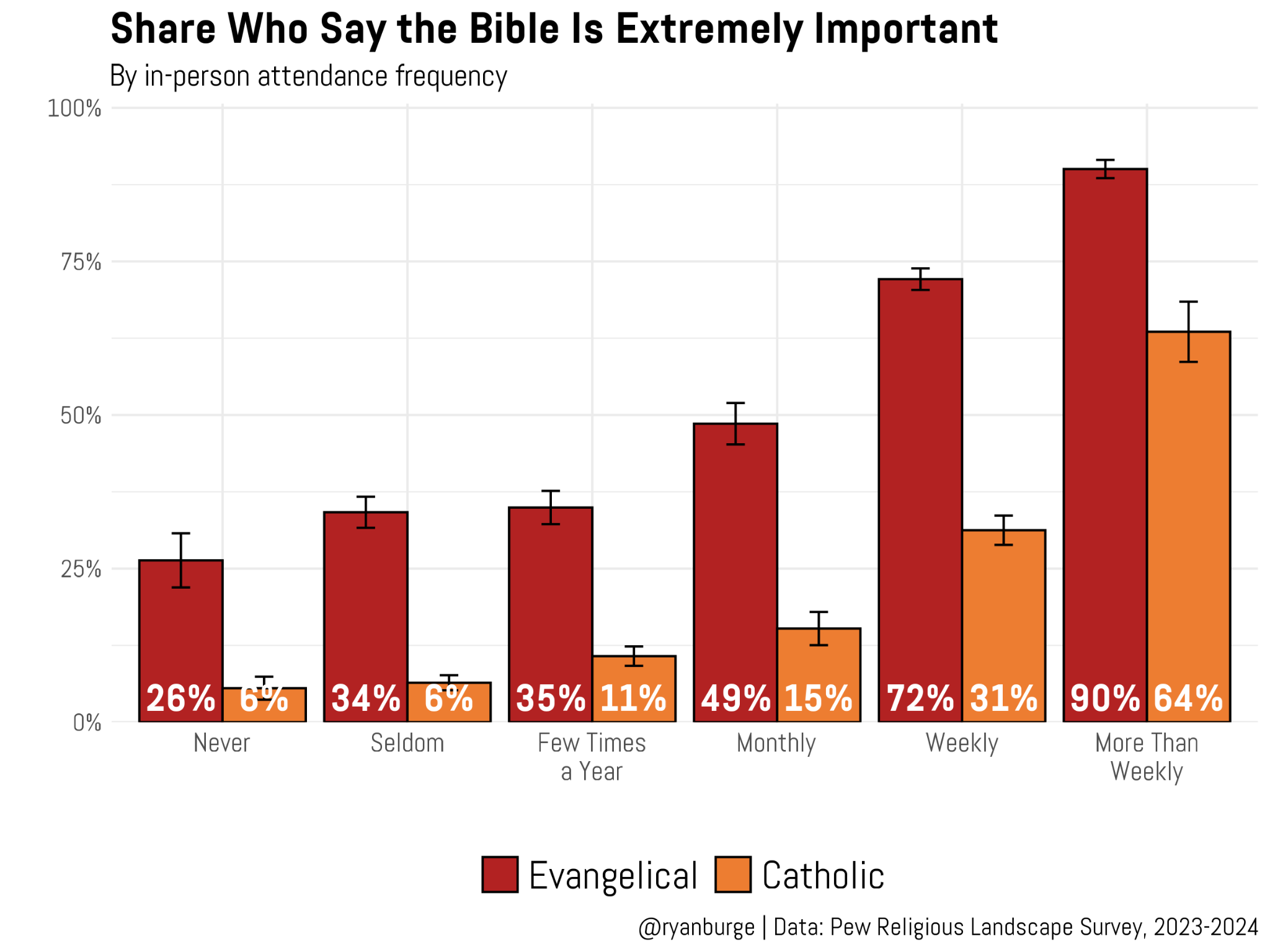
And it pretty clearly does for both evangelicals and Catholics. There’s a distinct linear progression going from left to right. But there’s also a huge gap between these two types of Christians. Even among evangelicals who never attend in person religious services, they are twenty points more likely to say that the Bible is extremely important compared to never attending Catholics. And what’s interesting is that the gap between the two groups only widens with each step up the attendance ladder. It’s 41 points when comparing weekly attenders.
However, Catholics’ view of the Bible does begin to rise really quickly once you get to the most active in the faith. For instance, just 15% of monthly Mass attending Catholics say that the Bible is extremely important. It doubles when moving to weekly attenders (31%) and then doubles again among those who attend multiple times per week (64%). So it does look like some Catholics do place more emphasis on the Bible.
But there was also a question about how often each respondent reads the Bible, too. Let me show you that alongside a more expansive version of the Bible importance question.
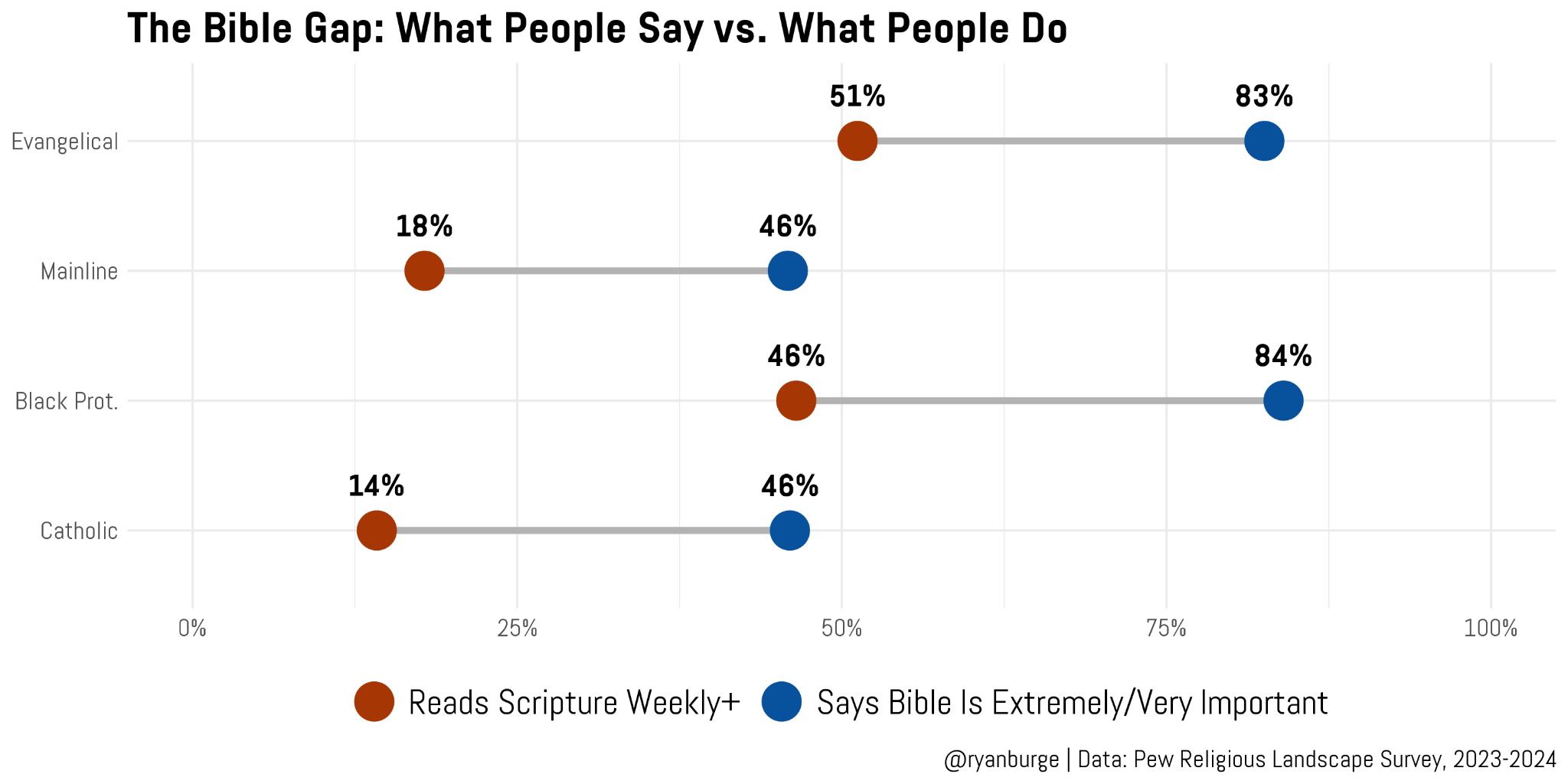
It’s interesting to me how there’s a very consistent gap in each tradition between the share who say that the Bible is extremely or very important and the portion who actually read the scriptures on a weekly basis. The gap is actually the smallest among mainline Protestants – 46% say that the Bible is extremely/very important while 18% read it weekly. A difference of 28 points. For Catholics, the divergence is 32 percentage points, which is exactly the same as evangelicals.
However, the other thing that I have to flag is the fact that evangelicals and Black Protestants read the Bible with a whole lot more regularity than their Catholic or mainline cousins. For the former groups, about half are reading the Bible once a week. For the latter groups? It’s 15-20%. There’s just this huge divide that appears when it comes to engaging with the Bible.
But when you look at this graph and the one right above it, I know what you are thinking: Ryan didn’t control for church attendance in the dumbbell plot. We know that Catholics just don’t go to church as much as evangelicals, so the next logical step is to do an apples to apples comparison.
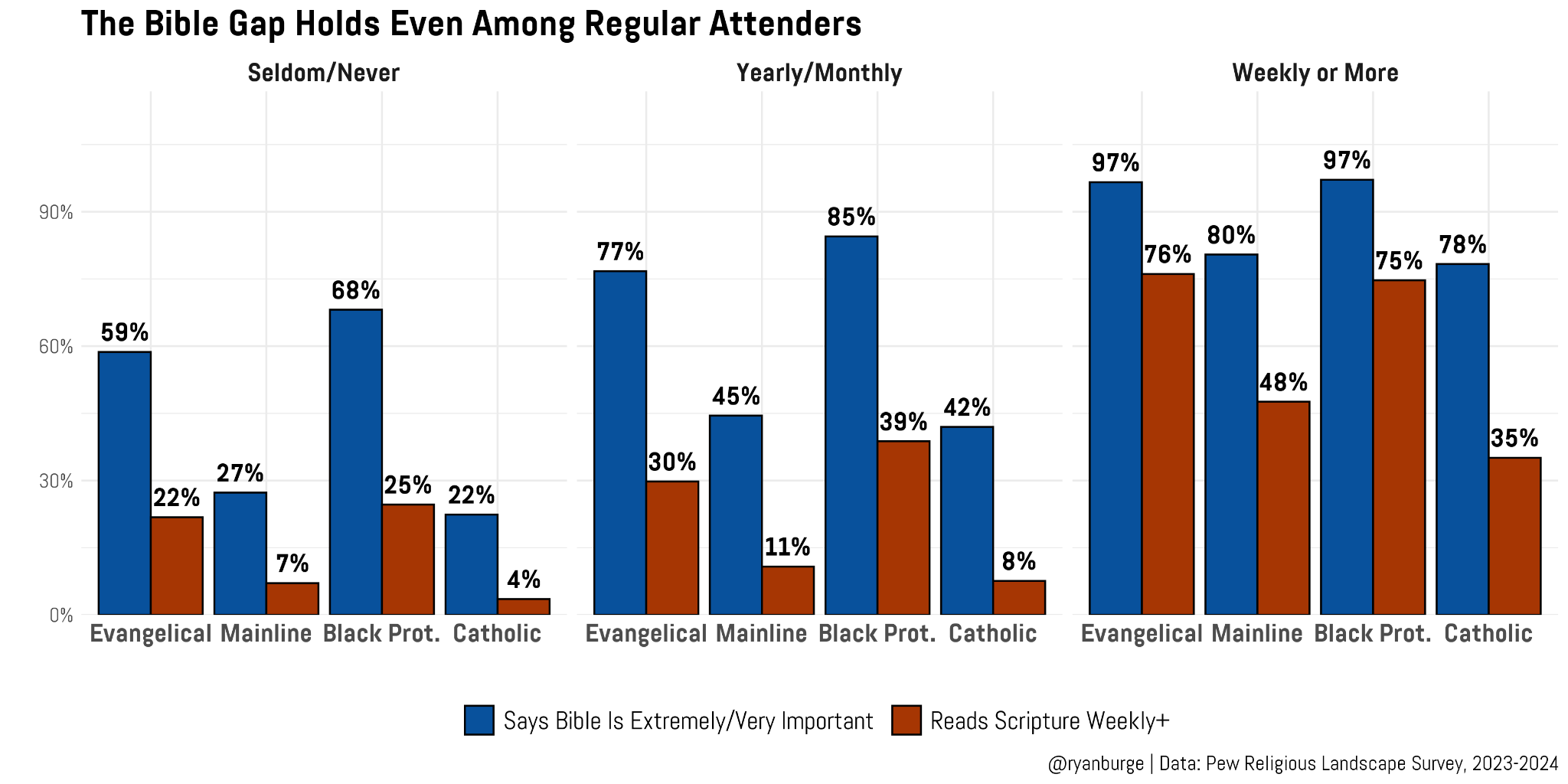
Everytime I look at this graph the first thing that my eye is drawn to is those stubby little bar graphs for Catholics and mainline Protestants on the left side of the plot. For those who attend church monthly or less the share of each tradition who reads the Bible on a weekly basis is less than 10%. For evangelicals and Black Protestants with low attendance, at least a quarter of them are still reading their Bible on a consistent basis.
But the real action is on the right side of the graph – that’s when I am just looking at Christians who attend church once a week or more. If we compare devout vs devout, that has to close the “Bible gap”, right? Kind of, but not completely. For instance, among weekly Mass-attending Catholics, 78% say that the Bible is extremely or very important to them. That’s still about twenty points lower than evangelicals.
The bigger gap, though, is when it comes to reading the Bible. The question explicitly asks respondents to exclude reading the scriptures as part of religious services, so this is the share who pick up the Bible on their own during the week. Even among Catholics who go to Mass weekly or more, only about a third of them read the Bible on a regular basis. That’s forty points lower than evangelicals and Black Protestants.
That created a bit of a challenge for me: could I figure out what factors would actually close the “Bible gap” between Catholics and evangelicals? That’s what I did in the graph below. The vertical dashed line is the share of evangelicals who say that the Bible is extremely/very important and those who read the scripture weekly. What factors lead Catholics to “catch up” to their evangelical counterparts?
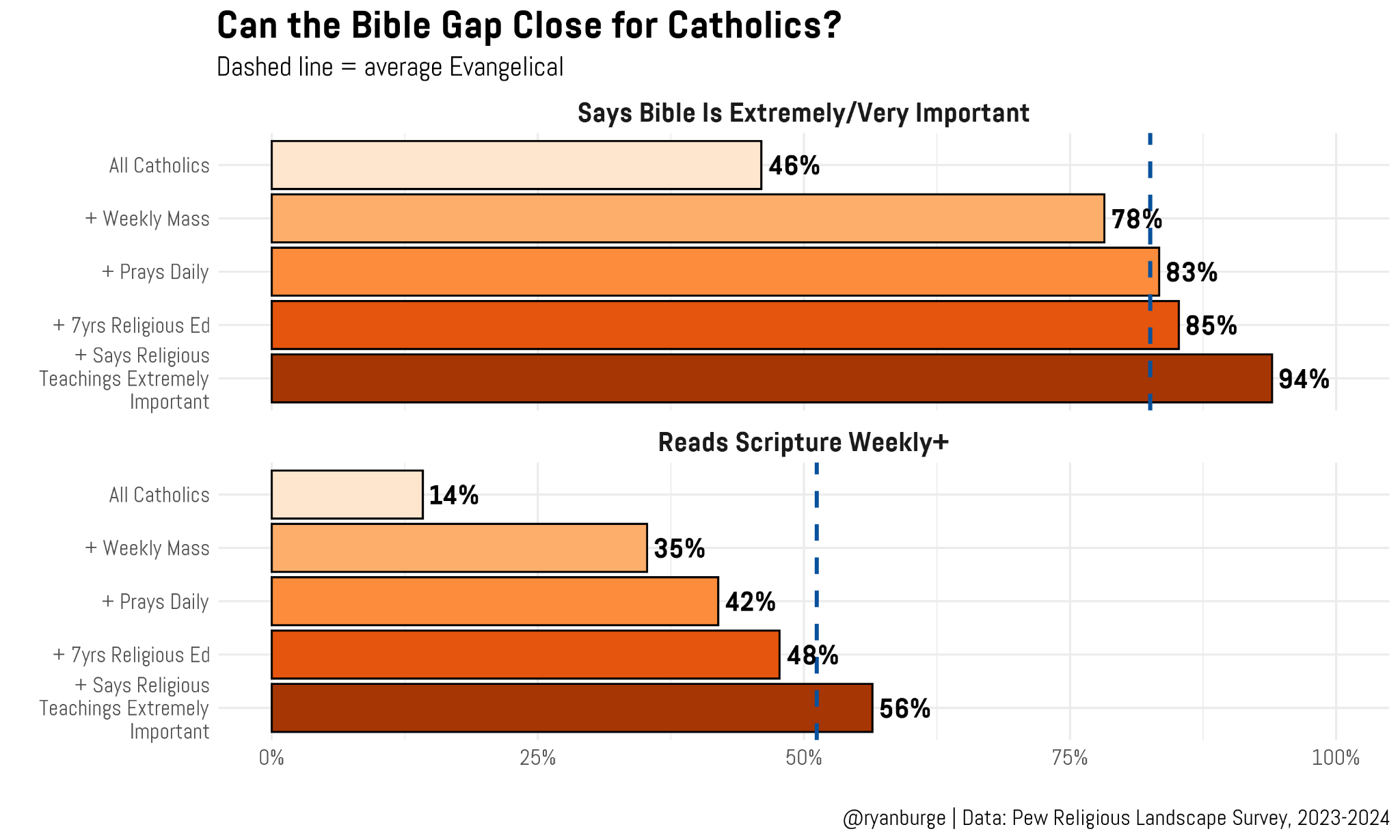
Comparing all evangelicals to all Catholics makes the gap pretty plain – it’s about thirty points on both metrics. But just adding one filter to Catholics (weekly Mass attendance) does a whole lot to bring the two groups together. A regular attending Catholic is only about 3 points lower than all evangelicals on the importance of the Bible, but it still leaves a 16 point difference on Bible reading.
If we compare all evangelicals to Catholics who both attend Mass weekly and pray daily, that gap basically disappears when it comes to their view of the Bible, but there’s still a pesky behavior gap. The only way that I can sort the sample to bring Catholics into line with the average evangelical is just limiting my sample to Catholics who: attend Mass weekly and pray daily and have at least seven years of religious education and also say that religious teachings are extremely important to them. That gets Catholics to 56%, which is a couple of points higher than the average evangelical.
If I compared the same level of devotion for evangelicals, though, it wouldn’t even be close. Evangelicals are “people of the book” in a way that Catholics are not.
This is where the pastors and theologians who subscribe to this newsletter will have very strong feelings about the “right way” to do church. I’m not going to indulge in any of that. On a typical Sunday I attend both a Methodist Church service and a Catholic Mass. Both have strengths and weaknesses. My faith is edified in different ways in both gatherings.
Catholics’ posture toward their faith is different from evangelicals. That is empirically indisputable. What implications that has for both types of Christians is a much more open question.
Code for this post can be found here.
Ryan P. Burge is a professor of practice at the Danforth Center on Religion and Politics at Washington University.
Would have been interesting to add the Jews to the mix, as our relation to Hebrew Bible seems quite different, though we have a wide spectrum of attendance at worship. Torah is central to the religion, liturgy is dominated by copy & paste from Biblical sources, so centrality has a high consensus. And Torah plus a section of Prophets is read publicly weekly as part of worship. Self-study seems a little different. It happens widely, across denominations, but we tend not to take the Old Testament that we all got as Bar Mitzvah gifts off the shelf and read from it. What we do instead is seek out commentaries by rabbis or other scholars who have already digested a section of the weekly portion to which they share their insights. It's more like reading op-eds than Cliff Notes, but it's also not reading a primary source that we will hear verbally and follow along in the Books, either in Hebrew or translation, as the reader chants each section.
How well that correlates with attendance is hard to guess. Much of this exposure is passive, the public reading and the rabbi's comments at worship, though many synagogues have classes where the weekly portion is discussed with questions offered to those who attend them. Individual study, likely minimal.
I think it would be worth evaluating within Catholics those who grew up in a pre-Vatican II experience vs. a post-Vatican II experience. Is there a change in Bible usage by Roman Catholics along generational lines once the Magisterium opened up Mass and Scripture reading to the vernacular languages?