


Okay, I guess it’s time to write the post that I’ve been dreading for a long time because I don’t know how it’s going to be received. Be warned—this one is super nerdy and goes very deep into the weeds of survey methodology. I want this newsletter to be really accessible to the average American, but I think it’s helpful every once in a while to pull back the curtain on stuff that I see in the data that just doesn’t sit right with me.
Let me start by showing a simple data point: the share of the public who says that they have no religious affiliation. But I’m going to give you that figure across six different surveys that I can find strewn all over the internet. They include the Cooperative Election Study, the Pew Research Center, the Nationscape Survey, the Public Religion Research Institute survey, the General Social Survey, and the Gallup Survey.
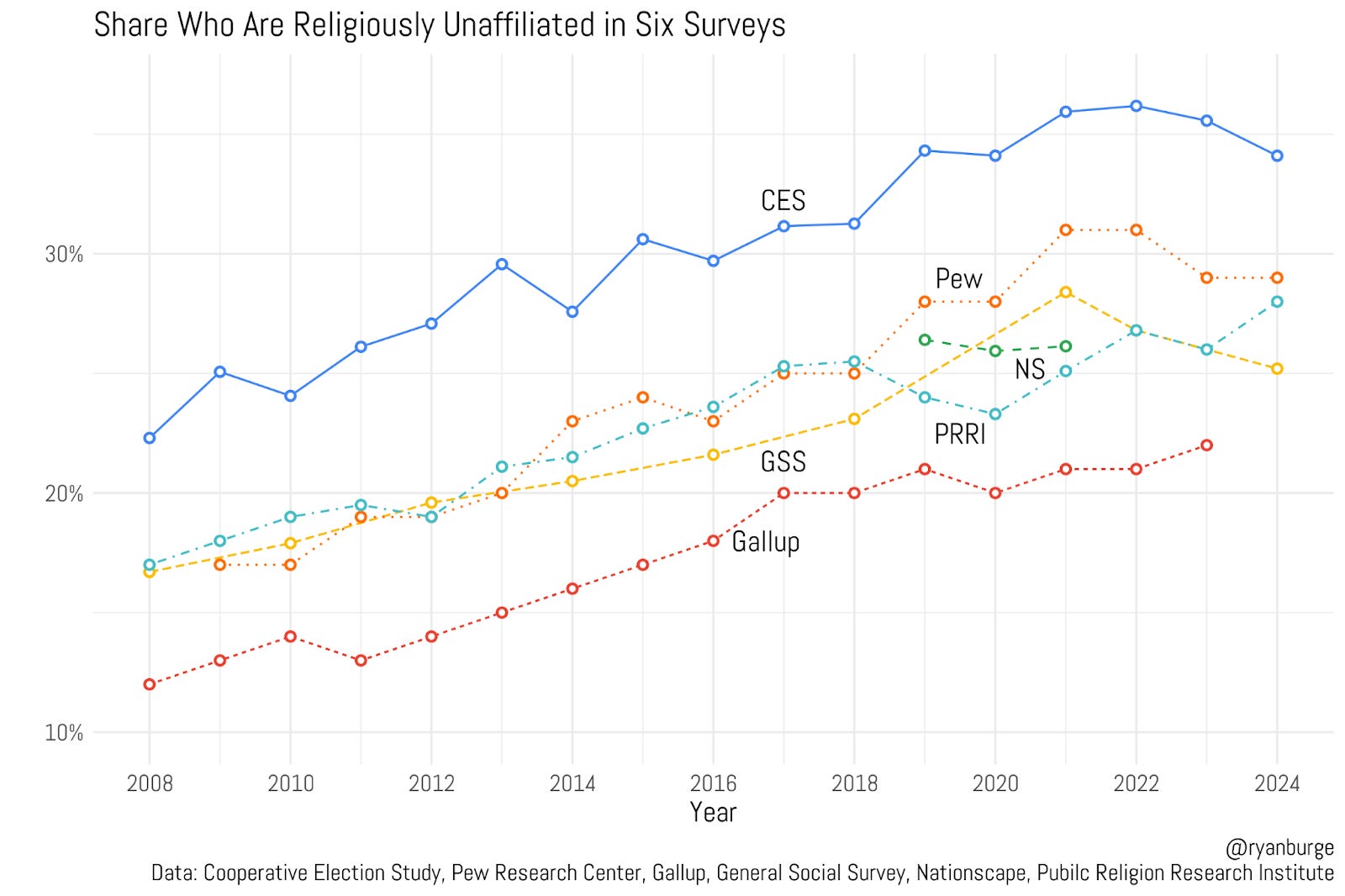
Here’s what they all basically agree on—the share of Americans who are non-religious has been increasing over the last fifteen years. That’s just undeniable, no matter what instrument you look at. But here’s where they disagree: the actual percentage of nones in the United States. And these differences aren’t small, either. Here are five estimates of the share of nones in 2024:
CES – 34%
Pew – 29%
PRRI – 28%
GSS – 25%
Gallup – 22%
If you use the CES estimate, the number of nones in the United States is about 115 million. If you use the Gallup statistic, it’s about 75 million. That’s a difference of 40 million people—basically the population of the state of California. These surveys, which all use different methodologies, different questions, and different response options, lead to widely different conclusions about the actual share of non-religious Americans. I actually wrote a paper about this a few years ago, making the case that the GSS figure is too low: How Many “Nones” Are There? Explaining the Discrepancies in Survey Estimates.
What Does it Mean to be 'Religious'?

This post has been unlocked through a generous grant from the Lilly Endowment for the Association of Religion Data Archives (ARDA). The graphs you see here use data that is publicly available for download and analysis through link(s) provided in the text below.
So, I’m pretty familiar with the nuances of how these different surveys approach this topic. But I want to zero in on a finding that I’ve sort of made “popular” over the last couple of years about the relationship between education and religion in the United States. The measurement of religion that I’m focusing on here is clearly belonging—how someone answers the question, “What is your present religion, if any?” Respondents are then given a bunch of options like Protestant, Catholic, LDS, Jewish, etc. But the last few are typically atheist, agnostic, and nothing in particular.
Here’s that result from the Nationscape Survey, which surveyed over 477,000 people in the United States using a survey instrument that was deployed weekly from mid-2019 through the first few weeks of 2021.
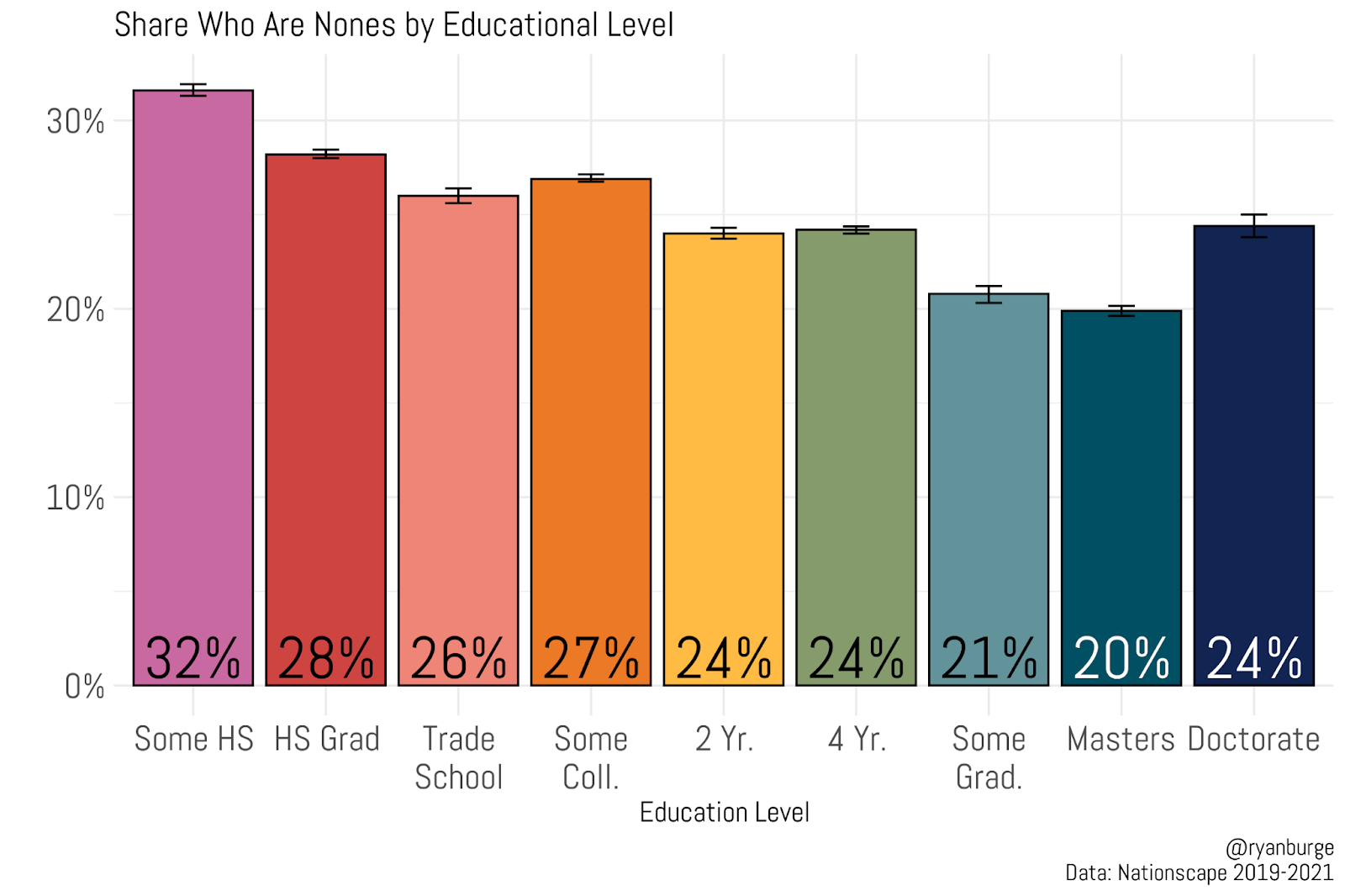
For long-time readers of this work, there’s no surprise here—educated people are less likely to be religious nones. These differences are pretty linear, too. Among folks who stopped at high school, 28% are non-religious. For those who finished a four-year college degree, it’s four points lower than that. But the level of education that yields the lowest percentage is clearly folks with master’s degrees. Only 20% of them are nones.
That’s a pretty striking finding, right? And it upends a whole lot of preconceived notions about how religion works in the United States.
But here’s the thing—variables about religious affiliation and education are in almost every single survey that’s being conducted right now. So let me show you that same relationship (education and religious affiliation) across three other survey instruments: Pew’s National Public Opinion Reference Survey (NPORS), the General Social Survey, and the Cooperative Election Study.
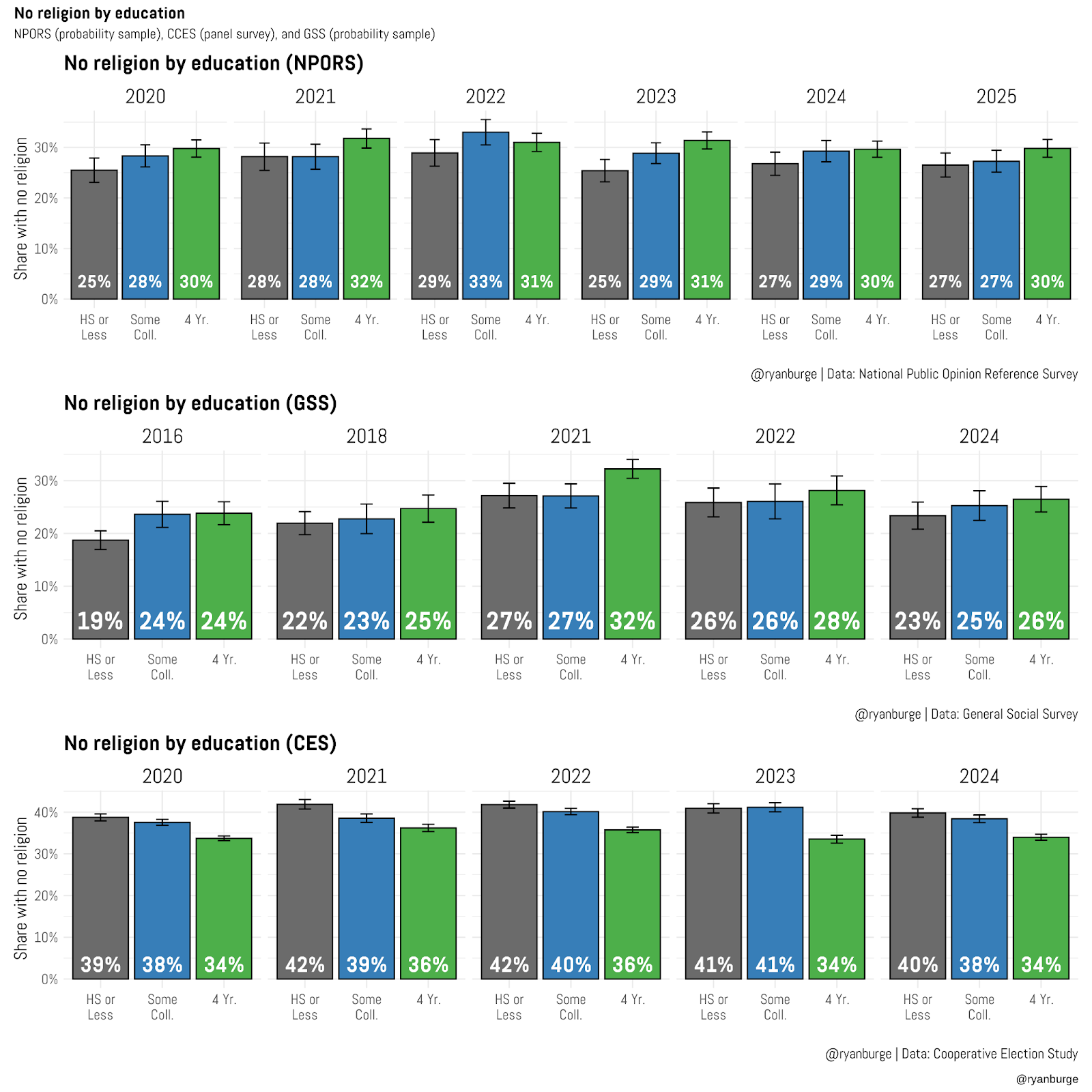
I’ve mapped 84% confidence intervals on each of these bars—a choice that allows us to visually identify statistical significance when intervals don’t overlap.1 I also collapsed education into three levels to keep the subgroup sample sizes robust. This is as rigorous a test of this relationship as I can muster across multiple instruments.
What does NPORS tell us? In 2021 and 2023, the relationship between education and non-religion is positive: highly educated folks are more likely to be atheist, agnostic, or “nothing in particular” compared to those with a high school diploma. In other years, the confidence intervals overlap, meaning there’s no clear relationship. Crucially, however, you cannot use this data to claim that educated people are more likely to be religious.
The GSS data leads us to the same basic conclusion. In 2016 and 2021, there is a clear positive relationship between higher education and being unaffiliated. In other years, the results are a wash. Again, there is zero evidence here that education correlates with religiosity; if anything, the evidence points toward the opposite.
However, the Cooperative Election Study (CES) results across the bottom of the graph tell a completely different story. Here, the conclusion isn’t mixed at all. In every single survey year, folks with four-year degrees are significantly less likely to be non-religious. Because the CES sample size is so massive, the confidence intervals are tight and do not overlap. The unmistakable conclusion from the CES—and the aforementioned Nationscape—is that educated folks are actually more likely to be religious.
Do you see the contradiction? In two surveys (NPORS and GSS), education predicts being a “None.” In two others (CES and Nationscape), education predicts being religious. My simple regression analysis of the impact of education on non-religion confirms this fundamental disagreement between the datasets.