


“What about the Unitarians?”
Man, I have been asked that question at least a hundred times across various social media platforms over the last couple of years. It’s really funny being in my position, because I have this really weird vantage point on what groups people really want to see visualized in data sources. There are a couple that pop up on a regular basis: Latter-day Saints are very interested in seeing themselves in charts and graphs. Members of the Presbyterian Church of America are also very much “reply guys” (and they are almost always male). And then the aforementioned Unitarians are frequently invoked in a comment.
Just for some quick background on our UU friends: Unitarian Universalism is a tradition that asks almost nothing doctrinally of its members — atheists, Christians, Buddhists, and pagans share the same pews, united by shared values around human dignity and social justice rather than creed. The UUA, formed in 1961, has always been small but culturally influential, claiming six U.S. presidents and a leading role in progressive social movements from abolition to marriage equality.
I’ve actually spoken at two separate UU gatherings. One was only a few blocks from my house and the other was in Nashville, TN earlier in 2026. I thought that the Nashville community had a great acronym: FUUN (First Unitarian Universalist of Nashville). When I was with both communities, the impression that I got was that there’s a lot of demographic similarities between the UU and many mainline denominations. They are usually quite a bit older and don’t have a ton of racial diversity.
Why I Can't Tell You How Quakers (or Unitarians) Voted in 2024

I’ve got to admit that I am writing this post while gritting my teeth just a bit. Which is probably not a good state of mind, but I just have to get all these thoughts down in a single post. Let me tell you what is driving my consternation.
That’s also reinforced in the data. The denomination has some obstacles in the future: shrinking membership, fewer congregations, and an increasingly narrow geographic and demographic footprint. There are some bright spots, of course, but many of the key trends facing the UU look strikingly like what’s happening with the Episcopalians or the United Methodists.
The Unitarians are nice enough to publish a “Certification Report” on an annual basis and that’s where almost all the data below came from, although, as you will see - I’ve also included some data from the Census Bureau as well.
Let’s start with the most logical metric: membership. Unlike most denominations which only count formal members, the UUA tracks two distinct groups: dues-paying members who have officially joined a congregation, and “non-member friends” — people who regularly participate and financially support a congregation but haven’t taken the formal step of membership.
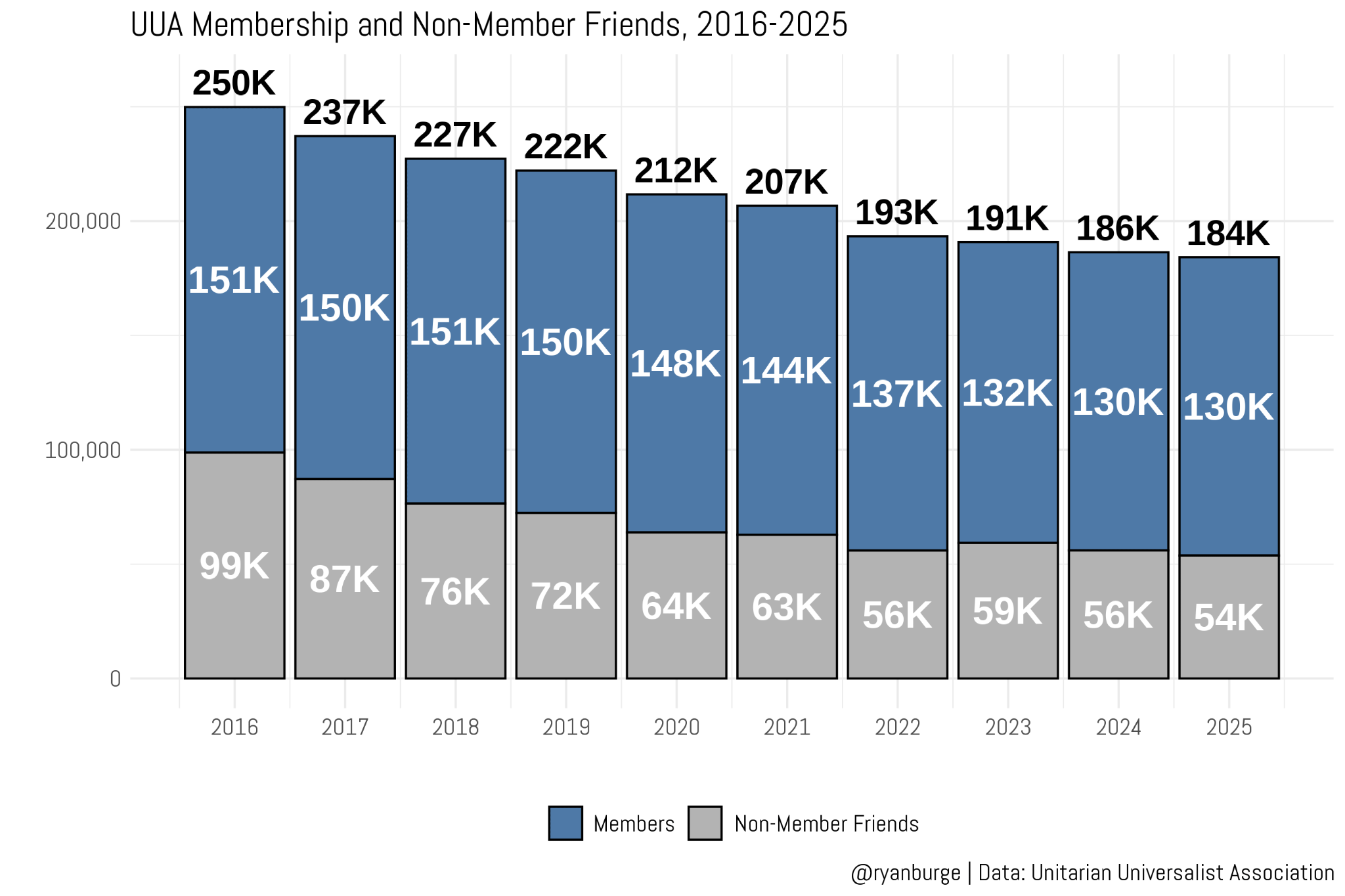
The trend for both groups is absolutely in the downward direction. In 2016, the UUs counted a total membership of just over 151,000 and then the “friends” added another 99K to that total. So, there were about a quarter of a million Unitarian Universalists in the United States a decade ago. That means that there is 1 UU for 1,340 Americans (give or take). It’s just not a numerically large group, a fact that I will return to in just a minute.
However, as you can clearly see in the previous graph: both types of membership metrics are in pretty steady decline for the UUs. Membership held relatively constant between 2016 and 2020 - losing just 7,000 folks. But the “friends” dropped by almost a third during that same time period (from 99K to just 64K). In the last few years, both metrics have continued to slide. In 2025, membership is down to 130,000 and non-member friends are at 54,000. In other words, there are 66K fewer Unitarians today than just a decade ago. That’s a drop of just over 26%.
But, can I just put the Unitarians in the larger context of American religion really quickly? This has become one of my hobby horses in the last couple of years: the average American just has absolutely no idea how large (or small) many religious groups really are in the grand sweep of the American religious landscape. Unitarians, numerically speaking, are a rounding error in the bigger picture.
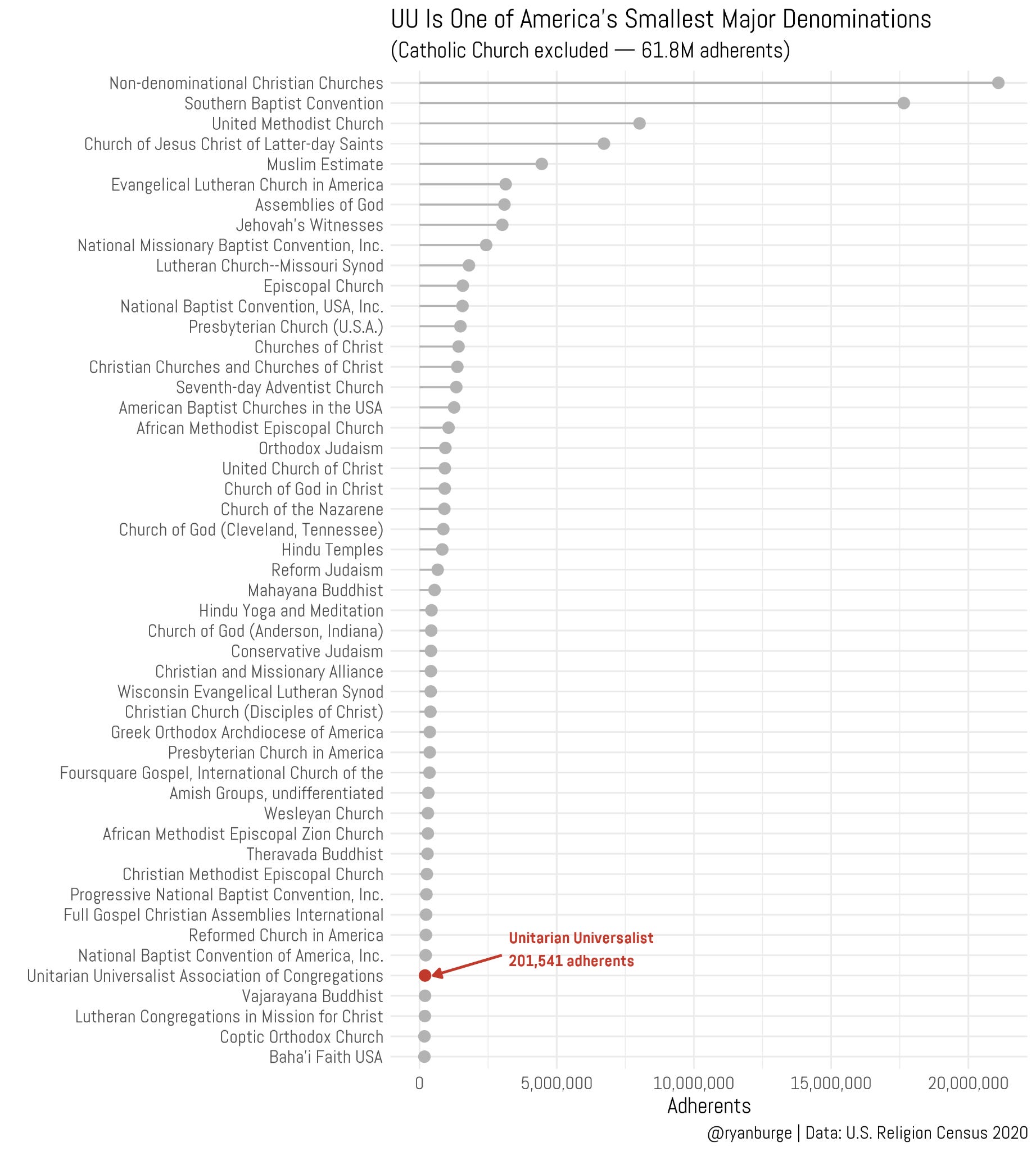
The Religion Census pegged them at just over 201,000 members when they did their data collection a few years ago. For context: for every UU in the United States there are sixty Southern Baptists, there are thirty Jews, and there are three hundred Catholics. The only survey that I’ve ever seen that really tries to assess the size of UUs using population based sampling is from PRRI, and they place them at .5% of the population.
In numeric terms, that’s 1.5-2M folks. Why the discrepancy? Well, it’s the classic case of members vs people who say that they are affiliated with a group. I have a sneaking suspicion that a whole bunch of Americans like the idea of Unitarianism but just can’t or don’t want to join a congregation. But according to their current membership data: UUs are less than half the size of the aforementioned PCA and are marginally larger than the Anglican Church of North America (who are in the 125K member range).