


I swear before I get done writing this newsletter, I will have written up a big report on nearly every American Protestant denomination. Just looking through the archive, I think I’ve tackled at least seven of them so far (TEC, ELCA, PCUSA, SBC, AG, PCA, UMC). Some are just “one-offs,” but a couple of those denominations have enough good annual data that it’s possible to analyze their trends every year. It’s time for me to add another one to the list—the United Church of Christ.
The UCC is a really interesting denomination because it was once a genuine powerhouse in American Protestantism. The UCC was formed in 1957 through a merger of two older traditions—the Congregational Christian Churches and the Evangelical and Reformed Church. And for the record, Congregationalism mattered a lot in early American history. In The American Religious Landscape, I make the point that Congregationalists likely represented the single largest religious tradition during the Revolutionary era.
Today, the UCC is best understood as a mashup of Congregational polity—especially its strong emphasis on local church autonomy—and German Reformed theology. It’s one of the so-called Seven Sisters of the Protestant mainline, known for a broad understanding of theological orthodoxy and a long, visible commitment to social justice. That combination helps explain both its influence and why it often feels very different from more doctrine-driven or centralized denominations.
What 12 Denominations Tell Us About American Christianity

I am running a holiday special - 20% off an annual subscription to this newsletter. That brings the cost down to just $48 per year. Take advantage by clicking this button:
One of my subscribers passed along a link to their most recent statistical report (PDF), which was chock-full of good data. This is my attempt at pointing you all to some cool stuff that I found buried in those glossy graphs that the United Church of Christ has provided.
I think it’s always helpful to start these write-ups by giving folks a good sense of the size and trajectory of the UCC. So what I’ve done is calculate the number of UCC congregations and members, and then calculate the ratio of membership to congregations.
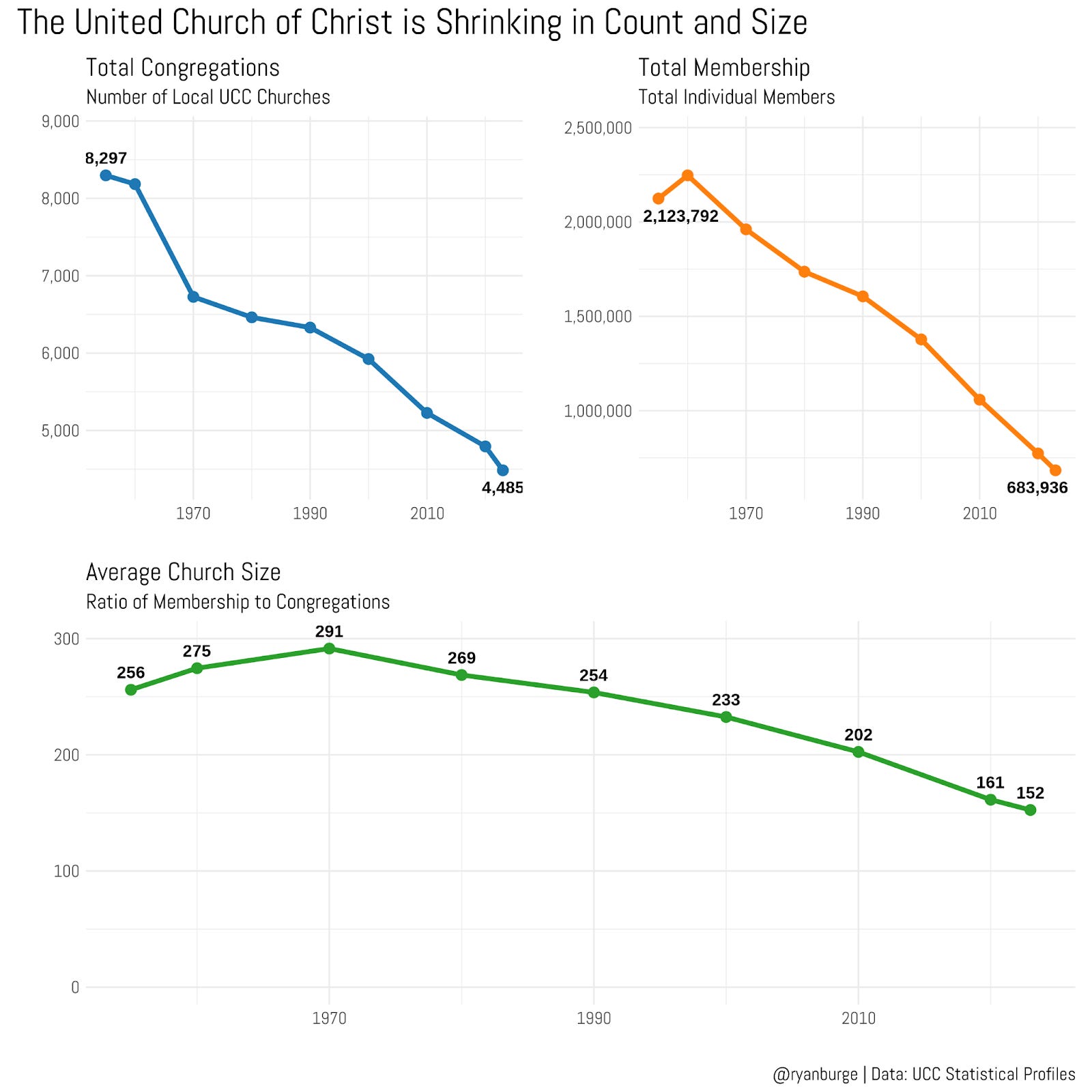
For those of you who have been around this newsletter even a little bit in the last couple of years, you know that the mainline is in really bad shape, and these figures from the United Church of Christ do nothing to disabuse us of that notion. This overall report is very bad for members and admirers of the UCC. In fact, there’s not much here that I could point to as a clearly positive indicator.
For instance, both congregations and membership have taken an absolute nosedive since the early days of the UCC. It’s pretty apparent that 1960 was the apex of the United Church of Christ, when they boasted about 2.25 million members and over 8,000 churches. From that point forward, decline was the norm. That’s something I want to make crystal clear here: the UCC has been moving in a downward direction for over six decades now.
The most current data indicate that the number of congregations has dropped to 4,485. That’s a decline of about 46%. The most recent membership number for the United Church of Christ is 683,936. In percentage terms, that’s a dip of just under 70%. Just think about that for a moment. For every 10 UCC members in 1960, there are three today. Just staggering stuff.
In 1970, the UCC reported its highest ratio of members to churches: 291 to one. That’s actually a really healthy number. But now the figure has dropped to only 152 members per congregation. In other words, they aren’t closing churches fast enough to keep that ratio up. To maintain a ratio of 291, it would require the UCC to have only 2,350 churches. That would mean shutting the doors of over 2,000 congregations.
How did they get here? Well, the UCC has a graph that charts inflows and outflows from the denomination at various points over the last sixty years. I charted a few of them below.