


Graduate school taught me plenty of technical skills: how to think carefully about causality, how to measure abstract concepts, and how to build statistical models that could separate signal from noise. It also taught me something less tangible. If you want to become truly good at scholarship, it has to be your primary obsession—at least for a while. There isn’t much room for hobbies when you’re trying to master a craft.
But one of the most valuable lessons came at the very end of my methods training. After years of learning regression analysis and research design, we felt ready to explain the world. Our professors offered two words of caution.
The first was an old saying: when all you have is a hammer, everything looks like a nail. We had learned a powerful statistical tool, but that didn’t mean every interesting question could—or should—be answered with a regression model.
The second warning has stayed with me even longer: don’t use those tools to predict the future. Forecasting is a dangerous business. Even if you’re right most of the time, no one remembers your successes. They remember the one prediction that turned out to be spectacularly wrong.
Well, I was reminded of that lesson a few weeks ago when I stumbled upon a book written in the early 2000s by the Canadian sociologist Reginald W. Bibby. In 2002, he published Restless Gods: The Renaissance of Religion in Canada. His thesis can be derived from the title: despite huge drops in religious attendance and involvement in Canada, there was a deep well of spirituality present in the population. It would just require churches to adapt a bit to bring in these seekers.
You can probably guess where this post is going. The Canadian General Social Survey is fielded every year, but it doesn’t ask about religion in every wave. However, it did include a battery of questions about religious affiliation, importance, and attendance in 2003, 2008, 2013, and 2020.1 This gives me ample data to test the theory of a religious revival in Canada.
Bibby couldn’t have been more wrong in his forecast.
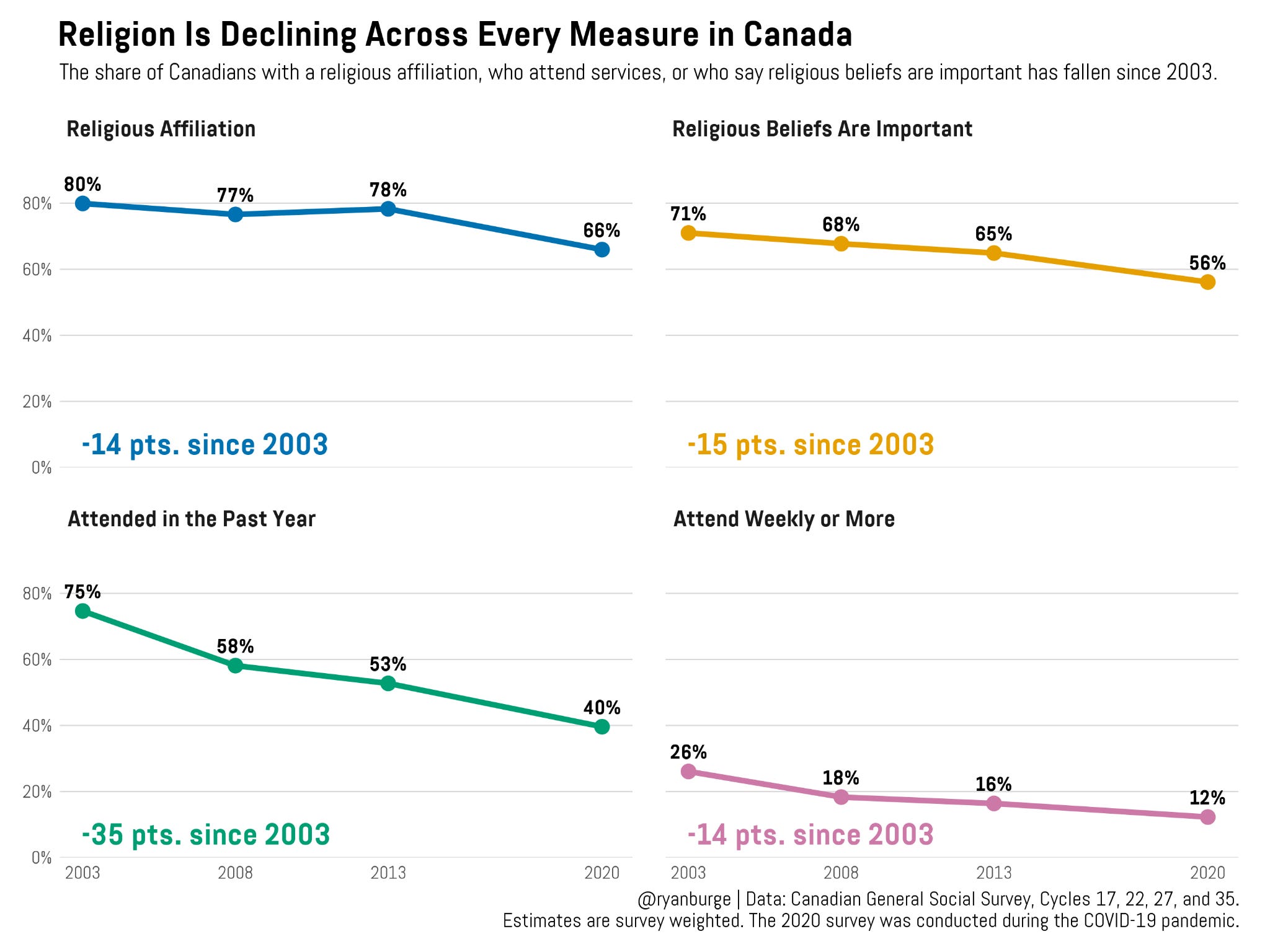
In the full sample, 80% of Canadians identified with some kind of religious tradition back in 2003. Today, that number is closer to 66%—a fourteen-point drop in seventeen years. The share of Canadians who say religious beliefs are important to them was 71%, but that has dropped to 56%. This is exactly what projection models would have predicted by simply tracing the trend lines from previous decades: a slow and methodical decline in overall religiosity.
In 2003, 26% of Canadians indicated they attended religious services at least once a week. By 2020, that had dropped by more than half to just 12%. Actually, the largest decline in terms of percentage points is the share who had attended church at all in the prior year. It was 75% in 2003 and just 40% in 2020. That may be the most telling statistic of all: a significant majority of Canadians have not darkened the door of a church in the last year.
There are two ways to make sense of this decline. One is simple generational replacement: older Canadians were more devout, and their children and grandchildren are more likely to claim no affiliation. People die and new generations come of age, moving aggregate trends downward. The other is that religiosity has declined within birth cohorts. Perhaps Boomers, Gen X, and Millennials have simply walked away from religion as they have aged.
We can test that by tracing religiosity across these four waves of the General Social Survey. Remember that in the full sample, religious affiliation dropped from 80% to 66% during this period.
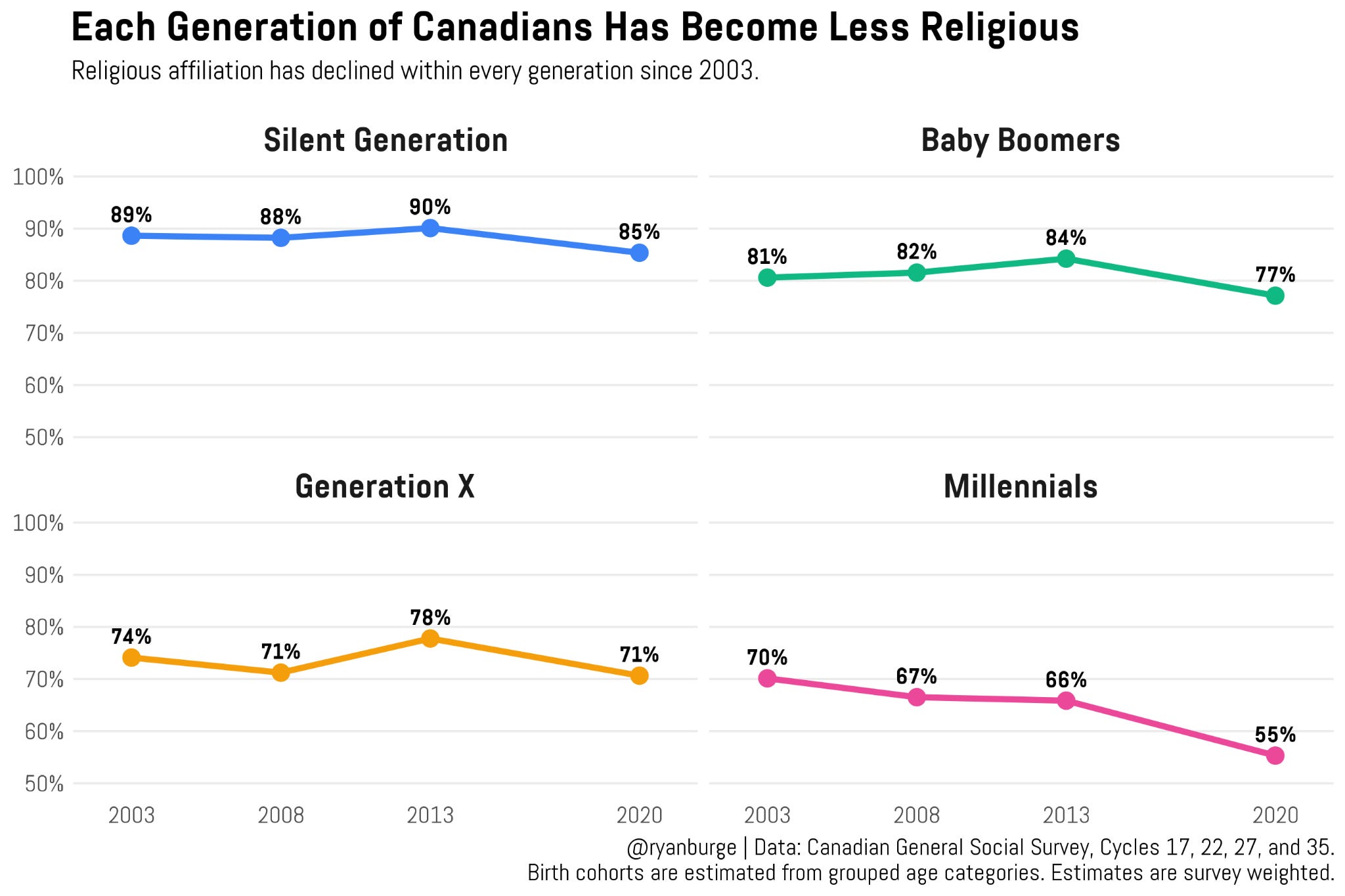
A quick glance at this graph reveals that the primary driver in the rise of the “nones” is generational replacement. There hasn’t been that much religious defection within the existing population. For instance, among Boomers, the share who were religious dropped just four percentage points between 2003 and 2020 (81% vs. 77%). For Generation X, the drop was only three points (74% vs. 71%).
Millennials buck this trend in a pretty significant way. In 2003, 70% of them aligned with some type of faith tradition. By the last wave of the GSS, that was down to 55%. That 15-point drop among Millennials was actually larger than the decline in the three older birth cohorts combined. Furthermore, while I didn’t include it because I only had one data point, just 51% of Gen Z were affiliated in 2020—nearly 20 points lower than Millennials when they were entering adulthood.
Let’s do the same thing for religious attendance and I used both metrics in this analysis: going to church in the prior year and attending weekly or more.
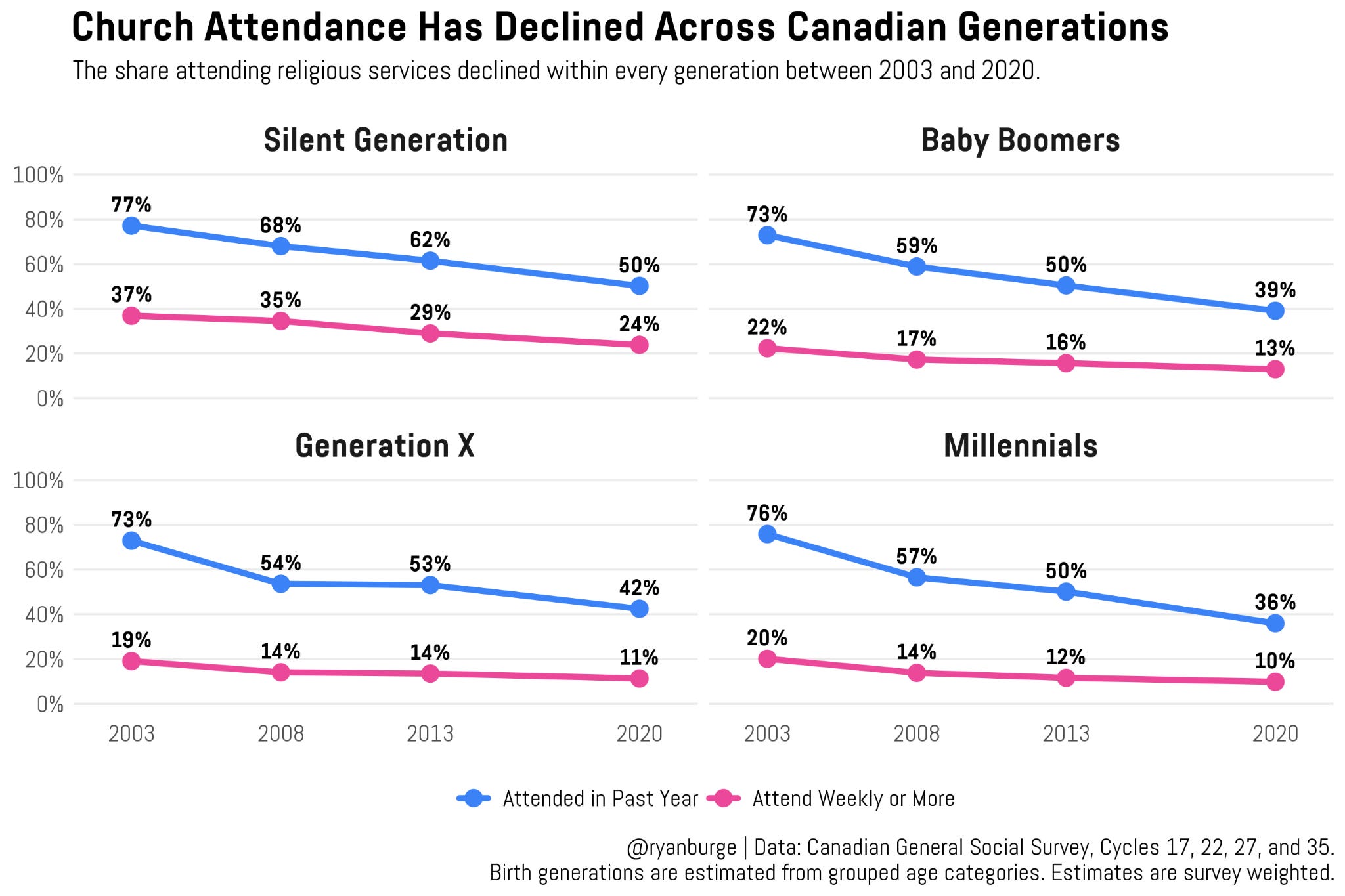
Here, the inter-cohort decline of religion gains much more empirical support. For the Silent Generation, the share who had attended at least once in the last year dropped by a staggering 27 percentage points between 2003 and 2020, and weekly attendance rates fell from 37% to 24%. For Boomers, the drop is even larger: in 2003, 73% had gone to church at least once in the prior year; by 2020, it was 39%. Weekly attendance rates among Boomers also fell from 22% to 13%.
For the younger two cohorts, it’s basically the same story. Yearly attendance rates dropped by at least thirty percentage points for both groups, while weekly attendance saw a more modest decline. Among Gen X Canadians, just 11% were weekly attenders in 2013, similar to the 10% found among Millennials.
But what about Gen Z? Are they still heading lower than their parents and grandparents on these religiosity metrics?
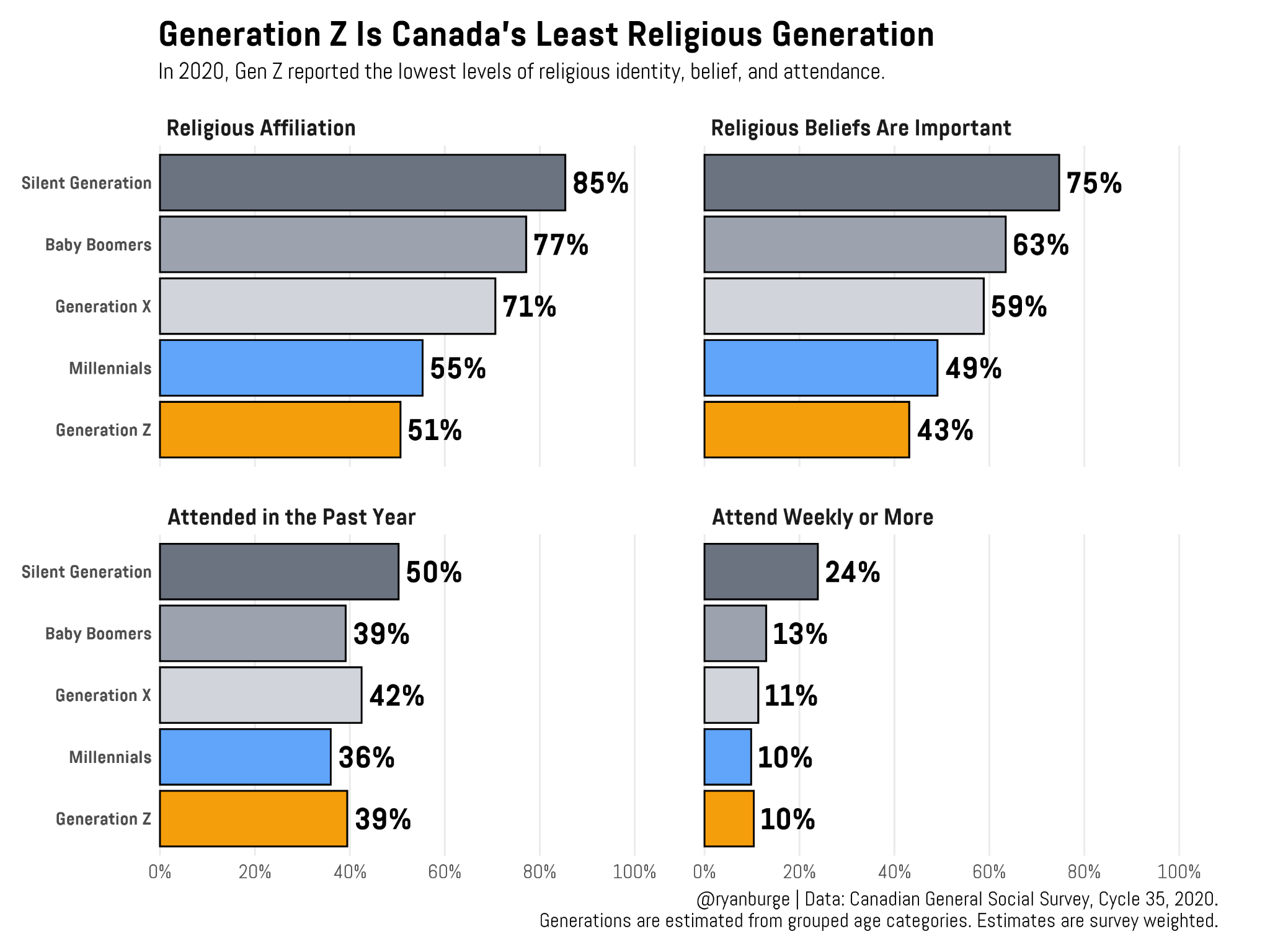
In some ways, the answer is very clear: yes, Generation Z Canadians are significantly less religious than Millennials or Gen X. As previously mentioned, only 51% of Gen Z claims a religious affiliation—four points lower than Millennials and twenty points behind Gen X. There’s also a huge gap in religious importance: just 43% of the youngest adult Canadians indicate that religious beliefs are important to them, six points lower than Millennials and sixteen points behind Generation X.
But on attendance measures, the picture is a bit muddier. For instance, 39% of Gen Z attended a religious service in the prior year, which is actually three points higher than Millennials and about the same rate as Boomers. Meanwhile, weekly attendance rates seem to have hit a hard floor. You can see that 10% appears to be about as low as these metrics go; that’s where Millennials and Gen Z are now, with Gen X just a single point above.
So while affiliation and importance measures still have room to fall, I think the decline in religious attendance has stopped. I believe this is a “floor effect.” Once you get to a certain point, you hit bedrock. That’s what is happening in Canada right now. The share who are deeply religious is about one in ten, and it’s not likely to move much from there, even with generational replacement.
I know what most readers are thinking: how does this Canadian data compare to their neighbors to the south? Well, the U.S. has its own General Social Survey, and while the years don’t line up perfectly, they are close enough to make solid comparisons.
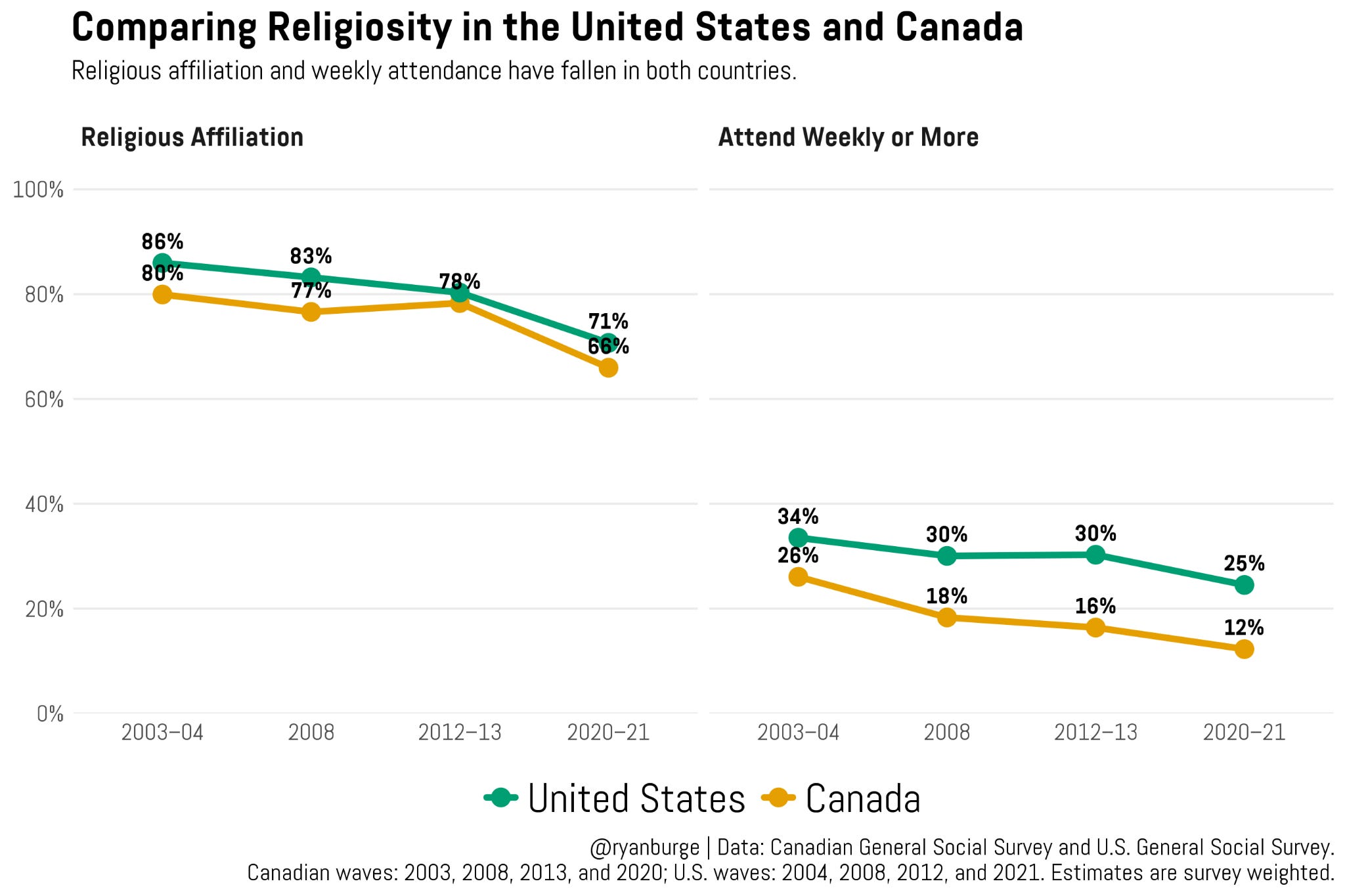
On affiliation, the United States has always been slightly more likely to be part of an established faith tradition compared to its Canadian cousins. Numerically speaking, the differences aren’t always large—some years show only a one or two point difference. But in the most recent data, the gap has widened. Among Canadians, 66% are part of a faith tradition versus 71% in the United States.
Attendance is trickier to compare because the Canadian survey offers five options while the U.S. instrument offers seven. I decided that weekly attendance would be defined using each survey’s standard measure: “at least once a week” in Canada and “nearly every week or more” in the U.S. General Social Survey.
With that caveat, you can clearly see that attendance rates in Canada are much lower than in the United States and the gap is widening. It was an 8-point gap back in 2003-2004 (26% vs. 34%), but by 2020-2021, it had grown to 13 points (12% vs. 25%). Secularization appears to have been more rapid up north.
Let’s do a generational comparison between the two countries, as well.
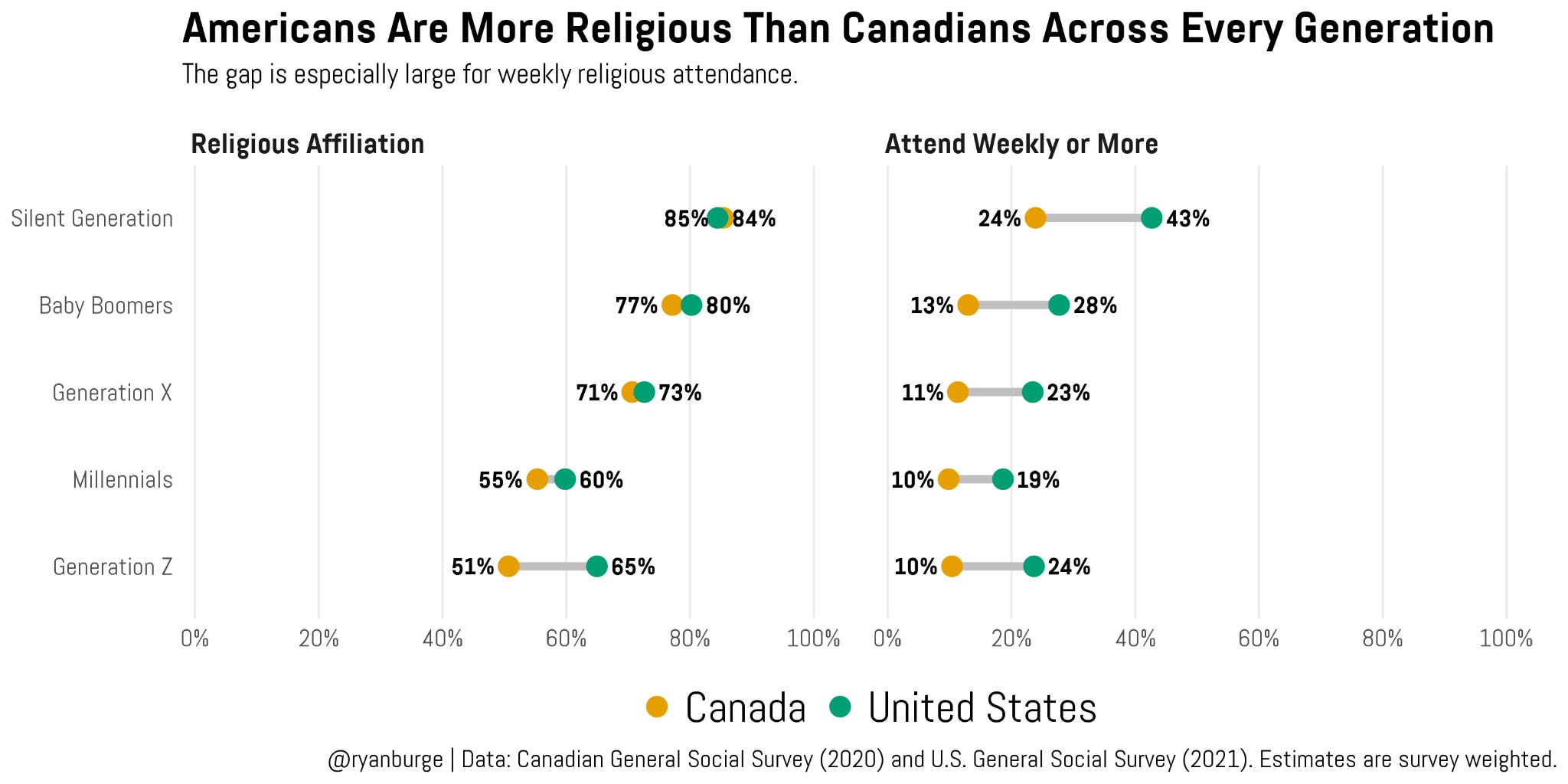
On affiliation measures, it’s striking how older folks in both countries are nearly as likely to be religiously affiliated. If you combine all respondents from the Silent Generation, Boomers, and Gen X, the share aligned with any religious tradition is basically the same. The gaps emerge with those born in 1980 or later. Among Canadian Millennials, 55% are part of a faith tradition compared to 60% of American Millennials. But the divide becomes a chasm with Gen Z: an American young adult is 14 percentage points more likely to be part of a faith tradition than their Canadian counterpart (65% vs. 51%).
The gaps in weekly attendance are more persistent across every generation. What is noteworthy is that the largest differences are among the oldest respondents. Among Americans from the Silent Generation, 43% are weekly attenders, compared to just 24% of Canadians from the same generation. In subsequent cohorts, the differences are smaller: 10 points among Gen X (23% vs. 13%) and 9 points among Millennials (19% vs. 10%). However, it opens up again for Generation Z: 24% for Americans versus 10% for Canadians.
By any objective metric, Bibby’s 2002 forecast was as wrong as it could be. Canadian religion has completely collapsed in the last twenty years, and there are no signs of revival. Interestingly, Bibby wrote a book in 1987 called Fragmented Gods: The Poverty and Potential of Religion in Canada, which was much more dour in its assessment. It earned him the nickname “Bad News Bibby.”
I can commiserate with Dr. Bibby. Tablet Magazine dubbed me “The Antiprophet“ back in May. But don’t expect a book about an American religious revival from me any time soon. Projection is always a fool’s errand, and I try my best to learn from the mistakes of others.
Code for this post can be found here.
Ryan P. Burge is a professor of practice at the Danforth Center on Religion and Politics at Washington University.

It does look like the 2026 survey included religion questions again. When those become available, I will make sure to update this post.
Their distribution of religion is a little different than ours. United CC had a very large share of Canadians with a steep decline; their evangenlicals have less of a presence than in the American Bible Belt. They also had a different immigration pattern than in the USA, where certain immigrant groups affiliate Catholic to prop up declines among other segments of the American population. And the Muslim representation is far higher in Canada than in the USA. All of these will affect the distribution and comparisons.
Prof Bibby likely included his reasoning for his prediction in his book. Forecasts require assumptions along with data. It would be interesting to know which foundations to his predictions led him astray.
On projections, they typically do not anticipate a reaction to the trend or counteraction. What are the consequences of declining religious belief? Believing in "none" would have a different effect than believing in Christ.