


In 1972, 41% of Americans in the General Social Survey reported that they attended religious services nearly every week or more. In 2024, that share had declined to just about 25%. At the same time, the share of those who never attend religious services rose from 9% to 30%. If I include people who attend more than never but less than once a year, those percentages become 17.5% and 40.5%, respectively.
Said simply, about a quarter of Americans report that they attend a house of worship at least a couple of times per month, and about forty percent are unlikely to go to a church, synagogue, or mosque at all in the next 12 months.
We measure American religion through three dimensions: belief, belonging, and behavior. It’s something I feel like I write about constantly, but if you need a quick primer, I’d recommend you peruse this piece: What Does It Mean to be ‘Religious’? — then come back to today’s post, which is going to be a deep dive into religious behavior.
Social scientists almost always measure behavior through the lens of religious attendance. It’s just the simplest, most straightforward way to do it. Nearly every survey includes the question, and it’s easy for a respondent to answer. But there are other metrics that tap into behavior, too. That’s what I want to explore today.
The Pew Religious Landscape Study has a wealth of questions about religious behavior in all kinds of contexts beyond just going to church on Sunday.
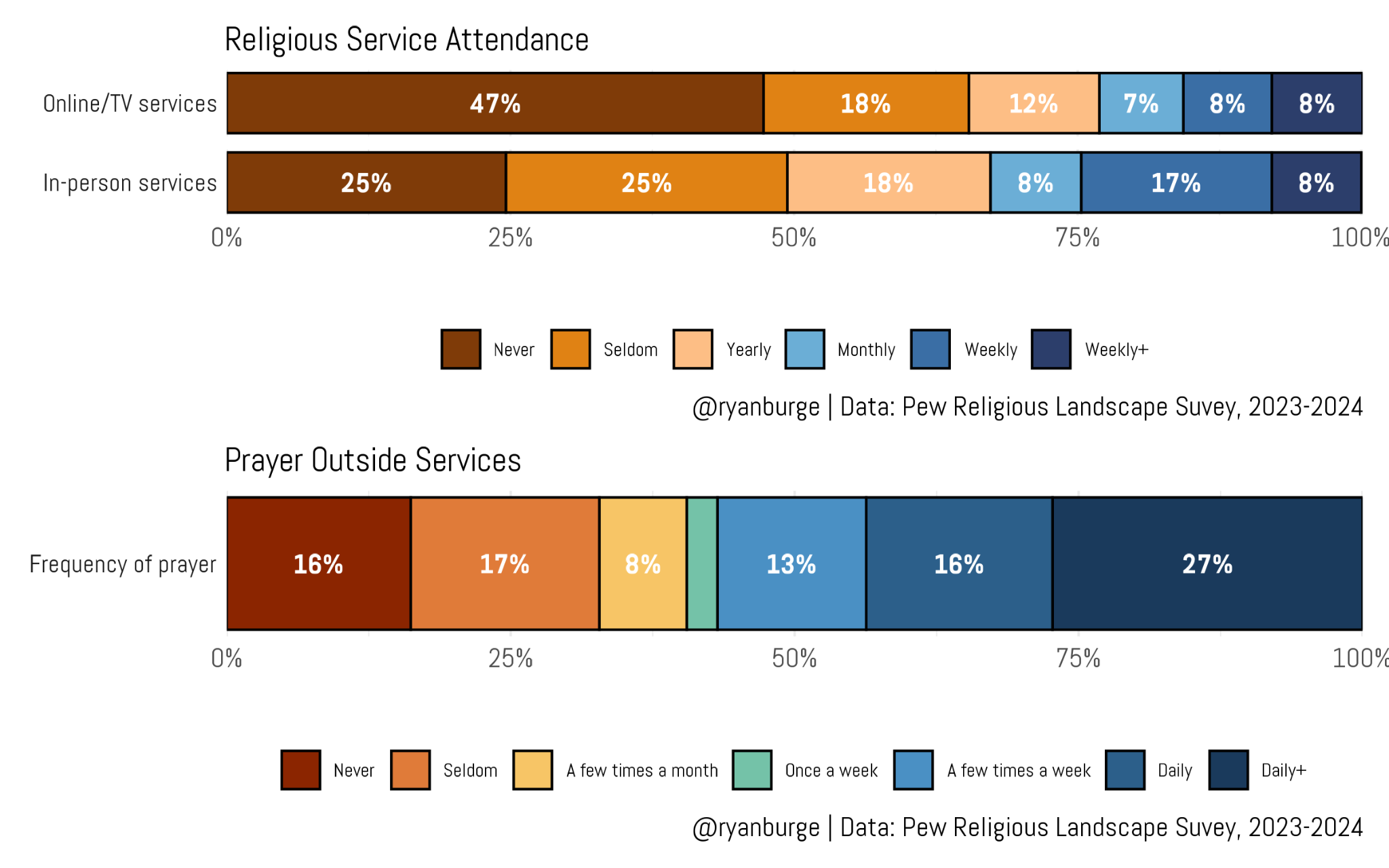
According to Pew’s data, about a quarter of Americans indicate weekly religious attendance in person. (That’s exactly the same as the General Social Survey, by the way.) At the same time, the share of Americans who indicate that their attendance is never/seldom is 50% of the sample. Online attendance is even lower: two-thirds report that they never or seldom attend a religious service via the internet. In contrast, 16% are watching every week.
Prayer frequency is another way to measure religious behavior, and this one specifically asks folks to exclude praying as part of religious services. Over a quarter of Americans say they pray multiple times per day, and another 16% say they pray by themselves every single day. In total, a majority of Americans say they pray at least a couple of times per week.
In contrast to religious attendance, there aren’t that many adults who say they don’t pray much at all — 16% say they never pray and the same share describe their prayer frequency as seldom. So a third aren’t praying much at all.
But then we’ve got all these other kinds of religious behaviors that offer a fascinating window into other ways of religious practice.
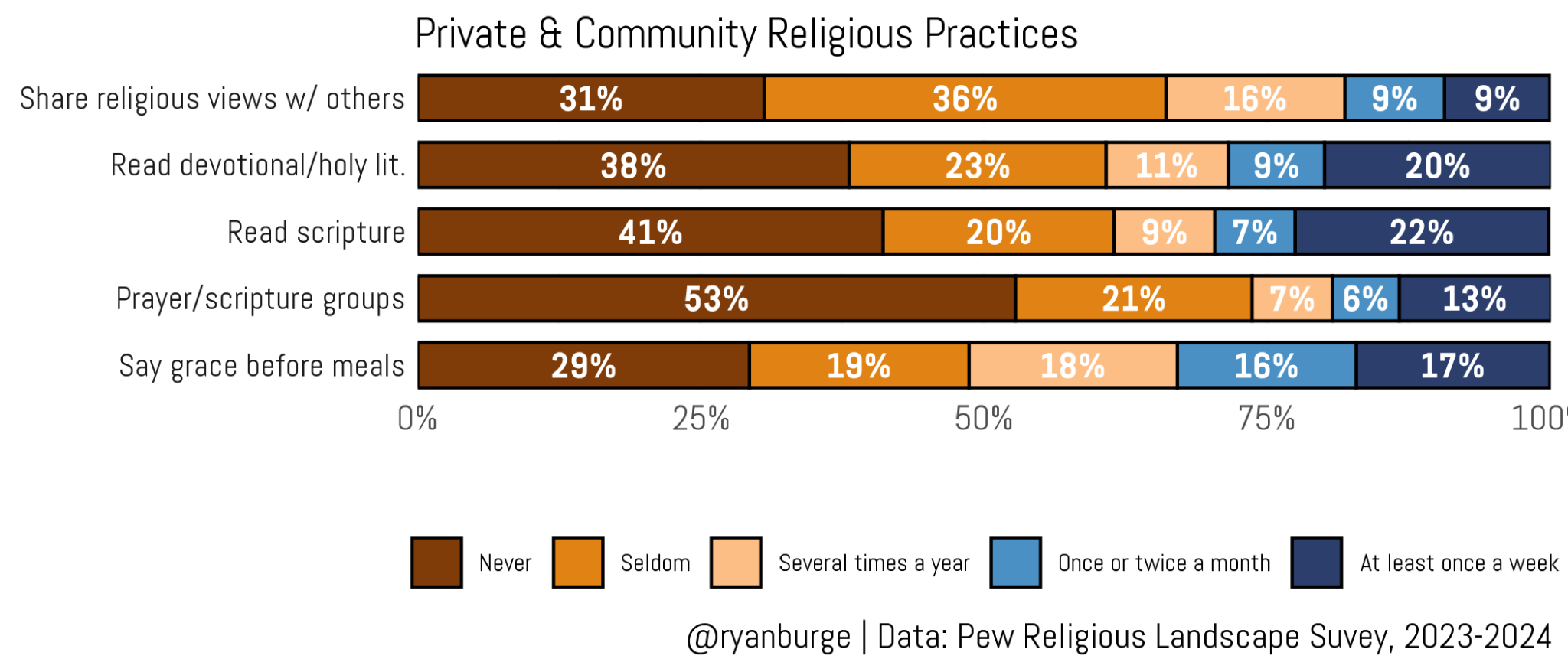
It’s readily apparent here that the vast majority of Americans are not engaging in religious dialogue with people outside their faith. In the full sample, less than one in five say they do this on a monthly basis or more. About the same share (19%) report that they attend a prayer or scripture group at least once a month. I feel like I have to point out that three quarters of all adults say they never or seldom attend a prayer or scripture group.
There are other behaviors that happen with a bit more frequency. When it comes to reading holy books or religious devotionals, 30% of respondents said this happens at least once a month. However, about 40% say this never happens in their daily lives.
It’s hard to look at this graph and think the average American is engaging in any type of religious behavior on a regular basis — just the opposite, in fact.
To try and simplify this, I created a “religious behavior index,” which is just a metric that combines all the above behaviors into a single scale running from 0 (meaning no behaviors at all) to 10 (those who indicated participation in each behavior at the highest frequency). I visualized the distribution of responses across all 37,000 survey participants below.
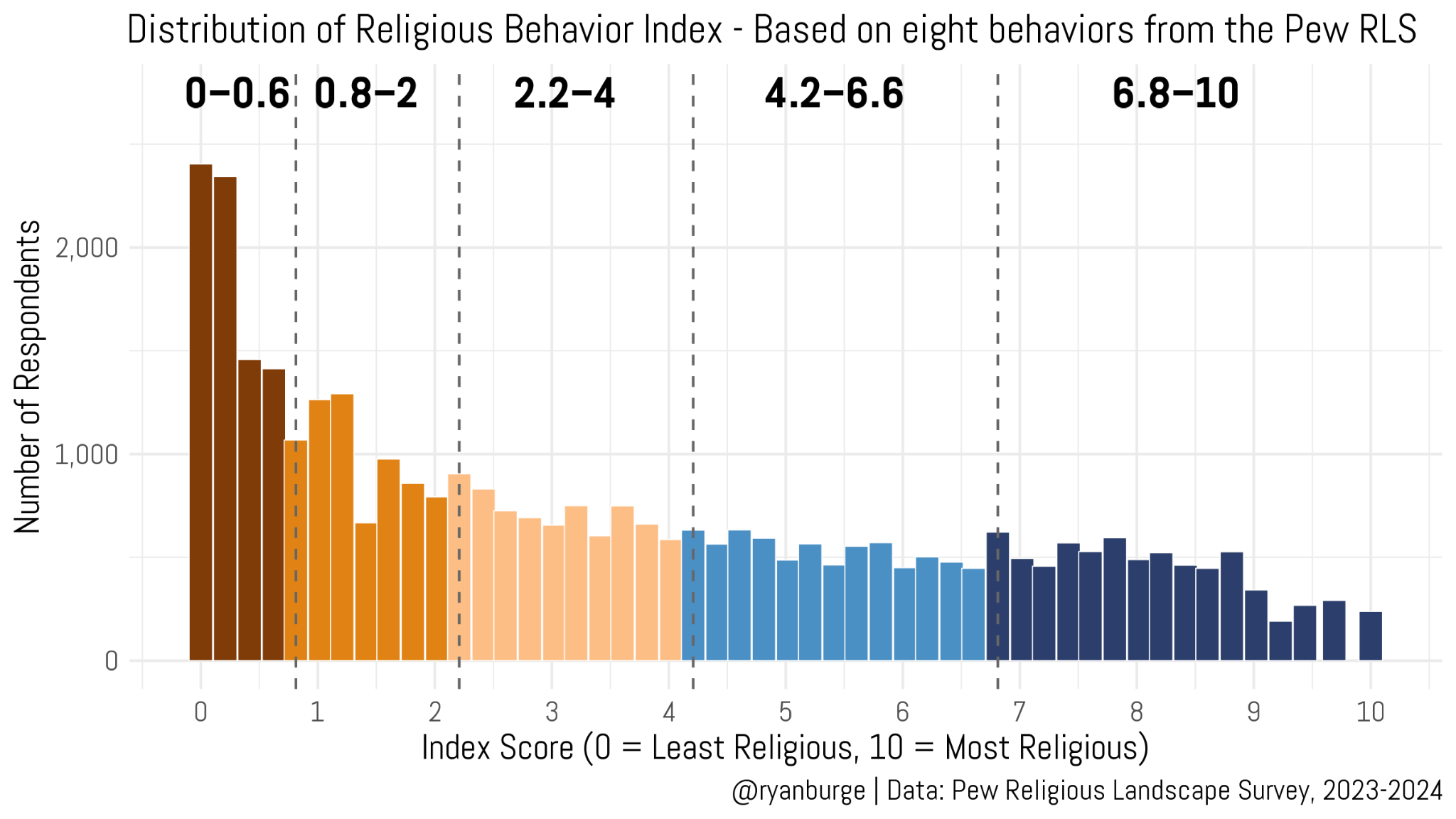
I broke the sample down into quintiles (those who score in the bottom 20%, next 20%, and so on). You can see those distributions based on the dashed lines and color changes. For instance, 20% of Americans scored between zero and .6 on this ten-point scale. In fact, about 7% of the sample scored exactly a zero. The mean score for the entire sample was 3.73 (weighted), which gives the clear impression that the typical American isn’t engaging in a whole lot of behaviors.
As you can probably tell, it doesn’t take a high score to end up in the top quintile — just 6.8 out of 10. In fact, only 3.7% of the full sample scores at least a nine on this index. The average American is just not that religious at all.
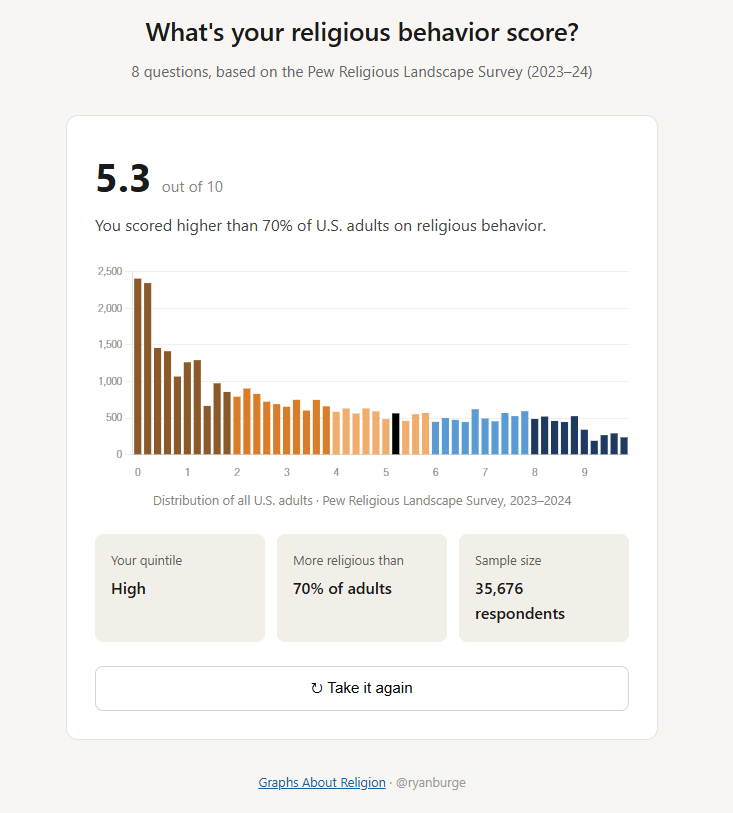
I’m sure you’d like to know where you’d land on this distribution, right? To that end, I’ve put together a simple online quiz you can take in about 90 seconds. It’s just the eight questions you see above.
Let’s do some data work, then, with this religion index. I first wanted to show you how the quintiles are distributed based on the birth decade of the respondents.
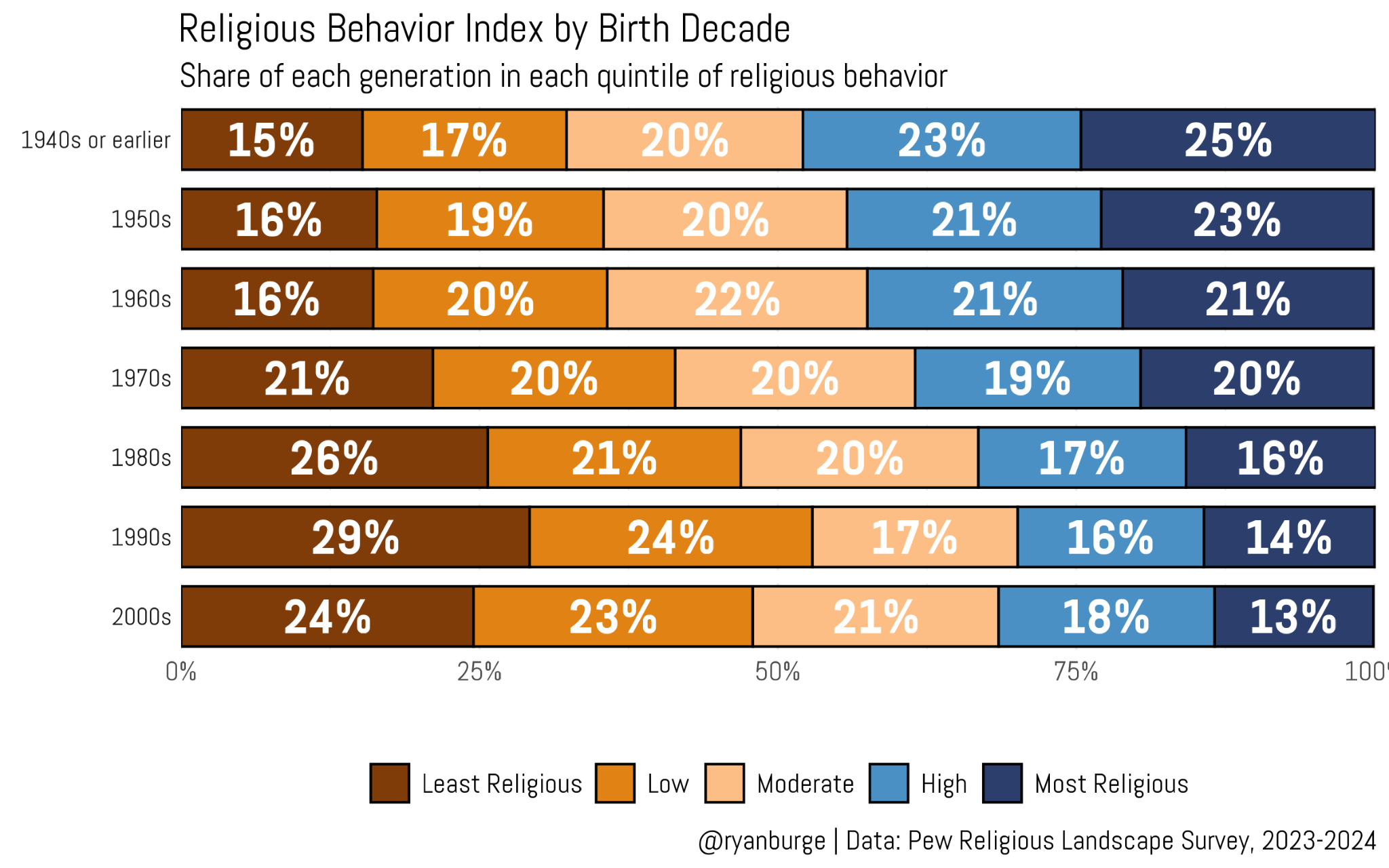
Anyone who has hung around here very long should have a good sense of how this graph would look before I pulled it together. Older Americans engage in a whole lot more religious behaviors than younger Americans. For the very oldest respondents, about a quarter landed in the top 20% for religious behavior, and about the same share landed in the next highest quintile. Those percentages drop with each subsequent decade of birth.
You can see that the blue bars get shorter in a methodical and consistent way as you move down the graph, and it really hits rock bottom for respondents born in the 1990s — just 14% are in the top category, and double that share are in the bottom grouping (29%). We do see a bit of a rebound among folks born in the early 2000s, but let’s not overinterpret this. A lot of these respondents still live with their parents or still have a high level of attachment to their parents’ religion. I’d expect their distribution to look a lot like the older cohorts in the next 5–10 years.
What religious groups have the highest level of religious behavior? That’s below.
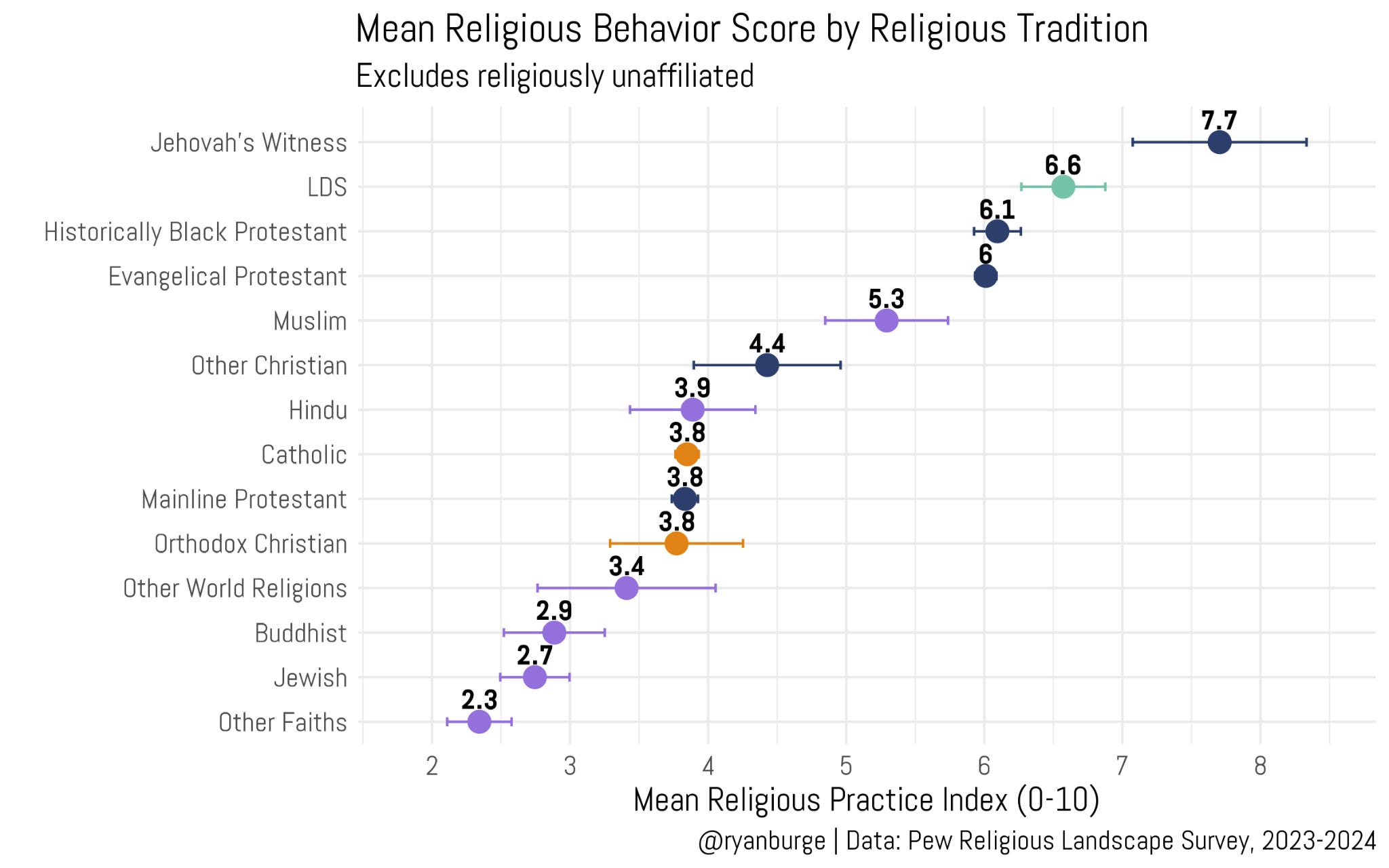
Without a shadow of a doubt, it’s Jehovah’s Witnesses. That’s a group I’ve written about before with this title: Politically Neutral, Religiously Intense. That fits them to a T. According to the data from that piece, about 70% of JWs say they go to church every week (with nearly 60% indicating weekly+ attendance). The Jehovah’s Witnesses are followed by Latter-day Saints at 6.6 out of 10. If you want to know which groups are the most religious — LDS and JWs are the most empirically defensible answer.
The cascade of the rest of the groups follows along with what many would have guessed: Black Protestants and evangelicals land in basically the same spot (around 6 out of 10). Catholics and mainline Protestants are way lower than that, though — they score 3.8 out of 10. What’s interesting to me is that the average Catholic or mainline Protestant is essentially as religiously engaged as the average American (which includes a whole bunch of non-religious folks).
Speaking of the nones, I thought it would be helpful to pull them out and visualize the distribution of their behaviors separately. When I calculated the mean score for each group, it was less than 1 for both atheists and agnostics, and only 1.5 for the nothing-in-particulars.
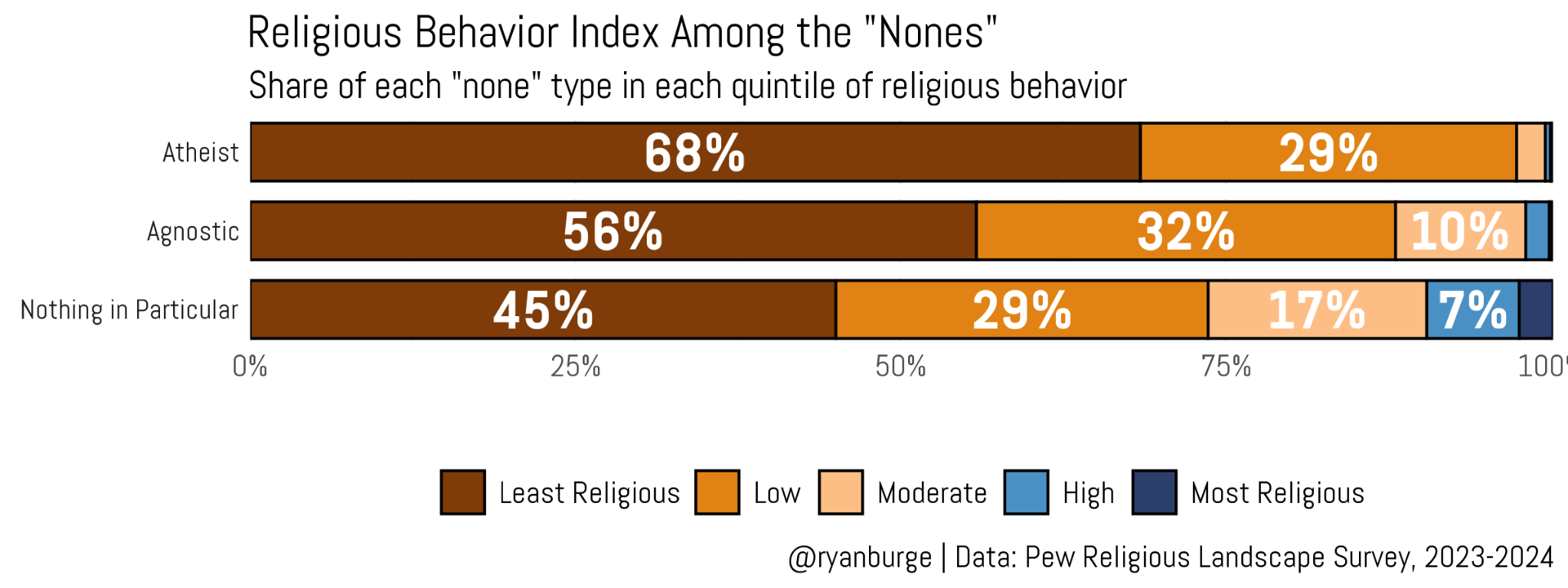
But the quintiles give us a much better sense of where these groups land. I like this visualization because it gives us a nice sense of how not all nones are created equal. Atheists are clearly the least likely to engage in religious behaviors: almost 70% of them score below .6 on this scale that runs from zero to ten. Among agnostics, 56% are found in the bottom bucket. For nothing in particulars, it’s still pretty high at 45%, but it’s less than half.
But here’s what I want you all to think about on this graph — the right side of the distribution. Among atheists, just 3% score “moderate” or above on the religious behavior index. For agnostics, it’s just a little higher: 12%. There’s a strong contingent of nothing-in-particulars who score in one of the top three quintiles, though: 26% of them. And remember this — about 60% of all the “nones” in the United States are nothing in particular, not atheist/agnostic.
I’ve become fond of saying that religious behavior is the type of religiosity that goes first. Remember — half of all Americans report that they attend religious services seldom or never. The share who identify as non-religious? About 30% of the country. And the percentage of people who indicate they have an atheist or agnostic belief in God? Only 15% in most surveys.
The unfortunate part of this equation is that religious behavior is more than likely the most beneficial type of religiosity that exists. The data indicates that those who engage in religious activities frequently have a longer life expectancy, are less likely to suffer from mental illness, are more politically engaged, are more likely to acquire civic skills, and are more tolerant of views they disagree with (among all other kinds of positive benefits). Yet it’s the type of religiosity that’s fading the fastest.
In a future post, I’m going to do an additional layer of analysis on religious behaviors by splitting them into personal vs. communal activities. Going to a Bible study is something entirely different than just reading the Bible by yourself, right?
I’m going to sort all of that out really soon.
Code for this post can be found here.
Ryan P. Burge is a professor of practice at the Danforth Center on Religion and Politics at Washington University.

Good to read this the day after Rosh Hashanah. There are perhaps some other ways to measure religious behavior, now that I see how low we Jews perform on the metrics of the Pew questions. Many of the people who built the modern State of Israel never attended synagogue or read Bible, but their commitment to community expressed their religion. They'd score zero. We had mediocre attendance at synagogue. People who never go often give generously of their time and treasure to charitable and advocacy initiatives. They'd score pretty low too. No doubt other religions have parallel behavioral opportunities that do not involve worship or scripture. Catholic families who never attend mass supporting Catholic Charities, serving on the Boards of Catholic hospitals, or insisting that their children attend a Jesuit college. Evangelicals who spend Sundays at brunch but help campaign for the candidates who promote their doctrinal positions. We could probably find some form of engagement for any religion, from advocacy to social affiliation, that affirms their identity with the religion, imposes some action on their part, but does not require them to enter a sanctuary.