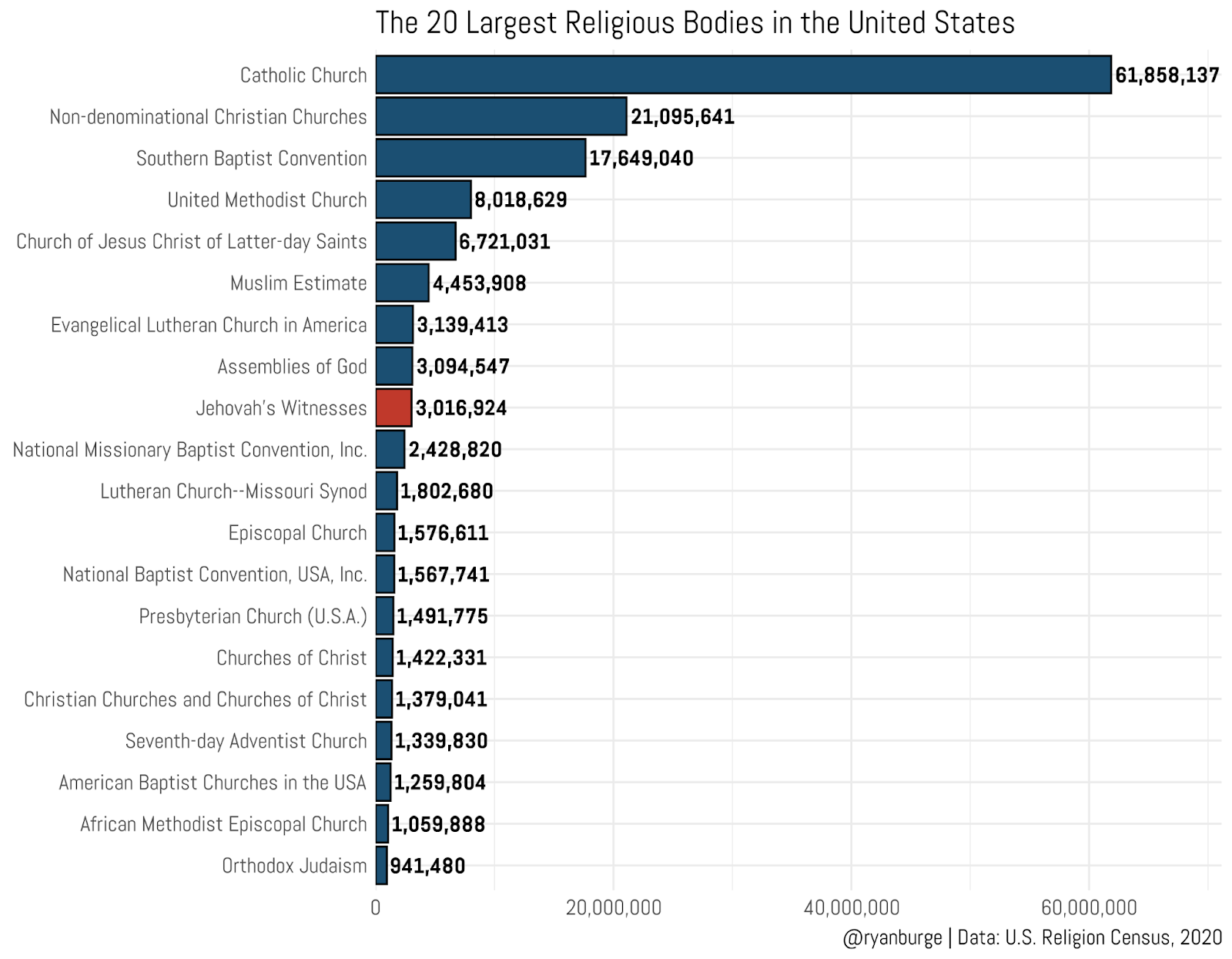

This is why I love the Substack community - a couple of weeks ago, one of my subscribers (Ben Hein) asked me if I had any good data on Jehovah’s Witnesses. And you know what? I actually do. For reasons that elude me, I have just never dug that deeply into this religious group and there’s a whole lot here that really surprised me about these folks.
Of course, I can’t offer a full history of Jehovah’s Witnesses, but here’s a really brief introduction. The Jehovah’s Witnesses trace their background to the Bible Student movement that emerged in the late 19th century, closely associated with the teaching and publishing work of Charles Taze Russell.
One of the most important figures in the early institutional development of the movement was Joseph F. Rutherford, who succeeded Russell as president of the Watch Tower Society and moved aggressively to centralize leadership, standardize doctrine, and expand the organization’s evangelistic efforts. One key aspect of Jehovah’s Witness theology is their rejection of the doctrine of the Trinity, a belief that places them outside the boundaries of orthodox Protestant and Catholic Christianity.
Why I Can't Tell You How Quakers (or Unitarians) Voted in 2024

I’ve got to admit that I am writing this post while gritting my teeth just a bit. Which is probably not a good state of mind, but I just have to get all these thoughts down in a single post. Let me tell you what is driving my consternation.
Sociologically, the Jehovah’s Witnesses are an interesting group because they engage in aggressive “boundary maintenance” with the rest of the world. JWs are incredibly engaged with congregational life and the denomination has a strict code of conduct that can often lead to disfellowshipping. They are supposed to be politically neutral, in fact they are not supposed to salute a national flag or engage in military service. Education is also not a primary emphasis of Jehovah’s Witnesses.
How many Jehovah’s Witnesses are there in the United States? Well, it’s a group that is pretty hard to estimate from pure survey data. The Cooperative Election Study is one of the few datasets that has a large enough sample size to capture them in any meaningful numbers.
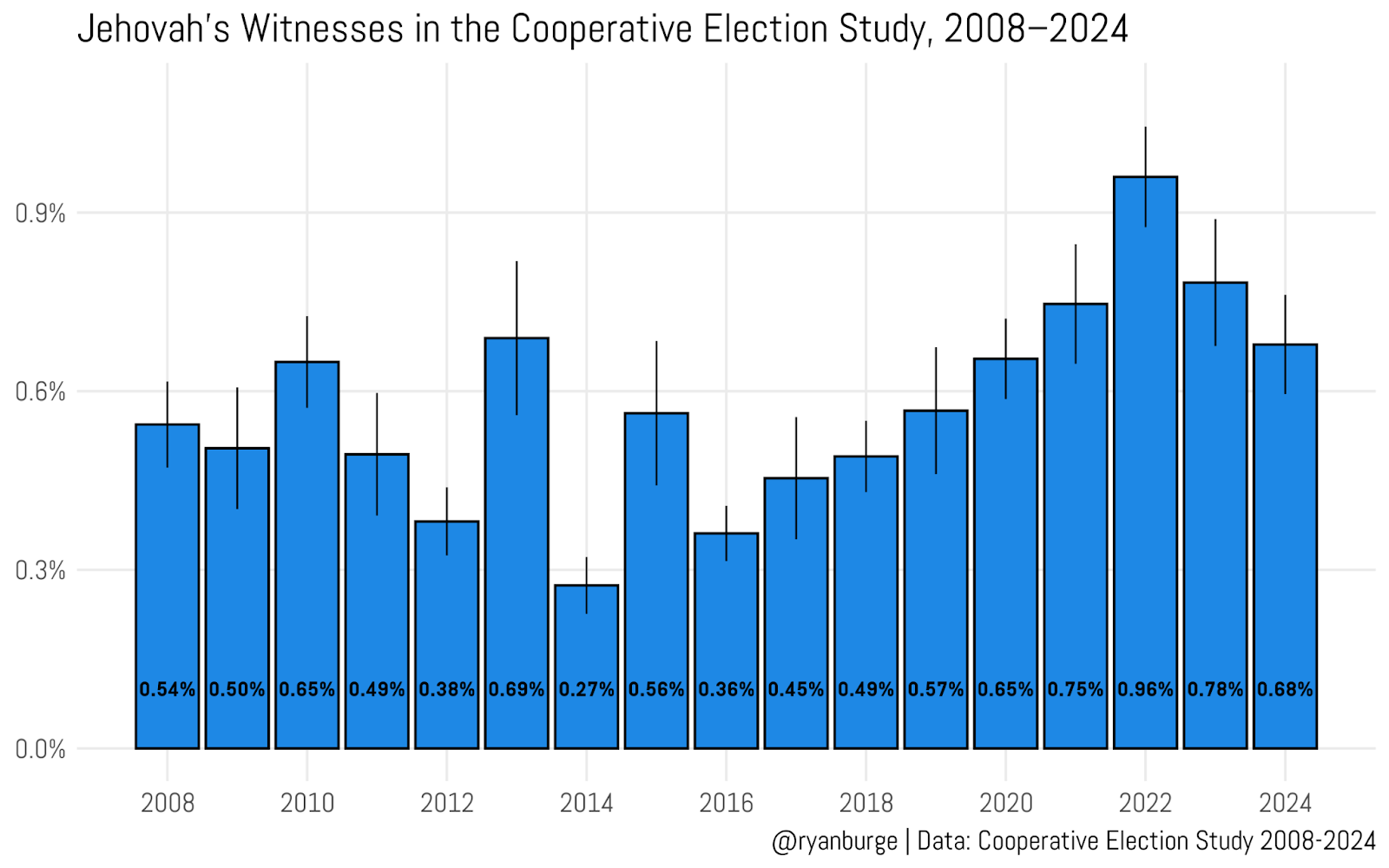
As you can see, even with a survey sample that often exceeds 50,000 respondents, they are still just a very small sliver of the United States population. In some years, they make up about .5% of the entire dataset. The numbers do vary a bit when tracing the estimates from year to year, but that’s to be expected when it comes to a group that small. Because of that, it would be unwise to make some type of claim about their growth or decline from survey analysis.
What I think we can say is that in the last few years of the CES, the share of the sample that identified as Jehovah’s Witnesses has been around .8% of the population. If you extrapolate that out to the entire American population you get about 2.75M Jehovah’s Witnesses. Now that’s just one angle on this. Let me pull in another dataset to cross validate that.
The 2020 Religion Census is a different approach. The Association of Statisticians of American Religious Bodies just contacts a whole bunch of denominations and religious groups and asks them to pass along their statistics related to congregations and membership. The Jehovah’s Witnesses just so happen to be in the database of the Religion Census.