



This post has been unlocked through a generous grant from the Lilly Endowment for the Association of Religion Data Archives (ARDA). The graphs you see here use data that is publicly available for download and analysis through link(s) provided in the text below.
There’s this concept in social science that I’ve brought up a few times in this newsletter that is worth revisiting: boundary maintenance. It’s the often subtle, subconscious process where groups make a decision about who can be included in a group and who should be excluded. Put simply, it’s the ongoing movement of defining and redefining who is “us” and who is “them.” The concept can be traced back to Émile Durkheim, one of the founding figures in modern social science, when he described how societies reinforce norms by how they respond to deviance.
Christian Smith can be credited with adapting it to the religious context in what he termed subcultural identity theory. This is most evidenced in his book American Evangelicalism: Embattled and Thriving. He argues that religious groups are most successful when they actively engage with the larger culture while also maintaining clear boundaries about us and them. In evangelicalism, boundaries are typically not defined by a hierarchical leadership organization; they are often informal and seemingly haphazard. For an example of this, I would recommend reading about the “Farewell, Rob Bell” incident.
Catholicism is an interesting case study in subcultural identity theory because of how the Church is structured. Catholics believe that the Magisterium — the Pope, Cardinals, and Bishops — holds the God-given authority to interpret scripture. Beyond that, they also believe Church teaching can develop over time through Divine revelation, a process guided by that same hierarchical leadership. This would suggest that boundary maintenance in Catholicism should flow from the top down, defined and enforced by church leadership rather than the laity. But as I’ve widely discussed in this newsletter and in various outlets: the average American Catholic disagrees with the teachings of the Church on all kinds of issues like sex outside marriage, the use of birth control, and the legality of abortion access.
I’m always interested in exploring how the average Catholic thinks about concepts like authority and how open they believe Catholicism should be when it comes to welcoming people who don’t agree with the Church’s teachings on key issues. To accomplish that, the Association of Religion Data Archives has been hosting the Catholic Laity Poll, which is a semi-regular questionnaire conducted by Gallup of American Catholics. It was first collected in 1987, and the most recent survey was fielded in 2017. It contains a wealth of information.
What may be the most relevant piece of information to inform the rest of this article is that the average Catholic doesn’t go to Mass nearly as frequently as the average Catholic from thirty years ago. Not even close. The question asks, “Aside from weddings and funerals, about how often do you attend Mass?”
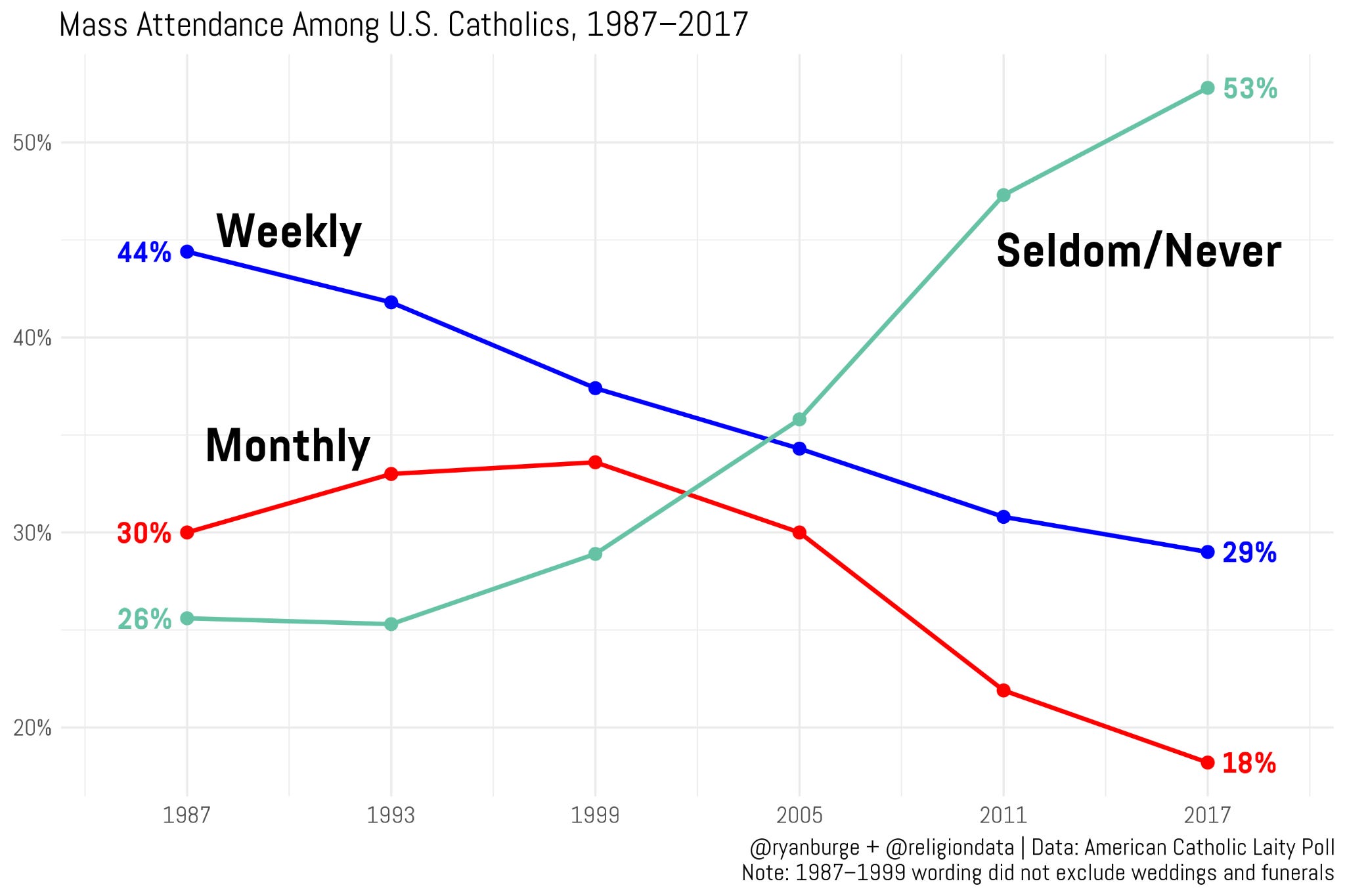
In the 1987 sample, the most popular response option was weekly attendance—44% chose this response on the survey. The rest of the sample was almost evenly divided between monthly Mass attendance (30%) and those who attended seldom or never (26%). By the time that survey was fielded again in 1993, attendance had already started to decline just a bit, and in 2005, the rare attendees had surpassed the weekly attendees for the first time.
From there, the never/seldom share of the sample continued to explode. It rose from 36% in 2005 to 47% in 2011 and landed at 53% of the sample from 2017. That’s a doubling of low attending Catholics in just thirty years. At the same time, the weekly attenders slowly eroded over time, dropping below 40% in 1999 and then dipping below 30% in 2017. There’s no doubt that Catholic attendance is down substantially in the last few decades.
But what’s interesting is that Mass attendance is just one way to gauge the attachment that the average Catholic feels toward their Church. There’s another question in the survey that offers additional insight: “On a scale from one to seven, with ‘1’ being ‘I would never leave the Catholic Church’ and ‘7’ being ‘Yes, I might leave the Catholic Church,’ where would you place yourself on this scale?” I simplified this into three categories: “I would never leave” (1), “middle” (2-4), and “I might leave” (5-7).
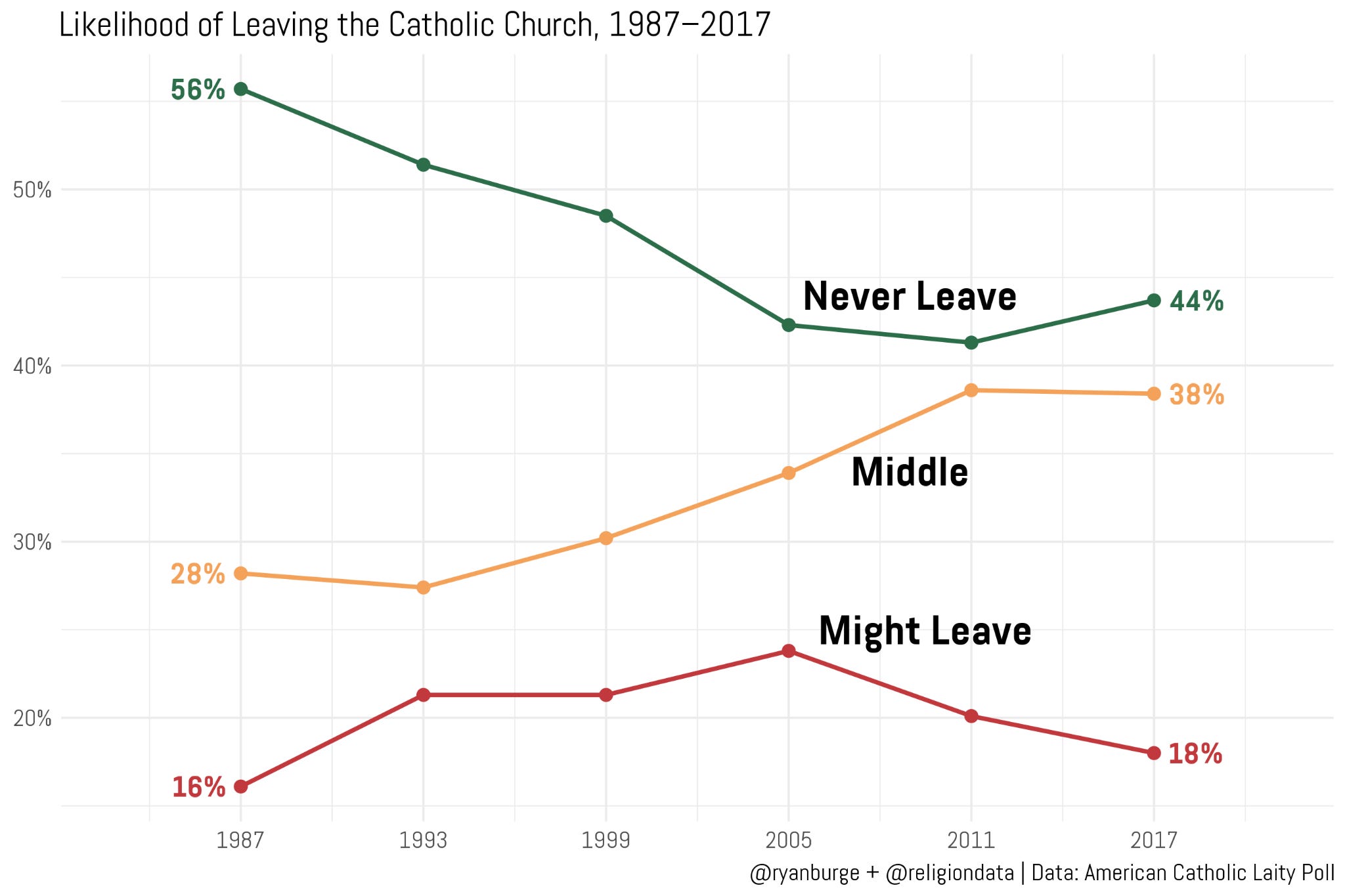
The most popular answer, both in 1987 and 2017, was that respondents had no intention of leaving the Catholic Church. Although this share has declined just a bit over time from 56% to 44%, it has stayed around that ~45% level since 2005. It’s still certainly the case that the average Catholic doesn’t have one foot out the door.
Instead, the percentage of Catholic laity who indicated that they might leave has never risen above 25% and has actually declined noticeably in the last few surveys. In 2017, just 18% of Catholic laity said that their response to this question was a 5, 6, or 7 on the scale. So, while Mass attendance has declined sharply, that doesn’t indicate that Catholics are going to leave the Church behind in terms of affiliation.
But how much do these rank-and-file Catholics feel like they need to listen to the moral teachings of their Church on contentious issues? The preamble to each of these questions is:
“Next, we are interested in your opinion on several issues that involve the moral authority in the Catholic Church. Is it Church leaders such as the pope and bishops, individuals taking Church teachings into account and deciding for themselves, or both individuals and leaders working together?”
They were given three response options: church leaders, individuals, or both. And they touched on topics like birth control, abortion, and sex outside of marriage. I plotted the share of Catholics who said that the individual, not the Church, has the final say on these issues.
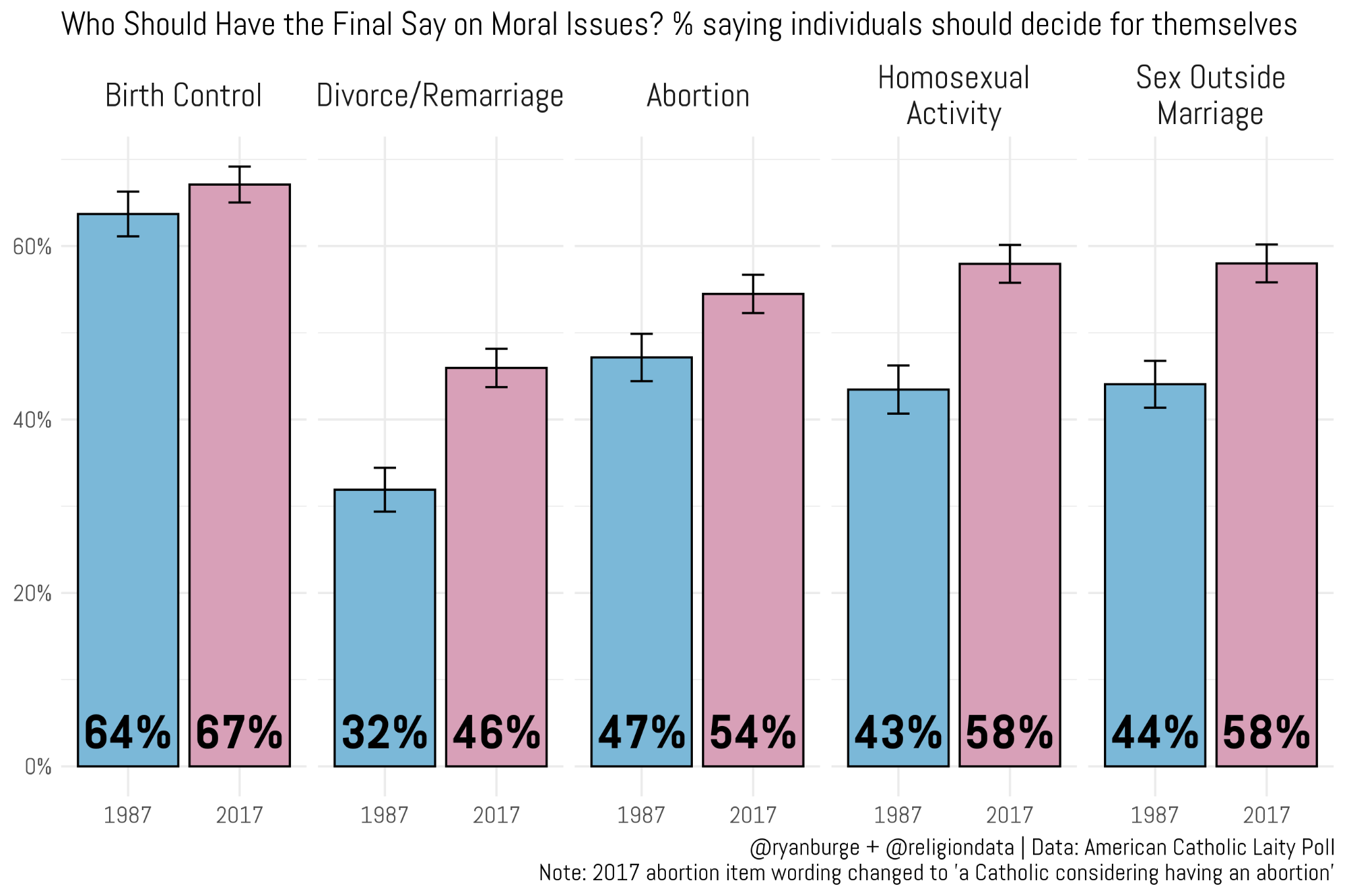
One commonality across these findings is that the average Catholic has a more individualized view of morality now than a similar Catholic in the late 1980s. For instance, in 1987, just 32% of Catholics believed that a person’s individual morality should be the final arbiter on the issue of “A divorced Catholic re-marrying without getting an annulment.” In 2017, that had jumped up to 47% of Catholics. There was fifteen points of movement on the topic of homosexual behavior and 14 points on the topic of sex outside of marriage.
Thus, the evidence is strong here that the average lay Catholic is questioning the moral leadership of the Church on these issues at a much higher rate in 2017 compared to 1987. There is a confounding variable here that we just discussed: Mass attendance. If the average Catholic is going to church less, it makes logical sense that they would be less open to deferring to the Church’s teachings on these hot button issues. To check that I just broke the sample down into weekly Mass attenders and those who attended seldom or never.
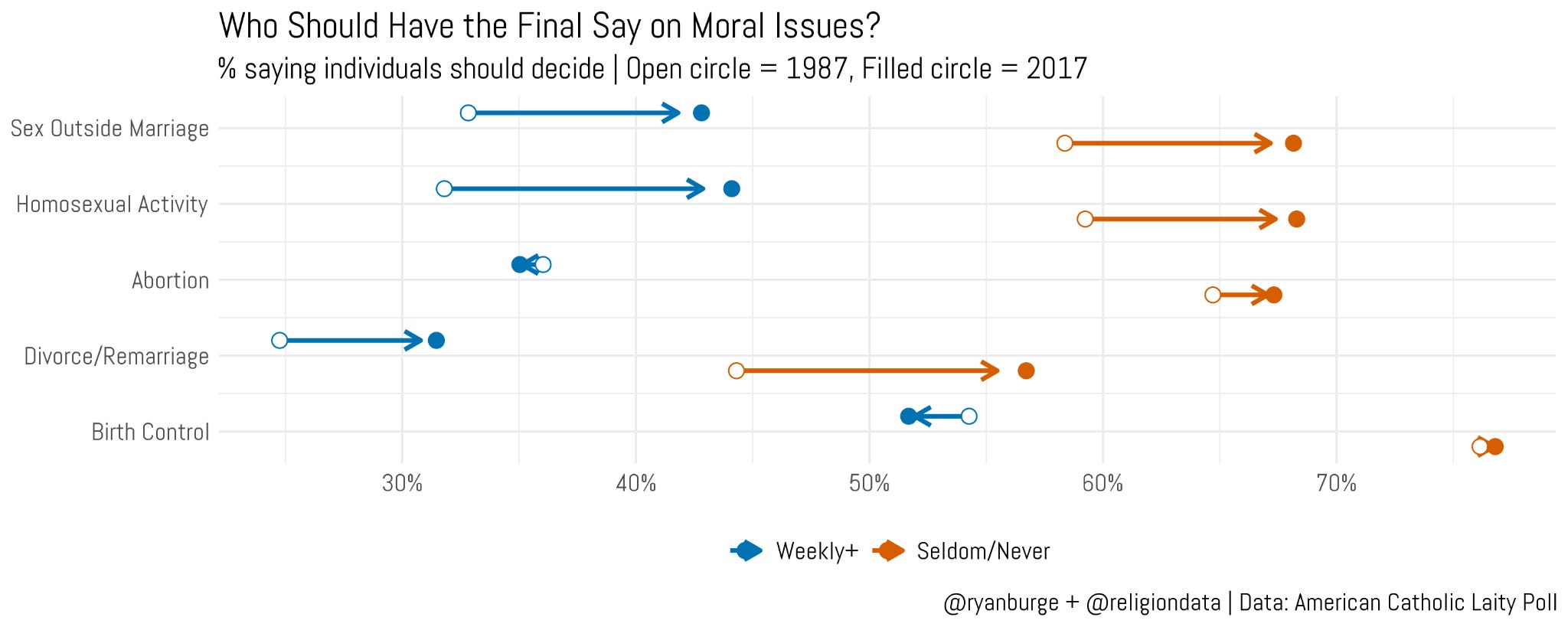
It’s always been the case that weekly attenders were more open to the authority of the Magisterium than the laity. You can see a huge gap on every single issue in the survey, and those differences are numerically massive—often 25 percentage points between high and low attenders. On three of the five issues, there’s compelling evidence that individual morality has risen sharply among Catholics, regardless of how often they attend Mass. Those topics are: sex outside of marriage, homosexual activity, and the issue of divorce and remarriage in the Church.
Among weekly Mass-attending Catholics in 1987, 32% believed that individuals should have the final say on homosexuality. In 2017, that share was up to 44%. On sex outside of marriage, there was a ten-point movement in the same direction (33% to 43%). In fact, the movement for both attendance groups was essentially the same magnitude.
There are two outliers that are worth some reflection, however. On abortion, weekly Mass attenders didn’t budge over a thirty-year window. In 1987, 36% said it was an issue of personal morality; it was 35% in 2017. And on birth control, there was movement away from individual morality as well: 54% to 52%. It would appear that those issues are now “distinctives” among devout Catholics while issues like sex outside of marriage or remarriage are not seen the same way.
Speaking of Catholic distinctives, there was also an intriguing battery of questions that had this setup, “The following statements deal with what you think it takes to be a good Catholic. Please indicate if you think a person can be a good Catholic without performing these actions or affirming these beliefs.” And then there were options like: not going to Mass every Sunday or opposing the Church’s teachings on contraception.
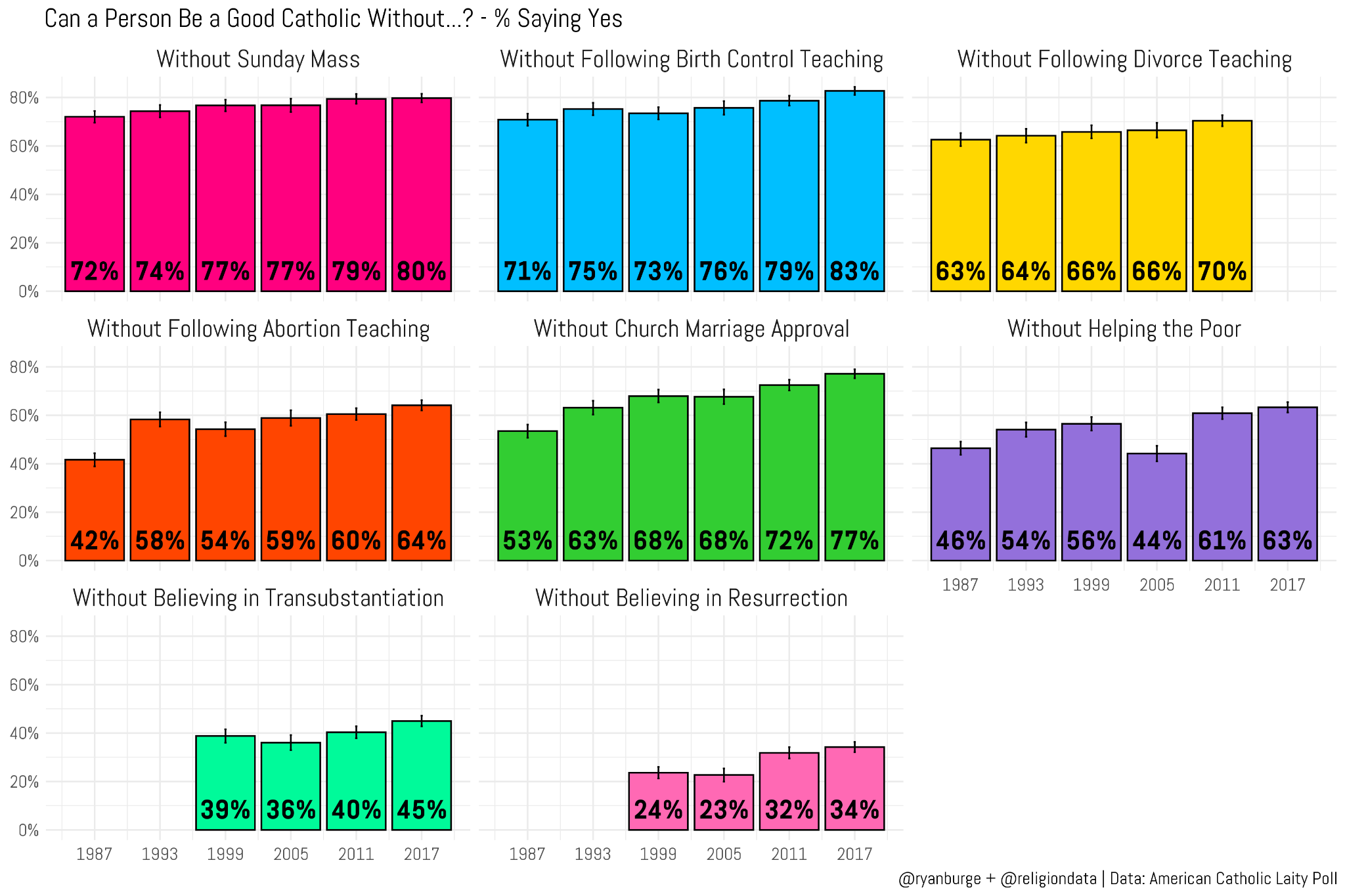
The broad conclusion that I arrive at in looking at the answers to these questions is that the average Catholic has a lot of grace for their brethren. For instance, 80% of Catholics believe that someone could be a good Catholic without going to Sunday Mass. An even larger share (83%) says that good Catholics can ignore the Church’s teachings on birth control. There’s also not a lot of appetite for boundary maintenance around the issue of divorce and remarriage. At least 7 in 10 Catholics seem unbothered about fellow Catholics bucking the Magisterium here.
There are just two issues where Catholics draw the line, and they are both theological matters. For instance, just 45% of Catholics believe that you can be a good Catholic and reject the teachings of the Church regarding what happens when the priest blesses the elements. The Church believes in transubstantiation—the idea that the bread and wine literally turn into the body and blood of Jesus Christ. The other doctrine that is a bridge too far is a belief in the resurrection of Jesus. Two-thirds of Catholics say that one cannot be a good Catholic and reject the Easter story.
But what happens if we break it down into those two attendance categories, though? (Also keep in mind that not every one of the questions above was asked in 1987 and 2017, so some were excluded).
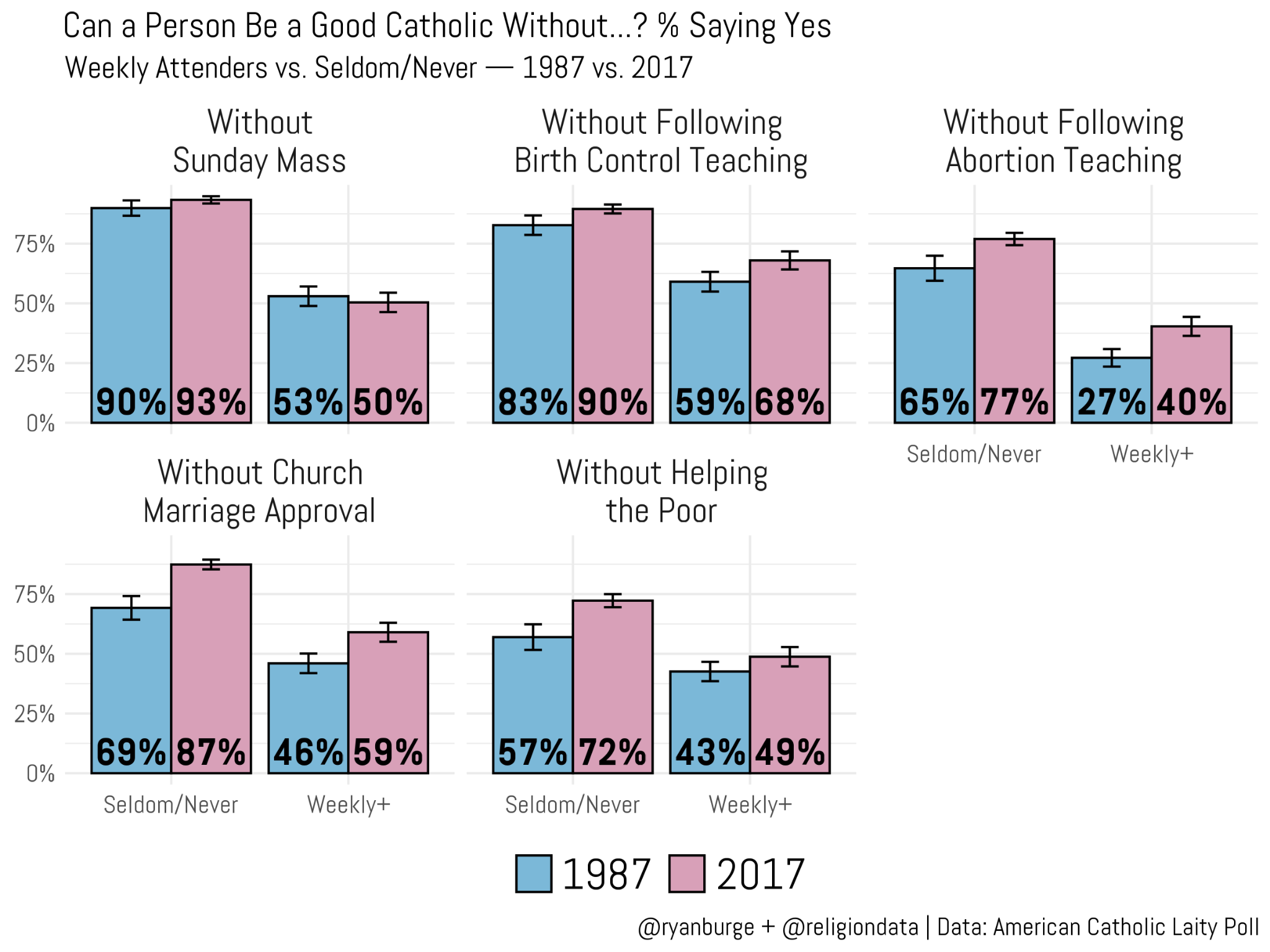
It’s certainly the case that weekly Mass attenders engage in stronger boundary maintenance than those who don’t attend so frequently. The gaps on many of these questions are 30-40 percentage points. When it comes to Mass attendance, half of the most devout Catholics believe that an individual can not go to church on Sunday and still be considered a good Catholic. That was true in 1987 and 2017. But on other issues, weekly Mass attenders seem to favor a larger Church, even if it’s less obedient to the Catholic hierarchy.
For instance, among weekly Mass goers in 1987, only 27% of them said that a good Catholic can reject the Church’s teaching on abortion. In 2017, that number had risen to 40%. There was a thirteen point jump in the share of who said that good Catholics can get remarried without seeking an annulment, too. There was a nine point increase around the topic of birth control, as well.
I just don’t get the impression that the most devout Catholics have gotten more “hardcore” about boundary maintenance in the last thirty years. In fact, the data points in the exact opposite direction. The boundaries have actually become more blurry and circumstantial. That finding stands in sharp contrast to the picture that emerges from the loudest voices in religious life today.
If one spends any time in religious corners of social media, the impression that emerges is that devoutly religious people have become strident and often belligerent over time. They often fight about what would appear to be obscure or esoteric parts of theology or worship practice. It’s easy to believe that these purists are indicative of the larger religious movement.
This data strongly rejects that notion. Among Catholics, even the ones who go to Mass every week, they seem more willing to reject the Church’s teachings on a number of controversial topics. And they are not willing to cut people off from the Catholic Church even if individuals hold views that fall outside of mainstream Catholic thought.
In other words - Twitter/Facebook/TikTok/Instagram are not real life.
Code for this post can be found here.
Ryan P. Burge is a professor of practice at the Danforth Center on Religion and Politics at Washington University.

People always talk about "cultural Jews", but there are "cultural Catholics" in the same way. That doesn't exist in the same extent in the Protestant denominations. Even if young lay Catholics don't go to church, they would feel comfortable going on Christmas and Easter. Meanwhile, I do not know if young WASP adults could elucidate what an Episcopalian or a Presbyterian is.
Recently, Pope Leo talked about how those speaking on behalf of the Church need to be less obsessed with "pelvic theology," and talk more about the many, many other moral teachings of Catholicism.
I'm struck by the absence of any topics other than "pelvic theology" in this polling about American Catholics' obedience to the Church's moral teachings. I'd love to see, for instance, the percentage of Catholics who think you can be a good Catholic without following the Church's teaching on helping the poor or opposing unjust wars, for instance.
Now, I'm one of those unrepresentative yammery converts that you read so much about, so of course I'm going to assent to what the Magisterium says on the transubstantiation or birth control or what have you; that's what I signed up for. But a key reason why I converted is because of the Church's teachings on social justice, not because of the teachings on divorce--and I know I'm not alone here.