


There are roughly 1.3 million Seventh-day Adventists in the United States. That’s not a small number — it’s larger than the Episcopal Church and not far behind the Presbyterian Church (USA). And yet, when scholars and journalists talk about American religion, Adventists rarely come up. They exist in a kind of demographic blind spot, too big to ignore but somehow consistently overlooked. You can probably guess where this post is going, right?
I’ve actually given several talks to the SDA crowd and I really enjoy hanging out with them. Wonderfully warm folks who have a real appreciation for the data. A couple of months ago, I got invited to speak to a gathering of Seventh-day Adventists in Alabama and I did a bunch of data analysis of the SDA data. And like almost every smaller religious group I’ve encountered, they were extremely pleased to see some charts, graphs, and maps about their specific tradition. I got an email a couple of weeks ago from a reader who asked me if I could pull together some information on Seventh-day Adventists, so I grabbed some stuff from that presentation and thought I would lay out some really interesting patterns I am seeing.
What 12 Denominations Tell Us About American Christianity

I am running a holiday special - 20% off an annual subscription to this newsletter. That brings the cost down to just $48 per year. Take advantage by clicking this button:
First, just a bit of background on the Seventh day Adventist movement. The SDA church traces its roots back to the mid-1800s, arising from the Millerite movement, named after William Miller, a prophet who believed that Jesus Christ would return to earth in short order. From the aftermath of that failed prophecy, a number of groups spun off, including what would become the Seventh-day Adventist Church. The SDA denomination has a few distinctives: worship on Saturday rather than Sunday, a strong emphasis on health and diet (a significant share of Adventists are vegetarian), and a robust global missionary infrastructure that has made them one of the fastest-growing denominations worldwide. They also operate one of the largest hospital systems in the United States - AdventHealth.
Let’s just start this whole thing by giving you a sense of the size of Seventh-day Adventists.
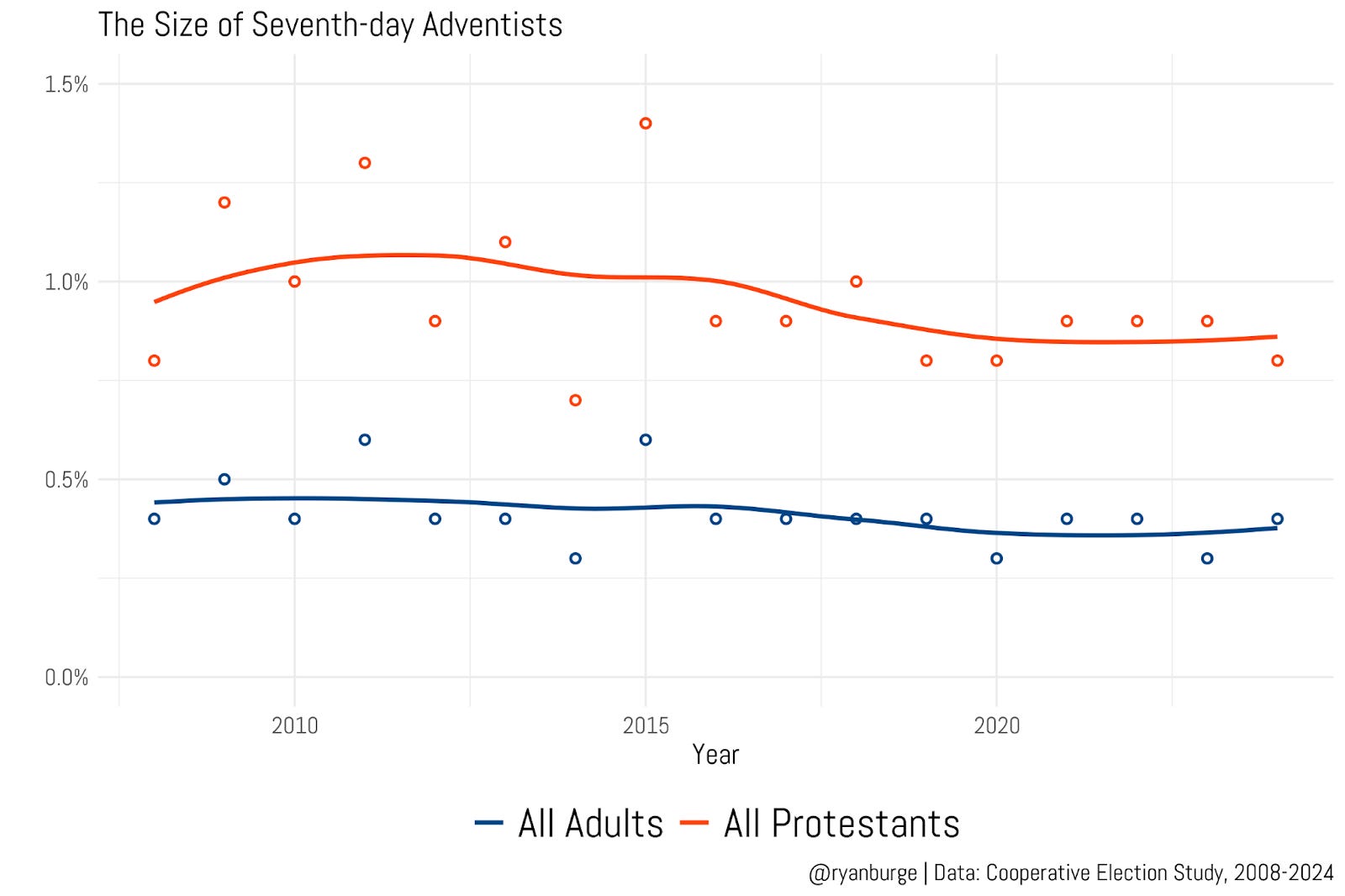
The data here is remarkably consistent - somewhere between .3% and .5% of all adults in the Cooperative Election Study identify as SDAs. I think there’s some evidence here that the trend line is moving in the downward direction, but I wouldn’t stake my career on that claim. When you are dealing with a group that is this small, it doesn’t take much to send a trend line downward. In fact, it probably only takes 20-30 fewer respondents identifying as Seventh-day Adventists (out of a sample of 60,000) to move the overall trends.
Of course, it’s always nice to have a type of “reference case” to compare the SDAs. They are about the same share of Americans as Hindus. They are likely half the size of Latter-day Saints or Muslims. And for every Seventh-day Adventist there are three Jews in the United States. So, pretty small in the grand sweep of American religion.
There’s another way to get at the size estimate, though: the Religion Census. It just goes to individual religious denominations and asks for a copy of their membership records. That provides another way at figuring out just how large they are compared to other well known religious groups.
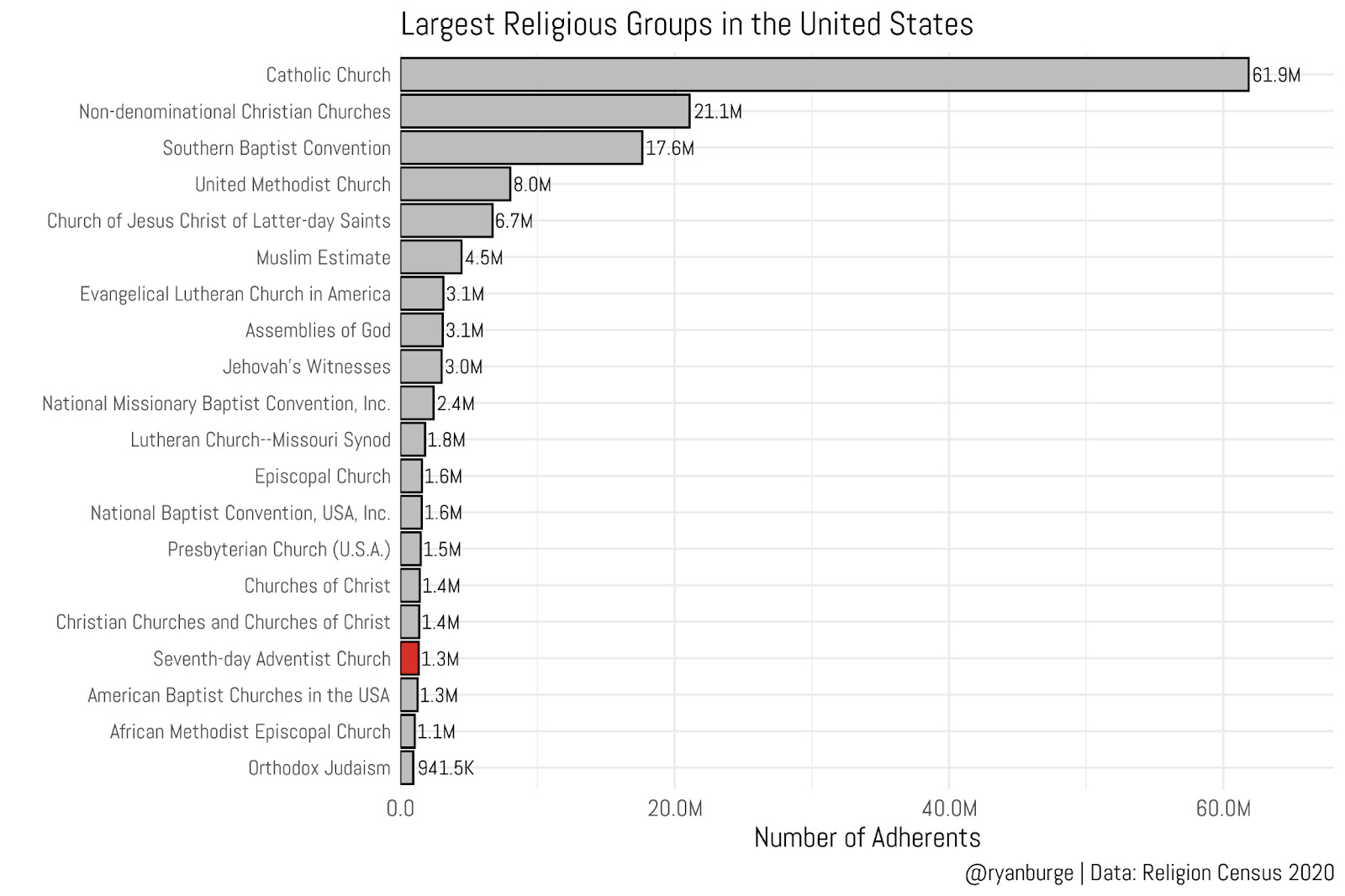
Obviously the Catholic church dominates. I’ve written about this plenty. There are nearly 62 million Catholics in the United States. The non-denominationals are listed at 21.1M, but I’m almost certain that’s an undercount. About 14% of all Americans identify as non-denominational. That works out to 35-40M folks. Then we have the Southern Baptists and United Methodists below that.
But if you take your eye down to the bottom half of the graph you can see a whole bunch of denominations that are tightly clustered between 1M and 1.8M. You’ve got a lot of the most widely discussed groups here: Missouri Synod Lutherans, Episcopalians, PCUSA and American Baptists are all pretty similar in size. This is exactly where the SDAs land: 1.3M members back in 2020. They are essentially the same size as most mainline denominations. Again, not tiny, but also not that consequential in our larger understanding of Protestantism.
But where are Seventh-day Adventists in terms of geography? Let me show you one way to visualize this and then another way. I think both are helpful to get a more accurate picture of this religious group.