



This post has been unlocked through a generous grant from the Lilly Endowment for the Association of Religion Data Archives (ARDA). The graphs you see here use data that is publicly available for download and analysis through link(s) provided in the text below.
If you’ve ever taken a sociology course in college, there’s a good chance that the instructor spent at least a little bit of time talking about the power of symbols in a society. They can be nothing more than a single word or just a short phrase that can convey a world of meaning, purpose, and solidarity.
I found an incredibly funny video about the power of symbolic ritual on Twitter the other day.

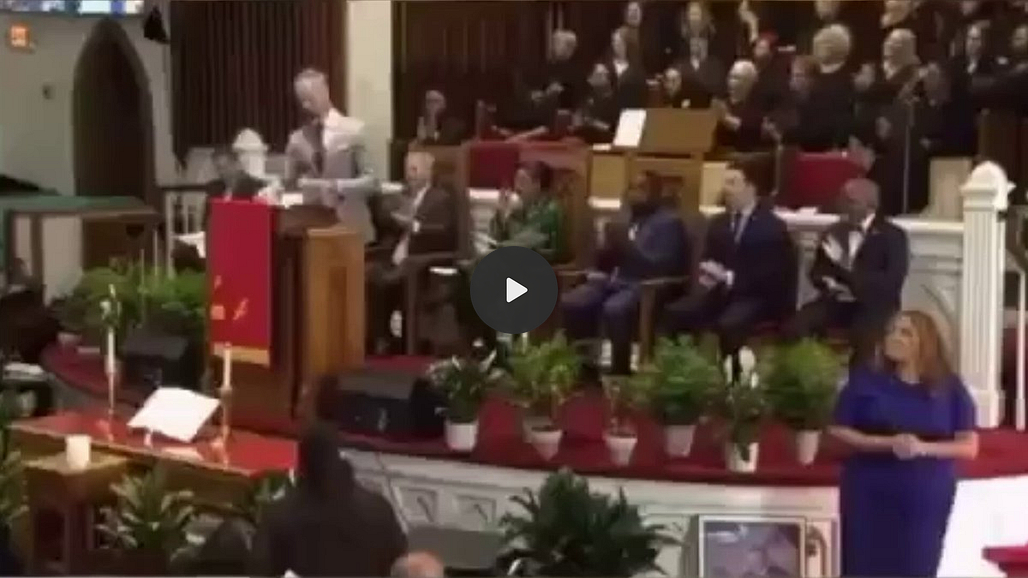
For those who can’t watch, a white politician was giving a speech in a Black church in Raleigh, North Carolina, and he casually said, “God is good.” The entire congregation responded, “All the time.” He didn’t know what to do at that moment. Later, one of the leaders of the church got up and instructed him how to finish the symbolic chant. After the congregation says, “All the time,” the speaker must say “All the time,” and the congregation responds with “God is good.” It may be the most frequently repeated phrase in many Black churches.
This is a symbol of shared identity. Rituals like that make the congregation feel unified and give the speaker a sense of dialogue with the crowd, not just a monologue. It’s a subtle but incredibly powerful feature of group dynamics.
Which Religious Groups Are Most—and Least—Likely to Get Tattoos?

This post has been unlocked through a generous grant from the Lilly Endowment for the Association of Religion Data Archives (ARDA). The graphs you see here use data that is publicly available for download and analysis through link(s) provided in the text below.
But symbols aren’t just words—they can be tangible objects. A tree or a building can convey an incredible amount of meaning by its sheer existence. In the world of politics, symbols are all over the place. One of the most visible manifestations is often a flag. It’s nothing more than a piece of brightly colored fabric that often hangs on a pole, but it has the power to convey history, pride, and unity all in just a 3-foot by 5-foot square. When that flag is unfurled before a basketball game, people stand up, put their hand on their hearts, and often sing along with the National Anthem. That moment has a lot in common with the aforementioned call and response in the Black church.
Those symbols can sometimes be contentious, though. When I was browsing through the recent additions to the Association of Religion Data Archives database, I came across a new dataset from PRRI called the Religion and Public Spaces Replication Survey. It contained a battery of questions that really piqued my interest because it was about the symbology of the American Confederacy.
There was a list of five examples given to respondents, and they were supposed to indicate whether they were “more a symbol of Southern pride or more a symbol of racism?” One was about the Confederate Flag. Another asked about monuments to soldiers who fought in the Confederacy. Here’s how the entire sample felt about each of the reminders of the Civil War.
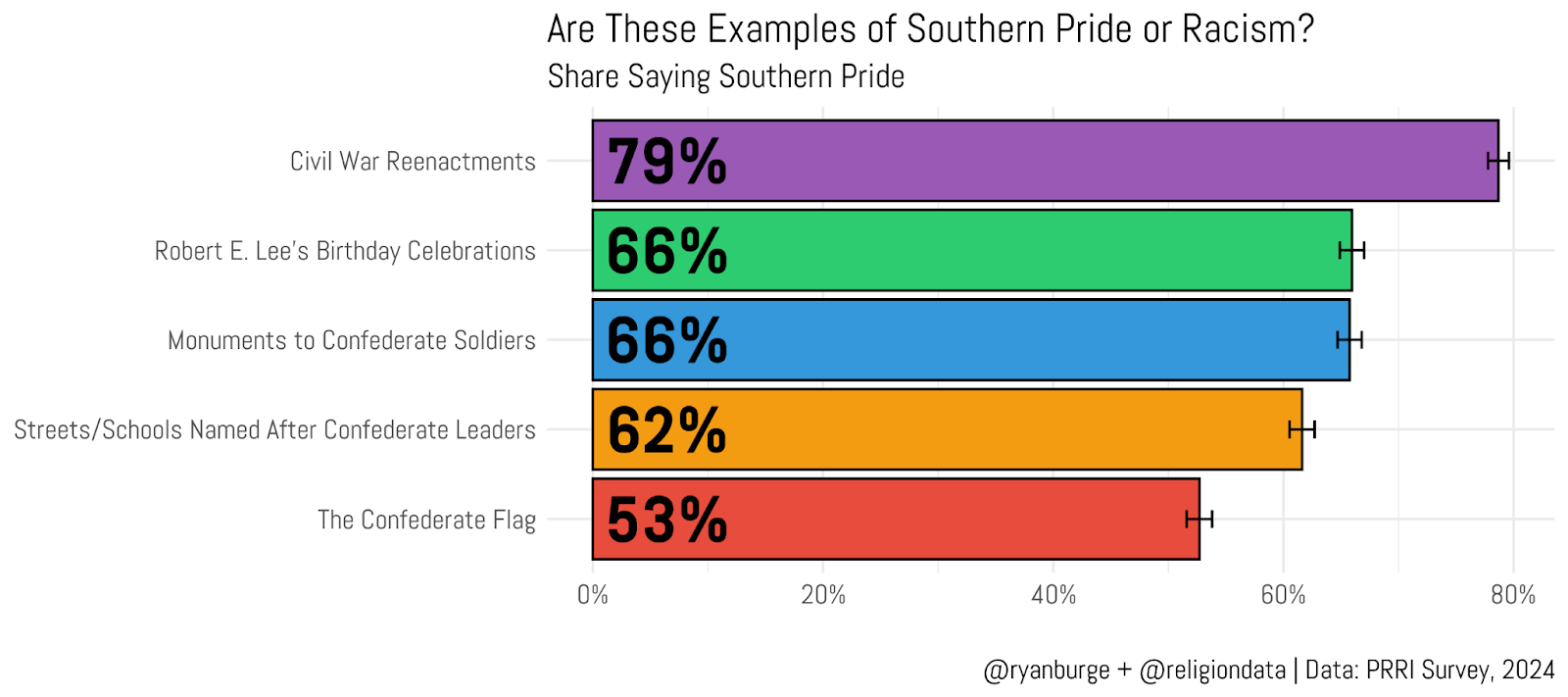
The first thing that must be pointed out is that a majority of Americans disagree that each of these are a symbol of racism. I think that’s an important finding from this survey—there are not majorities of Americans who believe that monuments to Confederate soldiers are inherently racist. In fact, just one in three adults embraces that viewpoint. The same share indicates commemorating the birthday of Confederate General Robert E. Lee is a racist activity. In fact, over three-quarters of Americans see no problem with Civil War reenactments.
There’s really only one symbol here that divides the American public when it comes to remembering the Civil War, and it’s the most straightforward one: displaying the Confederate Flag. In the full sample, 53% of respondents believed that it was nothing more than an indication of Southern Pride and thus was not inherently racist. Because of the margin of error, the most accurate description of this data is that the “Stars and Bars” evenly divides America on whether it’s a symbol of racism or not.
I found that breaking the sample down into a handful of the largest religious traditions was really helpful to see how opinion varies in these five instances.
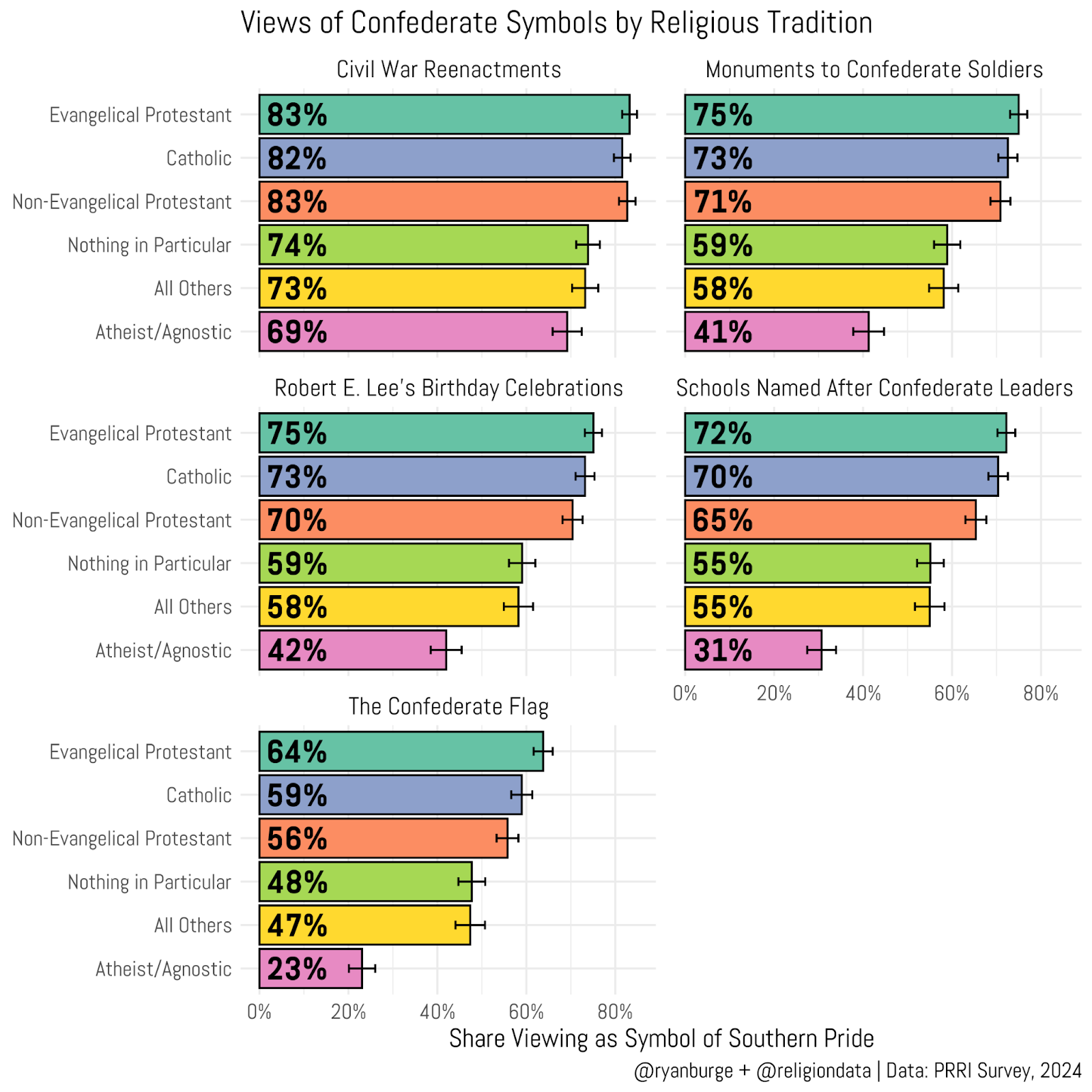
The first thing I must point out is that there is very little resistance to folks engaging in Civil War reenactments. I don’t think anyone is shocked by the fact that 80%+ of Christians see it as Southern Pride, but what was a bit more intriguing was that nearly seven in ten atheists/agnostics took no issue with this activity. Given their political inclinations toward progressivism, this level of support was not at all what I expected.
I should point out, though, that this is the only issue where a majority of atheist/agnostic folks chose “Southern Pride” over racism. A significant majority of them believed that monuments to Confederate soldiers were an example of racism, and basically the same share objected to celebrating Robert E. Lee’s birthday. When it came to displaying the Confederate Flag, over three-quarters of atheists/agnostics said it was a symbol of racism.
Speaking of that question, it’s clearly the most likely to generate mixed feelings of this entire battery of survey statements. Among evangelicals, about two-thirds believed that the Confederate Flag was an example of Southern Pride. It was 59% of Catholics and 56% of non-evangelical Protestants. Given the divided opinions on this specific question, I wanted to make it the focus of the rest of the post.
I wondered if age played some kind of role in this debate. I know that when I was growing up in rural Southern Illinois in the 1990s, I would encounter the “Stars and Bars” every once in a while on a classmate’s truck or in their garage. Those kinds of sightings have become more infrequent as I’ve grown older, and it made me wonder if it’s just fallen out of favor with the younger set.
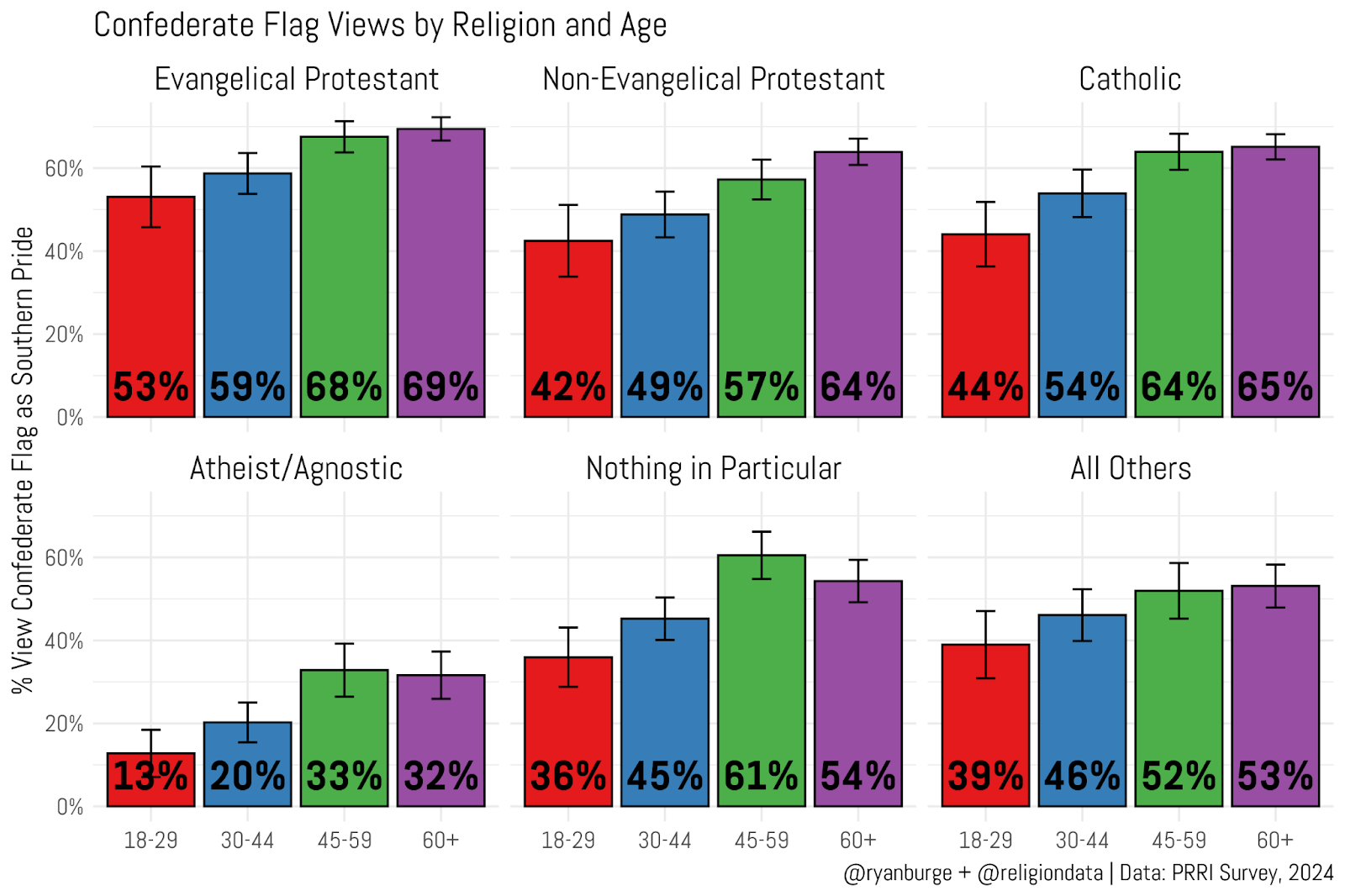
The data is crystal clear on this point: younger Americans are much more likely to say that the Confederate flag is a symbol of racism compared to their older counterparts. In the full sample, just 39% of 18-29 year olds chose the “Southern Pride” option compared to about 60% of respondents who were 45 or older. So, there’s definitely a generational difference in this data.
You can also see it when broken down by religious tradition. Among younger evangelicals, 53% see the flag as denoting Southern Pride. That’s about ten points higher than young adult Catholics and non-evangelical Protestants. But you see that same stair-step pattern across the top row—each successive age bracket is more accepting of the Confederate Flag compared to the previous one.
Among atheists/agnostics, acceptance is just lower across the board. There’s no group that is more likely to say that the flag is racist than young atheists/agnostics—nearly 90% of them hold that position. But even among those who are in their sixties or seventies, just one-third believe that the flag is a symbol of Southern Pride.
If you’ve been following along with this newsletter for a while, you know that there’s a latent variable here that’s probably doing quite a bit of the “work” in driving views of the Confederate flag: political ideology. So, let me address that now.
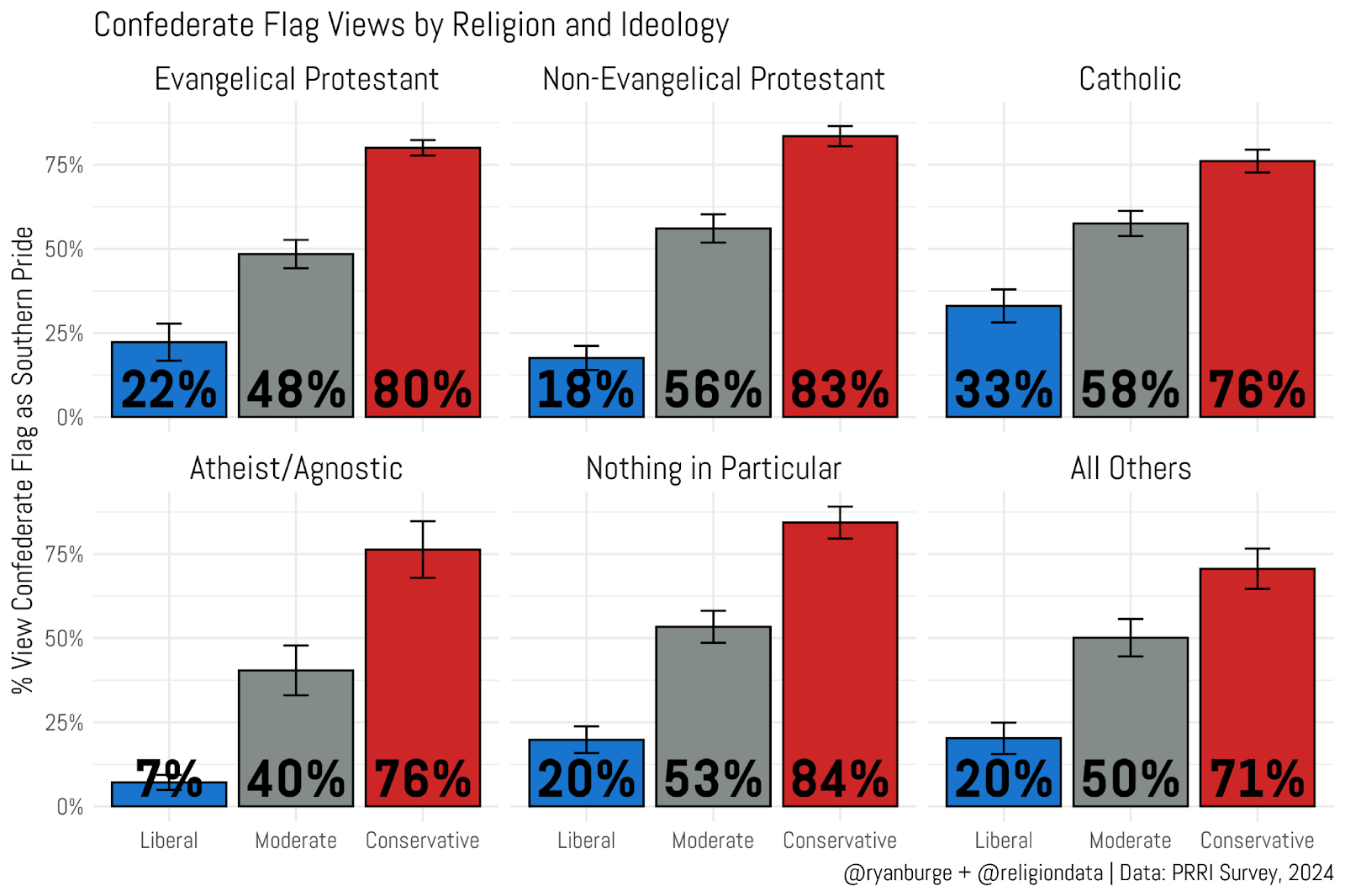
You can absolutely see the huge political divide on the symbolism of the Confederate flag in this graph. In the total sample, just 19% of liberals said that the Confederate flag was just a manifestation of Southern Pride; for conservatives, it was sixty percentage points higher. Among moderates they were nearly perfectly divided: 53% chose the Southern Pride option.
But those divides manifest even more when adding religious tradition to the mix. I do need to point out one oddity in this data, though. The one that really jumped out to me was liberal Catholics. One-third of them said the Confederate Flag was Southern Pride. That was eleven points higher than any other liberal group in the data. But then only 76% of conservative Catholics took the same stance, which was near the bottom of support. I just don’t know what to make of that, really.
Overall, however, these results tend to shake out the way one would expect: liberal atheists are more likely to see the flag as a symbol of racism than other liberal groups.
Now, I know what some of you are thinking right now—”Ryan has left out the most important variable of all when it comes to an analysis like this.” And you would be right. We most certainly can’t explore views on Confederate symbols without taking into account the location of the survey respondent. Folks who are living in the South probably have a different perspective than those who are living in the Northeast or the West.
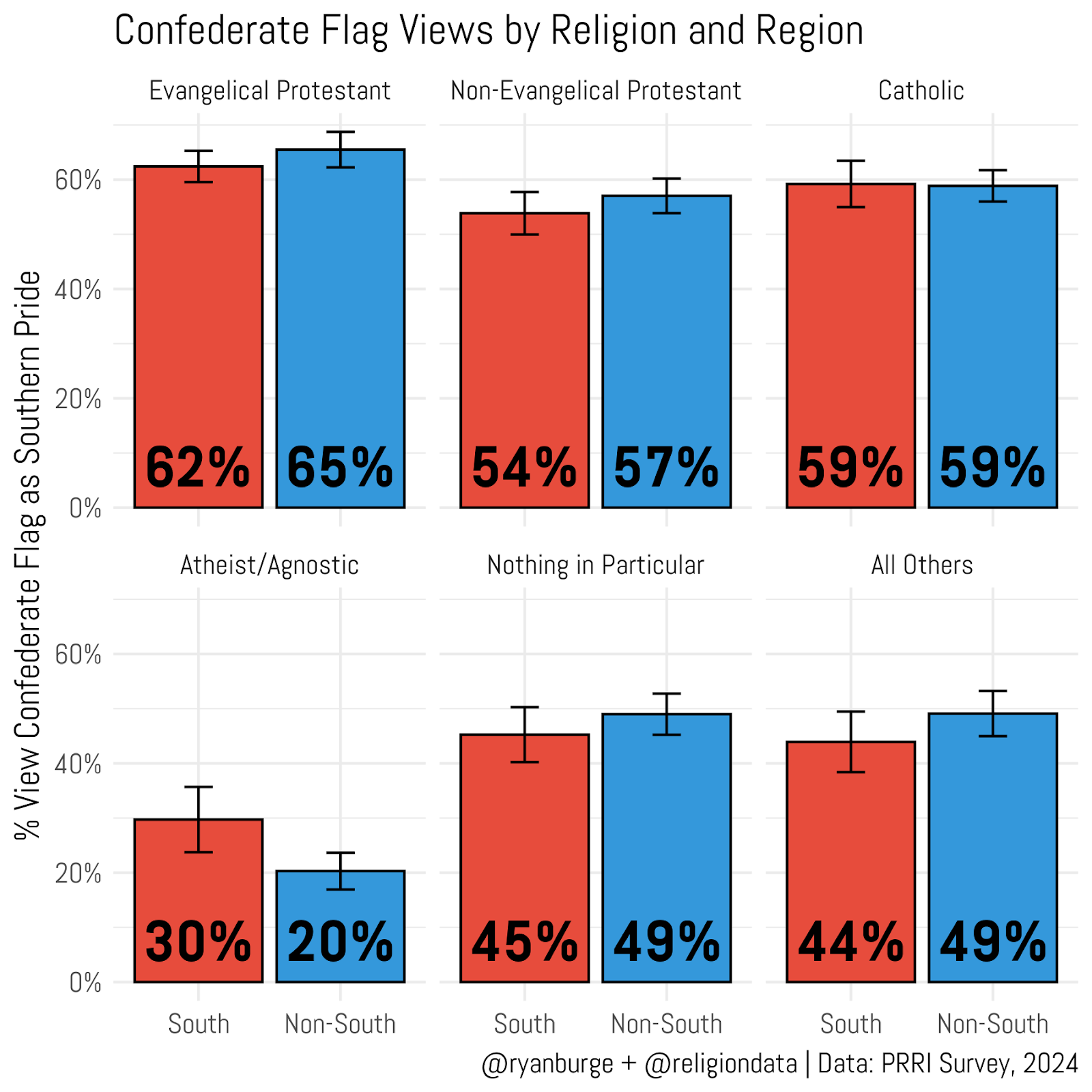
But guess what? Region actually didn’t matter all that much in this data. In the full sample of 5,784 respondents, the difference was not statistically or substantively significant. Among folks living in the South, 54% believed that the flag was a symbol of Southern Pride. For those living in any other region, it was 52%. The confidence intervals overlap, too. That was a real shock to me.
You can see that lack of difference when breaking the sample down into religious tradition, too. Among Catholics and Protestants, there’s no statistically significant difference between those living in the South and those living anywhere else on the question of the symbology of the Confederate Flag. In fact, there was only one group where the error bars didn’t overlap: atheists/agnostics. For those living in the South, 30% believed that the Confederate Flag was a symbol of Southern Pride compared to 20% of those living anywhere else. I guess I need to do some more digging into Southern atheists in a future post.
I’ve thrown a lot of variables at you so far: religion, age, ideology, and region. However, each bit of analysis is not controlling for the other variables. Let’s fix that now. I specified a regression model with all the usual suspects as controls: ideology, age, education, gender, race, and income.
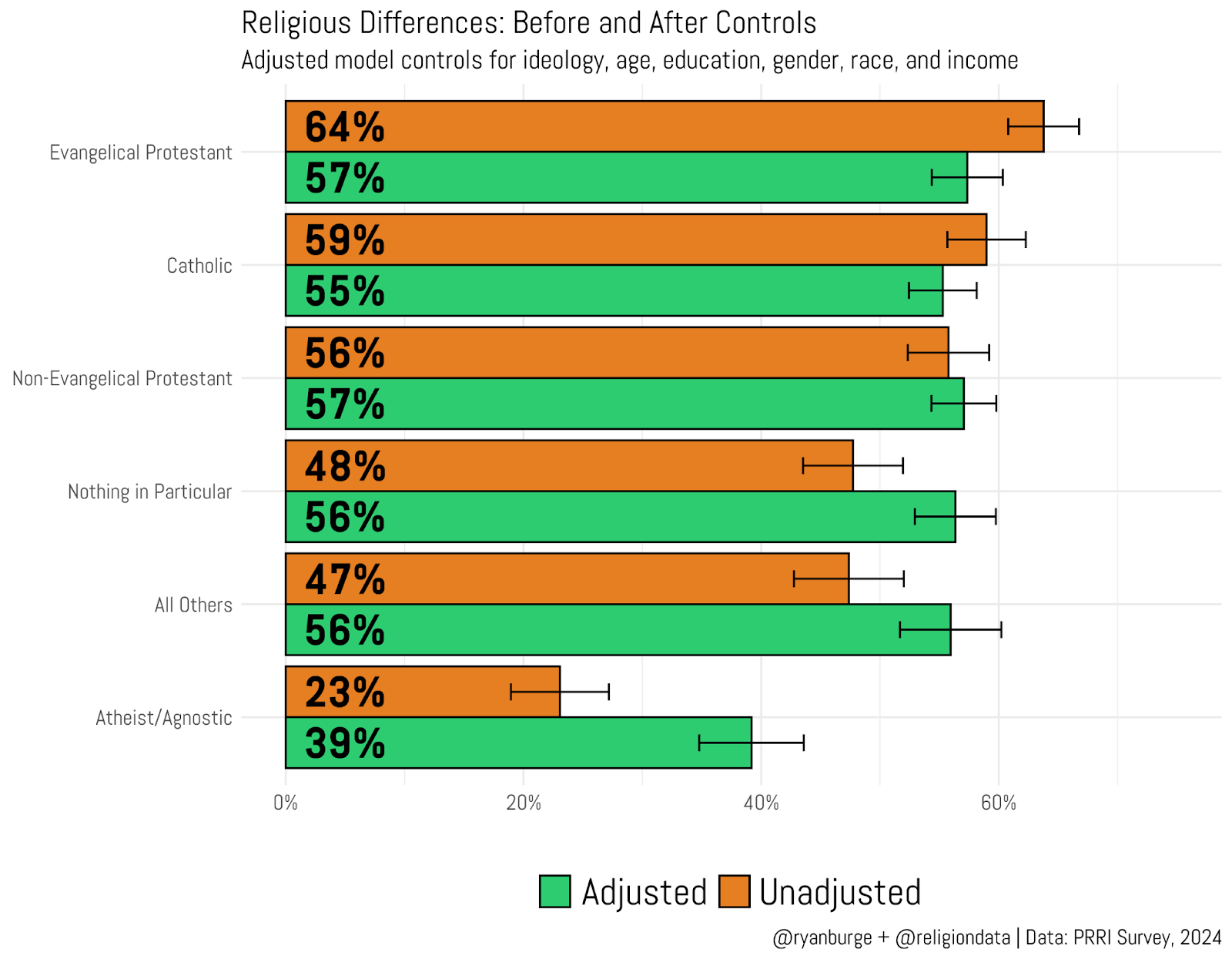
The unadjusted numbers are just the simple percentages I showed you above—I’m not controlling for anything there. The adjusted numbers are controlling for all those factors that I just listed. They essentially are showing us, “What would the percentage be if all religious groups had the same ideology, age, education, gender, race, and income distribution?”
How Do Home Schooled College Students Compare to Those From Public Schools?

I grew up in a pretty conservative Southern Baptist Church in rural southern Illinois. I was there three of four times a week, on average, during my four years of high school. Our youth group was this odd mish mash of all kinds of kids. I had gone to Sunday School with some of them from the time we were in the nursery. Others were just there because the…
For instance, among white evangelicals, you can see that the adjusted number is about seven points lower than the unadjusted statistic. This means that ideology, age, etc. are really what are driving up the support for the Confederate Flag. For atheists/agnostics, things go the other way—the adjusted support is much higher. Why? Well, it’s because their political liberalism is “holding down” their support for the Confederate Flag. If their ideology, age, education, etc. matched the general public, support would rise about sixteen percentage points.
Here’s what we learned from this regression: Religious differences in Confederate flag views are largely driven by ideology and demographics, not religion per se. If an evangelical and an atheist have the same ideology, age, education, etc., their views of the flag wouldn’t totally converge, but they would come much closer together.
I think we can put this in the category of “It’s not religion that’s doing the work here, it’s almost certainly politics.” Clergy are not frequently talking about the power of symbols like the Confederate Flag or the legacy of racism in the country. (A paper published in 2021 found that just 3% of sermons addressed the topic of civil rights). When they aren’t doing that, something else has to fill the void. For most Americans, it seems like politics is doing the work.
Code for this post can be found here.
Ryan P. Burge is a professor of practice at the Danforth Center on Religion and Politics at Washington University.

What did the numbers around different races show?
I think this is a case where phrasing the questions impacts the data. I could envision people saying that a confederate flag is both a symbol of southern pride and or racism. As for myself I see it more of a symbol of treason.