


Here’s one of the things that I have become more and more convinced of the longer I look at trends in American religion – you can’t convert your way out of a shrinking congregation. There are traditions who make this a point of emphasis, of course. The Church of Jesus Christ of Latter-day Saints has, in my mind, the most robust missionary network of any religious group in the history of the world. They send young men and women out across the globe to try and convert new people to the LDS church. I’m sure you’ve seen them before, wearing the black pants and the white shirts with the name tags.
How successful is that program? Well, it depends on who you ask. The Church’s own report is that each missionary baptizes about 4 new converts per year of service. But how many of those converts “stick”? A report (PDF) in 2022 indicated that only 30% of those new converts are actually still engaged in the church 12 months after their baptism. So a missionary working full time for a year may actually yield a single new convert. That’s not a great ROI.
Inertia Still Rules American Religion

Just a reminder — my book The Vanishing Church was released about two months ago. If you like the content you see on this newsletter, then you will love the book.
But here’s the brilliance of the LDS missionary program – retention. The chief aim of such an apparatus is not to bring that many new people into the faith. Instead, the goal is to keep young men and women deeply rooted in the church at a time in their life when we know religiosity tends to wane.
Retention is the most important metric for any church or denomination. Having kids and keeping them as active members as they age into adulthood is the most important thing a faith community can do to sustain itself for decades into the future.
That leads me to the question that drives today’s post: what factors in a child’s life make them more likely to stay committed members of their faith? The Pew Religious Landscape Survey asks all kinds of good questions about a respondent’s childhood in regards to religious attendance, religious importance, etc.
Start with the most basic question – if a child was raised in any type of religious faith, what’s the likelihood that they identify with any faith community as an adult?
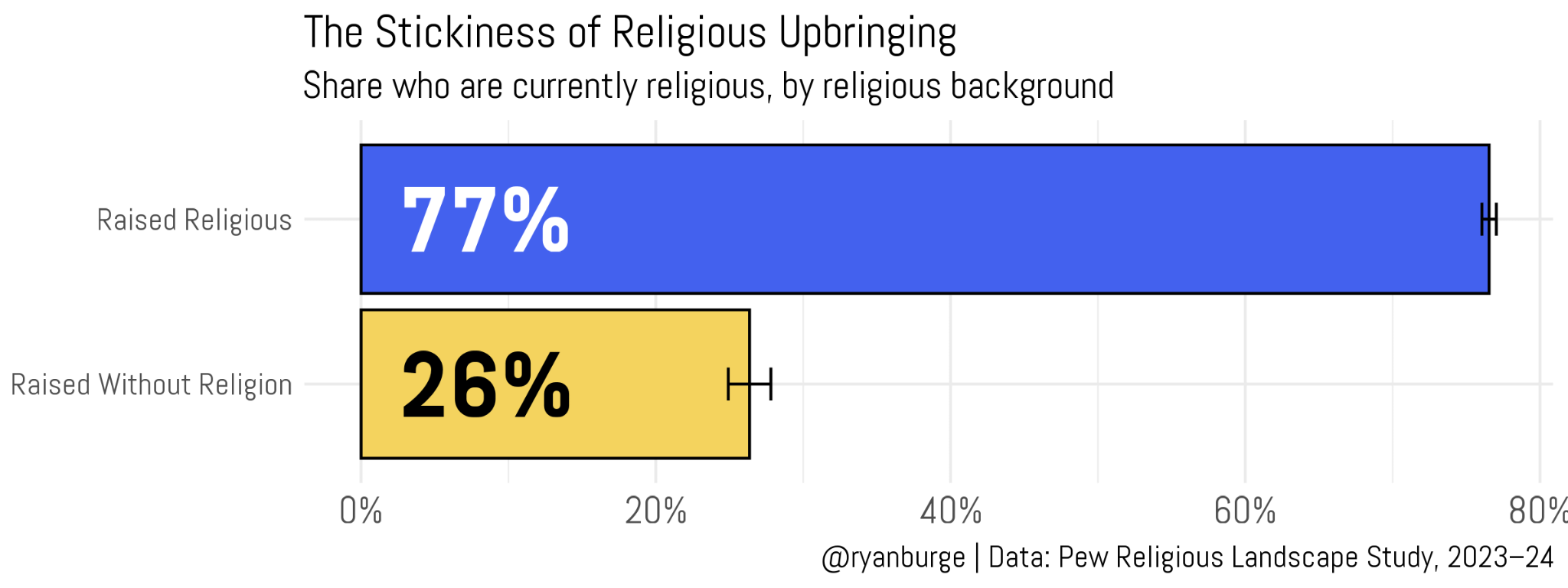
The data points to this simple fact: if a kid is raised as a Protestant, Catholic, Jew, Muslim or any other faith tradition, the likelihood of them identifying as non-religious is pretty small. In the Pew sample, 77% of folks raised as religious are still religious as adults. Only one in four kids who were raised religious end up as adult nones.
What about the converse of that – folks who were raised non-religious who end up joining a faith community later in life? That number is just 26%. The “retention rate” is about the same for both groups. Three quarters of kids raised religious are still religious, and three quarters of kids raised without a faith background will be non-religious as adults. Inertia runs in both directions equally — the secular household is just as effective at producing secular adults as the religious household is at producing religious adults
There’s an old line from Proverbs that keeps coming to mind, “Train up a child in the way he should go; even when he is old he will not depart from it.”
That said, not all religious upbringings are equal. One question asked people to reflect on how important religion was to their family when they were growing up.