


Just a reminder — my book The Vanishing Church was released about two months ago. If you like the content you see on this newsletter, then you will love the book.
And if you’ve read the book (and hopefully liked it), would you please consider leaving a review on Amazon? It helps with sales. And, thanks as always, for all your support, in whatever fashion.
Are you the same religion right now as the one you were raised in? I bet for readers of my newsletter, “switching” is probably a whole lot more common than among the public at large. Why do I make that assumption? Well, all you wonderful folks who manage to find your way here are not just a random sample of all Americans. Religion has to matter to you at some deep level. Which means you are, statistically speaking, outliers.
The more I look at data, the more I’m convinced that this is not the median American. In fact, when it comes to something so basic as whether an individual is retained in the religion of their youth, what I’ve come to conclude is that inertia may be one of the most powerful forces in the social world. It’s just easier to stay the same than it is to change.
So, then, we just have to assume that religious switching is a process that takes work, and many folks just don’t have some kind of burning desire to seek out a different faith tradition. And we won’t judge that here, okay? That’s something I want to make exceedingly clear—I don’t begrudge anyone for not thinking about religion that much. It’s a huge part of my life, but that doesn’t mean that the way I think about the world is the only way (or the best way) to consider my humanity. Everyone can just live their life however they want, and it’s my job to try and make sense of that.
How Many People Leave Their Childhood Religion?

Being an academic is an exercise in the absurd. That’s what I’ve realized after doing this for the better part of two decades. For instance, I have devoted thousands upon thousands of hours to trying to untangle a very difficult puzzle: when people are asked about their current religion on surveys, what is the mental process they go through to arrive at…
And making sense out of how often people change their religious affiliation is what we are going to do today, along with where they manage to land. Let’s get to the graphs.
What I wanted to do to start was trace retention at the highest level possible. I did this by separating the sample into the three largest groups: Catholics, Protestants, and the non-religious. These three combine for about 90% of all Americans. The way that I can generate this analysis is that the General Social Survey asks both about current affiliation as well as the religious affiliation of one’s youth.
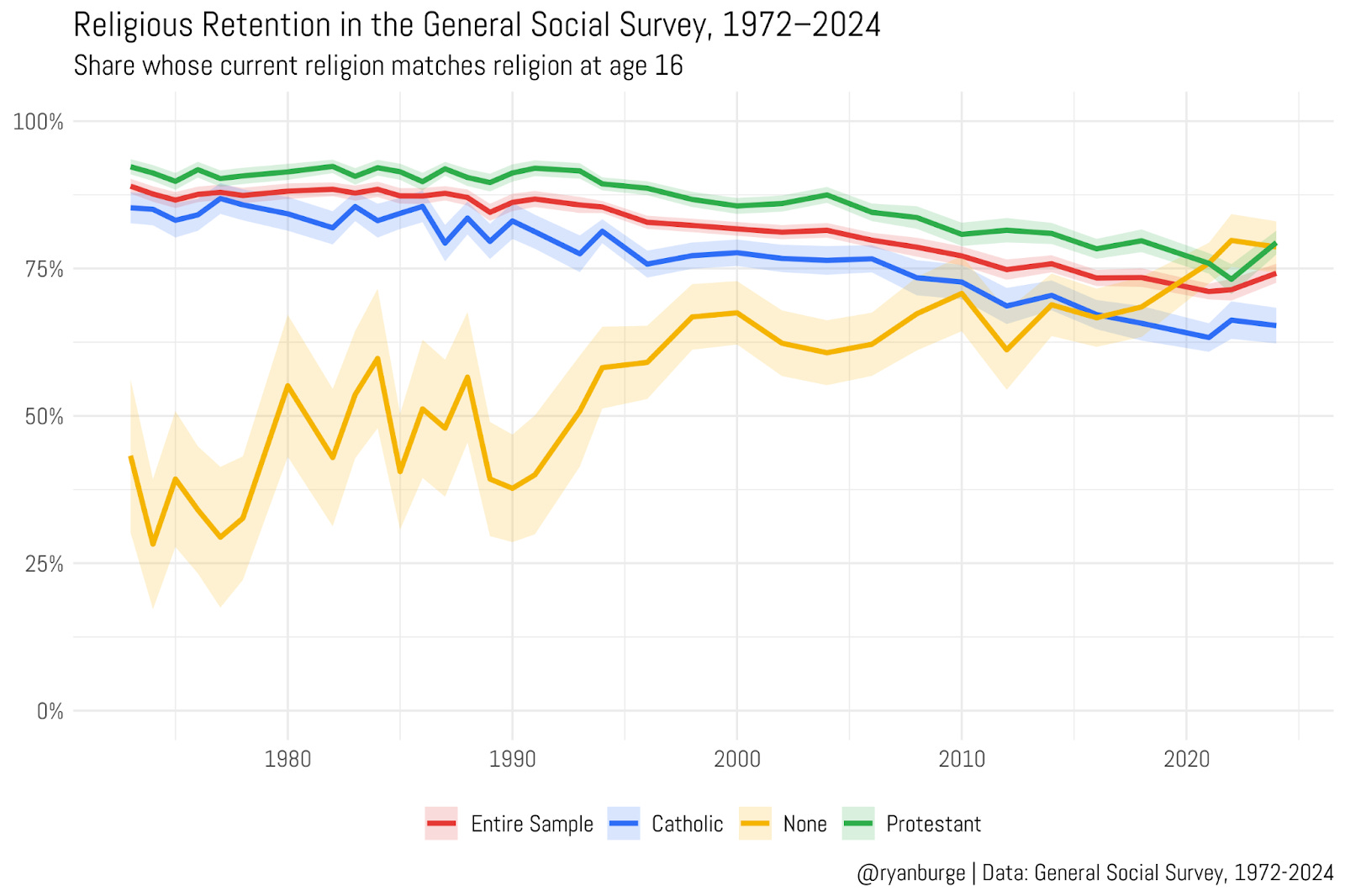
I’ve categorized retention here in a broad way. If someone moves from one type of Protestant to another type of Protestant, that’s not a switch. Here, I’m interested in movement between major religious families, not denominational reshuffling. But if someone becomes Catholic, non-religious, or anything else besides Protestant, that counts as a change in religion.
Using this criteria, the retention rate of the entire sample in 1973 was a whopping 89%. Yup—just about one in ten Americans had changed religions in the early 1970s. Today’s retention number is 74%, which is probably surprisingly high for folks who read this newsletter. If you grabbed four Americans right now and asked if they were still affiliated with the same religion today as the one from their youth, just one would report a change. Inertia is strong!
Given that baseline, it should come as little surprise that the trend lines for the other three groups don’t really dip and dive or rise and fall in some dramatic way. For adult Catholics who took the GSS back in 1973, 85% reported that they were raised in a Catholic household. The data from 2024 indicates that retention has dropped to 65%. That’s a 20-point decline compared to a 15-point drop overall. So we can definitely say that Catholic retention is worse than average.
For Protestants, retention was 92% back in the 1973 data, and it dipped to 79% in the most recent survey. That’s about in line with the national average, but Protestants have consistently been more stable than the baseline.
But the nones are the biggest story here. Back in 1973, just 43% of the currently non-religious were raised in non-religious households. In the 2024 survey, that had jumped to 79%—exactly the same retention rate as Protestants. In other words, being raised non-religious is incredibly predictive of being non-religious as an adult.