


If you hang around a college campus long enough, you quickly begin to realize that a lot of the stereotypes are true, especially on the faculty side of things. Every college has a whole bunch of “deadwood.” These are professors who got to full professor about ten years ago and just stopped doing anything more than the bare minimum. They are just counting down the days until they retire. And then you’ve got the “reformer.” This is a faculty member who was hired right out of grad school and has big plans for how to change the curriculum or the educational goals or something else that’s very service related. They typically burn out before they get to tenure review because the pace of change in academia is absolutely glacial.
There are also a ton of tropes about which departments tend to have the most liberal and conservative faculty. I know that when I was at EIU, the folks who led the faculty union almost always came from the humanities departments (particularly English and History). In contrast, the professors in the business school had next to nothing to do with the rest of the university. They had the nicest cars, the most up-to-date building, and the lowest level of union membership.
Higher Education on Trial: Religion, Politics, and Public Doubt

This post has been unlocked through a generous grant from the Lilly Endowment for the Association of Religion Data Archives (ARDA). The graphs you see here use data that is publicly available for download and analysis through link(s) provided in the text below.
That got me wondering if the students can sort of suss those things out when it comes to choosing their college major. Do the Alex P. Keaton types know that they should gravitate toward a degree in finance, while the more hippy inclined students know that they can find a lot of like minded individuals in the arts? I get asked all the time if more religious students tend to cluster in one type of major vs another and I’ve not really been able to answer that question with any real specificity until now.
The Foundation for Individual Rights and Expression (FIRE) has been doing an annual survey that I just love because its focus is squarely on college students. The most recent version has a sample size in excess of 68,000, and they are drawn from more than 400 institutes of higher learning spread throughout the United States. There’s a section of the survey that asks students to indicate their major, with about fifty possible options.
Let me just start by showing you the basic religious composition of the twenty-five largest majors according to this dataset. I tried to sort this where the least Christian majors are at the top and the most Christian ones are at the bottom.
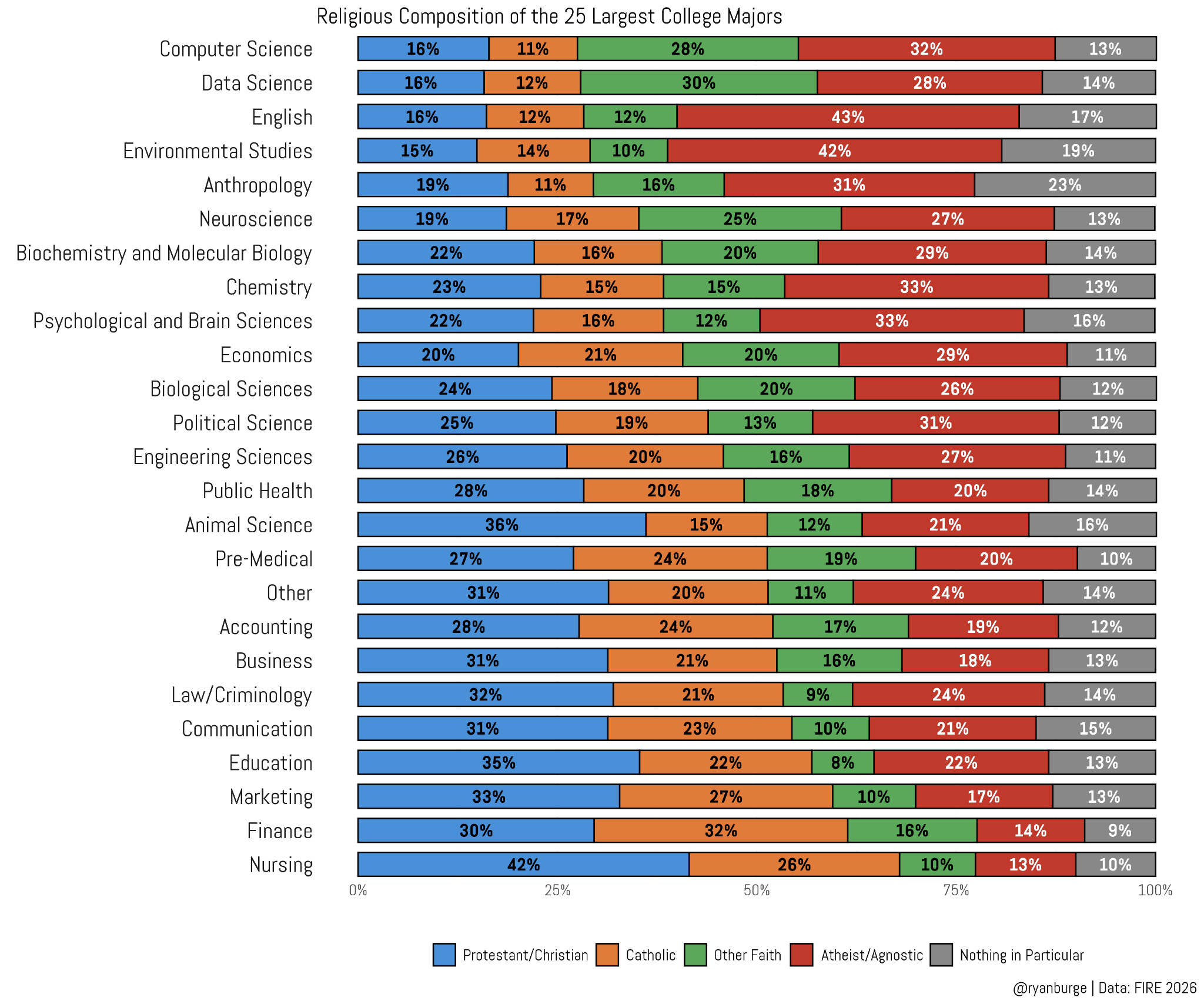
The two most “teched up” majors are the least Christian: data science and computer science. Just 27-28% of these folks identify as Protestants, Catholics, or generic Christians. In contrast, about 30% say that they are atheist/agnostic and another 13% are non-religious. In other words, they are about fifteen points more apt to be nones than Christians.
But they actually aren’t the most likely to be strictly atheist/agnostic. There are two majors who clearly lead in this regard: English and Environmental Studies. In fact, Environmental Studies is the most secular of all with 61% of students claiming that they are atheist, agnostic, or claim no religion in particular. English is at 60% on this metric.
What majors are at the bottom of the list? Well, there are two that are clearly outliers: Finance and Nursing. Among the latter group, 68% identify as Protestants, Catholics, or generic Christians. It’s 62% among the Finance majors. For each group, less than a quarter are non-religious. You can see quite a bit of “business” adjacent majors near the bottom of the list, things like marketing, general business, and accounting are all fairly religious.
Of course, I can’t provide all the nuance that I want in just a simple bar graph. For instance, I bet some of you are guessing that a lot of those computer science majors are actually Hindus, Muslims, or Buddhists and you would be correct in that. Those types of majors tend to be popular among immigrant students.
To provide even more granularity, here’s a sortable table to poke around this data a whole lot more.
The hunch about how computer science/data science students are more likely to be Hindus is absolutely confirmed in this table. In fact, those majors have more Hindus than Catholics. There are lots of fun little oddities to explore in the table (like one third of Finance majors are Catholics). So, have fun with that.
Let’s move on to religious attendance now.
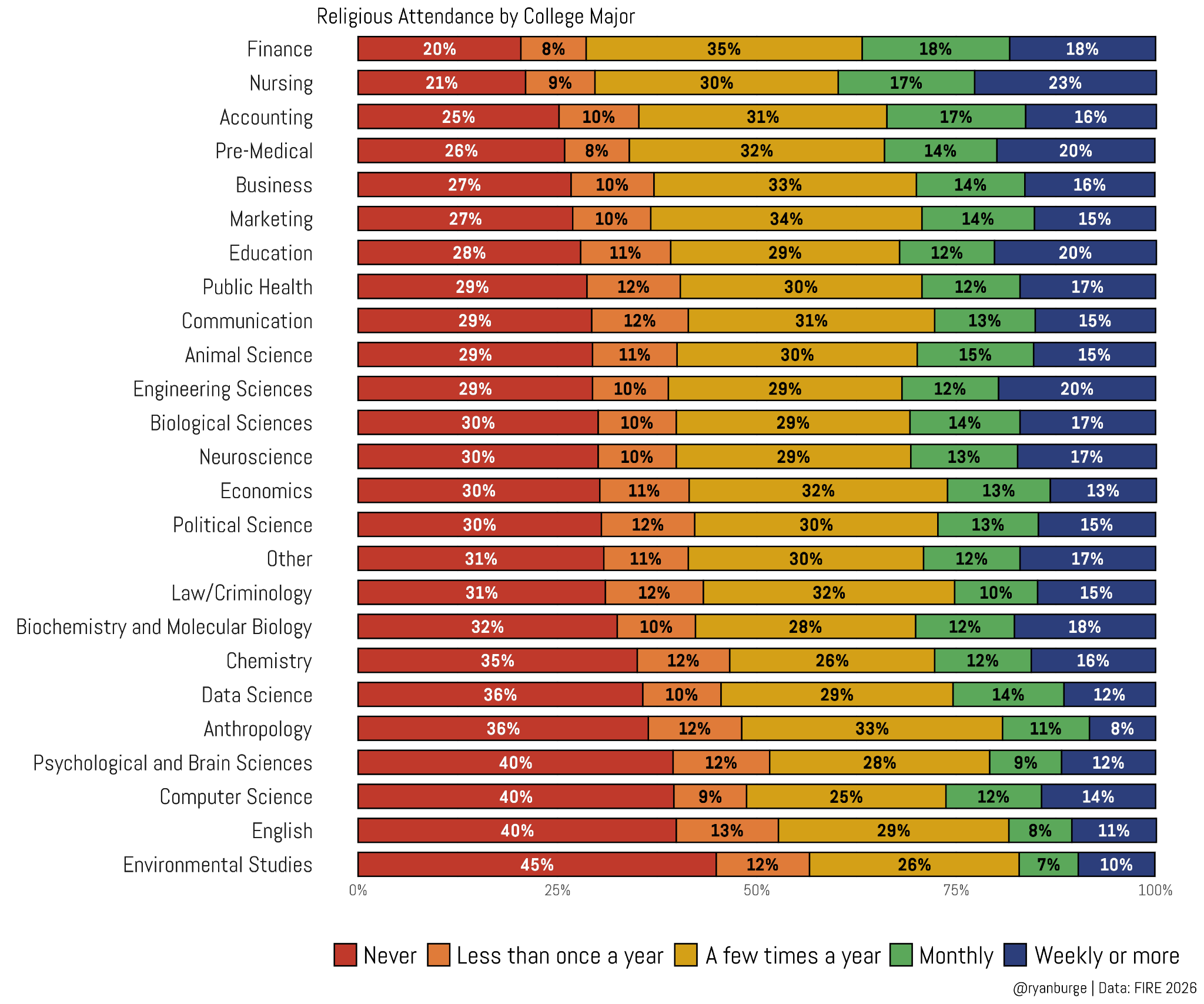
I sorted this so that the groups that they were the least likely to never attend were up top and we see basically a repeat of the findings from the first graph: Finance and Nursing are some of the most religiously active majors on college campuses. In fact, no one goes to church more than aspiring nurses: 23% are attending weekly or more. That’s more than double the rate of the full sample (10% weekly attenders).
You shouldn’t be surprised to see those English and Environmental Studies folks at the bottom here, either, based on what we observed in the previous analysis. A majority of both groups say that they attend a house of worship less than once a year. What I did find notable is Anthropology majors. Just 8% were weekly attenders - that’s the lowest I can find.
But you get a clear impression from this graph that college students are not a particularly religious group, overall. If you pick a random major the chances of sitting next to a non-church goer is at least twice as likely as sitting next to a student who attends on a regular basis.
Let’s combine both these metrics now into a single scatter plot. The x-axis is the share who never attend religious services and the y-axis is the share who have no religious affiliation. I also added several more majors to the list, I included all those with at least 100 respondents. I also color coded them by general disciplines and the size of the circles is related to the number of respondents in the sample.
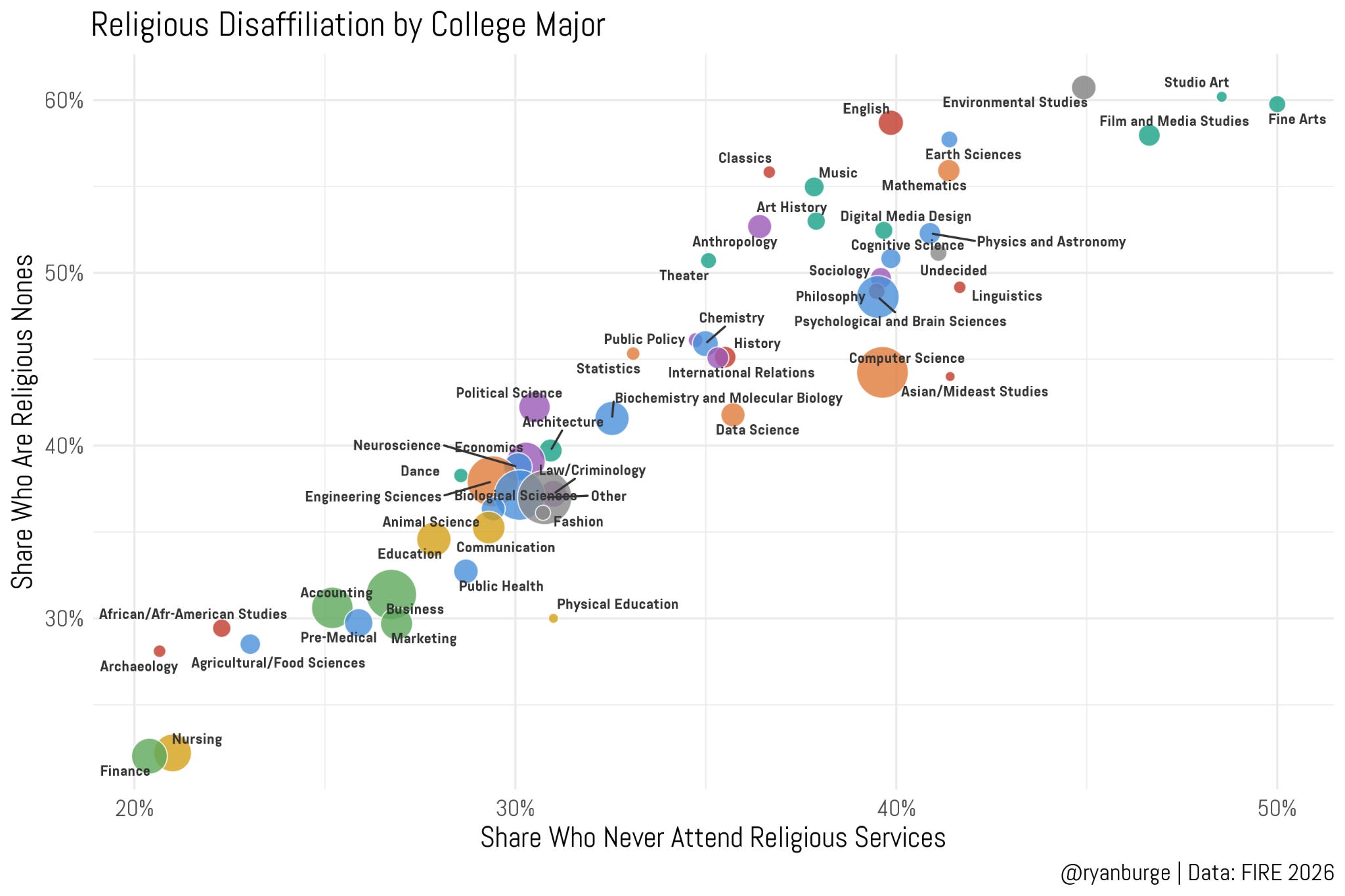
It’s pretty amazing how well these two metrics track each other, right? I mean it does make sense that the most secular major was also the most likely to have a huge share of never attenders. But it is surprising how there are no real outliers from the trend line.
Who’s in the top right? The performing arts: studio art, fine arts, and film and media studies. I think I can definitively say that this is the most secular discipline in academia. There are also a bunch more of those green circles in that general quadrant, too: music, art history, and digital media design. But there are a number of other disciplines, too: English, Environmental Studies, Math, and Earth Science jump out. A strange combination, right?
What about the bottom left? Well, it’s a whole bunch of students in the business school. You can see a lot of darker green circles: Finance, Accounting, Business and Marketing. But also nursing, as we’ve discussed earlier. However, there are some interesting outliers, too. Archaeology and African-American Studies are down in this quadrant. Pre-Med being in this part of the scatter plot is also very intriguing to me.
Now, I do feel like I am only showing you one side of the coin here. It’s been all religion to this point—belonging and behavior. But we all know that those two factors are intimately related to political viewpoints. I write about this ad nauseam now, but to be Republican/conservative is to be religious. And the opposite is true for the left side of the political spectrum: there are a whole lot more nones among the ranks of liberals.
Let me just visualize partisanship and ideology across all those majors.
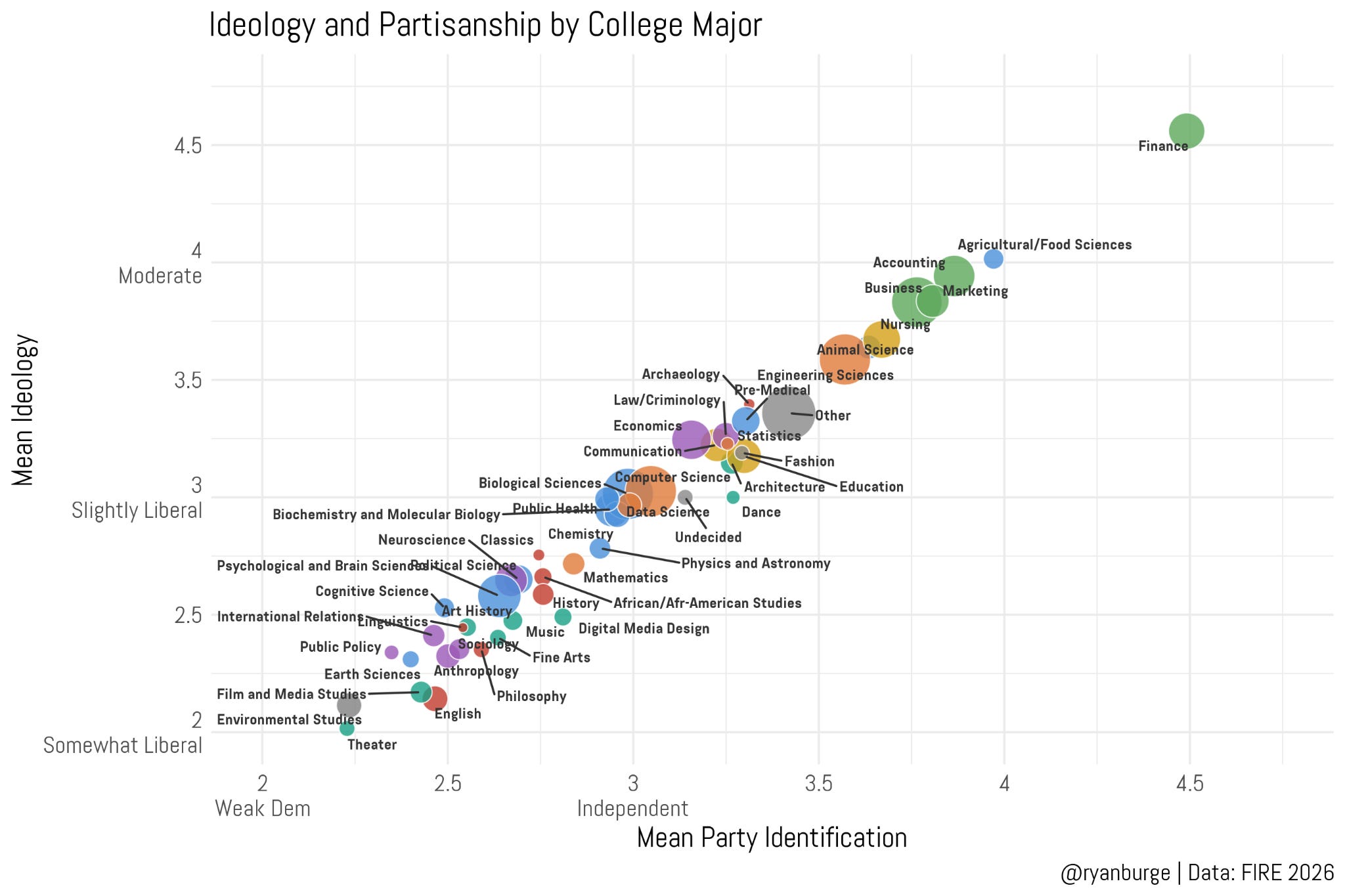
Isn’t it amazing how straight that line is across the diagonal of the plot? Of course ideology is related to partisanship and vice versa but it’s still visually stunning to see just how strong the correlation is between the two factors. There are basically no majors that are significantly above or below the trend line.
There is one clear outlier, though: Finance majors. They are, without a shadow of a doubt, the most right leaning and Republican of any group on a college campus. And by a significant margin, too. They are about half a point away from the next most conservative group: Agricultural/Food Science majors. There are a whole bunch of green circles in the top right, aren’t there?
The bottom left is also a bunch of majors that fit the stereotype: Theatre, Film Studies, English, and Environmental Studies are all pretty far to the left. I also feel like I need to point out that there are a number of purple circles down there—that’s social sciences. Fields like public policy, anthropology, and sociology are all pretty far left of center. Do note, though, that political science is a bit more centrist than those other social science disciplines.
To cap this off, I wanted to throw both religion and politics into a single graph. So I just built an index for each based on the four measures we have discussed previously. I used the most right leaning and the most left leaning majors as the anchor points and I think this does a good job of visualizing the relationship between the two.
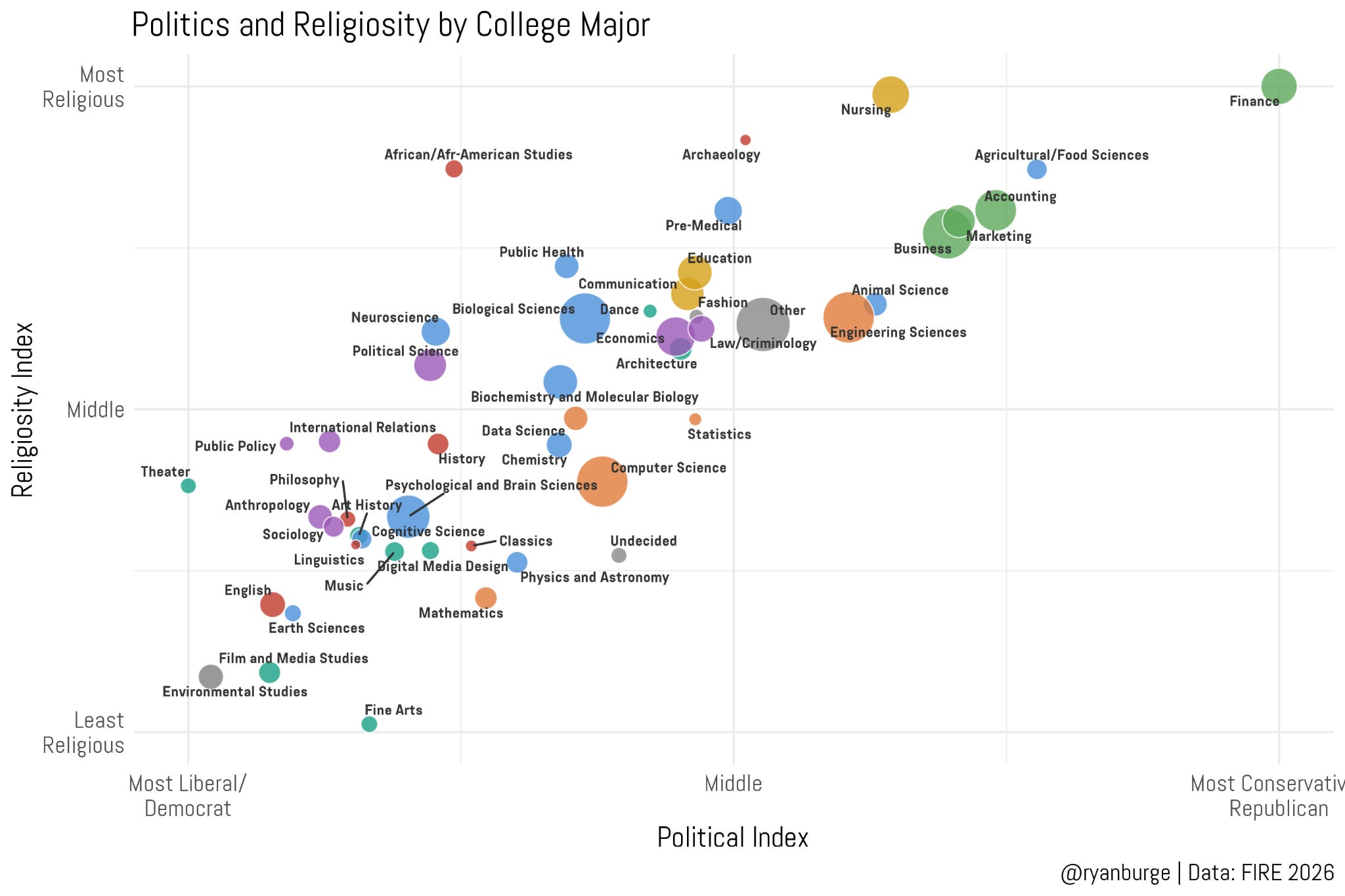
Of course, it’s a bit easy to draw a trend line in this graph but the points are not so tightly clustered around the middle like what we observed in the previous graph. That means that more conservative majors tend to be more religious but there are a number of circles that do deviate quite a bit. For instance, look at nursing. They are one of the most religious majors, but their political views are just slightly right of center. When you compare them to Finance majors you realize that they are just totally different groups of students.
Have the Democrats Lost the Black Church?

One of the most important components of the Democratic coalition is the Black Church. Joe Biden has appeared at a number of prominent Black Protestant churches over the last several years including a recent visit to Mother Emanuel AME Church in Charleston, South Carolina. This congregation is one of the most well known Black Churches in the United State…
African-American studies also deviates from the norm in a way that I could have probably hypothesized. Lots of those majors are Black college students. Which means that they are both left-leaning politically but also pretty religious. That’s why it’s so hard to classify Black Protestants in the larger landscape. They don’t fit neatly into any one box.
There are lots of other things that I can point out on this graph, but I will leave it up to you to pull out the choice bits in the comments.
I love this kind of data because it helps shine a flashlight into a darker corner of social science. We know that some majors on campus tend to be more religious and/or conservative but it’s nice to actually put numbers to our assumptions.
As you can probably guess - there are some majors that fit the stereotype perfectly. There are others that really surprised me. That’s the fun of working with data.
Code for this post can be found here.
Ryan P. Burge is a professor of practice at the Danforth Center on Religion and Politics at Washington University.
Hi, Ryan! I work as a dean and teaching faculty at a small medical school. Before that, I worked teaching nursing students. My own doctorate is from a midwestern medical school. I am not surprised by the relatively high religiosity of pre-med majors, or by the absolute religiosity dominance of aspiring nurses.
I know it sounds like a cliche, but it's really true that the major reason why people want to go into healthcare is because they want to help people, especially people who are in real danger and/or suffering. This is even more true of nursing than it is of medicine, where there are other motivators like prestige, money, and parental pressure that can lead a young adult to want to become a doctor.
I think the causal arrows here can run in a lot of ways, and are self-reinforcing. But it's going to go something like:
God says help people --> I believe in God --> so I want to go into healthcare
-or-
I want to help people --> and that's why I want to go into healthcare and also be part of a church
-or-
I want to go into healthcare --> helping people is so meaningful --> I should be part of a church so I can help people more in my spare time
Another way that this healthcare/religion selection effect becomes self-reinforcing is that religion asks you to do things that are hard, and healthcare is hard, and emotionally harder the further people go in their careers. Healthcare asks you to emotionally invest in people who you will watch suffer and die, over and over again. I honestly don't see how one could have the strength to do this without faith. Nursing students see this earlier in their educational careers than future doctors, and are generally hit harder by it over the course of their careers, too. So I think that for nurses in particular there's going to be a heavy self-selection effect for: God has called me to care for people, and God calls us to do difficult things. But I can do all things through Him who strengthens me. Additionally, among folks with more traditional views on gender roles, nursing is still a feminine profession that doesn't threaten conservative religious views on women's roles.
I have no idea what to say about finance, though.
I love this. It really is fascinating. I'm saving it so I can come back and dig through this. My college years are long behind me but I will say that as much as I can see with this survey historically seems to be true. Just about everyone in my Nursing School dorm went to church on Sunday. I initially didn't (because I was dual enrolled and studied non stop) -until the two sisters next to me poked me to go. I went. I won't elaborate on my attendance post grad, I did however go back to church when I moved back to my home state. I would like to see that gender based survey- so yes, I dare you.