


This post has been unlocked through a generous grant from the Lilly Endowment for the Association of Religion Data Archives (ARDA). The graphs you see here use data that is publicly available for download and analysis through link(s) provided in the text below.
I wanted to make you all aware that the Danforth Center on Religion and Politics has compiled all my 2024 Election Post-Mortems into a single publication. Each of these first appeared on this Substack. But now they are compiled into a single volume.
The graphic design is just AWESOME. They have printed up a bunch of copies that we will be distributing at events at WashU. But there’s also a PDF version. You can download that HERE.
Expect more things like this coming out of the Danforth Center in the future.
There’s this idea that I’ve written about on a number of occasions—religion as a cultural identity. When we’re asked, “Are you religious?” There are a number of different ways someone might justify an affirmative answer. It could be that they attend a house of worship regularly or pray frequently. It could be that they hold specific beliefs about Jesus Christ or Muhammad. Those would be behavior and belief measures of religion. But there’s a third dimension that often gets overlooked: belonging.
Belonging is usually measured with a very straightforward question: What is your present religion, if any? Respondents are typically shown a long list of options—Protestant, Jewish, Buddhist, atheist, and so on—and asked to check a box. But two people can select the same affiliation for completely different reasons.
Take Judaism as an example. Some respondents who check the Jewish box attend synagogue regularly and observe holidays like Yom Kippur and Passover. Others indicate they are Jewish even though they haven’t practiced the faith since childhood. For them, Judaism functions more as a cultural or ethnic identity than a religious one. It’s not really about belief or behavior.
Religion as a Cultural and Political Identity

You know what phenomenon just fascinates me recently? Stolen valor. It’s when people misrepresent their past when it comes to military service. It could be saying that they served in the Armed Forces when they never did. Or saying that they earned medals that were never awarded.
That distinction is hard to tease out in most surveys. Very few instruments follow up with something like, “Did you indicate you were Jewish because your mother is Jewish, or because you actively practice the religion?” But thanks to the Pew Religious Landscape Survey, we now have a way to parse “religious” versus “cultural” identification with much more precision.
Here’s how it works. The ARDA hosts the most recent Religious Landscape Survey, which was conducted in 2023 and 2024. It includes the standard religious affiliation question and sorts respondents into traditions like evangelical, Catholic, and the non-religious. But it also includes a follow-up sequence that asks: “Aside from religion, do you consider yourself to be any of the following in any way (for example, ethnically, culturally, or because of your family’s background)?”
In the case of Judaism, respondents can answer “yes” or “no”—but only if they were not already classified as Jewish in the initial affiliation question. In other words, the survey is effectively saying: I know you said your present religion isn’t Judaism, but do you still consider yourself Jewish in some other way?
And this isn’t just done for Jews. The same follow-up question is asked for Catholics, Hindus, Muslims, and Buddhists.
So what this set of questions allows us to do is compare two things side by side: the share of the sample that affiliates with each tradition using the standard religion question, and the additional share that identifies with that tradition in a cultural or ethnic sense. Let me show you how those two measures line up.
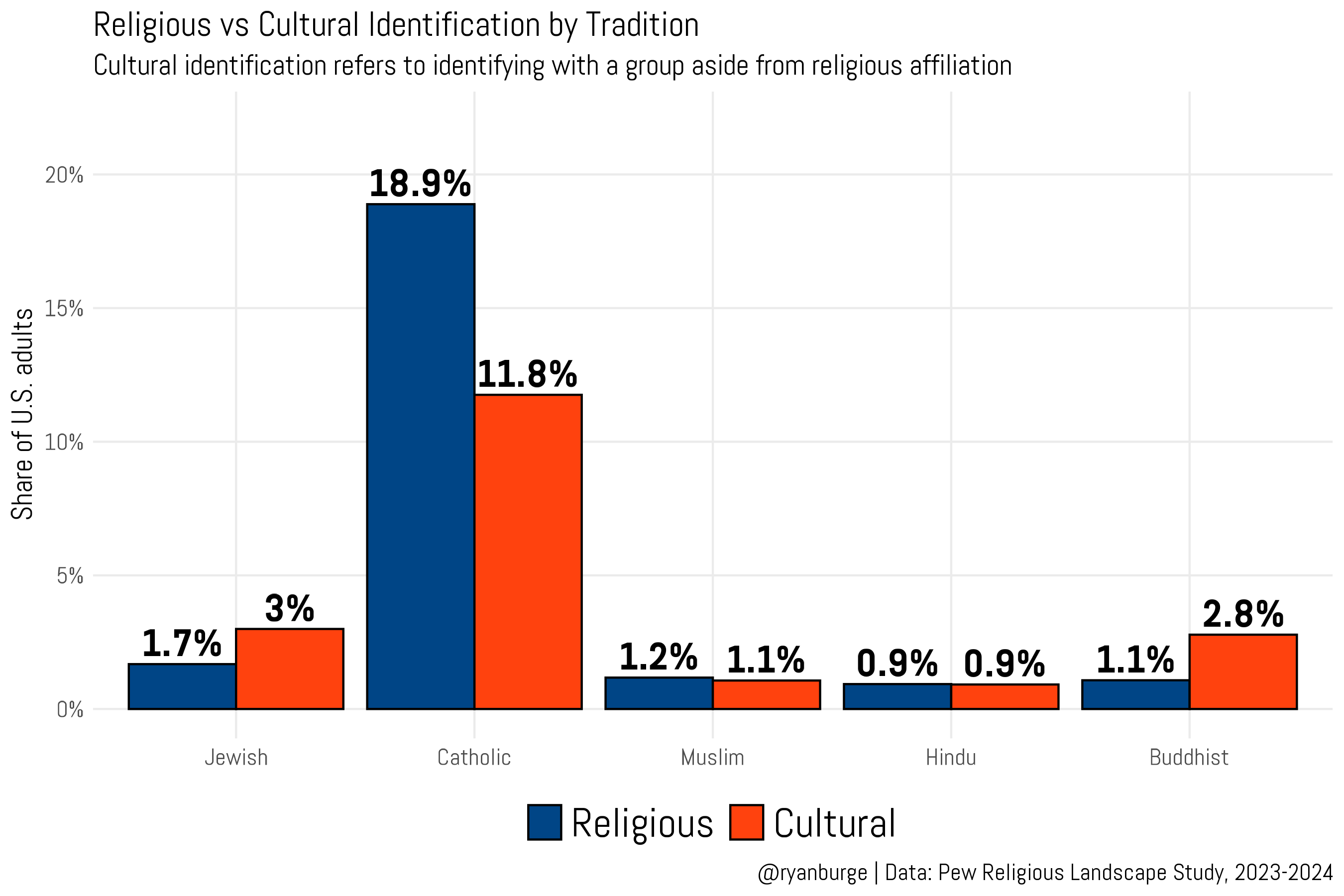
Using the traditional religious affiliation question, about 1.7% of the sample said that they were Jewish. That lines up well with widely accepted estimates of the Jewish population in the United States. But here’s what’s even more fascinating: an additional 3% of respondents answered the follow-up Jewish question in the affirmative.
In other words, for every religious Jew in the United States, there may be roughly two cultural Jews. That might tempt some readers to conclude that Jews make up nearly 5% of the population—but please don’t draw that conclusion from this data. There’s a lot more going on here, and I’ll dig into those complications in a separate post.
For Catholics, the pattern is reversed. There are far more religious Catholics (19%) than cultural Catholics (12%). In fact, Catholicism is the only tradition in this list where the religious share is substantially larger than the cultural share. Taken together, those two figures suggest that roughly 30% of the population identifies as Catholic in either a religious or cultural sense.
As for the remaining three groups, the samples are much smaller, so these estimates should be taken with a grain of salt. For Muslims, the religious and cultural shares are about equal—roughly 1% each. The same is true for Hindus. Buddhism looks a bit different: cultural Buddhism is considerably more common than religious Buddhism (2.8% versus 1.1%).
That said, for the remainder of this analysis I’m going to set these three groups aside. The sample sizes are simply too small to support more detailed breakdowns.
Instead, let me show you how this “religious versus cultural” divide looks when broken down by age—for both Catholics and Jews.
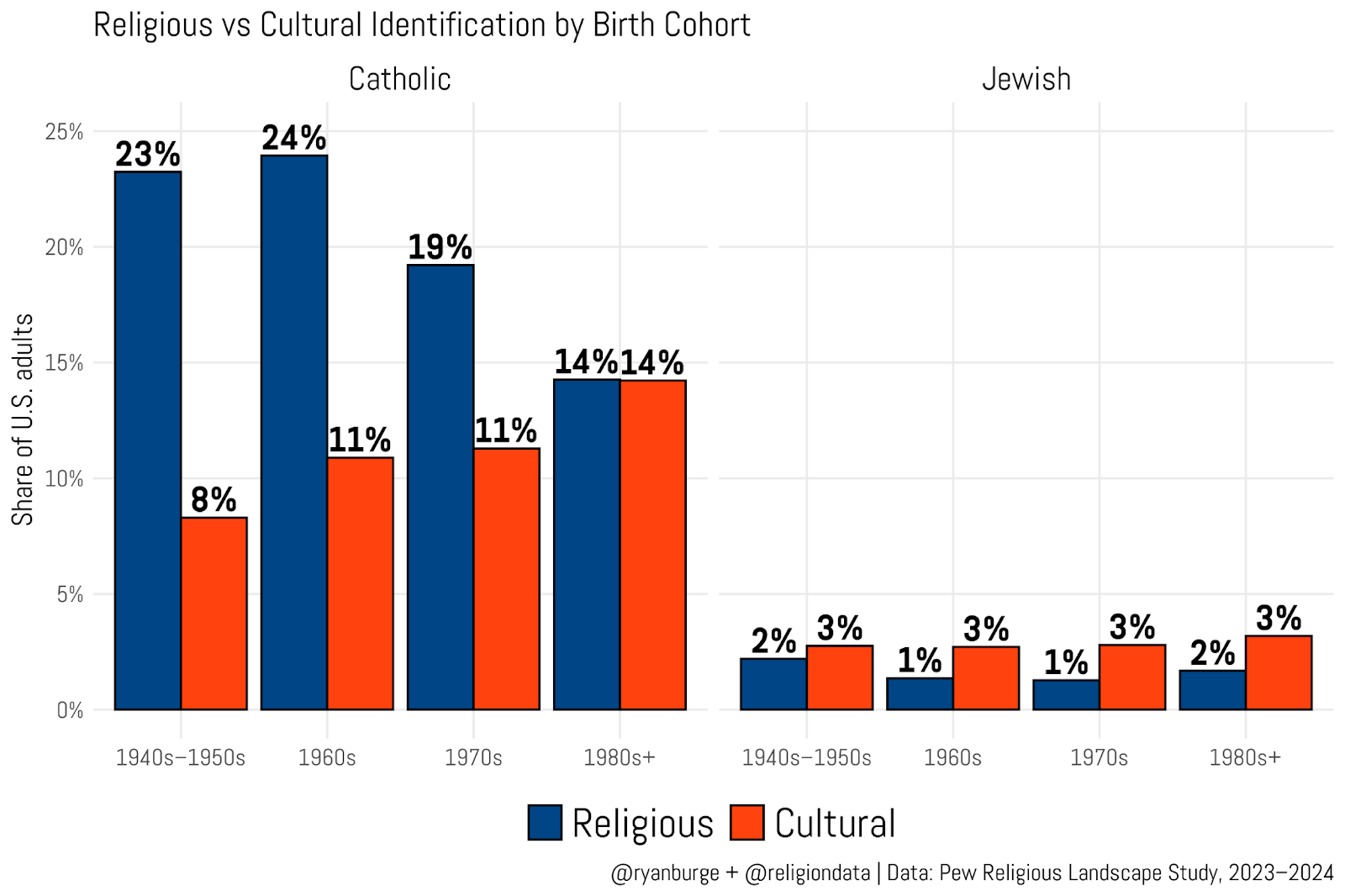
Among older Americans, you’re much more likely to find religiously engaged Catholics than cultural Catholics. For those born before 1960, the split is 23% religious versus 8% cultural. The pattern looks nearly identical among people born in the 1960s (24% vs. 11%).
But things begin to change with those born in the 1970s. The share of religious Catholics drops by about five percentage points, while the cultural Catholic share remains rock steady at 11%. Then look at the youngest cohort. Among people born in 1980 or later, 14% identify as religious Catholics—and the exact same share say they are cultural Catholics.
If you combine those two categories for each cohort, the share who are Catholic in any sense moves from 31% to 35% to 30% to 28% across generations. Using this broader definition, Catholic identity hasn’t shifted all that dramatically from one cohort to the next. But this pattern also points to a primary reason why the pews weren’t full at last weekend’s Mass.
A natural next step is to compare childhood religion to present religion among Catholics and Jews. In the first graph, I restrict the sample to respondents who say they were raised in a Catholic household.
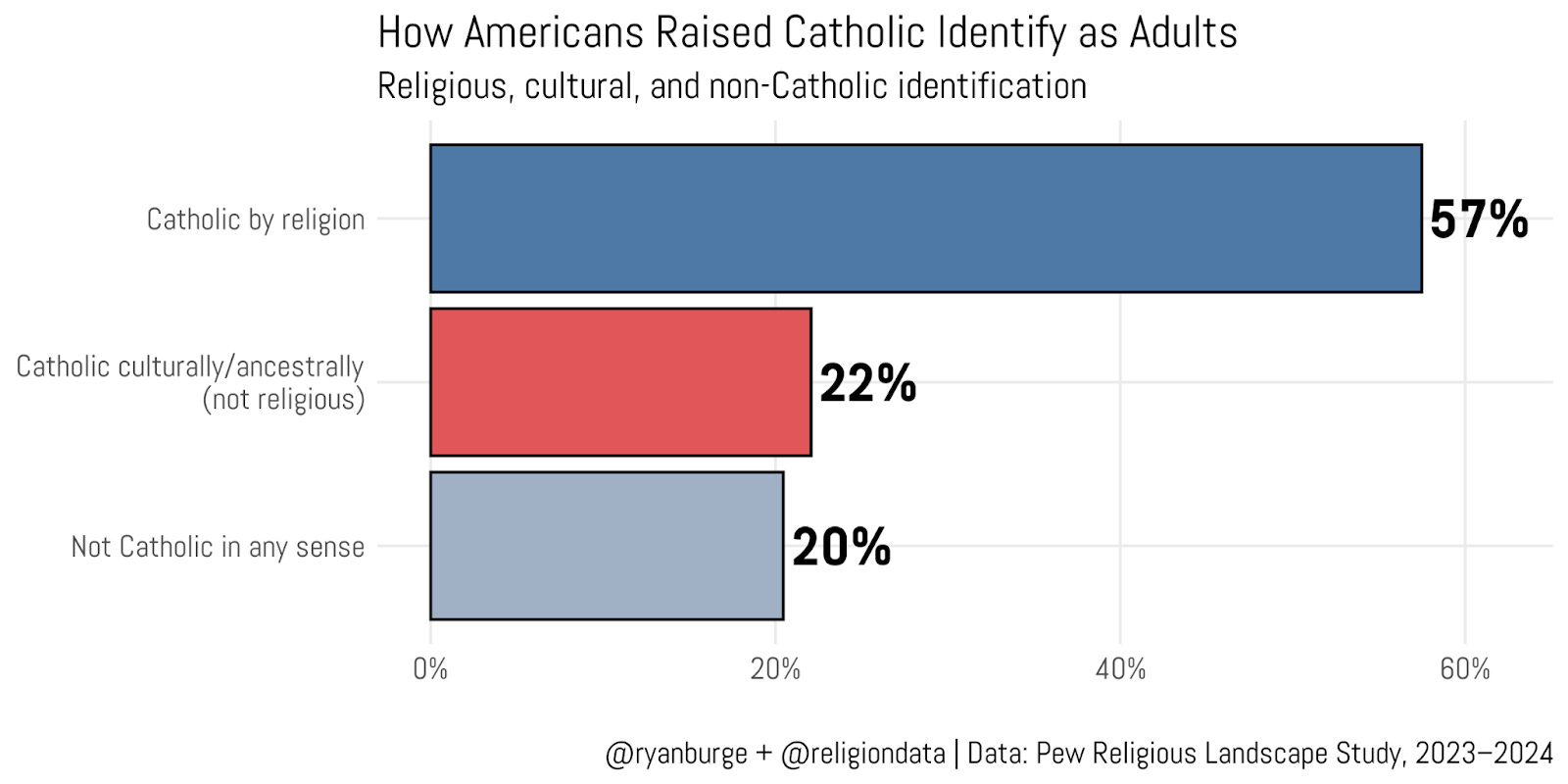
Among these cradle Catholics, about three in five still identify as religious Catholics in adulthood. Another 22% did not select Catholic when asked about their current religious affiliation, but did respond affirmatively to the follow-up question about Catholic identity.
Taken together, that means roughly 80% of those who were raised Catholic still feel some kind of connection to Catholicism. At the same time, it also means that about 20% have no connection to the Church at all.
So what does the current religious affiliation of that remaining 20% look like?
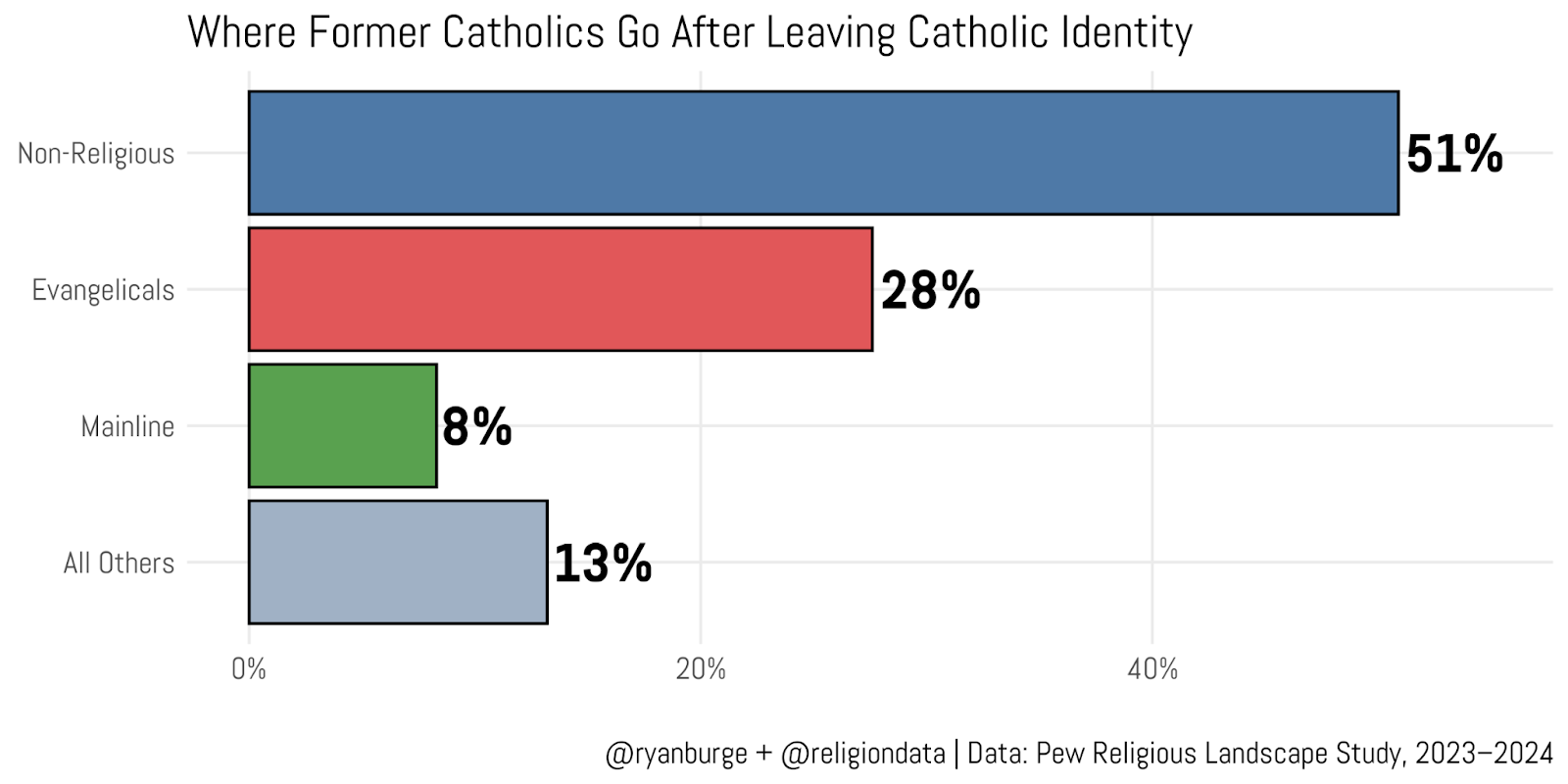
About half of them report no religious affiliation at all. The next largest share—28%—say that they now belong to an evangelical denomination, such as the Southern Baptist Convention or the Assemblies of God. Just 8% identify as mainline Protestant, while 13% end up in some other faith tradition.
It’s helpful to place these numbers in a broader context. Remember, only about 20% of people raised Catholic leave Catholicism entirely. That means roughly 1 in 10 people who were baptized Catholic end up non-religious in adulthood. About 7% of Catholic-raised respondents move into a Protestant church, and only 3% shift into another faith tradition altogether.
So what does this same breakdown look like for Jewish respondents?
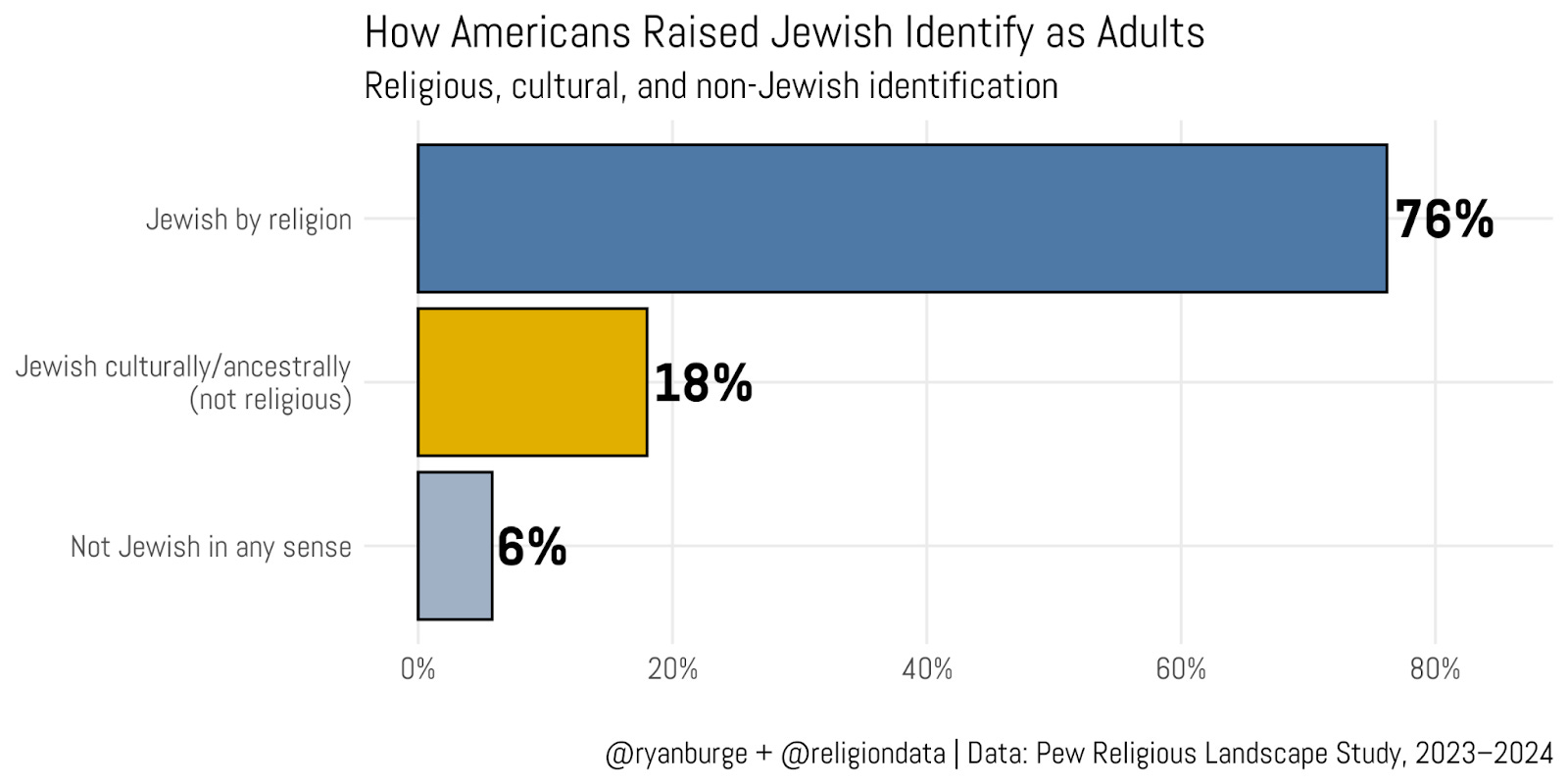
I think it’s fair to say that Jews show much higher retention than their Catholic counterparts. About three-quarters of people raised in a Jewish household say they are still religiously Jewish in adulthood. Recall that the comparable figure for Catholics was just 57%. Another one in five respondents raised Jewish report that they are still culturally Jewish, even though they no longer describe Judaism as their religious affiliation. That leaves only 6% of those raised Jewish who do not identify as Jewish in any way, shape, or form as adults.
I wish I could offer a detailed breakdown of the current religious identities of that remaining 6%, but you can probably guess what comes next—the sample just isn’t large enough. The survey includes about 850 respondents who were raised Jewish, and 6% of that is roughly 50 people. That’s simply too small a group to support any strong conclusions.
Still, I couldn’t resist looking at how these three categories—religious, cultural, and neither—shift when comparing younger adults to older adults.
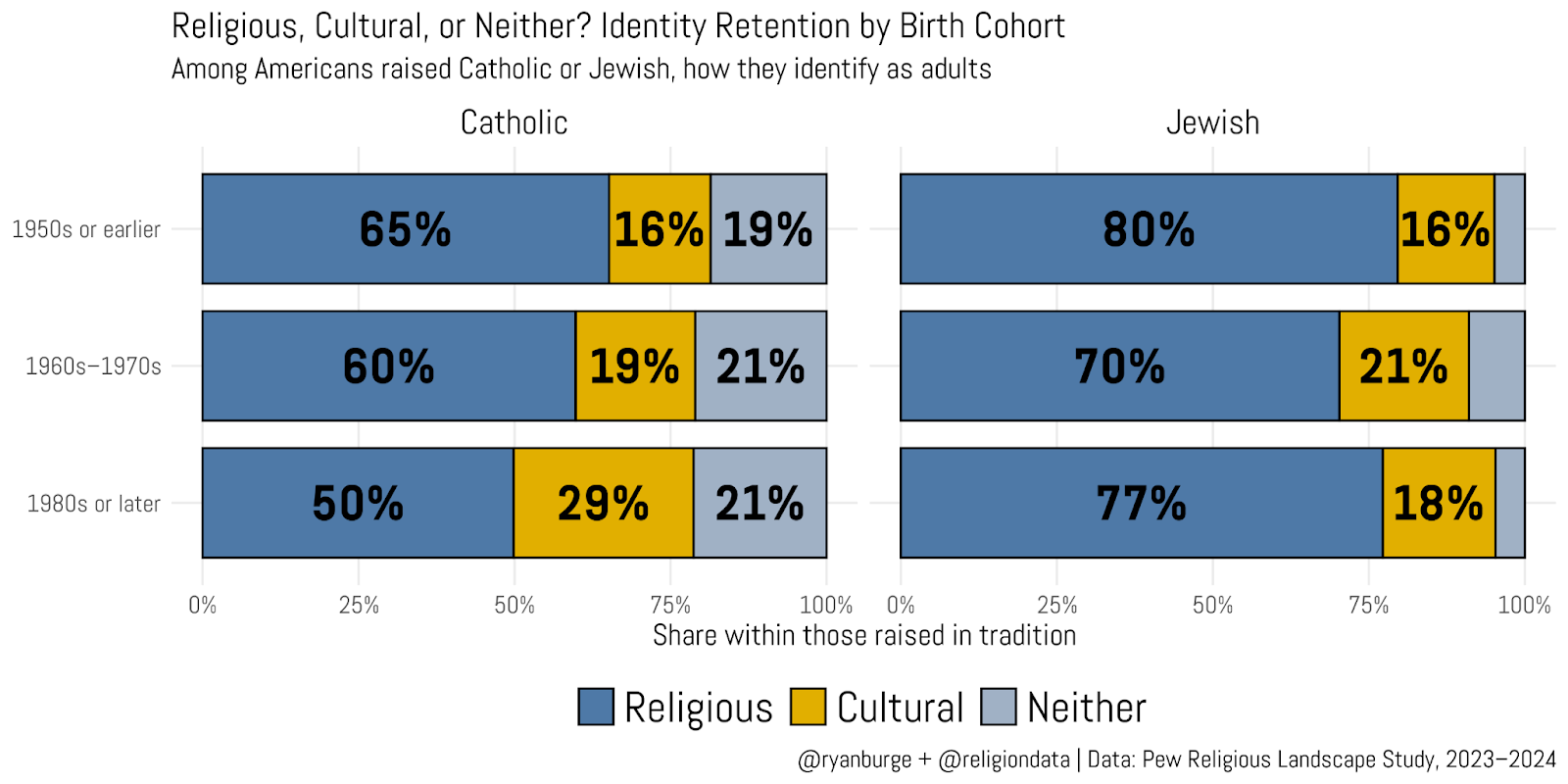
For the Jewish sample, there isn’t much variation across cohorts. Whether looking at people raised Jewish in the 1950s or the 1990s, the retention rate into religious Judaism falls between 77% and 80%. Retention does dip somewhat among those born in the 1960s and 1970s, but even then it remains relatively high at around 70%. Meanwhile, the share of people raised Jewish who leave Judaism entirely is very small regardless of age—ranging from 4% to 9% across birth decades. That’s not a meaningful deviation.
Cafeteria Catholicism?

This post has been unlocked through a generous grant from the Lilly Endowment for the Association of Religion Data Archives (ARDA). The graphs you see here use data that is publicly available for download and analysis through link(s) provided in the text below.
The Catholic story is more clearly defined. Among those born into a Catholic household before 1960, about two-thirds still report Catholicism as their religious affiliation in adulthood. That share drops to 60% for people born in the 1960s and 1970s, and falls further to 50% among those born in 1980 or later. At the same time, the share of younger adults who identify as culturally Catholic rises to nearly 30%, almost double the rate among the oldest Catholics in the sample. What’s worth flagging, however, is what doesn’t change: the share of cradle Catholics who are not Catholic in any way as adults is essentially constant across cohorts, hovering right around 20%.
I also ran a more granular analysis of Catholics by individual birth decade—you can see that in this table. There aren’t major differences when comparing cradle Catholics born in the 1980s, 1990s, or the early 2000s. That suggests the slide in religious retention has largely stopped among younger adults.
As I mentioned briefly earlier, there’s another layer to these numbers that I’ll explore in a future post—especially when it comes to people who identify as culturally Jewish. I went into this analysis with a strong assumption about that group, and the data completely overturned it once I started making a few graphs. So stay tuned for that in a couple of weeks.
Code for this post can be found here.
Ryan P. Burge is a professor of practice at the Danforth Center on Religion and Politics at Washington University.

Nice work Ryan, this was really interesting to me and look forward to seeing more data about this. Thanks
We Jews have other survey sources that probe these questions in a more detailed way. The leading organization for doing this seems to be the Cohen Center at Brandeis University, which surveyed my community in 2022. https://www.brandeis.edu/cmjs/community-studies/delaware.html I was part of their random representative sample for that one. Filling out the questionnaire took a while. They basically concluded that we fall into four categories as Jews. About 40% are personally observant in some way and engaged with the community, about 20% have a DIY religion of personal practice but negligible community ties, 20% have communal attachment but no personal belief or practice, and 20% identify as Jewish culturally but largely opted out.
There are some important differences between Brandeis and Ryan's survey. These are all people who identify themselves as Jewish as their primary religion, not as secondary afterthoughts. The survey has a sponsor with an agenda to act on the results, that is shift the unengaged to engaged and ask them for money each year, or allocate money already under their control in a different way.
Matt, the prof who tabulated and presented the findings, indicated that the results of my area were similar to regional results that the Cohen Center had done elsewhere, so probably can be generalized.