


Hey Washington, D.C. friends! I’m going to be in town on Sunday, October 11th. I would love to add a speaking event on either Saturday night or Sunday night. If you are interested, get in contact by filling out my speaker request form.
I feel like I got into a debate or a disagreement with someone about politics or religion on a near daily basis when I was between the ages of 13 and 25. I would fight with anyone about anything and I would often argue positions that I completely disagreed with because I just liked the intellectual gamesmanship of the whole exercise.
In short, I was a pretentious jerk. I’m very glad that I outgrew that phase of my life.
But if I look back on the last decade of my life, I think that the pendulum has clearly swung in the other direction and in a really severe way: I hardly ever get into a disagreement with anyone about anything. (Insert hacky joke with the exception being my wife and sons). I really don’t get into any type of verbal conflict anymore. And I can’t say that I am pining for my teenage years when I seemed to be geared up to be a disagreeable snot-nosed kid on an hourly basis.
There’s a practical reason for that, by the way. I generally don’t hang out with people that I strongly disagree with on important matters. And even if I do manage to find myself in that type of company, both parties are smart enough to know not to talk about topics that will raise our blood pressure. We are middle aged, after all.
How Big is the God Gap on College Campuses?

Central Indiana Friends! I will be driving through your area on Sunday, March 1st on the way to Oxford, Ohio for an engagement o the evening of March 2nd. I would love to speak at an event in your area for a reduced rate. It could be a church, community group, etc.
I also teach on a college campus. One of the most prestigious in the United States, empirically speaking. And it’s got students from all over the country (and a bunch of international students, too). They come from about every background you can imagine and they have very different political and religious experiences.
But they are incredibly reluctant to actually disagree with me (or other students) in class. It’s super frustrating because my understanding of the classroom is that it’s exactly the space where free speech should flourish. It doesn’t. Everyone seems so afraid of saying something that will be recorded and reposted on social media. Thus, we sort of cosplay a rich debate. We don’t actually do it.
The Foundation for Individual Rights and Expression (FIRE) has been doing an annual survey of college students where they ask questions about which topics are particularly hard for them to discuss in various environments on campus.
They were given a list of twenty items and asked to indicate which ones were particularly difficult to talk about on their campus. Here’s the ordering of those twenty topics.
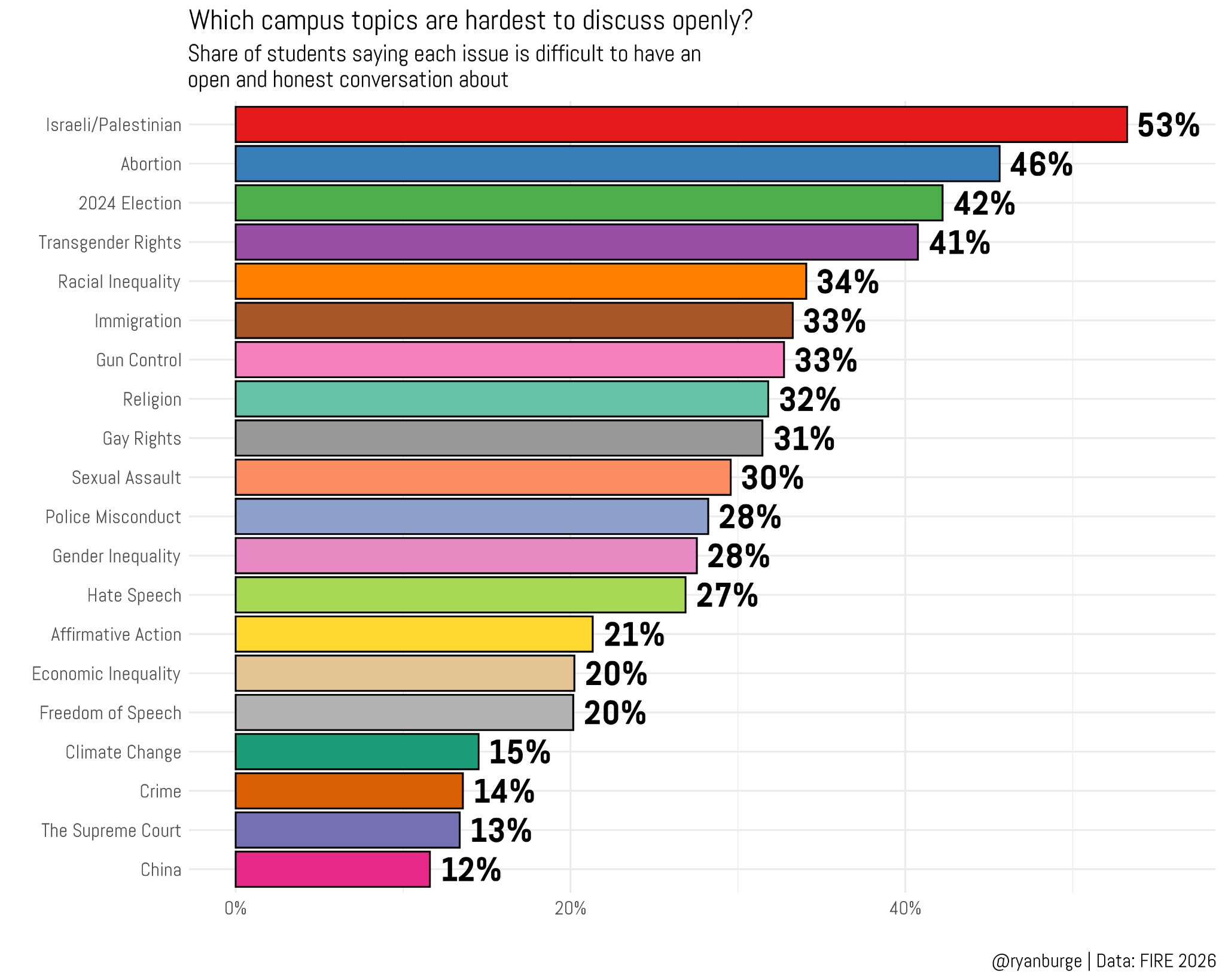
The “third rail” of discourse on college campuses is the conflict in the Middle East. Over half of all those who took part in the survey said it was hard to have an open and honest conversation about the war between Israel and Hamas. You have to remember that this survey was conducted about a year ago, when this was still a very ongoing war between those two entities. I don’t know if (and how much) that percentage would decline if FIRE includes this question again on this year’s questionnaire.
What else scores near the top? I think I would call them “the usual suspects”: abortion, the 2024 election, and transgender rights. They were all in the 41%-46% range. I don’t think that anyone would be particularly surprised to see those issues float to the top of the list. Adults don’t want to talk about them either.
I also need to mention the issues that don’t raise so much hesitation that appear at the bottom of the list. Students don’t seem to be wary of discussing: climate change, crime, the Supreme Court, or China. It’s interesting how there aren’t really any “culture war” issues at the bottom of this graph.
That got me thinking, though: I wonder if Christian college students have a different idea about what topics are unwise to go near compared to Muslims, or atheists. Below, I just visualized what items were in the top three for about a dozen religious groups.
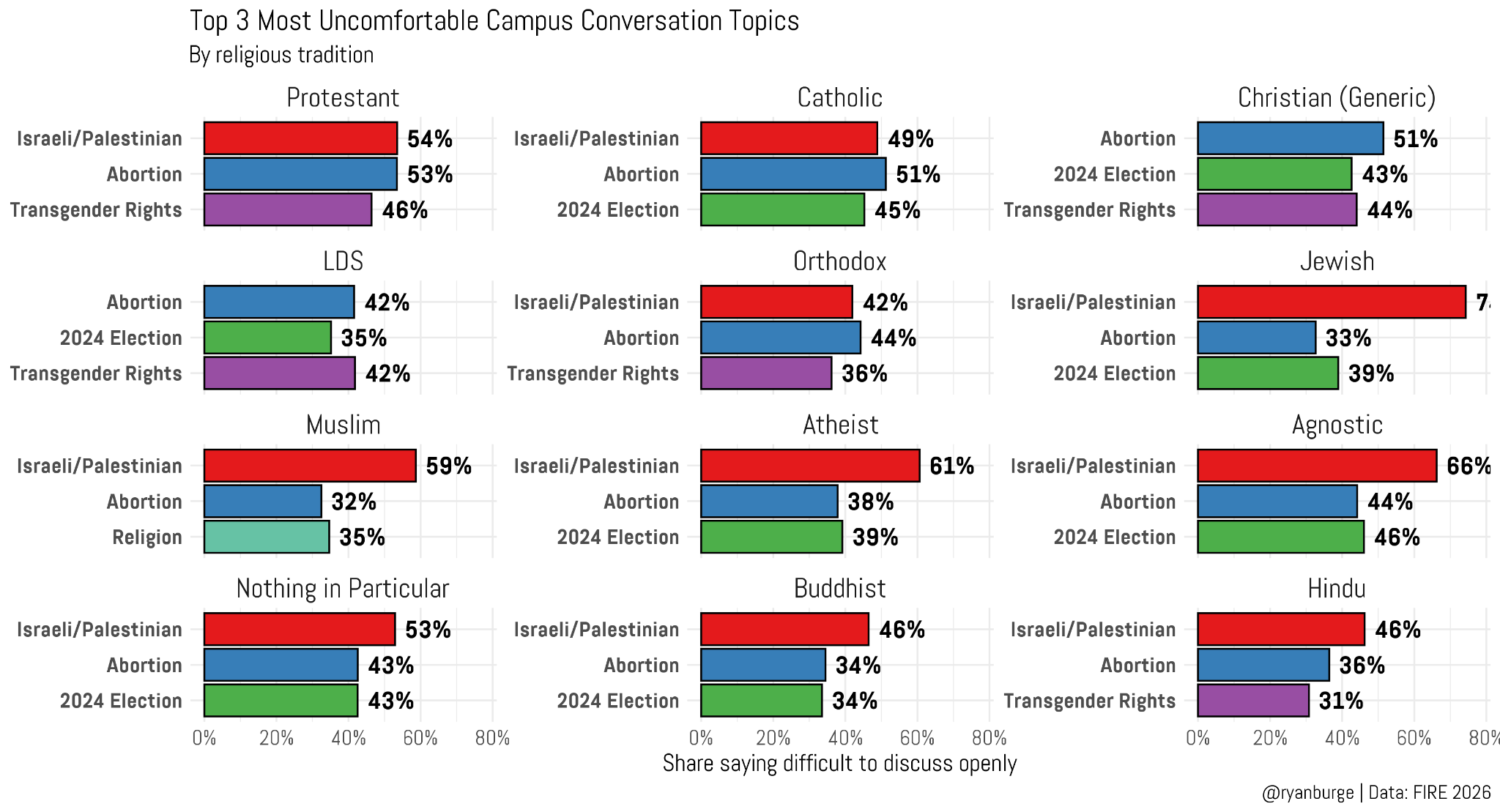
This graph is really boring, honestly. I would have hoped that for one of these religious groups there would be a true “wild card” issue that they find pretty difficult to talk about. Instead, it pretty much follows what I would have expected. For all but two groups (generic Christians and LDS), the Middle East conflict scored at the very top. What’s also notable about those two aforementioned groups - the conflict doesn’t even appear in the top three for either.
But it’s basically the same issues showing up over and over again. Abortion is on every single graph. The 2024 election shows up in nine of the twelve. The transgender issue is there for five of these religious groups. But it doesn’t appear on the list for any of the non-religious college students in the sample. Again, I don’t know what to make of that one.
I really did want to dig into the most “unique” issue for each group. To do that, I just compared the overall scores for all twenty items to the scores for each religious group and then plucked out the one topic that deviated the most from the overall percentage. That’s what is in the table below.
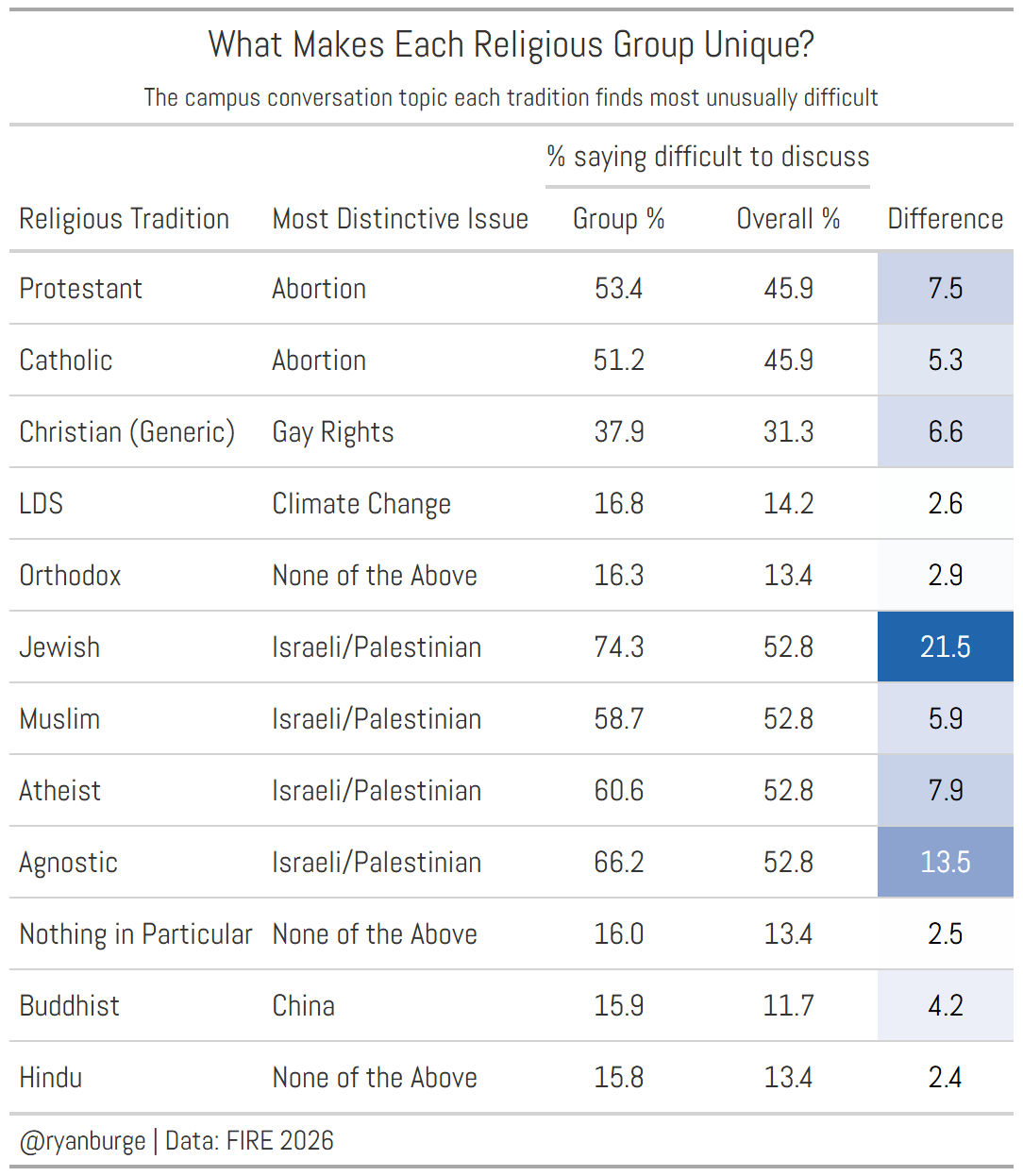
For both Catholics and Protestants, abortion is the one issue that they are more reluctant to talk about than the average college student. They are the only two groups where abortion is the outlier. The other huge thing that jumps out to me is the Israeli/Palestinian conflict that appears a bunch of times in the middle of the table. For Jews, Muslims, atheists, and agnostics it’s the big outlier in their responses.
Notice the largest delta between the two figures, though? It’s Jewish students and the Middle East conflict and it’s in the expected direction. In the full sample, 53% of students found it difficult to discuss. For Jews, 74% found it uncomfortable. Agnostics were also in double digits on this one, too.
However, for a bunch of groups, the deviations from the norm are just non-existent. For instance, the biggest outlier for Latter-day Saints was climate change. But even then, they were less than three points away from the baseline. And for nothing in particulars and Hindus, they were about as average as you can get.
To this point, though, we haven’t discussed the fact that the political partisanship of respondents can have a big impact on whether they are willing to discuss an issue on campus or not. So that’s what I tried to visualize below: I rank ordered all 20 topics across the political spectrum. I tried to highlight the ones that were the most important or had the greatest amount of movement from left to right.
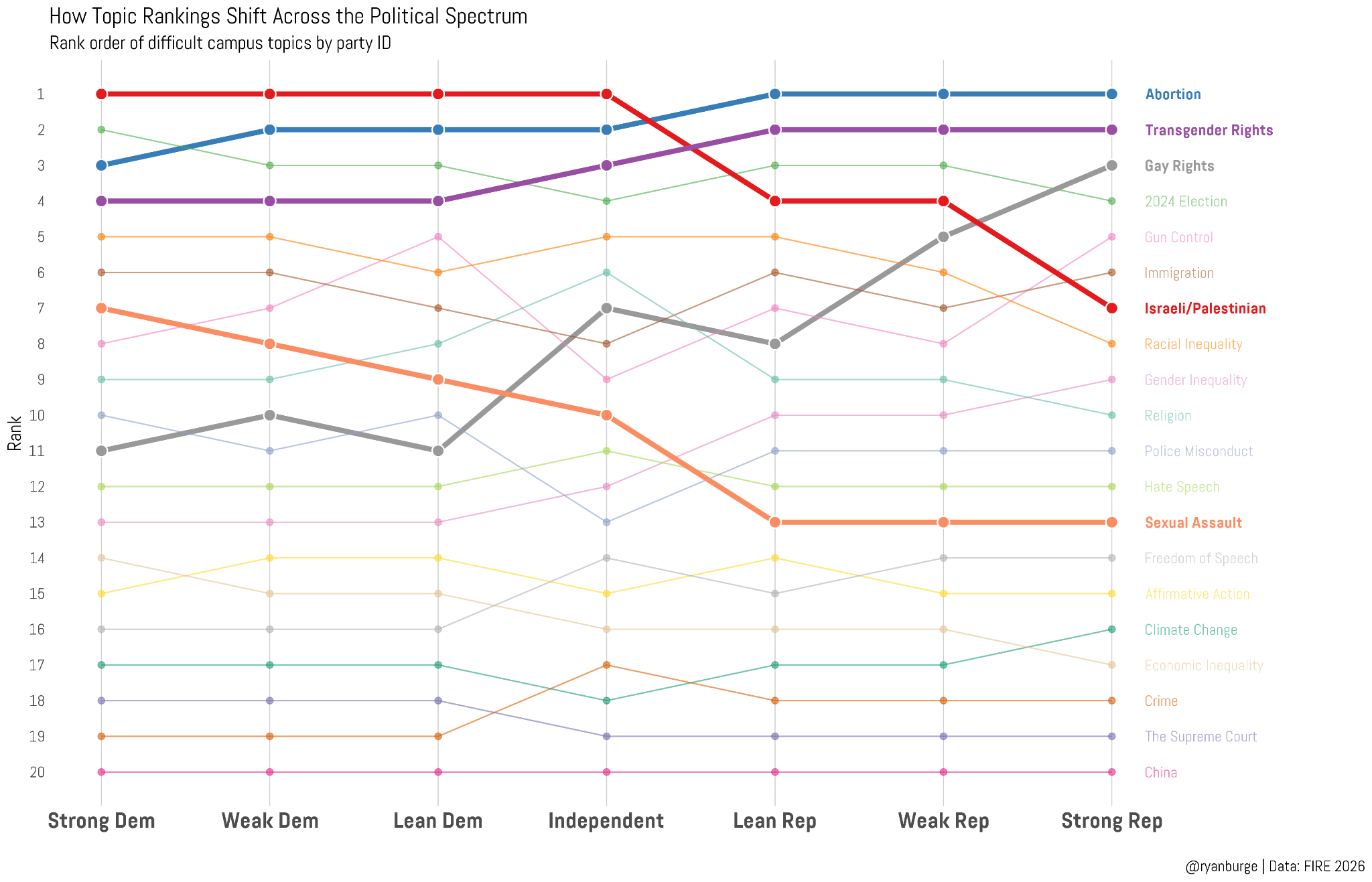
First note that abortion and transgender rights almost always rank at the top, no matter the personal politics of the respondent. But I do need to point out that the lines go up from left to right. That means that Republicans are more reluctant to talk about both compared to Democrats. In contrast, the Middle East conflict goes in the opposite direction: it’s the most difficult topic to discuss for those on the political left but it ranks sixth among strong Republicans.
I was also struck by the variation in a couple of other lines that I highlighted. For instance, look at “gay rights.” Among the strong Democrats in the sample, it ranked 11th out of 20 issues. For strong Republicans, it was 3rd. I think you can probably figure out why a strong Republican is less likely to bring it up. Then, sexual assault goes the other direction. It’s 7th among strong Democrats but 13th among strong Republicans.
You can probably assume the next logical step, right? Let’s try to parse out how political partisanship and religious affiliation impact reluctance to speak out on certain topics on college campuses. I wanted to begin by looking at the three largest Christian groups and how they felt about three topics that tend to be central for them: abortion, gay rights and transgender rights.
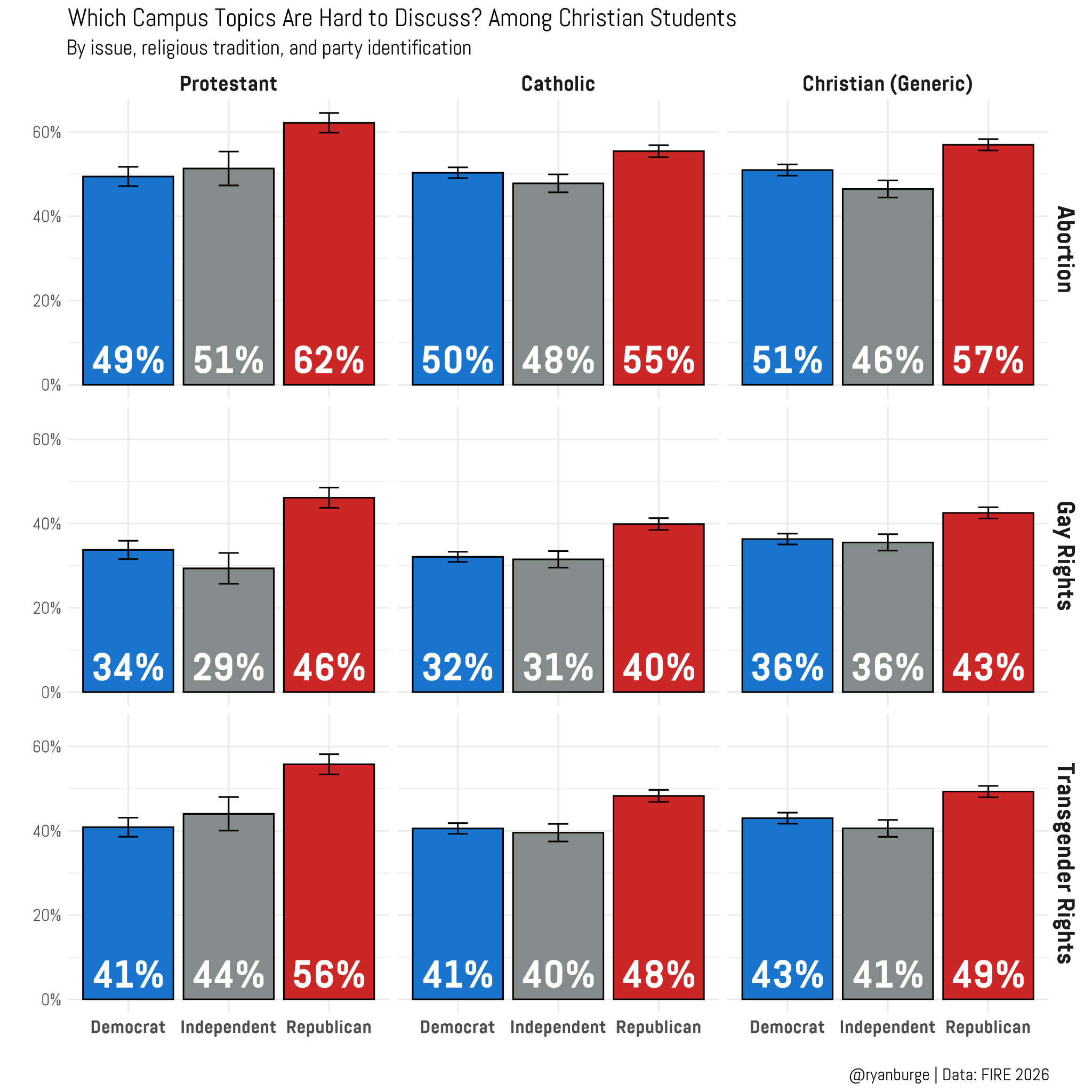
There’s a consistent finding across this analysis: Republican college students are more likely to hold their tongue compared to independents and Democrats. Among Protestant respondents, the gap was noticeably large. On abortion, 62% of Republican Protestants said it was difficult to talk about compared to just 49% of Democrat Protestants. The divide was 12 points on gay rights and 15 points on transgender rights. It doesn’t take a lot of wild guessing to figure out the reason: those Republican college students have an opinion that is outside of widely held views on college campuses.
There is a gap between left and right among Catholics, but it’s noticeably smaller. It’s five points on abortion, eight points on gay rights and seven points on transgender rights. I don’t know if I can easily explain why the divergence between Republican and Democratic Catholics is not so severe compared to Protestants, but it’s a very consistent finding in this data.
Let’s do the same kind of thing but for a topic that stood out on the left: the Middle East conflict.
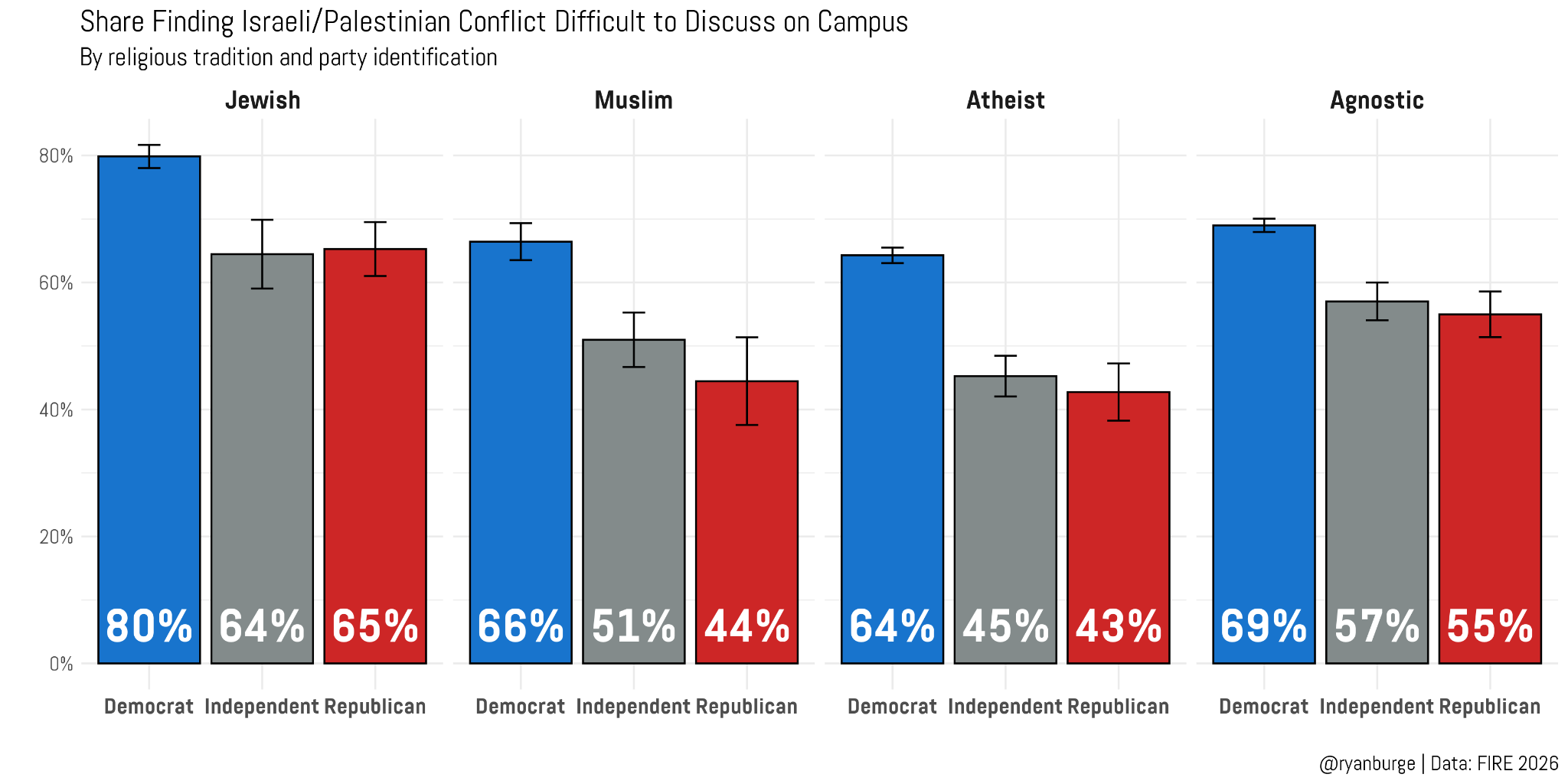
Here the partisan gap is reversed from the previous graph. Instead of Republicans being more hesitant to speak out, it’s the Democratic students who are more prone to keeping their mouth shut. Think about this: 80% of Democratic Jews said that they found the conflict between Israel and Palestine to be hard to discuss on their college campus. That was 27 points higher than the full sample. I think I may have found the hottest of hot button issues for a subgroup of American college students.
How Do College Students Feel About Free Speech

I’ve taught a course on a college campus as either a teaching assistant or the instructor of record since the Fall of 2006. The places I have worked at are not what most people would consider to be highly prestigious institutions. Outside of one course I lead as an adjunct at the University of Illinois about seven years ago, you probably haven’t heard o…
But even among Muslims and atheists and agnostics, it’s pretty much the “third rail” of discourse at universities across the country. At least two-thirds of the Democrats say that they just don’t want to talk about it. I do find the partisan gap among atheists interesting, though: only 43% of atheist Republicans don’t want to talk about the Middle East Conflict.
Are colleges and universities bastions of free speech? In my experience, not really. They are certainly more open to the idea of honest discussion than the average workplace or sideline of a soccer field. But everyone is terrified of getting cancelled. Myself included.
Maybe there needs to be a concerted effort to introduce Chatham House rules in some form or fashion on college campuses. But I don’t think that’s even feasible.
Instead, the cosplaying of ideas will continue full speed at colleges across the United States for the foreseeable future.
Code for this post can be found here.
Ryan P. Burge is a professor of practice at the Danforth Center on Religion and Politics at Washington University.
On topic #2 on this list, abortion: I work in administration at a small medical school. Abortion is one of the topics that, per some of our accrediting bodies, should be discussed in medical ethics. For years in our curriculum it was.
Since 2020, the pro-abortion contingent became increasingly aggressive in insisting that there was only one appropriate opinion to have as a medical professional, which is that there is an unlimited human right to abortion, as "abortion is health care." What had previously been nuanced discussion topics--like parental notification for abortion in minors, at what developmental stage the fetus can feel pain, regulation of medical abortions vs. surgical abortions, what features make humans valuable cp. to animals and how this informs ethical considerations on how research is conducted on animals, humans, and embryos--was becoming impossible to get any discussion of, at all. Student complaints were made that there should be no discussion of these topics, because abortion is not controversial, because "abortion is health care." This silencing on this topic harmed student discussions on other topics, and made both students and faculty members very uncomfortable. As a result, we have not included abortion as a topic in medical ethics since 2023.
These are neat, ongoing studies but without the same (or similar) study going back 10, 15, 20 years we don't have data to back up how it used to be. We have vibes. And those vibes tend to be nostalgic (a toxic impulse), doomerist (the world is always getting worse), and "kids these days!".