



This post has been unlocked through a generous grant from the Lilly Endowment for the Association of Religion Data Archives (ARDA). The graphs you see here use data that is publicly available for download and analysis through link(s) provided in the text below.
A couple of months ago, I wrote a post about the retention crisis facing the Church of Jesus Christ of Latter-day Saints. The headline finding is pretty straightforward: nearly half the kids who are raised as LDS no longer identify that way as adults. There was a bit of controversy about the best way to compare LDS retention rates to those of other groups like Protestants or Jews, but no one has been able to dispute the simplest conclusion of the data from Pew – 46% of the LDS are not retained.
In the comments for that post, one of my paid subscribers noted that they would like to see me do a more in-depth analysis of retention among American Catholics. And I immediately jotted that down as a note to follow up. Now, I’ve managed to flesh out a full post on this topic.
The Association of Religion Data Archives is awesome for a project like this because I can quickly find the datasets that I need to answer this question from multiple angles. I am going to use two different sources – the General Social Survey, which allows me to trace the contours of American religion all the way back to the early 1970s, and the Pew Religious Landscape Survey, which permits me to do a really deep dive on the state of Catholic retention in the last couple of years.
My biggest impression through looking at all the data is that American Catholicism does seem to be hemorrhaging members at a pretty alarming rate. The Pew RLS found that just 58% of Catholics were being retained into adulthood. But how did we get here? The GSS makes it pretty simple to trace the trajectory of Catholic retention over time.
I am going to do a lot of comparisons of Catholicism and Protestant Christianity in this post because these are the two largest religious traditions in the United States. However, I also recognize that the comparison is not completely apples to apples, which I will discuss at the end of the piece.
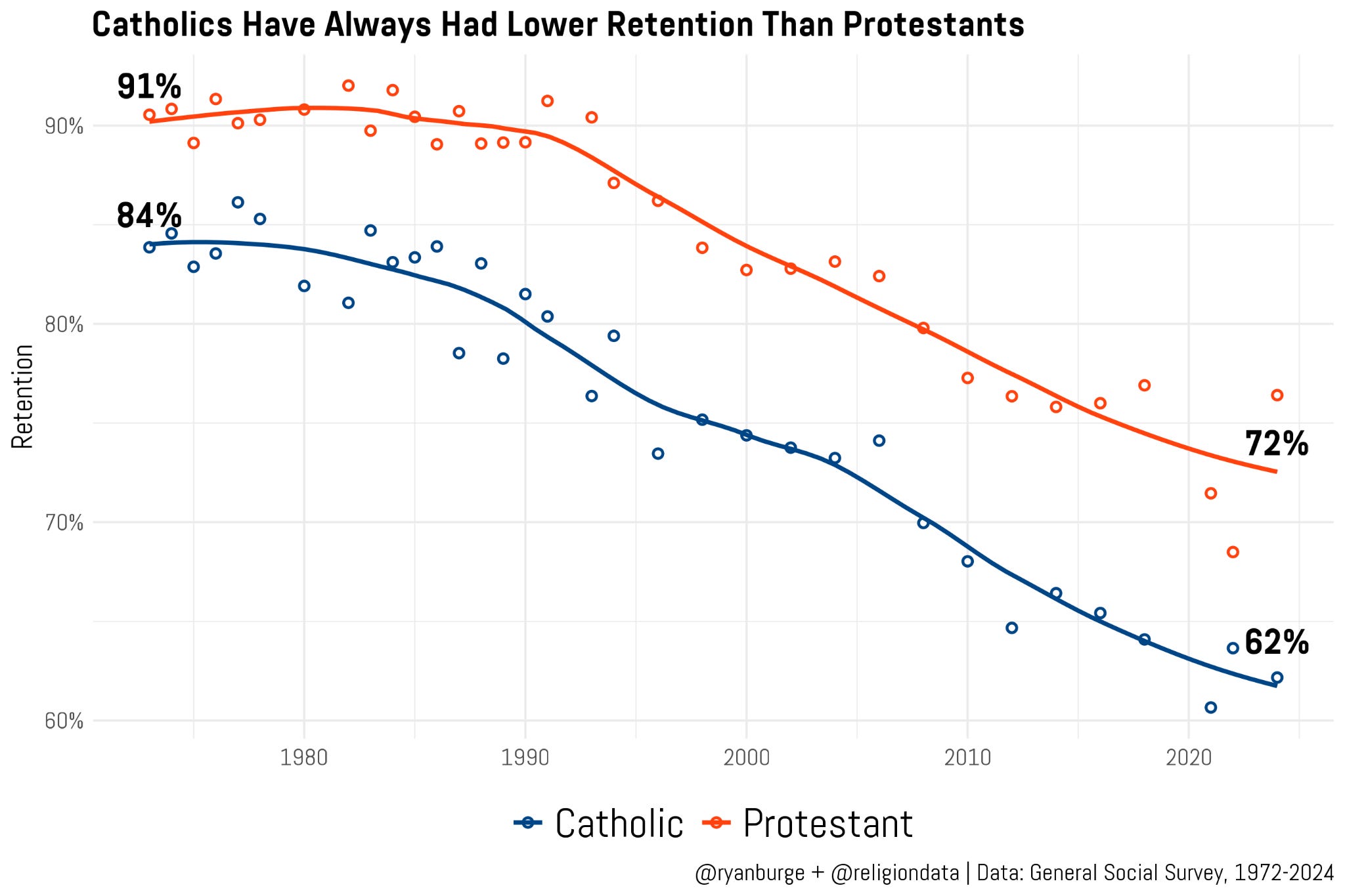
Protestant retention has always been higher than Catholic retention. That’s true at every single point over the last five decades. The gap is not that small, either. Back in 1973, 91% of folks raised Protestant were still Protestant. For Catholics, it was 84%. So a difference of seven percentage points. It’s notable to me that Catholic retention was already clearly dropping by the early 1980s, when the same can’t be said for the Protestant trend line for at least another decade or so.
I am a bit surprised by how these lines tend to run in pretty consistent parallel to each other. There are a few dips and dives for one or the other, but they always seem to be in the neighborhood of ten points apart. That’s basically where they stand in the most recent data, too: 72% of Protestants were retained in 2024. It was 62% of Catholics.
So that’s pretty clear and compelling evidence that Catholicism tends to be “leakier” than their Protestant cousins.
The graph above is pretty blunt, though: it just calculates “retained” or “not retained” with no nuance. I wanted to take that a step further by visualizing four possible outcomes: not retained, retained but only rarely attending church, retained but only attending occasionally, and retained and attending weekly or more. This may be the most revealing data visualization of the whole bunch.
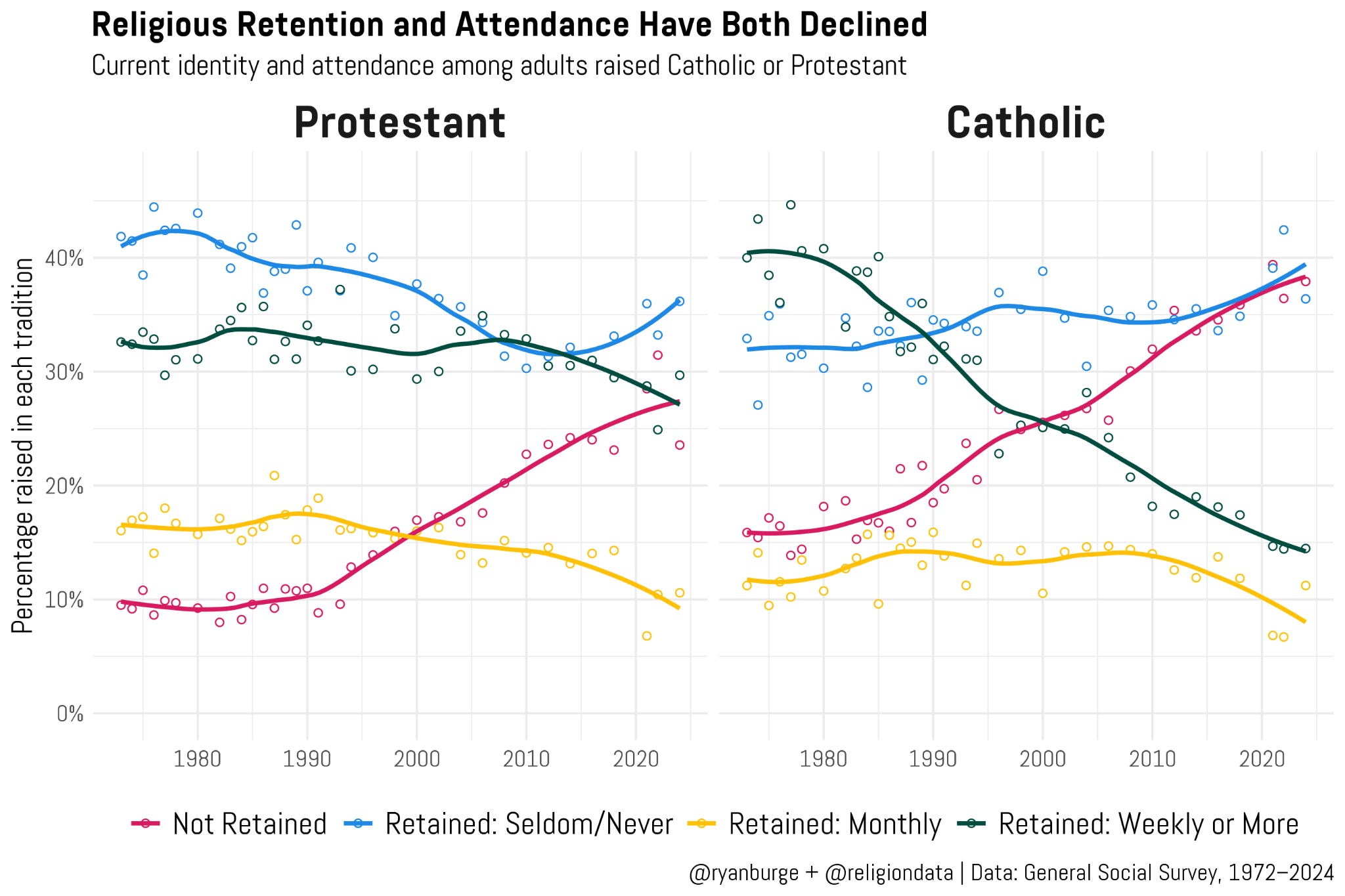
The “not retained” line should come as no surprise based on the prior graph. It’s basically the reverse of what I did in the first visualization. It’s the other three lines that tell a much different story about how retention works in these two traditions.
The one thing that I want you to focus on is when the red line eventually crosses the green line. That’s the point in which the “not retained” outnumber the “retained and attending weekly” share. For Catholics, this happened over twenty-five years ago. That’s when someone who was raised Catholic was just as likely to leave Catholicism as they were to stay in the Church and be a weekly Mass attender. Now, someone raised Catholic is about twice as likely to leave the Church entirely as they are to be a regular Mass goer as an adult.
For Protestants, the crossing of the two lines didn’t happen until the last couple of years. Now, about 28% of those raised Protestant will leave the tradition entirely and the same share will stay in Protestantism and go to church nearly every week or more.
Let me put a really fine point on this. In the 2024 data, among people who were raised Catholic, nearly three quarters of those respondents were either no longer Catholic or they still identified as Catholic but attended Mass seldom or never. Just a quarter were going to Mass at least once a month. Now, it’s not like Protestants have nothing to worry about in this regard – the same statistic for them is about 55%. But Catholics are 20 points worse than that.
Now, I turn to the Pew Religious Landscape Survey, which is perfect for analyzing the factors around retention because of its recency and huge sample size (nearly 37,000). First, let’s calculate retention of Catholics and Protestants by the decade of birth of the respondent.
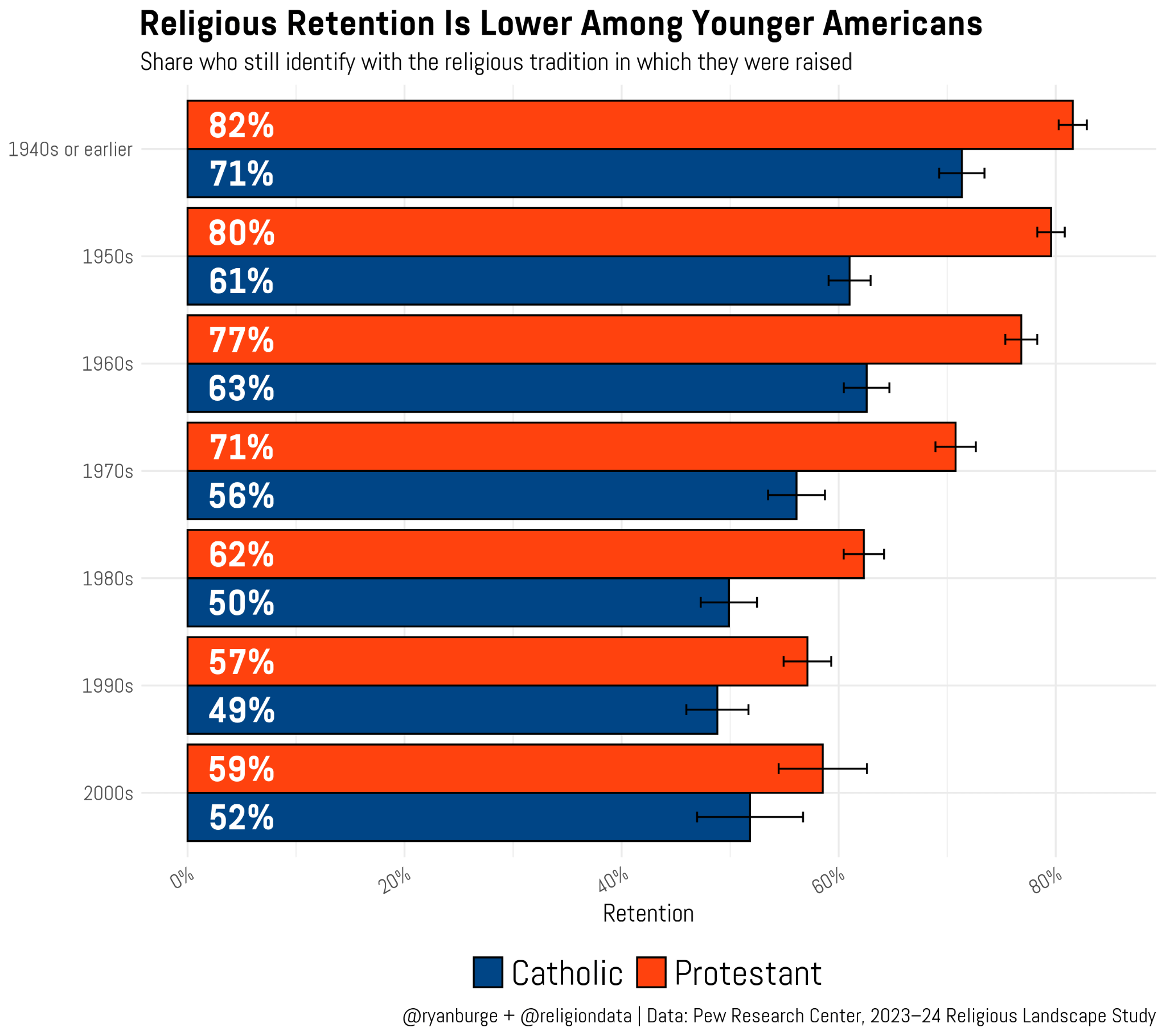
The macro trend is pretty easy to parse out – retention is declining among younger Americans compared to their parents and grandparents. For the very oldest respondents to the RLS, 71% of Catholics and 82% of Protestants were retained. But with each successive decade, both numbers begin to erode in a pretty meaningful way. When you get to folks born in the 1970s, Protestant retention is down to 71% and for Catholics, it’s even lower at 56%. For the very youngest adults, retention is about 60% for Protestants and 50% for Catholics.
Let me point out something that I missed on my first pass at this graph, though: Catholic retention has bottomed out. It was 50% among those born in the 1980s and it’s functionally the same for folks born in the 1990s or early 2000s. That’s a hopeful sign that it won’t tumble much further from there. But the same is also true for Protestants, too – except retention is about ten points higher (~60%).
But one thing that is unmistakable: that ten point retention gap that appeared in the first graph is also replicated here, more or less. In older cohorts, it runs as high as 21 percentage points, but among younger adults it seems to have held around ten percentage points or so.
However, here’s where the value of the Pew RLS data comes into play. It asked respondents how often they attended religious services when they were kids. So we can answer a question like, “Maybe Catholic retention is just lower because they were never that engaged in their faith community.”
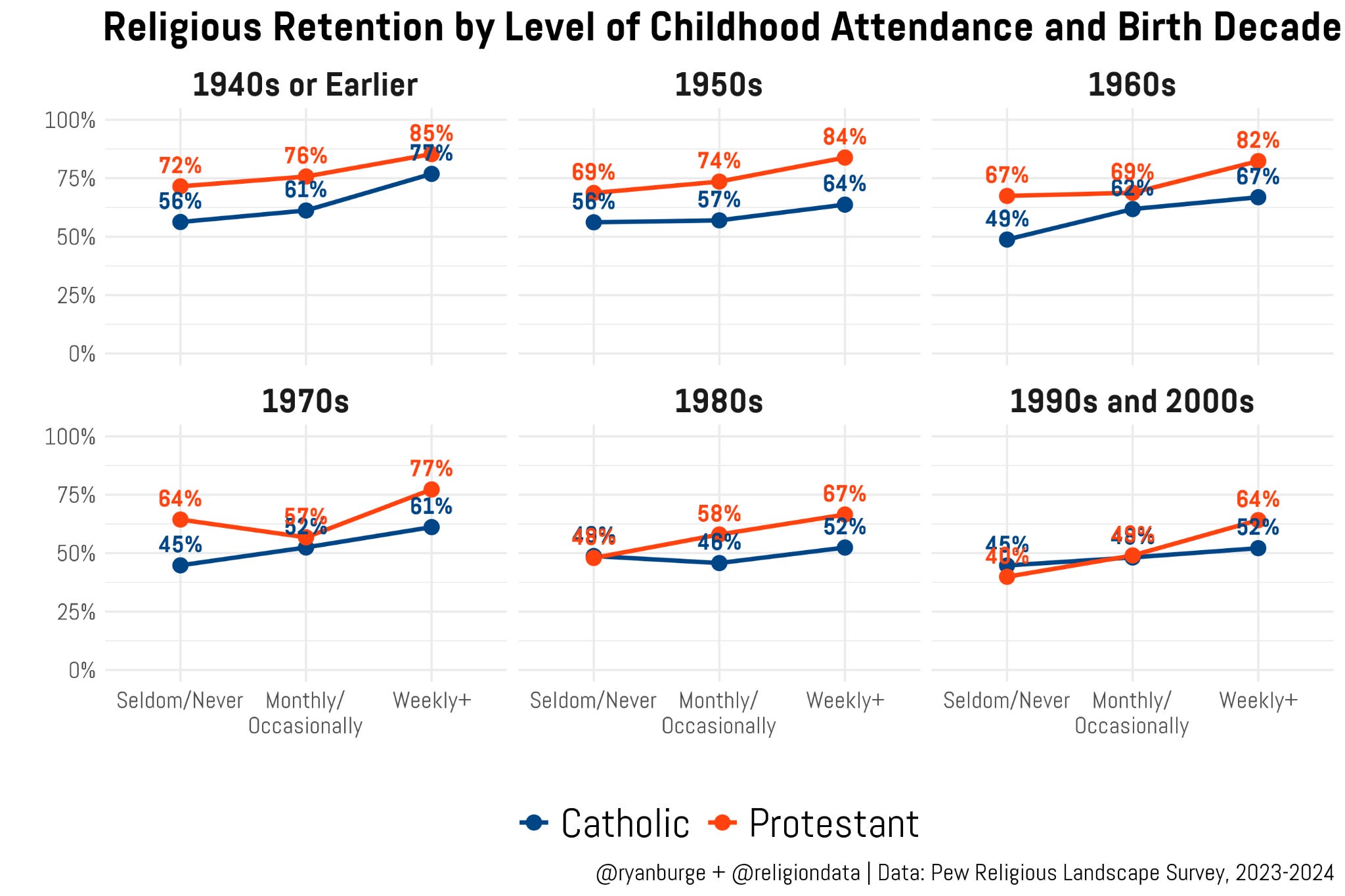
The older birth cohorts are indicated across the top set of graphs. You can see that there’s a persistent gap between Protestants and Catholics that logically follows from the prior analysis. Even holding childhood religious attendance constant, a person raised Protestant is often 15 points more likely to still be Protestant compared to Catholics from the same birth decade. For instance, among those born in the 1950s who attended church weekly as kids, 84% of Protestants were still Protestants. It was only 64% of Catholics.
The bottom row does complicate this narrative just a bit, though. The gaps are certainly smaller among younger birth cohorts compared to older ones. That becomes most apparent when looking at the trend lines for those born in the 1980s and later. Among the youngest adults who were raised not going to church that much, retention is about the same for Protestants and Catholics (between 45 and 50%). I do need to point out, though, that the gaps shoot back up for weekly attenders. For a Protestant born in 1980 or later who went to church weekly, about two-thirds were retained. For Catholics from the same cohort, retention was just above 50%.
I did want to explore one other question that asked respondents, “Thinking about the type of school you attended when you were growing up, from kindergarten through 12th grade, how many years did you attend a private religious school, if any?” I wondered if Catholics had been able to close the retention gap by sending their kids to private Catholic education.
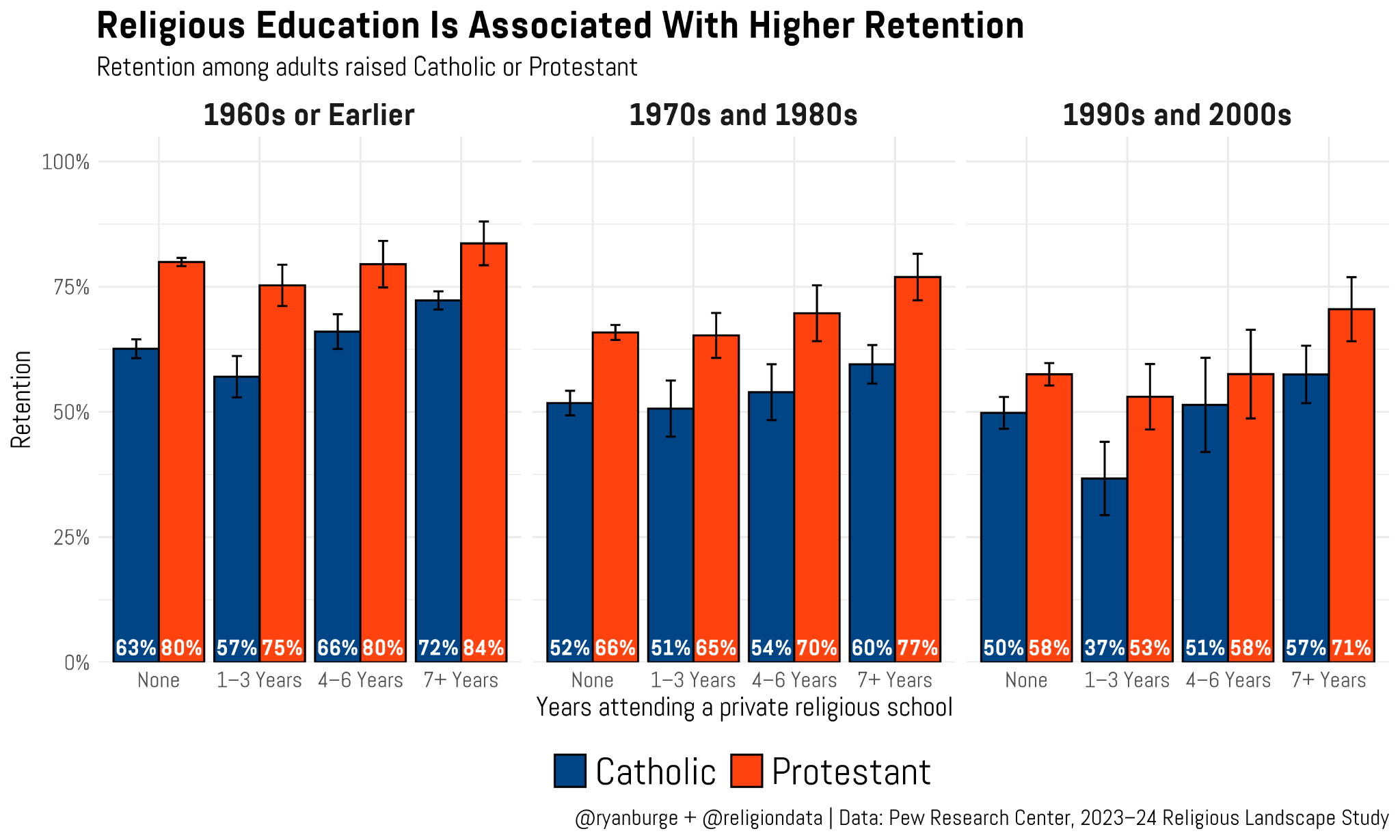
The answer for older cohorts was clearly “no.” I mean if you compare Protestants who went to at least seven years of Christian education, retention rates were a staggering 84%. (That’s Amish level retention, for what it’s worth). For Catholics, it was a dozen points lower than that. Among the middle birth cohorts, the gap was actually larger (60% vs 77%). So, that’s actually pretty compelling evidence that a Protestant going to Christian school is more effective at keeping kids in the church compared to Catholics sending their children to the local parish school.
Among the youngest folks in the survey, retention is just lower. That’s already been established, but that persistent gap between Catholics and Protestants is still there. For those who attended private Christian schools for at least seven years, Protestant retention was 71% compared to 57% for Catholics. That’s a pretty tough pill to swallow. And let me point a finer point on this:
Among Catholics born in the 1990s or 2000s who attended Mass at least weekly as children and spent seven or more years in religious school, just 57% still identify as Catholic as adults.
When I was pulling together that last stat, I thought it would be helpful for me to control for a bunch of factors to see if I could get that retention gap to close between Protestants and Catholics. So I threw in control variables for just about everything I could reasonably measure about a respondent’s religious upbringing: how often they attended services as a child, whether they attended a private religious school, how personally important religion was to them growing up, how important religion was to their family, and when they were born. Even after accounting for all of that, the gap remained.
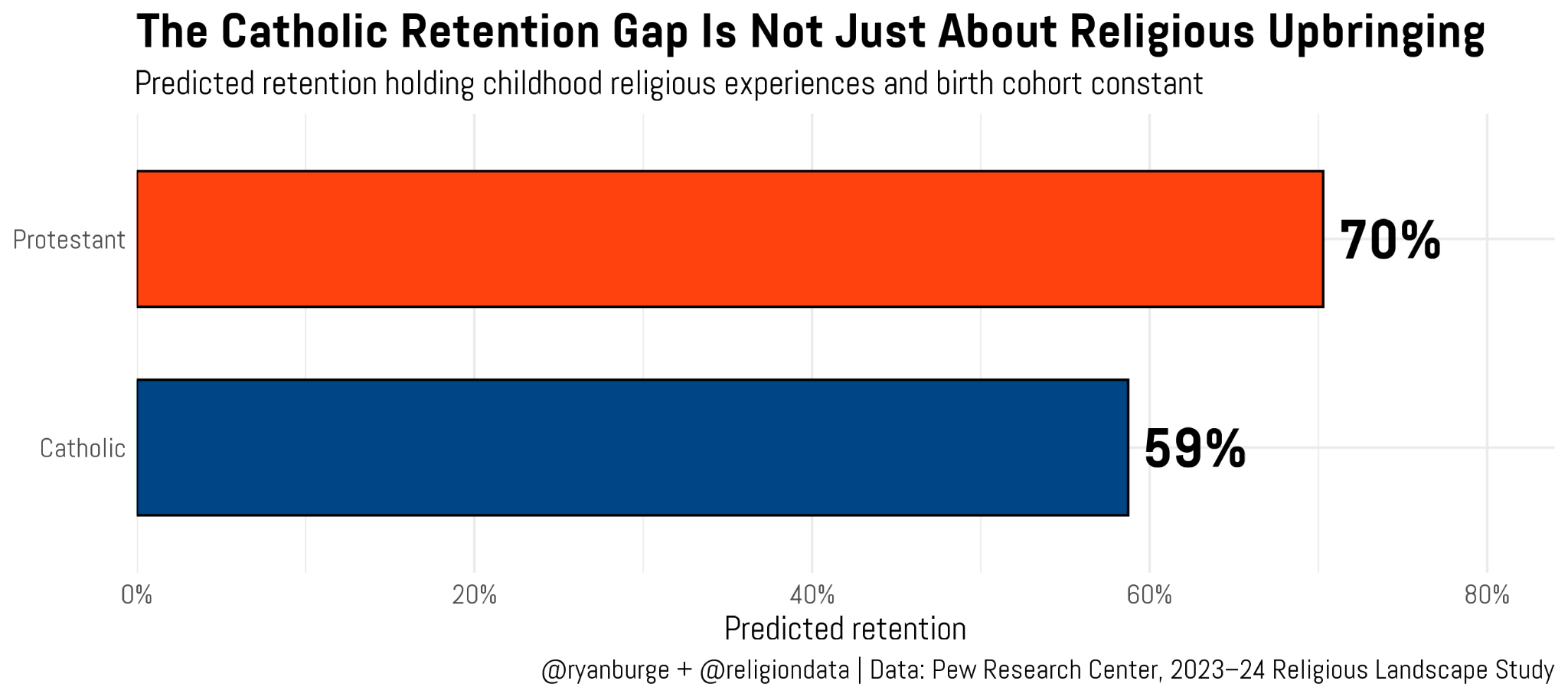
If you had two children who were born in the same decade, and raised them in a very similar religious environment, the Catholic kid would be about eleven points less likely to be retained compared to the Protestant. Now, I did try to poke around some variables to try and help us understand what factors were the most predictive for retention for both groups.
My conclusion is: the strongest childhood predictor is not simply attending services or religious school. What matters most is whether religion feels personally important. Compared with adults who said religion was very important during childhood, those who said it was not important have dramatically lower odds of remaining in their childhood tradition. This relationship is evident among both Catholics and Protestants.
Additionally, younger birth cohorts have lower retention even after their childhood religious experiences are held constant. This generational decline is especially steep among Protestants. Compared with Protestants born in the 1960s or earlier, those born in the 1990s and 2000s have about 69% lower odds of retention. The corresponding decline among Catholics is about 41%. Catholics still have lower retention overall, but the traditional Protestant advantage has narrowed considerably among younger Americans.
But I do have to end on this point that I mentioned earlier: comparing retention rates for Protestants and Catholics is not just apples to apples. Someone raised Southern Baptist can become non-denominational and that’s still being retained. Or a United Methodist could join an Episcopal Church and that’s retention, too. For Catholics, it’s pretty binary. Either you are Catholic or you are not.
I don’t know how to account for that because there’s really no way to throw that difference into a statistical model. But I’m not even sure that comparing things is that useful. Instead, I think that I will end this by reiterating a point I made earlier.
If someone is raised Catholic, there’s a 75% chance that as an adult they are no longer Catholic or they are still a Catholic but hardly ever attend Mass. Among people who were raised Catholic, just 15% are now weekly Mass attenders. For Protestants, it’s nearly double that rate (~28%).
That’s about as apples to apples as I can get. And on that metric, the difference is a chasm.
Code for this post can be found here.
Ryan P. Burge is a professor of practice at the Danforth Center on Religion and Politics at Washington University.

I guess I have 2 thoughts: 1. I was a very faithful Catholic until Paul VI promulgated his encyclical on birth control. It was preached from the pulpit and a lot of folks were outraged. I never went back. 2. the Catholic church (maybe apart from Bishop Fulton Sheen and a few others) doesn't have good preachers. The sermons are lousy and the preacher often has difficulty keeping people focused on the Message. I think many Protestant preachers are so much better in this regard and attendance is supported as a result.
This is a hard one to grasp with Jewish lenses. A few surprises. The decline among both Protestants and Catholics seems a smooth curve. It misses serious inflection points that correlate with scandals or other events that might cause a surge in attrition.
The school data also gives results that are not intuitive. At one time parochial schools had tuition within the reach of working families, as Sisters got small stipends. As the faculty shifted to higher paid lay teachers, enrollment dropped amid rising costs, the expectation might be that the families most committed to instilling Catholic values would absorb the expense. There seems a gap in data that suggests identity brings retention and commitment to burdensome tuition does not.
The crossover lines suggest that the Christian religions do not really require much behavioral expression to stay within the tent. While the crossover curves that Ryan pointed out are where lapsed member crosses weekly attender, there is a similarly interesting set of curves above that. Those are the retained by seldom worship which have a distinct rise in recent years, and they are very highly placed on the graphs. So identity is self-declared but acting on that identity less so.
Our Jewish framework has some tantalizing parallels and differences. Ryan's original post on this had us at high retention, with perhaps voluntary escape a little harder now as random individuals get taunted or threatened. Day School is often looked at as a panacea. The Christian data suggests it may not be. And we just had our three Holy Days when everyone shows up in their new duds, that very top part of the curves of seldom attend.