



This post has been unlocked through a generous grant from the Lilly Endowment for the Association of Religion Data Archives (ARDA). The graphs you see here use data that is publicly available for download and analysis through link(s) provided in the text below.
I often think of religious traditions as a styrofoam cup. Each of them has a different level of water in them at any given time. However, that volume of water never stays fixed for long, because religious groups operate in a volatile environment with constant pressure to rise or fall.
The most unavoidable pressure is generational replacement. People will die and new people will be born every single day. The new births add a bit of water to the cup, while those funerals poke a little hole in the side of the styrofoam and allow water to leak out. Congregations that are poised to grow usually have a lot of young couples whose new babies add to the community and not so many people are being lost through death. In other words, the water flowing in the top will more than offset that small hole that is forming through death.
But there are other ways to change the water level of the cup in either direction. One way to add volume is to convert new people into the tradition. Many religious groups including evangelicals and Latter-day Saints put a tremendous amount of emphasis on sharing their faith with outsiders. But conversion is incredibly hard. Very few door knocks produce converts.
The most often overlooked part of this experiment is the way that the largest holes form in the cup: lack of retention. While a young couple who has a new baby and brings them to church adds some liquid to the styrofoam vessel, what happens if that child grows into a teenager or young adult who stops attending entirely? To stick with the metaphor, this forms a little hole where water begins to flow outwards.
Most congregations can’t really do much about the holes created through death, but they can have a more direct impact on the losses that occur through retention.
So which traditions are doing the best on this metric, and which are hemorrhaging water? Well, the Pew Religious Landscape Survey (hosted at the ARDA) makes it really easy to do a simple calculation to sort this out.
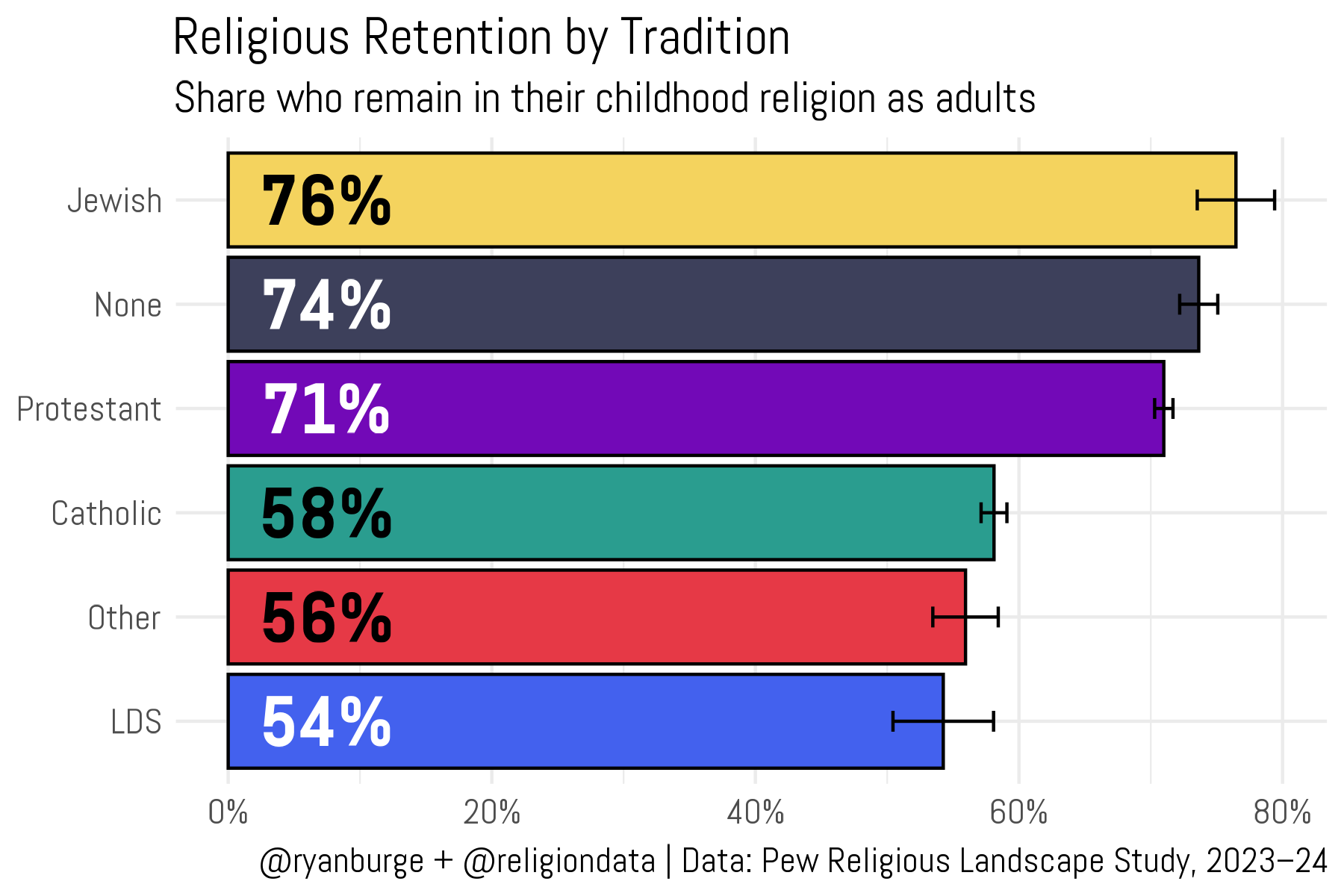
The two groups with the highest retention rates may surprise you: Jews and the non-religious. In both cases, roughly three quarters of people raised in that tradition remain there as adults. Protestants are just a tick lower at 71%.1 After that there’s a notable drop off -- Catholics clock in at just 58%, meaning more than four in ten people raised Catholic have since left the faith.
But when I showed this graph to a couple people, every one of them mentioned the exact same thing: the Church of Jesus Christ of Latter-day Saints has a real retention problem. Just a bare majority of kids raised LDS are still LDS as adults (54%). And whenever I get a flood of questions about a single finding like that, it prompts me to explore it in further detail.
For instance, here’s the overall retention rate of LDS, Protestants, and Catholics broken down by the decade of birth of the respondent. This helps us see whether retention is fading faster for one group than another.
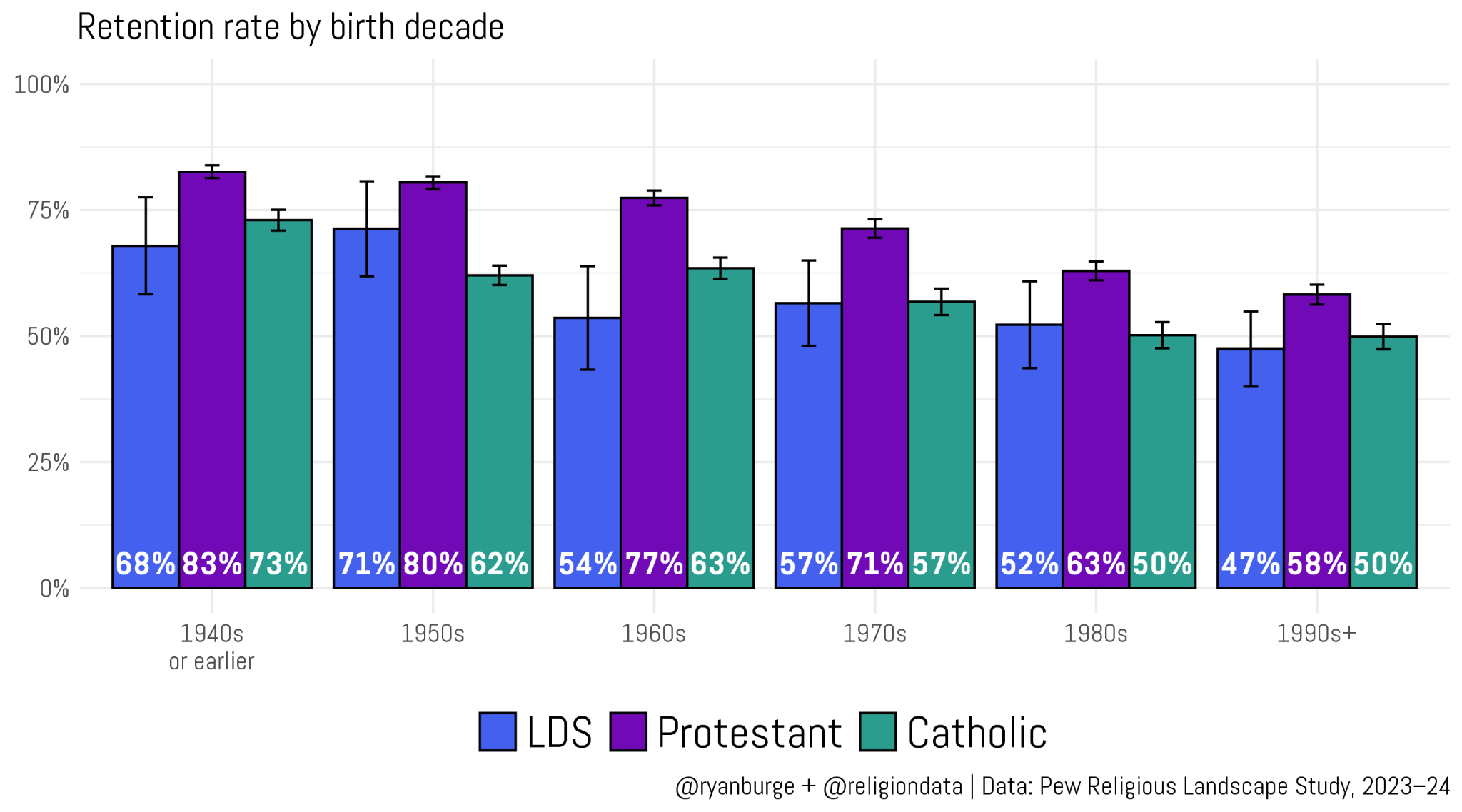
One pattern holds across all three traditions: Catholic and LDS retention are pretty similar to each other, while Protestant retention runs noticeably higher. Among the oldest respondents to the survey, LDS retention was 68%, Catholic retention was 73% and the Protestant number was much higher – 83%. That’s repeated in the next couple of bar graphs, as well.
Retention has dropped across the board — this isn’t a uniquely LDS problem. From the left side of the graph to the right, Protestant retention is down by 25 points, it’s dropped 23 points among Catholics, and it’s off by 21 points for LDS.
The LDS retention decline is real, but it tracks Protestant and Catholic losses almost exactly with all three falling roughly 21-25 points across generations. The real issue is that the LDS started at a lower baseline than Protestants and Catholics and then all three figures declined at essentially the same rate from one generation to the next.
A big question is where did all these Latter-day Saint “defectors” go if they left the Church? It’s important to point out that we don’t have a huge sample to begin with – just 730 folks said that they were raised LDS. And remember that most of them (54%) stayed LDS as adults. But here’s where the other ~300 ended up.
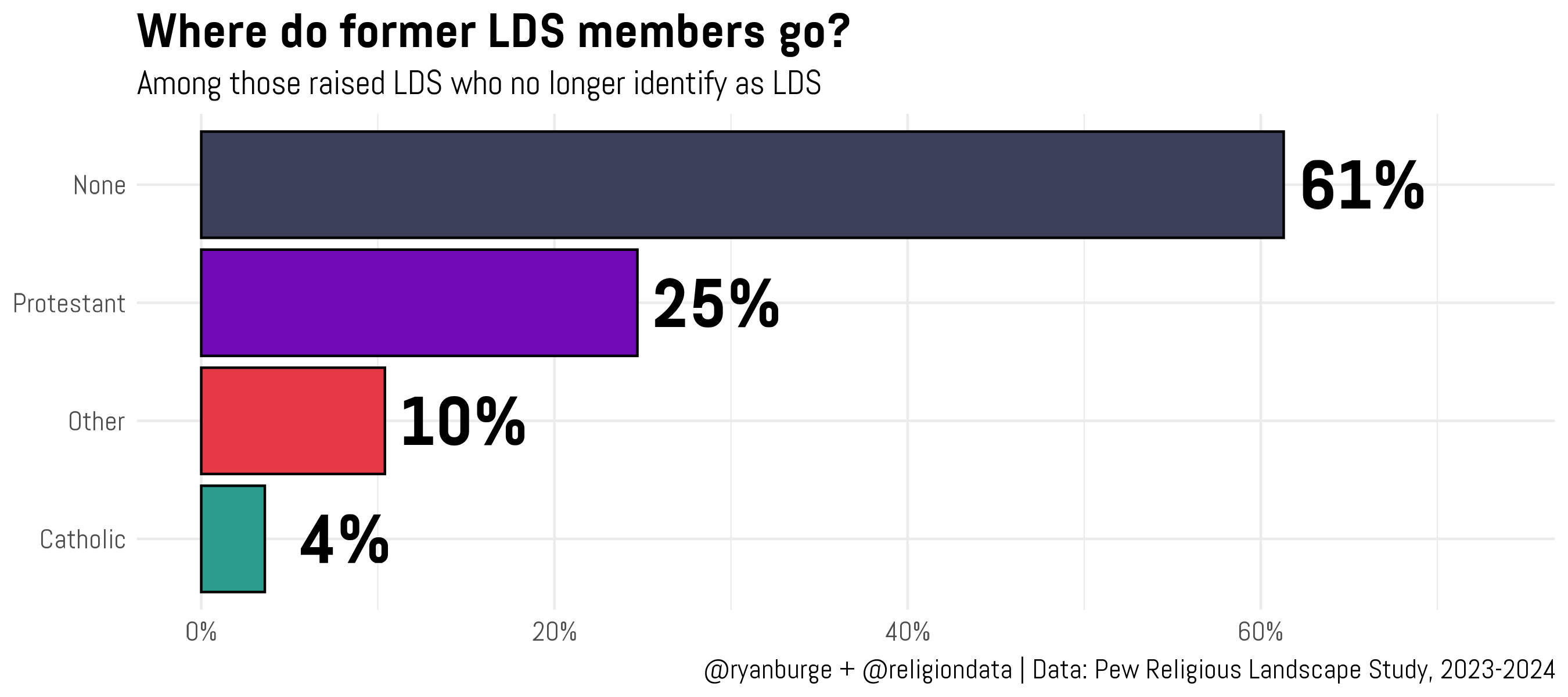
A quick glance at the graph and you quickly arrive at this central conclusion: the vast majority of them (almost two-thirds) joined the growing ranks of the non-religious. The other landing spot for a significant number was Protestant Christianity, about one in five ex-Latter-day Saints.
There were only about 40 in total who ended up becoming Catholic or joining one of the smaller faith traditions like Islam or Buddhism. But it’s hard to make sweeping claims about these folks because they are so rare.
One question we can ask is if those ex-LDS who became members of a Protestant or Catholic Church become actively involved in their new faith community. To test that I plotted the reported church attendance of adult LDS against those who went from LDS to other forms of Christianity.
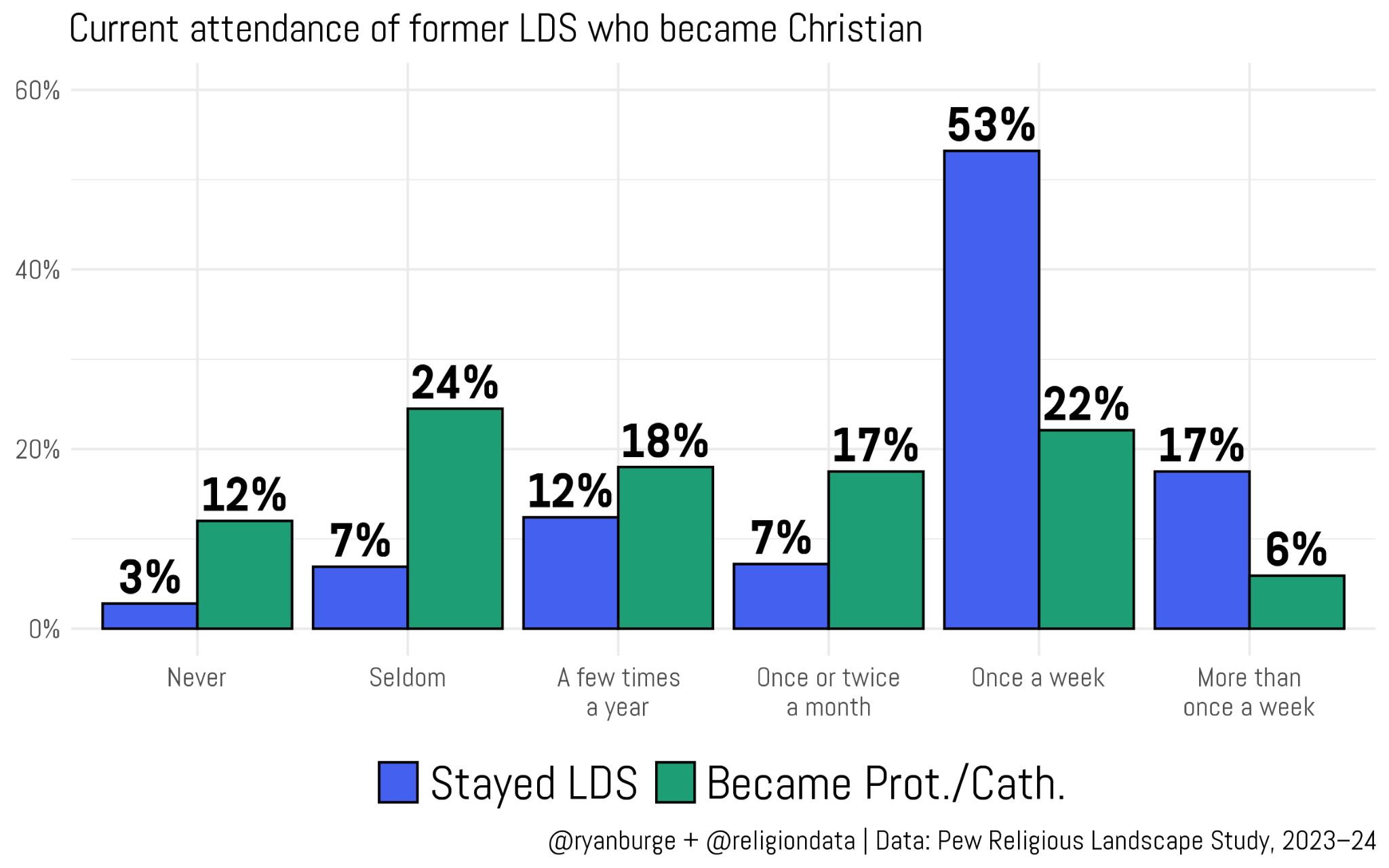
Adult Latter-day Saints are among the most religiously engaged groups in America. In fact, 70% of LDS indicate that they attend church services at least once a week compared to only 10% who say that they go less than once a year. They are, by any objective metric, one of, if not the most, engaged religious groups in the United States today.
That is not the case, however, among folks who leave the Latter-day Saints and become Catholic or Protestant. Among this group of defectors, attendance is significantly lower. Just 28% indicate that they attend their new church on a weekly basis compared to 36% who go less than once a year.
It seems pretty clear to me that the habit of regular church going that is developed growing up Latter-day Saint does not carry over to people who leave the LDS and join another faith community.
To this point, I’ve not really delved into the question of “why do folks leave the LDS church in such significant numbers?” The survey doesn’t ask that directly, but we can get closer by examining political ideology among stayers versus leavers.
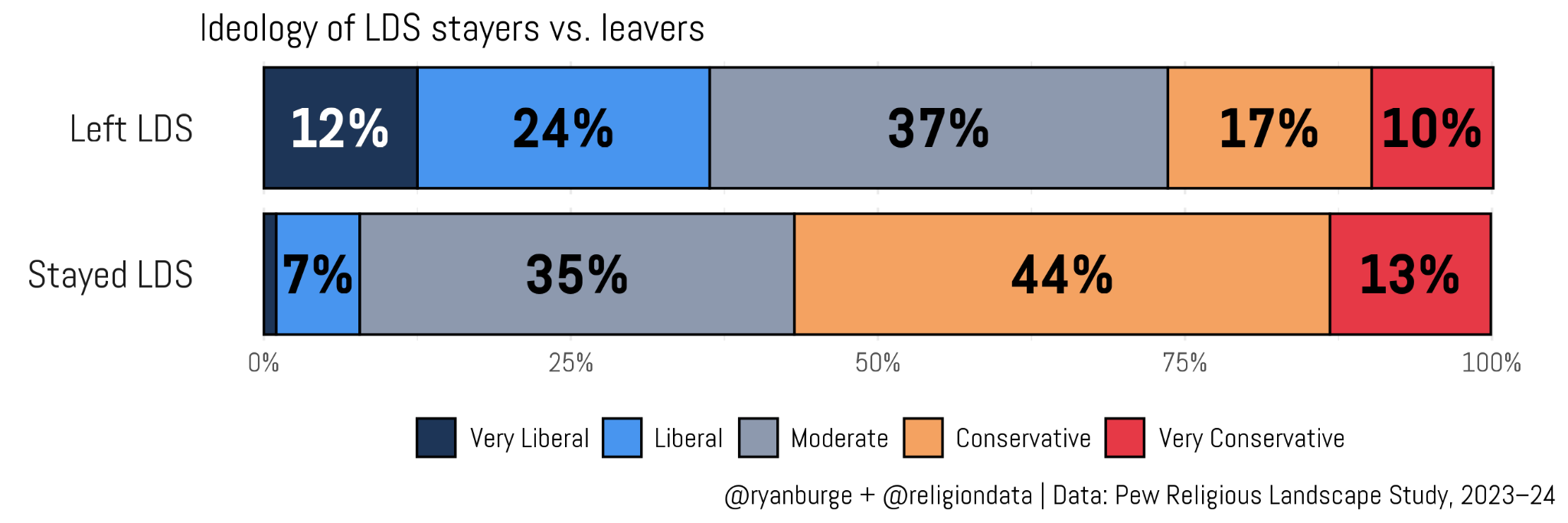
That’s a pretty stark result. For those people who have been LDS their entire lives, conservatism is the norm, with 44% saying that they are conservative and another 13% indicating that they are “very conservative.” It’s hard to find a liberal among lifelong Latter-day Saints, it’s less than 10% of them.
For those who left the church behind, the liberals outnumber the conservatives at 36% vs 27%. The share who are very liberal is actually larger than the share who are very conservative (12% vs 10%). LDS leavers are fundamentally different politically than those who stayed.
Whether politics was a proximate cause of departure is impossible to determine from this data alone — but the ideological gap between stayers and leavers is too wide to ignore
Another potential reason for someone to leave the Church is if they grew up in a Latter-day Saint environment that was not particularly religious. The Pew Survey asks about religious importance for both the individual and the family unit when the respondent was a child.
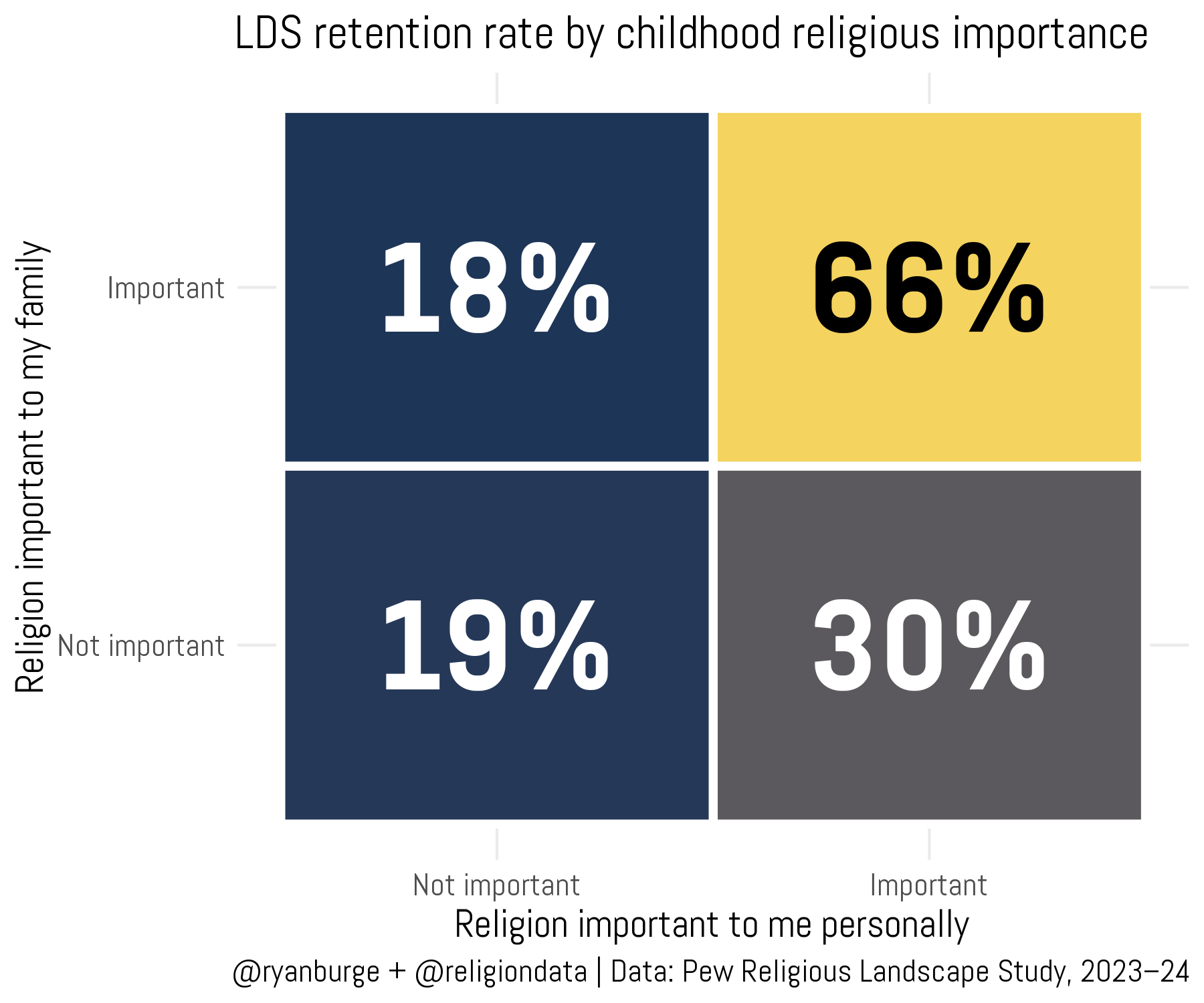
The top right cell is the one that is clearly the outlier. These are folks who say that when they were kids, religion was very important to both them and their family. In this environment of their youth, only about one third of those kids left the Church of Jesus Christ of Latter-day Saints when they became adults. Remember that the retention rate in the full LDS sample was 54%.
What is striking though, is how low retention was among people who were raised in an LDS home but never really internalized their faith. In each case, 80% of these subgroups left the Church at some point in adulthood. It didn’t matter at all whether their family treated religion as central -- if the child never internalized the faith personally, roughly 80% left regardless.
But there’s another variable we can check out that gives us a window into the childhood of folks raised in the LDS Church – how often they attended religious services as a child.
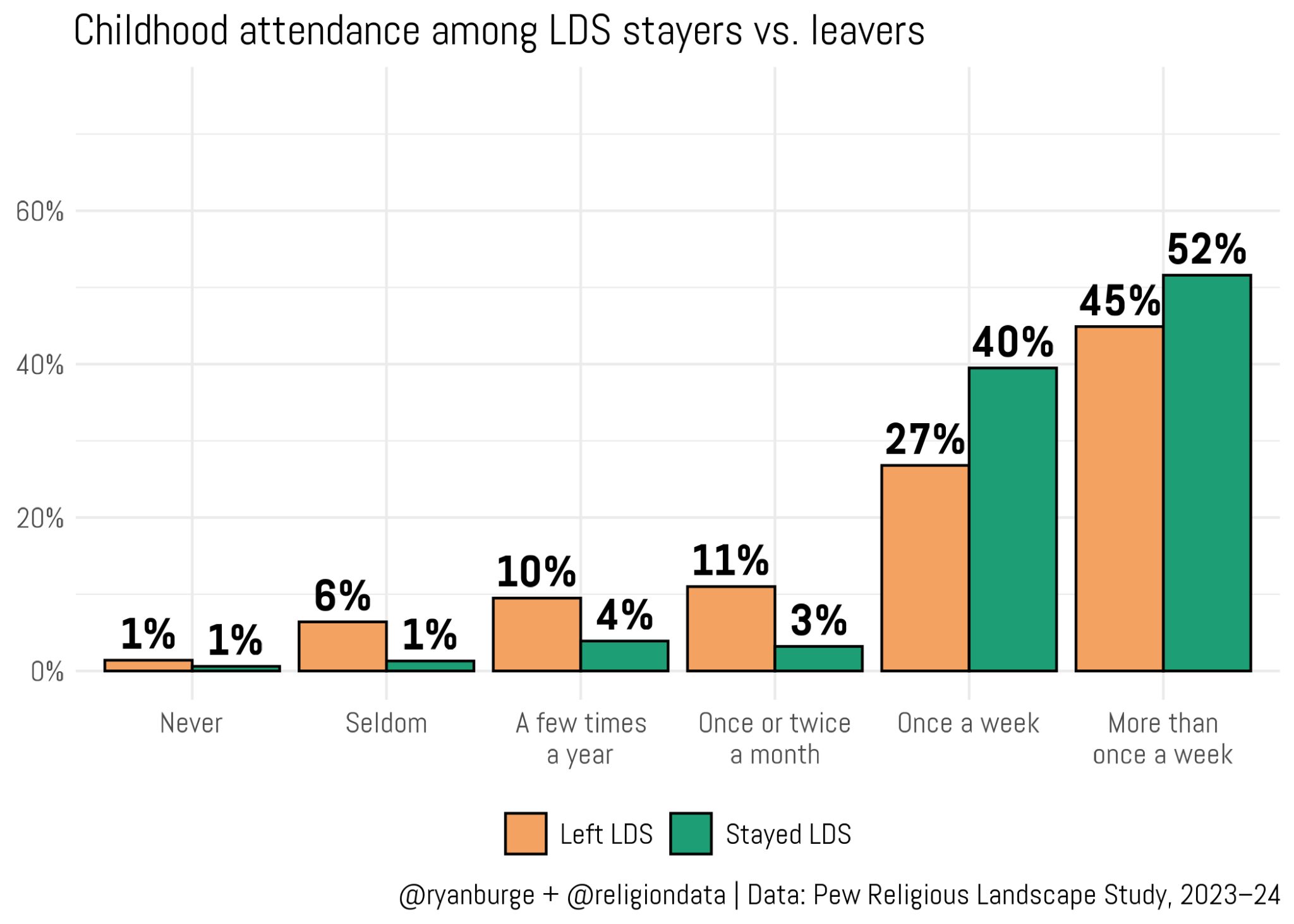
There are certainly differences in the distribution of attendance for those who stayed LDS versus those who left, but I wouldn’t call them dramatic. Among those who were retained, 92% said that as a child they were attending religious services at least once a week. Among those who left the faith, weekly attendance rates were 72%. Twenty points lower, yes — but 72% weekly attendance as a child is still a remarkably high baseline by any measure.
There are differences at the bottom end of the attendance spectrum, too. Among those who left the LDS church, 7% went to church less than once a year compared to 2% of those who stuck around. But, again, it’s not true to say that the average ex-mo was not going to church that much to begin with, when in fact most of them were there every single week.
Among those raised in the LDS faith where religion was very or somewhat important to both their family and themselves and they attended church weekly, retention was about 68%. What about those raised in an environment deficient in at least one of those factors? Retention was a paltry 25%.
I know that it seems tempting to latch on to that second figure. When three quarters of folks leave a faith tradition, that’s a huge defection rate. But I am more stunned by the first number. Even when an LDS family raises their kid in a manner that would lead to the highest level of retention, still one third of those kids leave as they become adults.
What makes that 68% figure even more striking is that roughly two-thirds of all people raised in the LDS faith checked every single box of a deeply committed childhood. And even then, a third of them left.
There are many leaks forming in the styrofoam cup of the Church of Jesus Christ of Latter-day Saints. Retention rates have always been lower than other religious groups and they keep falling with each successive generation. This is a problem that a high fertility rate just can’t fix. The holes in the bottom of the cup are widening each year.
While conversion may be able to add a bit more liquid to the cup, it’s numerically impossible to add people at a rate fast enough to balance out the losses from defection.
If LDS leaders are paying attention to the data, this imbalance is the problem that demands the most urgent attention.
Code for this post can be found here.
Ryan P. Burge is a professor of practice at the Danforth Center on Religion and Politics at Washington University.

A technical note on retention rates: Pew's Religious Landscape Study lets me sort respondents' current religion into the standard evangelical/mainline/historically Black Protestant categories, but it doesn't do the same for the religion they were raised in — that variable only distinguishes "Protestant" as one big bucket. I spent a few hours trying to reconstruct those subgroups using other questions in the survey (whether someone was raised born-again, the racial makeup of the church they grew up in), but the results didn't hold up — the workaround-produced numbers were implausible for mainline Protestants (33% retention) and Black Protestants (52% retention) specifically. So rather than publish a number I don't trust, I'm reporting Protestant-to-Protestant retention as a single category here. It's a blunter measure than I'd like, but it's the one the data can actually support.
This is a wonderful post, Dr. Burge. Thank you.
Given Catholics are quite close to LDS, could we possibly get a similar analysis for Catholics? I'm especially curious to see if Hispanic retention is lower or higher than the population at large and also the retention rate for people who grew up in a high rate of religious practice.
There are other features of LDS that would affect retention. The church has a few geographic clusters: Utah, parts of Idaho and Nevada. They also educate their kids who excel enough to head off to prestigious secular universities and the lucrative employment that follows, mostly outside the geographic clusters. Ryan's graphs indicated political liberal leanings as part of the exit ramp, with the university as a potential demarcation point. The Pew questions likely included some educational attainment and geographic questions. And as these kids become enmeshed as a small successful minority in new places, there is also a challenge of marriage to partners of other faiths and decision on raising children outside the locations of high LDS presence.
Observant Mormonism also puts some lifestyle restraints. Perhaps as people become more integrated to secular culture, some decide they like drinking coffee and quaffing a pint with friends in college, the military, or after work.
As a Jewish observer, we have many of the same challenges with generational transfer, but higher retention. And unlike the LDS, we have a much clearer correlation between childhood observance and adult retention. It is unclear what creates this different outcome.