



This post has been unlocked through a generous grant from the Lilly Endowment for the Association of Religion Data Archives (ARDA). The graphs you see here use data that is publicly available for download and analysis through link(s) provided in the text below.
Who do you talk to when you’re struggling? When it feels like you’re carrying the weight of the world and there’s no way out of the mess you’re in—who can you turn to for an honest conversation? I’d bet that for a lot of us, the answer is “no one.” Many Americans are suffering in silence, without a spouse, a close friend, or even a co-worker they can lean on when times get tough. The loneliness epidemic has real casualties. Of that, I am absolutely sure.
I saw a video on Reddit a couple of weeks ago that got me thinking about this. It was posted in “HumansBeingBros,” a subreddit that exists to make you feel a little better about the world. A motorcyclist comes upon a man walking down the middle of the road, clearly in distress. The rider stops his bike, turns around, and engages with the man—at one point even asking if he needs a hug.
Later in the video, the two of them are sitting against a fence on the side of the road. Here’s the part I love: whoever uploaded it blurred the man’s face and captioned the moment with just a few words—”talked about his struggles.” No details. I can really appreciate that. We don’t need to know what the man was dealing with. He deserves his privacy. The video ends with the police arriving to offer him a ride home.
But it left me with a question: who can people actually talk to in an open and honest way? I’ve got some data from Pew that speaks directly to this. It’s a simple battery of questions from American Trends Panel 142, hosted on the ARDA. The preamble is straightforward: “How comfortable would you be talking about your mental health and emotional well-being with each of the following?” Then respondents rated several options:
Let’s start with the share of each religious group who said they were extremely or very comfortable talking about their mental health with each of those individuals.
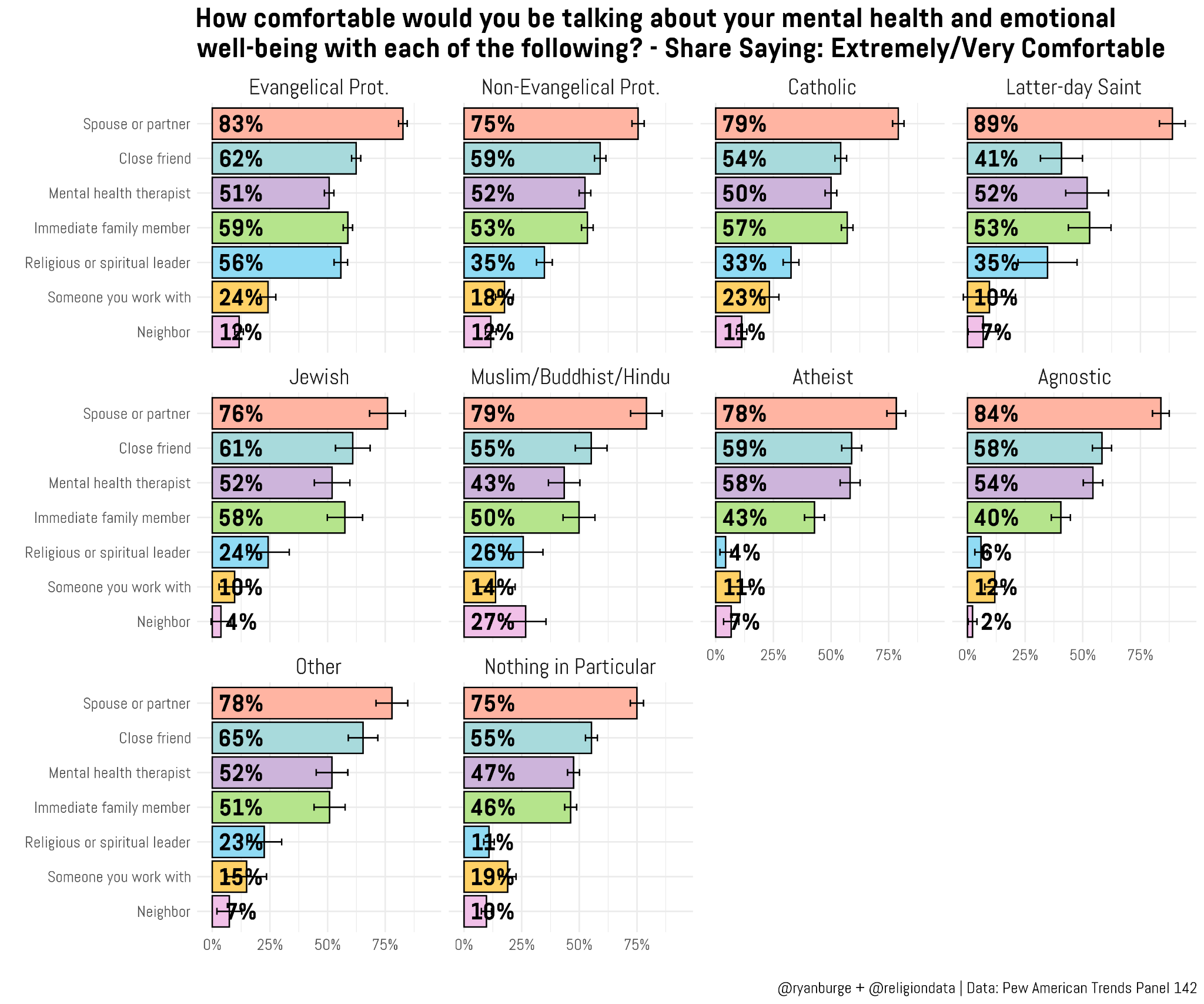
One thing that is crystal clear from this data is that people truly rely on their spouses or partners when it comes to being honest and open about what’s happening in their lives. Among every religious group, the spouse scores the highest, often by a wide margin. The response levels are remarkably consistent, too: most are within a few points of 80%. An interesting outlier is the LDS community—nearly 90% say they are very or extremely comfortable sharing mental health issues with their spouse.
The other groups follow a consistent rank ordering. Close friends, mental health therapists, and immediate family members all rank similarly, typically in the 50-60% range for most religious traditions. At the bottom are co-workers and neighbors, who score poorly; people generally aren’t willing to be vulnerable around them.
But there was one blip in the data worth digging into: the responses regarding comfort levels with religious or spiritual leaders. For most respondents, this doesn’t rank high. Only about a third of non-evangelical Protestants, Catholics, and LDS members feel very or extremely comfortable speaking with their pastor about their struggles. But for evangelicals, that number jumps to 56%—putting clergy in the same neighborhood as immediate family or close friends.
That outlier led me to compare two specific options: speaking with a mental health therapist versus a member of the clergy. I wondered if certain religious groups favored one over the other. The graph below explores that comparison.
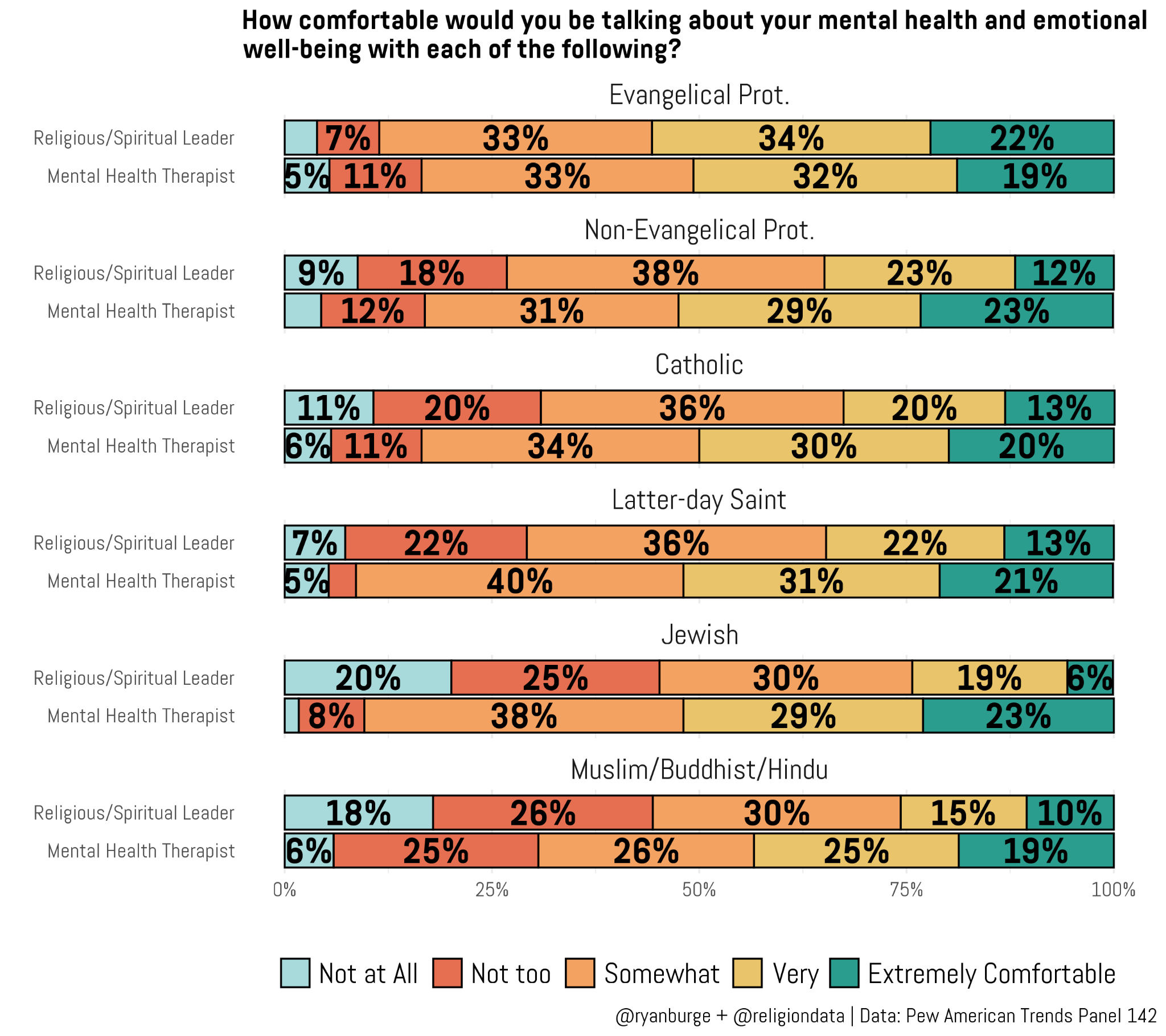
It’s clearly the case that the average person of faith feels more comfortable talking with a counselor than a member of the clergy. Among Catholics, half feel very or extremely comfortable talking to a mental health professional, while only 33% say the same about talking to a priest. For LDS members, those numbers are 52% and 25%, respectively. (This may be related to how the LDS Church is organized, as they do not have a traditional paid clergy). Across almost every group, there’s a clear throughline: people of faith aren’t always keen on talking to their pastors about their troubles.
However, evangelicals are the exception. They are actually slightly more comfortable talking with their pastor (56%) than with a therapist (51%) regarding their emotional well-being.
Part of this may stem from the fact that evangelicals attend church more frequently than other Christians. It stands to reason that being around someone more often makes you more willing to share your struggles. I can test this by breaking down the three largest groups by attendance levels.
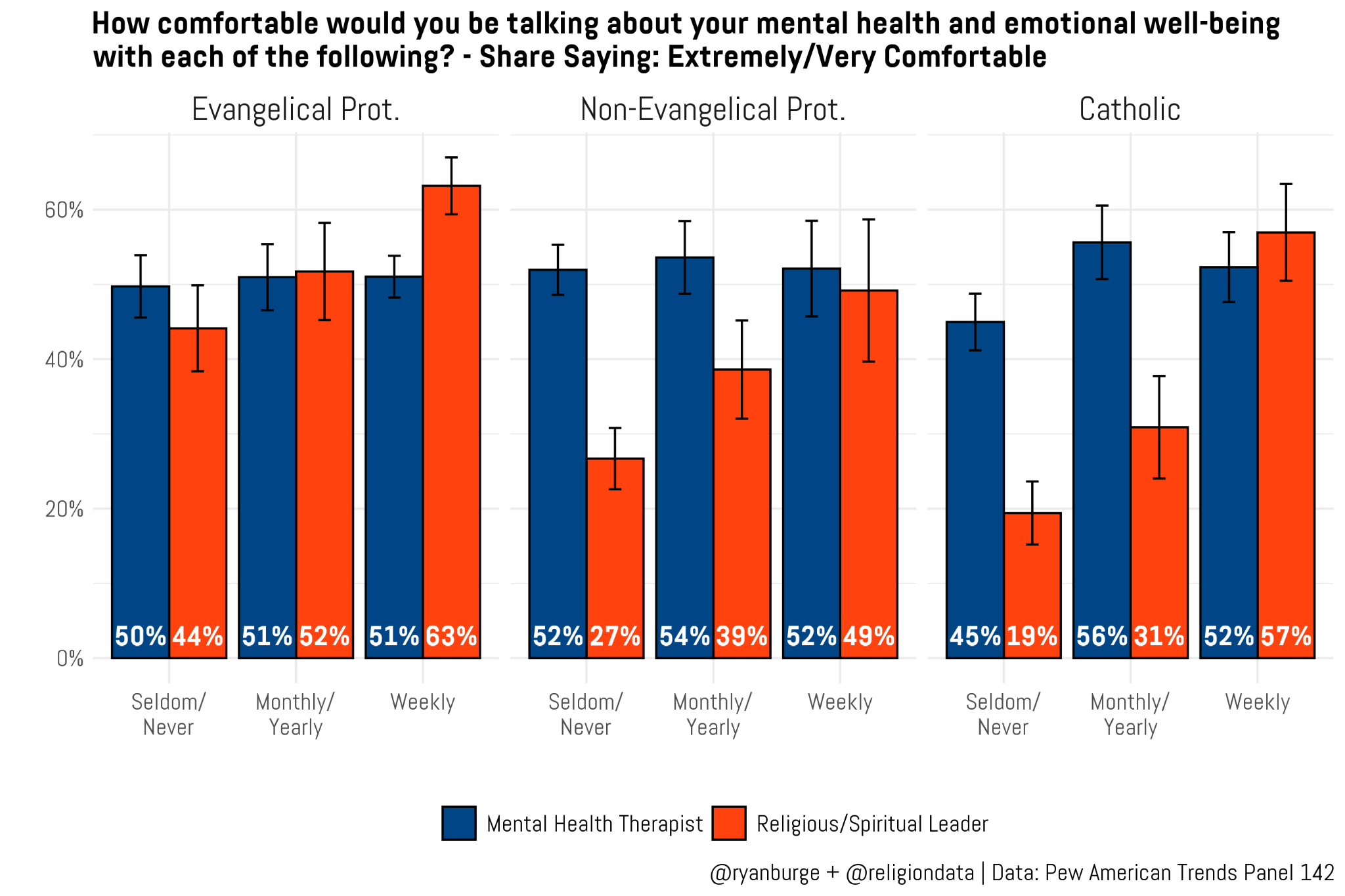
One consistent finding is that church attendance has very little impact on how comfortable someone is speaking to a mental health professional. Across Protestants and Catholics, about half say they are very or extremely comfortable speaking with a counselor. Aside from low-attending Catholics, these differences fall within the margin of error.
However, frequent church attendance does increase comfort levels when speaking to a pastor. For evangelicals, comfort increases from 44% among infrequent attenders to 63% for weekly attenders. For non-evangelical Protestants, it rises from 27% to 49%. For Catholics, the jump is even larger: 19% vs. 57%. Clearly, more religiously active people are more likely to see their pastor as a resource for their mental health journey.
It is worth noting that among weekly attending non-evangelicals and Catholics, the comfort levels for therapists and clergy are nearly identical. For weekly attending evangelicals, however, the preference for their pastor over a therapist is clear.
I also wondered if age played a role in whether Christians are comfortable speaking with mental health professionals. Recent commentary suggests young adults are “The Therapy Generation”—seeking counseling at much higher rates than previous generations. This would suggest that younger Christians might feel more comfortable seeking out a counselor.
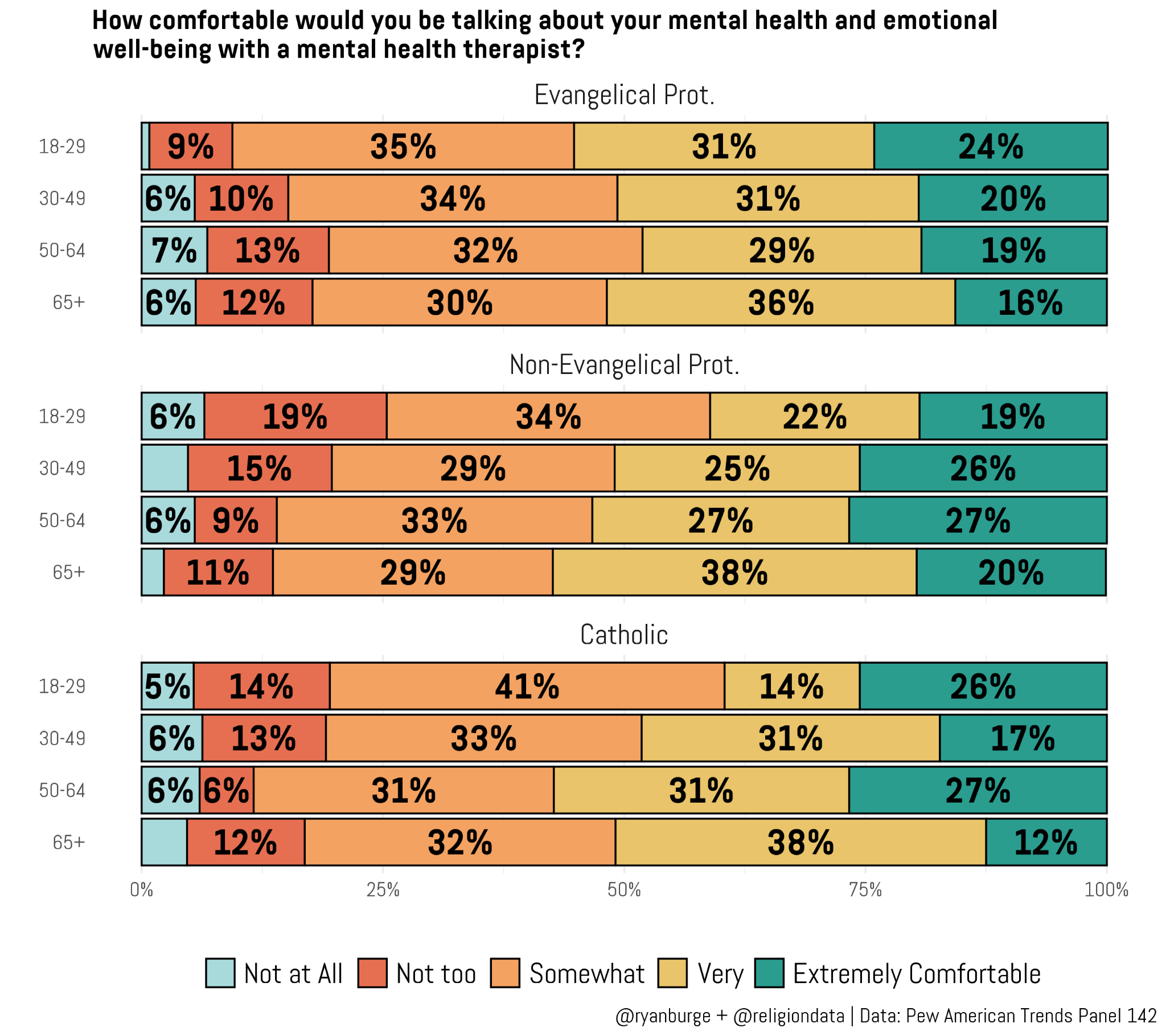
For evangelicals, there is a higher level of comfort among young adults. Of those aged 18-29, 55% are very or extremely comfortable talking to a mental health professional, compared to 48% among those aged 50-64. It appears the stigma is weakening within this group.
However, this trend isn’t as clear for non-evangelical Protestants and Catholics. There isn’t a smooth age gradient in either group. Among Catholics, for example, those aged 50-64 are the most comfortable with therapy. For non-evangelicals, it is the 30-64 age range.
The variation across these religious groups is difficult to pin down.
Many factors could influence openness toward a therapist or clergy member, including gender, race, education, income, and partisanship. To test this, I used a regression model to control for these factors simultaneously, looking at comfort levels with both mental health professionals and religious leaders.
There’s a lot to dissect here.
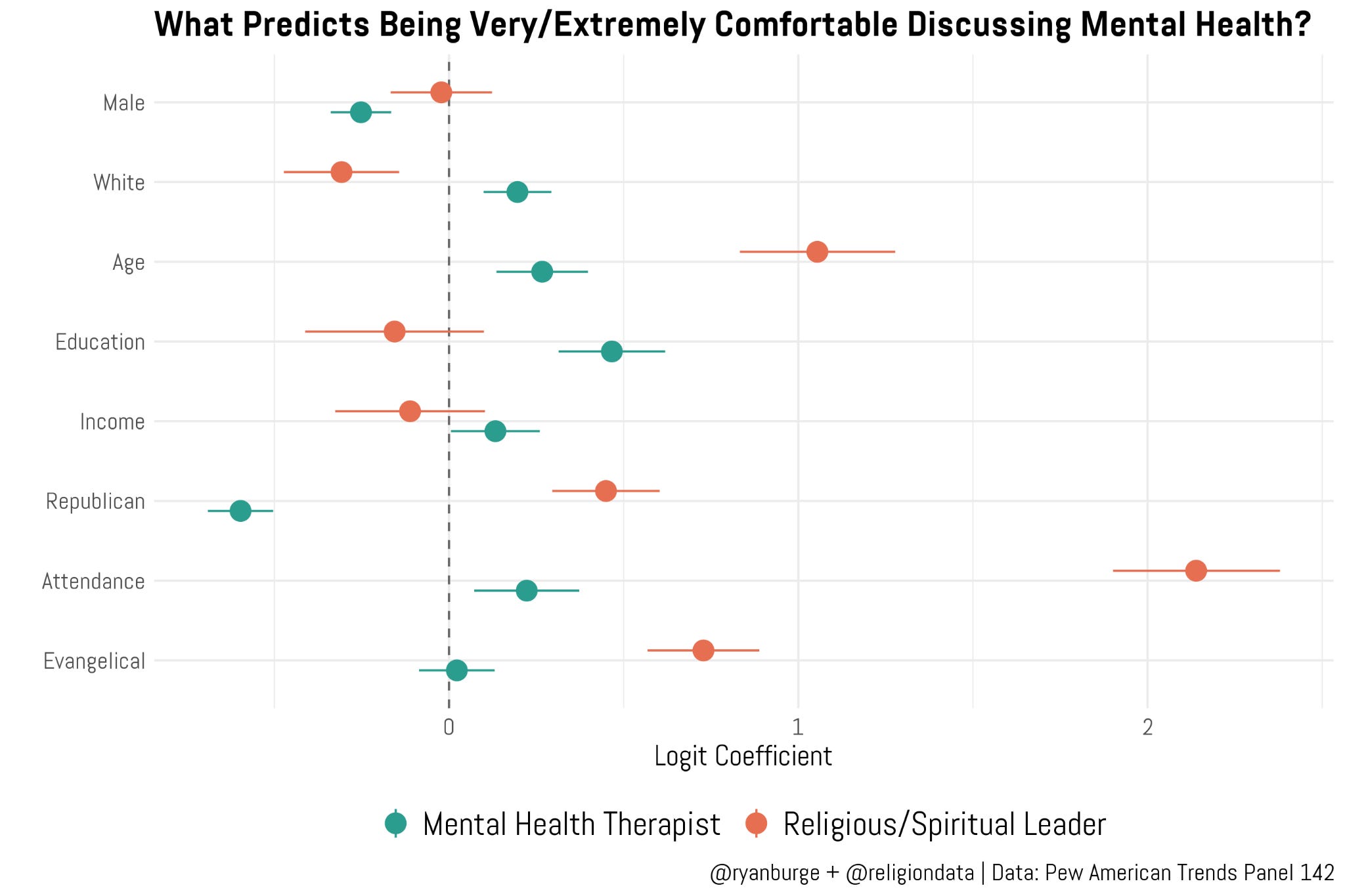
Regarding gender, men are slightly less comfortable talking to a therapist, but it makes no difference when talking to a religious leader. Race also has a differential impact: white respondents are generally more comfortable speaking with a therapist than with clergy. Age works similarly in both models: older individuals are more open to discussing mental health with both counselors and clergy (though the effect is more pronounced for the latter).
The most significant factor is religious attendance, which strongly correlates with comfort in speaking to clergy. Surprisingly, it remains a positive and significant factor for talking to a therapist as well. While identifying as evangelical increases openness with a pastor, it has zero impact on comfort levels with a therapist.
The variable that stands out most is Republican identification. It works in opposite directions depending on the confidant. A Republican is significantly more comfortable talking to a member of the clergy about their mental health, but significantly less comfortable opening up to a therapist. In fact, partisanship is the strongest negative predictor of therapist comfort in the model—surpassing gender, race, and education.
This holds true even after controlling for religious attendance and evangelical identification. It isn’t just that Republicans are more religious; even two people in the same pew every week will differ—the Republican remains measurably more wary of the therapist’s couch than the Democrat. Comfort with mental health care has become another facet of political sorting in the U.S.
Why Republicans are more averse to therapists is a question for another time. My more pressing concern is for the man in that video. Did he have no one in his life he could talk to? What would have happened if that motorcyclist hadn’t driven by?
Social atomization has real consequences, both seen and unseen. And as this data shows, the question isn’t just whether Americans have someone to open up to — it’s that even the answer to “who would you trust?” now depends on their politics, their education, and their pew. The doors people are willing to walk through are different. What matters is that they walk through one.
Code for this post can be found here.
Ryan P. Burge is a professor of practice at the Danforth Center on Religion and Politics at Washington University.

I'm actually pleasantly surprised that Evangelicals score as high on comfort with mental health specialists as they do. I know many Evangelicals who are vocally against anything linked to modern psychology. It's easy to think that a vocal minority represents the rest of the community. I'm encouraged that this appears to not be the case in this instance!
I am not surprised that Republicans of all religious leanings are more reluctant to seek help from mental health counselors than political liberals are. There is a whole movement in mental health counseling right now on the "ethical duty" of mental health professionals to "educate" clients on anti-racism and social justice as part of normal clinic visits. There are also ever-expanding mandatory reporter guidelines on when a counselor must report a client for being a threat to others. This, combined with the fact that politically- or culturally-conservative counselors are rare as hens' teeth, provide disincentives for conservatives to seek counseling.
If I'm politically conservative and suffering from depression, do I go back if the first part of my visit was spent on a lesson on structural racism? Do I tell my friends to see a counselor after that happens, even if I truly believe they need help? If I know I'm suffering from anxiety, do I tell a counselor that a source of my anxiety is my 7-year-old homeschooled daughter playing outside with no supervision, or am I risking having her taken away?
I'm not an American conservative, and I wouldn't see an American counselor knowing what I know about current practice in American counseling.