


Every once in a while, an academic book gets published with a title that’s hard for me to forget. I mean, Bowling Alone is just an all-timer, right? What most people don’t know is that Putnam’s first book about Italy is assigned much more frequently in graduate schools. I know I read it in the Comparative Politics ProSeminar, but I couldn’t remember the name — it’s Making Democracy Work: Civic Traditions in Modern Italy. Not nearly as catchy.
There are a couple of books in the sociology of religion that always stick in my head, too. American Evangelicalism: Embattled and Thriving is one I will never forget. Another was released a few years ago that keeps coming back to mind — Religion Is Raced: Understanding American Religion in the Twenty-First Century. It’s an edited volume, and I bet you can guess the subject matter just from the title.
Religion in the United States “works” differently for Asian Americans compared to African Americans. The average white American doesn’t think about religion the same way, or practice their faith in the same patterns, as Hispanic Americans. Race is a central component of how religion operates in the American context. But despite those varied expressions, I wanted to try to answer, with as much data as I can muster, a deceptively simple question: which racial group is the most religious?
To do that, I’m going to use the Pew Religious Landscape Study, because it has a huge sample size (~37,000) and asks a ton of questions about the various manifestations of religion, which are primarily along the dimensions of behavior, belief, and belonging. For more on this, I will always link to this post: What Does it Mean to Be Religious?
Let’s start with the religious composition of each racial group.
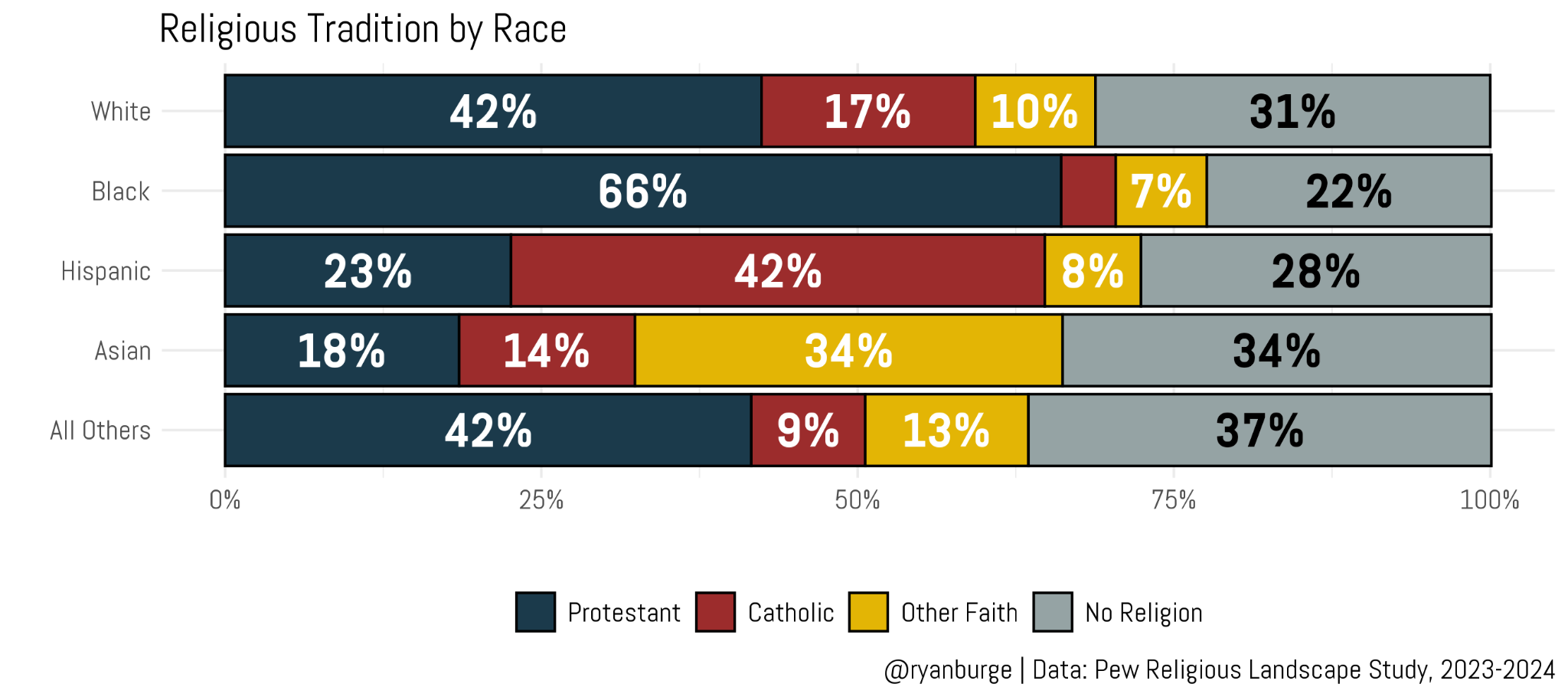
Huge differences emerge right away. Which group is the most likely to be Protestant? That’s Black respondents, by nearly twenty-five percentage points. The most likely to be Catholic? Easily Hispanics at 42% — again, about twenty-five points higher than any other group.
Asian Americans are far and away the most likely to identify with another faith tradition, a category that includes Jews, Hindus, Muslims, Buddhists, and the like. In the rest of the population, those groups rarely combine for more than 10% of the sample. What about the nones? The “All Others” category leads the pack at 37%, followed closely by Asian Americans at 34%. I also need to point out that Asian Americans are the only racial group that is not majority Christian, too.
What about religious importance? This is where a clear pattern starts to emerge.
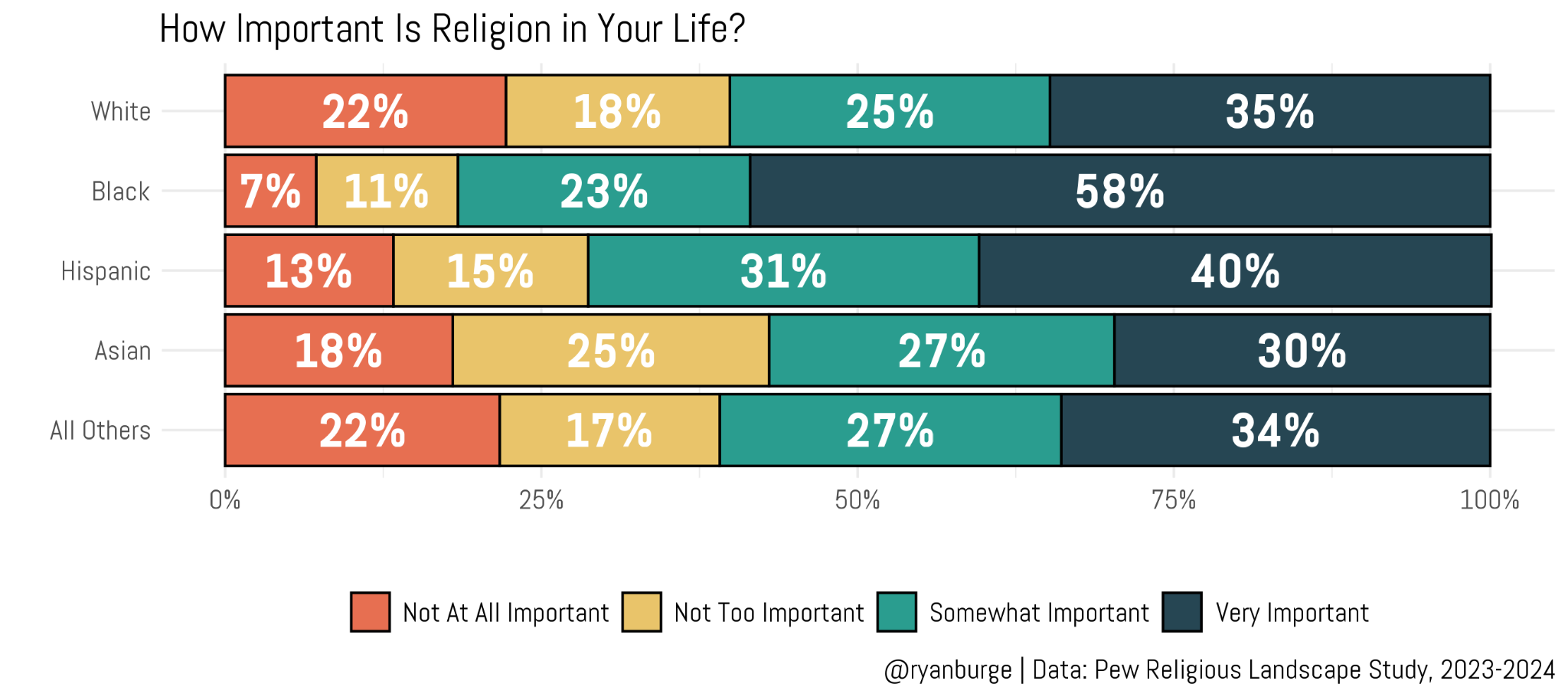
Black respondents are, by a long shot, the most likely to say that religion is very important to them — 58%, compared to 30-40% for every other racial group. In fact, only 18% of Black respondents say religion is not too important or not at all important to them. That’s ten points lower than any other group.
By contrast, 22% of white respondents say religion is not at all important, the same share as the “All Others” category. Among Hispanic respondents it’s only 13%, and among Asian respondents it’s 18%. Looking at this graph in totality, it’s fair to say that African Americans are the most religious, Hispanic Americans are next in line, and then it’s basically a tie between white Americans, Asian Americans, and everyone else.
When I analyzed a question about belief in God, the same pattern came up again.
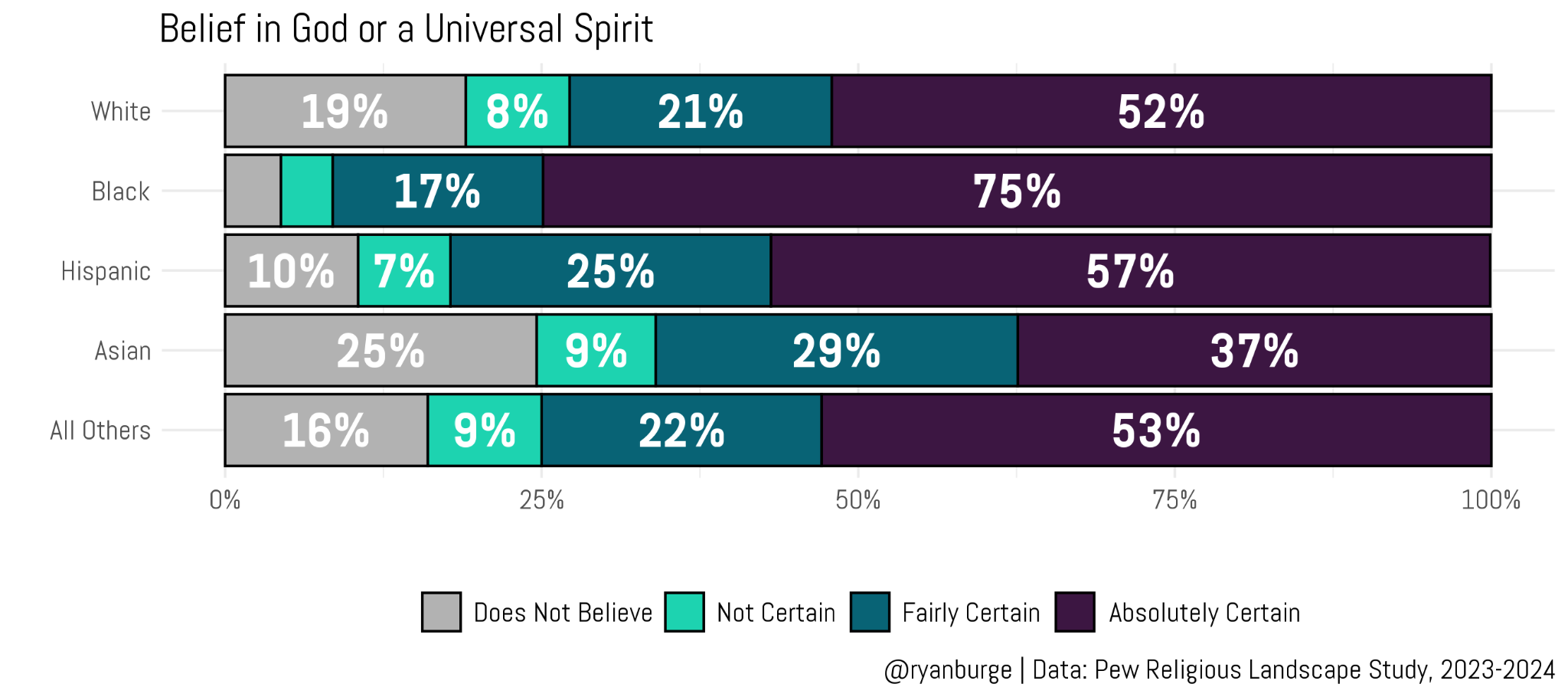
Black respondents are undoubtedly the most likely to believe in God without a doubt — 75% of them. The share of African Americans who say they don’t believe in God at all is tiny, about five percent. You get a clear sense from this graph that African Americans, on belief metrics, are just in a different world than every other racial group in the United States.
Then the next question becomes: who is the least likely to believe? The answer is Asian Americans. Only 37% believe in God with absolute certainty — fifteen points lower than white Americans, who come in second-to-last on this measure. At the same time, 25% of Asian respondents say they don’t believe in God at all, easily the highest of any group.
On religious importance, African Americans are clearly in the lead. On belief in God, it’s African Americans again — but for the other groups, it’s hard to settle on a rank ordering. Maybe questions about religious behavior can break the tie.
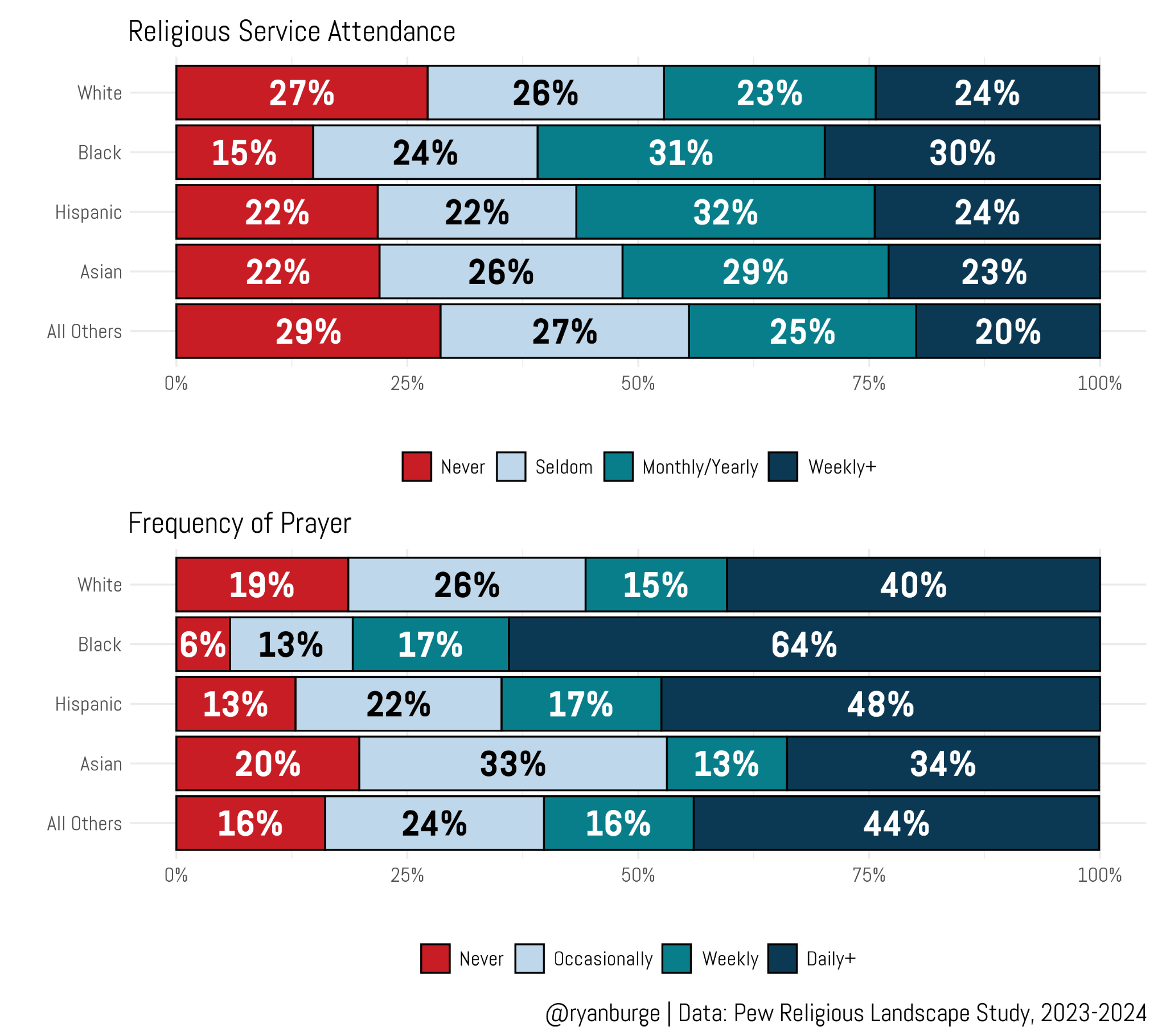
When it comes to religious service attendance, Black Americans are the most likely to report weekly attendance at 30% — six or seven points higher than white, Hispanic, and Asian respondents. In total, 61% of African Americans say they attend church at least yearly. That’s about five points higher than Hispanic respondents, who come in second.
At the bottom end of the scale, 27% of white respondents say they never attend. It’s 29% among “All Others,” and 22% for both Hispanic and Asian respondents. Those numbers are close enough that it’s hard to say definitively which group is the least likely to darken a church door.
Prayer frequency follows the same script. African Americans are clearly in the lead — nearly two-thirds of them pray every single day. Among Hispanic respondents, 48% pray daily and another 17% pray at least weekly, which means about two-thirds are praying on a weekly basis. That’s roughly ten points higher than white respondents and eighteen points higher than Asian respondents.
So on religious behavior, the picture is: African Americans, and then everyone else in a muddled pack.
But what happens when I combine all four of these items into a single composite measure? I constructed the scale to run from 0 to 10, with 0 indicating the least religious and 10 the most religious. This additive index brings some real clarity to the question.
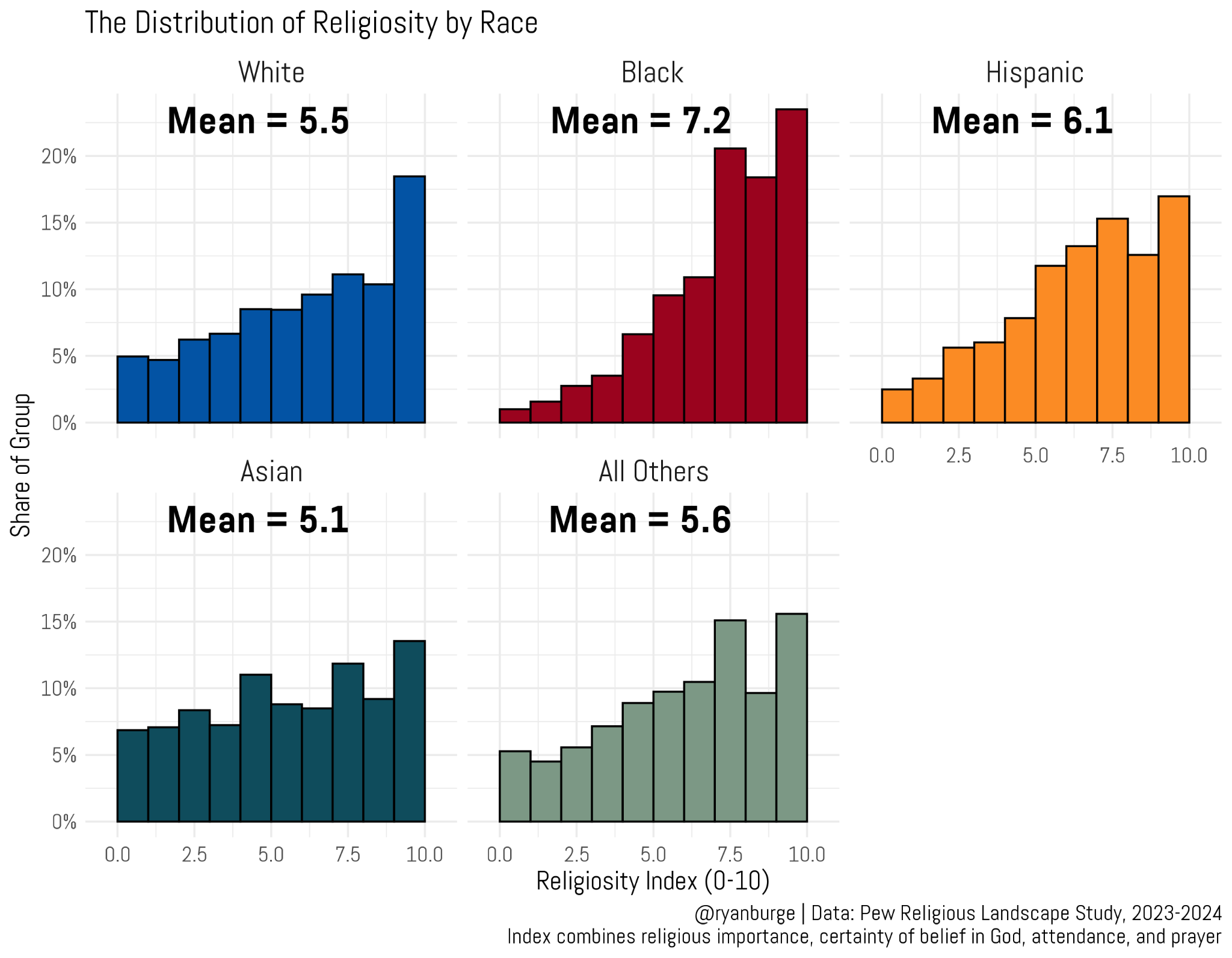
For anyone paying attention to the prior analysis, it should be no surprise that African Americans score the highest — 7.2 out of 10. The share of African Americans scoring at least a 9 on this index was 28%, which is eight points higher than white Americans and ten points higher than Hispanic respondents. No matter how I measure it, African Americans lead on the question of which racial group is the most religious.
The comparison between the white histogram and the Hispanic histogram is the most statistically interesting one in this graph. Hispanics post the higher mean on this index — 6.1 versus 5.5 for white respondents. Yet look at the far right edge of each panel: there are clearly more white respondents maxing out the scale than Hispanic ones.
So why is the Hispanic mean about half a point higher? It’s the middle of the distribution. Nearly 71% of Hispanics score at least a 5 on this index, compared to just 59% of white respondents. Meanwhile, 26% of white respondents land below a 3, compared to only 16% of Hispanics. Said another way: white America contains a smaller group that is incredibly religious and a much larger bloc that isn’t religious at all. Hispanic religiosity doesn’t have that hollowed-out bottom — the typical Hispanic respondent sits comfortably on the religious side of the scale.
And when it comes to the question of which racial group is the least religious, I think this graph makes it clear: Asian Americans, with a mean of just 5.1. Only 52% of Asian respondents score at least a 5 out of 10, which is seven points lower than any other group. And here’s a startling data nugget: for every Black American who scores near the bottom of this index, there are more than four who score a nine or higher. Among white Americans, the bottom group is actually larger than the top one
But what happens when I throw age into the mix? Maybe the religiosity gap is closing among young Americans?
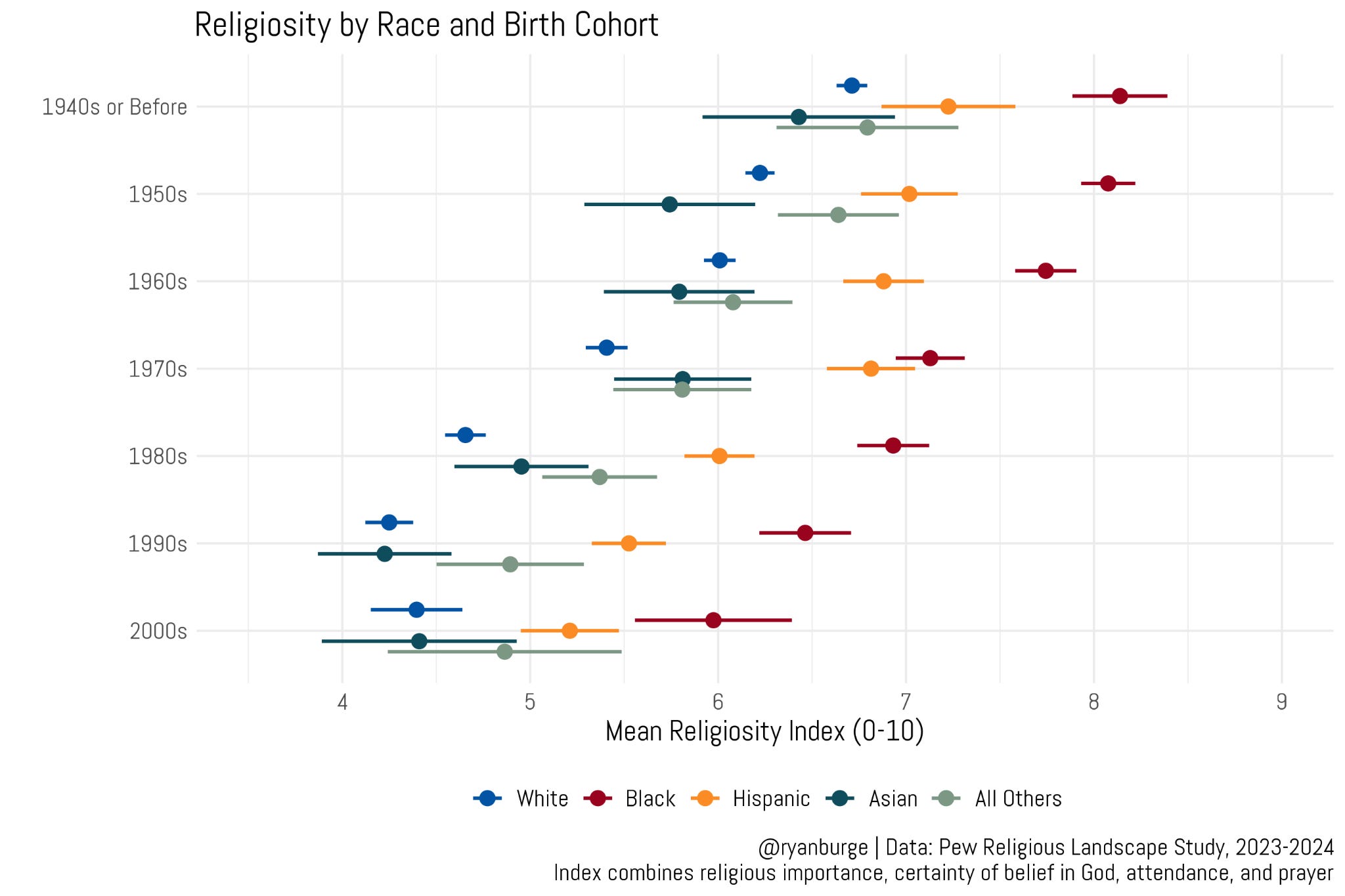
One macro-level trend that’s hard to deny: each successive birth cohort is less religious than the one before it, and that’s true across all racial groups. Among the oldest African Americans, the mean score is about 8 out of 10. Among the youngest, it’s only 6.
However, the gap between African Americans and everyone else persists across nearly every birth cohort in this data. There’s one aberration among people born in the 1970s, where Hispanic and Black respondents post essentially the same level of religiosity. In every other cohort, Black respondents score noticeably higher than anyone else.
I also have to point out the white respondents, especially those born in 1980 or later. Among these younger white adults, the average score is 4 to 4.5 on a ten-point scale — about a point lower than Hispanics from the same birth cohorts and roughly two points lower than African Americans born in the same decades.
But the overall rank ordering holds. African Americans are easily the most religious, followed by Hispanic Americans. In the full sample, white Americans were about half a point more religious than Asian Americans, but I’m not sure that’s going to hold up in future generations.
So there you have it. African Americans are significantly more religious than anyone else, whether you measure it through behavior, belief, or belonging. It holds up among older respondents and younger ones, too. That’s the clear thread running through all this data.
But it’s also hard to deny this: a young African American — while notably more religious than their peers — is still significantly less religious than the average Baby Boomer.
Secularism is coming for us all, and I wonder if there will be a new edited volume someday: Non-Religion Is Raced.
Code for this post can be found here.
Ryan P. Burge is a professor of practice at the Danforth Center on Religion and Politics at Washington University.

This is one of the most revealing and insightful articles you have given us. And, of course, it reveals that race is a factor and predictor.
While it seems that us Boomers are the most religious across race, we don’t tend to think that way because we remember the most religious who were the GI generation.
One question I ponder is which group by age and race might be more open to religious faith. For example, are the reports of young white men turning to the Catholic Church statistically significant or anecdotal?
The press keep reporting on this, but I remain skeptical 🧐 I don’t doubt that it is meaningful to those who do, just wondering if it’s statistically significant. I hope it is.
The age graph is especially interesting. Those born before 1970 personally experienceds 11AM Sunday mornings to be the most segregated hour in America, much as MLK wove into many speeches. The church served not only as a religious center but as a place of advocacy. Once mission accomplished with legislation and principal leader assassinated, the African-American generations which followed seemed to tail off on their attachment to church more quickly than some of the other groups. It might be interesting to do some of the correlations with education and income/wealth which has expanded since that era, though not for everyone.
For the Asians, not all are monotheistic, so no surprise that belief in God would lag. It may not be a great measure of religiosity for Buddhists and Confucians who have no deity or Hindus who have many. Do know what a better surrogate for belief would be, though.