


My book The Vanishing Church just released on Tuesday (1/13). I have a couple of events that I wanted to make you aware of regarding its release.
I am doing an online discussion with the wonderful Adelle Banks of Religion News Service. It will be on January 20, 2026 at 11am Central Time. You can register for that event here.
I am also doing an online discussion with the Trinity Forum on January 23 at 12:30pm Central Time. You can register for that event here.
And please order a copy of the book. If you are a faithful reader of this newsletter, it’s right up your alley.
Where are there lots of evangelical Christians in the United States, and where is it hard to find one? That’s actually a really difficult question to answer from a methodological perspective. Very few surveys offer enough granularity to provide rigorous state-level estimates, let alone data at the county level. But because of the rapid acceleration of Artificial Intelligence, I can actually provide you all with a really good answer now.
The 2020 Religion Census lists over 400 traditions of all kinds. I wanted to aggregate them into their larger religious families. For instance, Reform, Orthodox, and Conservative Jews need to be placed in a larger “Jewish” category. That didn’t take much work. That’s not so easy for Protestant Christianity. In fact, there were about 350 groups listed that needed to be sorted. Here’s how I solved that: Artificial Intelligence. I fed the list into both ChatGPT and Gemini and had them iterate over all those denominations to sort them into three categories: Evangelical, Mainline, and Black Protestant.
Even with the help of AI, I had to do this exercise a bunch of times just to get to a list that I felt pretty good about. I would run my classifier, check the top 50 largest Evangelical denominations, and inevitably find one that was not supposed to be there. Right now, I’m about 98% confident that this list is as good as it’s going to get. There are certainly no large Protestant denominations that are misclassified. You can check my work:
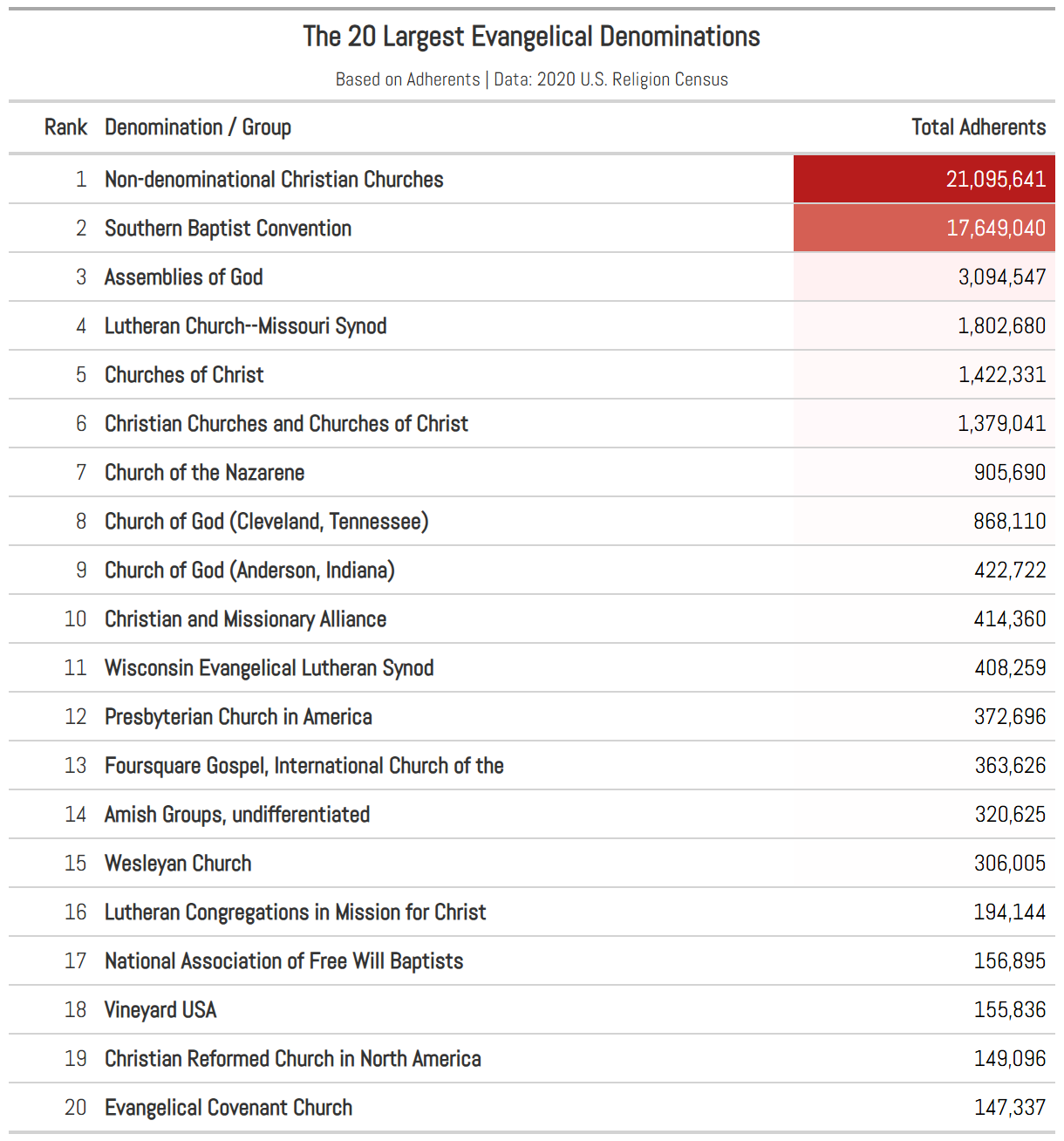
I don’t think anyone could look at this list and have any major gripes about these groups being classified as Evangelical. Maybe the Amish? But if they aren’t Evangelical, then what are they? They certainly aren’t Mainline Protestants or part of the Black Church. But here’s a point I want to make clear: The Religion Census identified just over 53 million Evangelicals in the country. If you add up the membership of just the first three traditions listed (Southern Baptists, Non-denominational, and the Assemblies of God), that’s nearly 80% of all Evangelicals right there.
I tell you that to make this point clear—while I’m not completely confident in these results due to the subjective nature of doing something like this, I do feel sure about this point: it almost certainly won’t make a material difference in any of the analyses that you see here. Missing a denomination of 80,000 folks just doesn’t move the needle at the macro level, because that group makes up about 0.1% of Evangelicalism.
So, what is the largest Christian tradition in each county in the United States? Well, here’s what that looks like visualized:
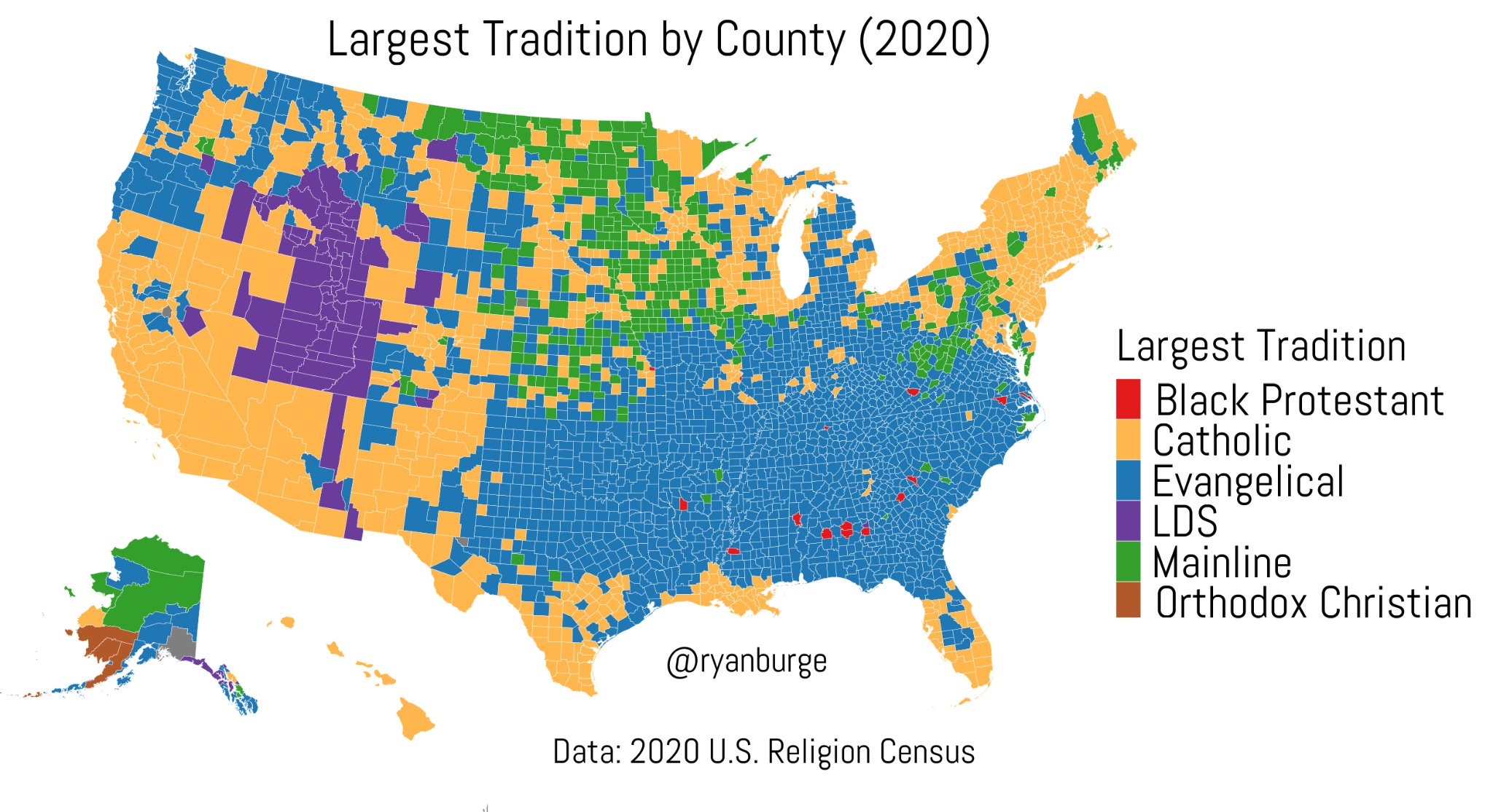
In 59% of counties in the United States, evangelicals are the largest tradition. You can clearly see that on the map here—they dominate in places that we would describe as “the Bible Belt.” But it’s not just the usual suspects like Mississippi and Alabama where one can find a bunch of evangelicals. In fact, there are a whole lot of evangelicals in places as far north as Illinois, Indiana, Michigan, Virginia, and Pennsylvania. It’s really impressive how consistent they are across a huge swath of the country.
Most Churches Aren’t Growing — What We Can Learn from Those That Are

I’ve been around churches my entire life—specifically evangelical ones. There’s a certain kind of conversation that happens among pastors and denominational leaders, usually in almost hushed tones: “Did you hear about how [insert church name] added a thousand new attendees last year?
Catholics, on the other hand, are the largest tradition across one-quarter of all the counties in the United States. But here’s what is really interesting about that—numerically speaking, the Catholic Church has more members than evangelicalism (62M vs 53M). The reason for the huge disparity is that Catholics are more concentrated in urban areas. That’s a point I will come back to a bit later on.
The mainline is the largest in just 12% of counties in the United States, mostly in the Great Plains and Upper Midwest. But you do see some pockets of the mainline in Pennsylvania and New York State, and just a touch up in Maine, too.
Latter-day Saints lead in just 2.7% of all counties, and you can pretty easily ascertain where that is on the map: Utah and the bordering states. The Black Church is only the largest in a total of 15 counties, and those are dotted in the middle of the traditional Bible Belt.
Okay, but let’s pivot back to evangelicals more specifically for the rest of this post. This is a map of evangelical concentration at the county level in 2020.