


Every once in a while I will get interviewed for a story about a church closure or the decline of religion or something similar and this question will come up, “Why should non-believers really pay attention to this downward trend? How are they going to be impacted by the closure of a local Methodist or Baptist church?” It’s a fantastic question, by the way, and I really love when people ask me about it because it gives me a chance to talk about the fact that religious organizations (from all backgrounds) do all kinds of “invisible” stuff for the community that lots of people don’t realize until it’s too late.
In my community, the church I attend has a tremendous mission called Angels on Assignment. They own a small building that’s just across the street from their sanctuary. At least once a week they are open for business, which is to give out clothes and food for folks who are in need. They also have a financial aid operation. On Fridays they have a food pantry that opens at 9am. A line will be forming down the sidewalk two hours before that.
But that’s the kind of ministry that is hard to miss. There are all kinds of other stuff that churches do that is often overlooked – they provide a place for folks to vote in local elections, host blood drives, and allow outside groups to meet like Alcoholics Anonymous. I worry about where these types of organizations will set up shop if lots of houses of worship close their doors.
I was thinking about this problem the other day and was wondering if I could actually quantify something like that. What follows is my best effort to put numbers to ideas.
Here was my question: could I actually figure out what share of Alcoholics Anonymous meetings happen in churches? It became something of a methodological mountain for me to climb. AA has no central database of meeting locations in any clean, analyzable format. The organization’s famously decentralized structure, a feature for those in recovery, turns out to be a significant obstacle for researchers. Meeting finder websites exist, but the data is user-generated, meaning addresses are inconsistent, outdated, or simply wrong. After several dead ends, I had to ask myself whether the question was even answerable.
But I did figure it out, at least partially. It turned out that a subset of AA intergroup websites publish their meeting listings as server-rendered HTML tables, which meant they were scrapeable with standard tools. After probing dozens of intergroup sites spread across the country to identify which ones were accessible, I scraped the venue names directly and ran them through a keyword matching algorithm that flagged religious language, both generic terms like “church” and “chapel” and specific denominational names. It is an imperfect method, but it got me to an answer.
Some caveats, though.
This list is only ~25 intergroups. It doesn’t represent the entire country. The coasts are largely missing.
This is totally biased toward groups that made it easy to scrape their websites.
Using keywords to guess religious venues for these meetings is imperfect. There’s no way around this unless you want to read through 10,000 meeting descriptions.
I’m not going to try and publish this anywhere. But I really do think that we can learn a lot from this limited data collection. So, with all that explained – let’s show you what I found.
Let’s just start with visualizing how many meetings I was able to analyze across all these cities.
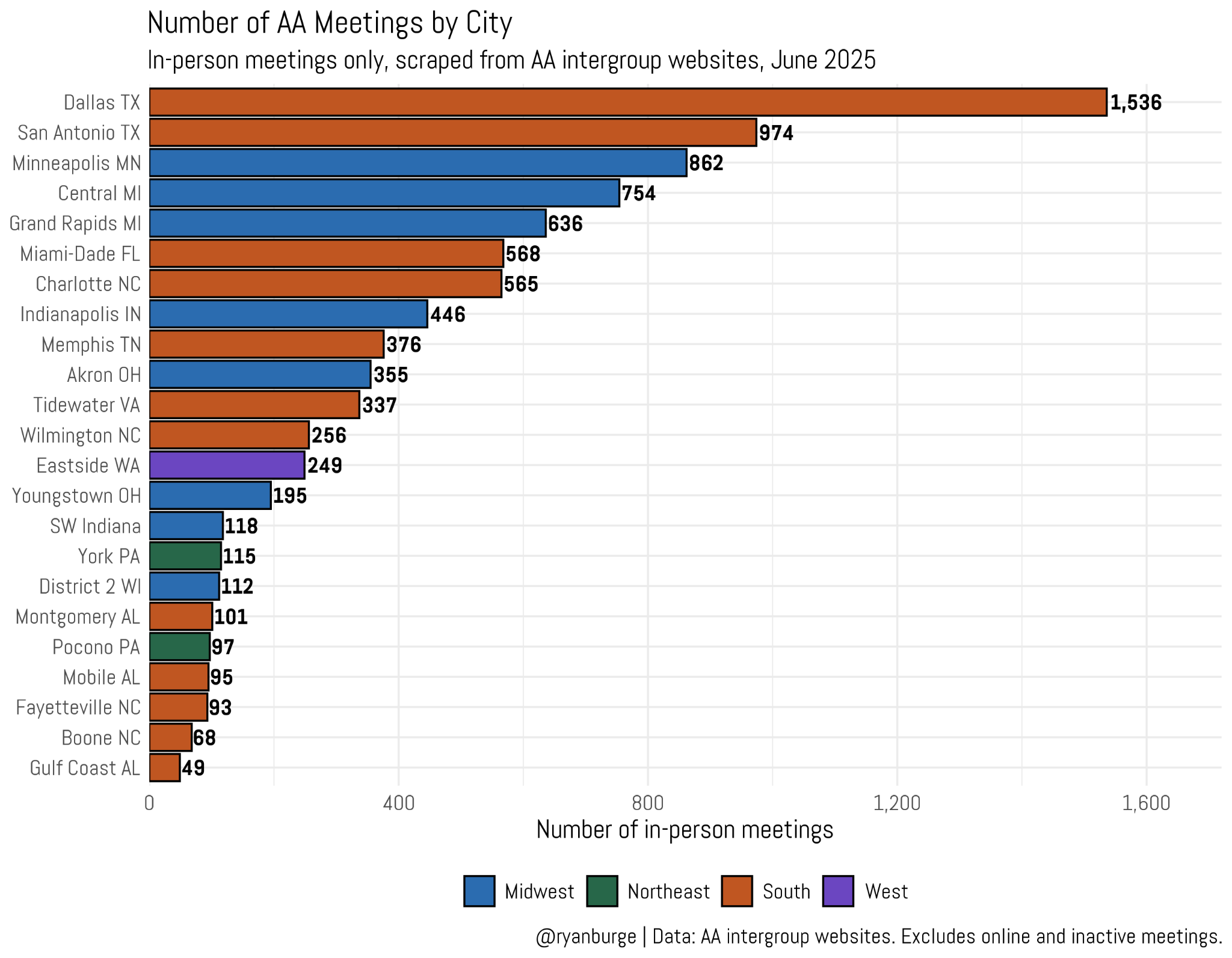
There’s a ton in Dallas, Texas. Which makes perfect sense because it was the largest city that ended up on the list. They had over 1,500 meetings currently listed as active in their database. Which is obviously staggering to think about. I wonder how many places like New York City, Chicago, or Los Angeles have compared to Dallas. But other larger cities on the list have a lot of active meetings including 974 in San Antonio and 826 in Minneapolis.
But there are also a high number of active AA meetings in towns that aren’t so large. For instance, Mobile Alabama has a population of 187,000 but it has 95 meetings in their database. Boone, North Carolina is just 20,000 folks but I found 68 active meetings on their list. When I was writing this piece, I just pulled up the AA meetings happening that day and there were 13 - running from 6:45am to 8:00pm. So, the 68 active meetings number does seem very plausible to me.
Now, what about the share of those AA meetings that are happening in houses of worship? I ran a classifier that flagged terms like “church”, “sanctuary”, “saint”, “fellowship hall” and a lot of other terms. What I found, when running this across a list of 25 cities, was that about one-third of AA meetings happened in houses of worship. I feel relatively confident that 33% is the “floor” on the right number. I’m certain that other meetings are happening in churches but they aren’t marked as such in the online directories.
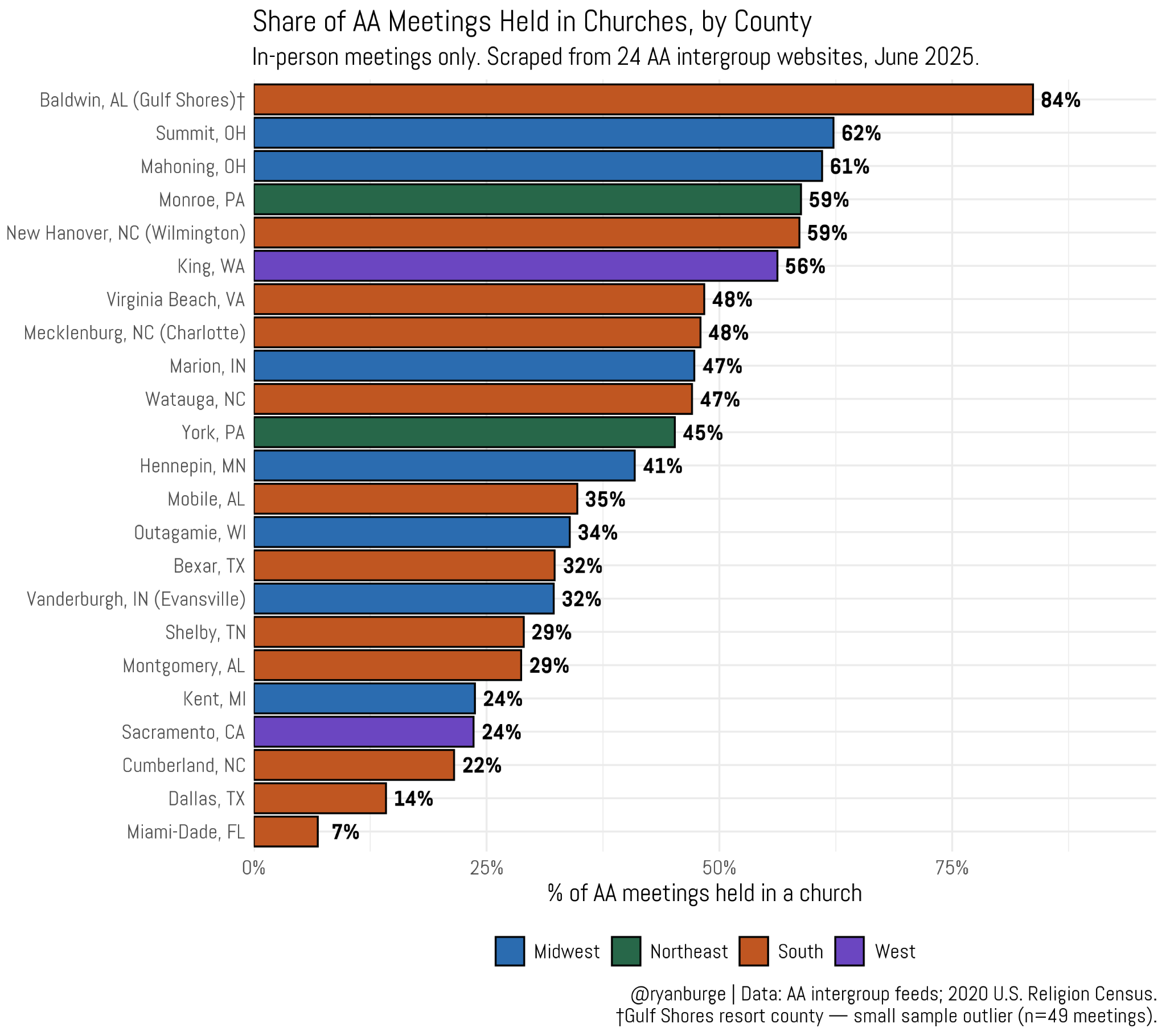
What parts of the country have the highest share of church based AA meetings? There’s not a clear indication from this data. In Baldwin, Alabama 84% of the meetings were happening in churches, but that’s an outlier based on a small sample size (N=49 meetings). But there were other cities where a majority were happening in houses of worship. Those included Summit and Mahoning Ohio, Monroe PA, Wilmington NC, and King county in Washington state. Again – there’s no regional pattern to be found there.
Because my list has a clear bias toward Southern locations, you can see those orange bars at all parts of the graph. While Virginia Beach has half its meetings in churches, it’s only 22% in Cumberland North Carolina and just 7% in Miami-Dade county in Florida. My overall impression is that the connection between AA and meeting in churches is largely idiosyncratic, probably based on some relationships that existed decades ago between AA organizers and local religious leaders and that has just carried on throughout the years.
Now, this is where I tried to get a little bit fancy by bringing in another dataset – the 2020 Religion Census which provides all kinds of information about the religious composition of folks at the county level. What I wanted to try and sort out is whether counties that had a higher share of AA meetings in churches had a larger share of evangelical or mainline Protestants. The evangelical graph is below.
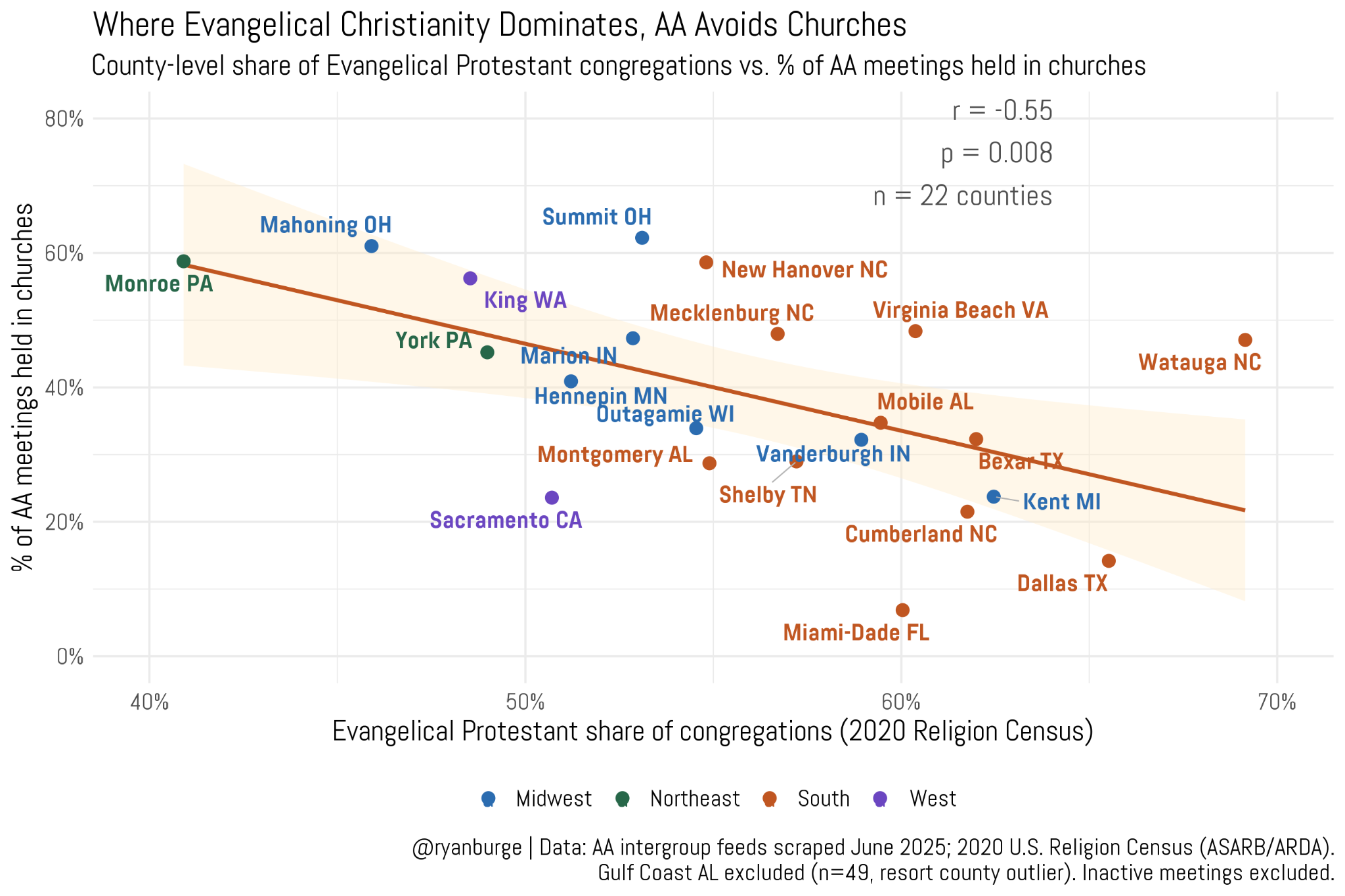
You can see that the trend line is undoubtedly in the negative direction – said simply the counties that have the highest share of church based AA meetings had the lowest share of evangelicals in the local area. The overall correlation was -.55 and I was surprised to see how tightly the data points were located around the trend line. There just weren’t that many true outliers.
One thing that jumps out of this graph is that there’s a whole lot of orange counties on the right hand side, these are classified as being in the South. There’s a lot more blue Midwestern counties across the middle of the scatterplot. That reflects the reality that I think we all basically understand: evangelicalism has a strong base of support in the South and loses influence as we move away from the Bible belt.
Then I did the same bit of analysis but just substituted the mainline share in each county. Here the trend line is headed in a more positive direction.
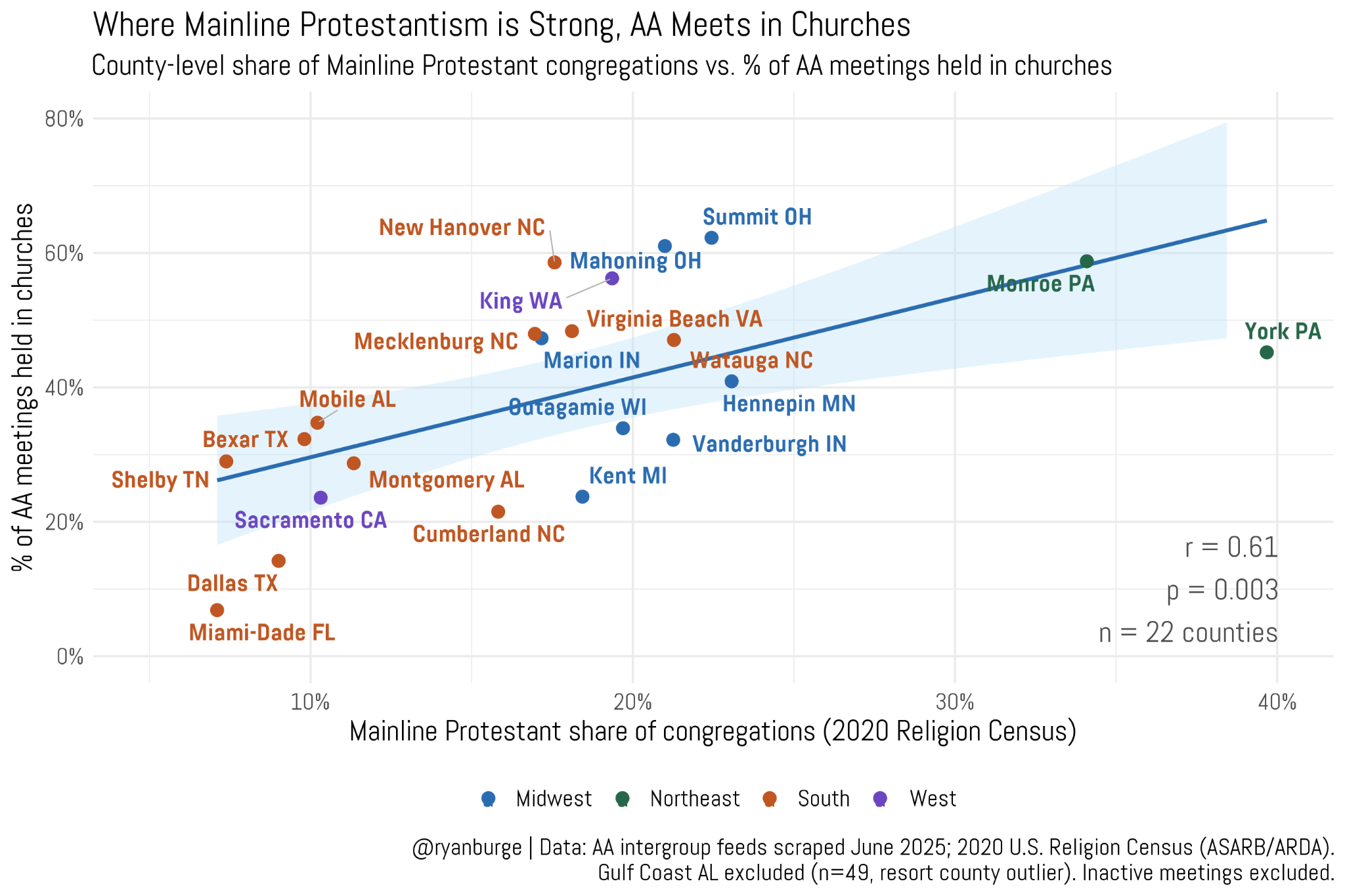
While church based AA meetings were less common in deeply evangelical counties, the opposite is true here: if a county has a greater share of mainline Protestants, that means that it likely has a higher percentage of Alcoholics Anonymous meetings being held in churches, synagogues, or mosques. The correlation is basically the opposite of the previous graph: +.61.
Now, I certainly don’t want any reader to overinterpret this finding. There are a dozen factors outside of religion that can have an impact on church based AA meetings, but I do think it’s worth reflecting on why evangelical counties have fewer AA meetings in a religious setting.
One possibility is logistical and cultural — evangelical churches tend to be larger, programmatic institutions with controlled access to their facilities, whereas mainline congregations often have underutilized fellowship halls and a long tradition of opening their doors to community groups. A United Methodist church with 150 members and a basement they’re not using on Tuesday nights is simply a more natural host than an evangelical church that is already bursting at the seams.
There’s also a theological dimension worth considering. Mainline Protestantism has historically emphasized social gospel work and community service as core expressions of faith, making hosting a recovery group feel like ministry. I’ve been around a lot of evangelicals in my life, and grew up Southern Baptist. I don’t think that I’ve ever heard anyone mention Alcoholics Anonymous, let alone the possibility of hosting a regular meeting in the church.
Finally, the infrastructure of secular recovery in evangelical areas may simply be more developed. Cities like Dallas and Miami have large networks of AA clubhouses — member-owned secular spaces built specifically for recovery meetings — which emerged precisely because church space wasn’t as readily available. The absence of AA in churches doesn’t necessarily mean less AA; it may mean the recovery community built its own parallel infrastructure.
You can also see suggestions of that evangelical/mainline divide if I just do a keyword search of the church names that hold AA meetings.
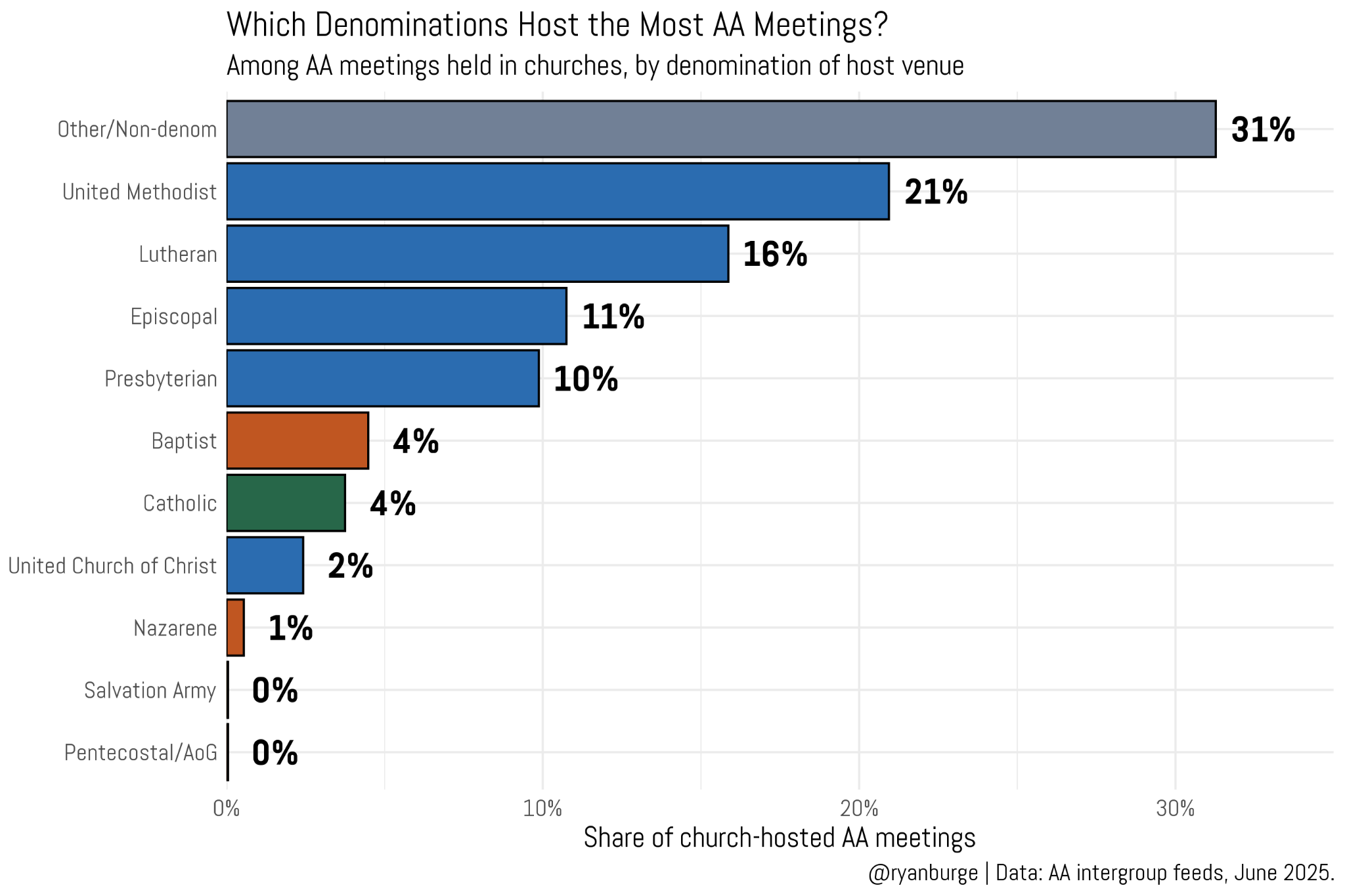
I couldn’t classify about a third of them because their names didn’t contain any clear identifications with a denomination. But after that the next four that pop up are primarily associated with the mainline tradition (United Methodist, Lutheran, Episcopal, and Presbyterian). The Baptists barely show up on the list and so do the Catholics. Part of the issue there is that many churches in each tradition don’t explicitly include “Baptist” or “Catholic” in their name. But even given this syntax issue, I’m not sure that Baptists are holding as many AA meetings as their Methodist counterparts.
There’s no doubt in my mind that houses of worship provide key community services in a variety of ways. That’s absolutely the case when it comes to AA meetings. One third of them are being held in churches, synagogues, mosques, temples, etc. Would it be possible for the AA community to move those to other gathering spaces? Maybe if it were only 2 or 3 churches that closed. But what happens if it’s 20-30 in a smaller community? The houses of worship that remain may just not have enough space in their buildings or time in the day to give it out to groups like AA.
Then what happens? I don’t want to consider the possibilities.
Code for this post can be found here.
Ryan P. Burge is a professor of practice at the Danforth Center on Religion and Politics at Washington University.

Well, guess what, fam?
I just scraped the location of every Celebrate Recovery meeting location in North America.
I have no idea what I'm going to do with it.
But it was a fun coding exercise.
I've been part of discussions in ministerial associations across three states and forty years, and can report in that narrow experience, folks like Southern Baptists, Assemblies of God, and non-denom contemporary church independents do not like or trust AA, in large part because of their "conception of God" and lack of explicit Christianity as part of the twelve step model. When SBCs in particular do alcohol/addiction programs, it's Celebrate Recovery, which is on the community level, at least, explicitly presented as the "Christian alternative" to AA, as Trail Life is to Scouting America. So I'd expect to see them low if not off this list entirely. Evangelicals tend to be surprised other ministers "let" AA meet in their buildings, since their version of a "higher power" can (as is famously often said) be "this styrofoam cup or that radiator over there." I think in practice, this is not how AA thinking works, but it is what they say, and they are emphatically non-sectarian as is Scouting, which Evangelicals just have an essential objection to. They don't do pluralism.