



About a year ago, I got an email from an undergraduate at Notre Dame University. Anna Bohlen wanted to know if she could work with me on this newsletter. I am always trying to find ways to collaborate with some aspiring data analysts, so I was intrigued. After a couple of emails and a Zoom meeting, we developed a plan of action. Anna would apply for a few small grants at Notre Dame and, if she won one of them, we would field a survey together and write up some of the results. And you can probably guess what happened – Anna won one of those awards and now we have data.
So, let me disclose this: This project was supported in part by a Sorin Fellows Program grant administered through the de Nicola Center for Ethics and Culture at the University of Notre Dame.
We fielded our survey through Qualtrics in August of 2025 and we managed to collect a total sample of 557 respondents. Not bad, right?
One concept that kept bubbling up during our discussion was the idea of self-improvement. Young folks have a term for this: “maxxing.” For instance, some young men are devotees of “jaw-maxxing,” which is a series of facial exercises to make them have a more defined jawline. There is also a corner of the internet that is obsessed with sleep-maxxing. These folks track their sleep patterns obsessively, always looking for ways to catch a few more minutes of shut-eye.
It’s pretty clear that the typical American is always on the lookout for ways to improve their lives on a whole bunch of different dimensions. We wanted to focus on that topic in a more philosophical way in our questionnaire. We asked them: How close do you feel you are to being the kind of person you ought to be, morally speaking?
Our goal here was just to get a sense of the level of self-reflection going on in the average American.
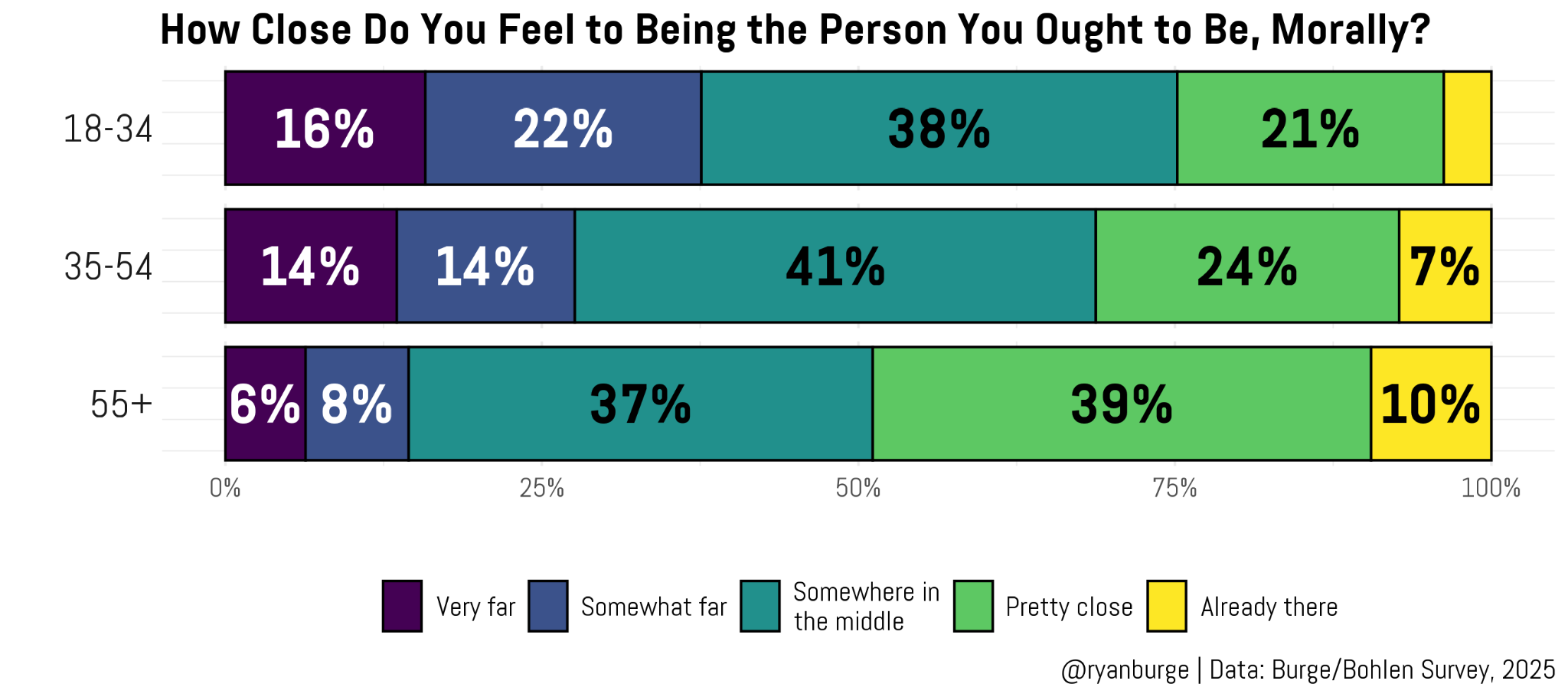
Because our sample size isn’t that big, we have to be careful about how we subdivide this data, so breaking it up into three age categories is about as good as we are going to do. But you can clearly see that there’s a distinct age effect on the question when it comes to people reflecting on their moral character.
Among the youngest adults, a significant portion (38%) say that they are “very far” or “somewhat far” from being the person that they ought to be from a moral standpoint. In contrast, almost none of them feel like they are “already there.” But as you move down the graph, the bars begin to shift in the opposite direction. Among the middle age bracket, only 28% place themselves in the bottom two categories.
But look at those who are 55 or older! Just 6% say that they are “very far” from the person that they want to be and 8% said “somewhat far.” In contrast, about half of them said that they were “pretty close” or “already there” when it came to the process of moral refinement. Older folks seem pretty content with the person that they’ve become.
However, there were other questions in the survey that focused on this process of self-improvement.
How often do you make a deliberate effort to improve your character?
How often do you reflect on whether your actions were right or wrong?
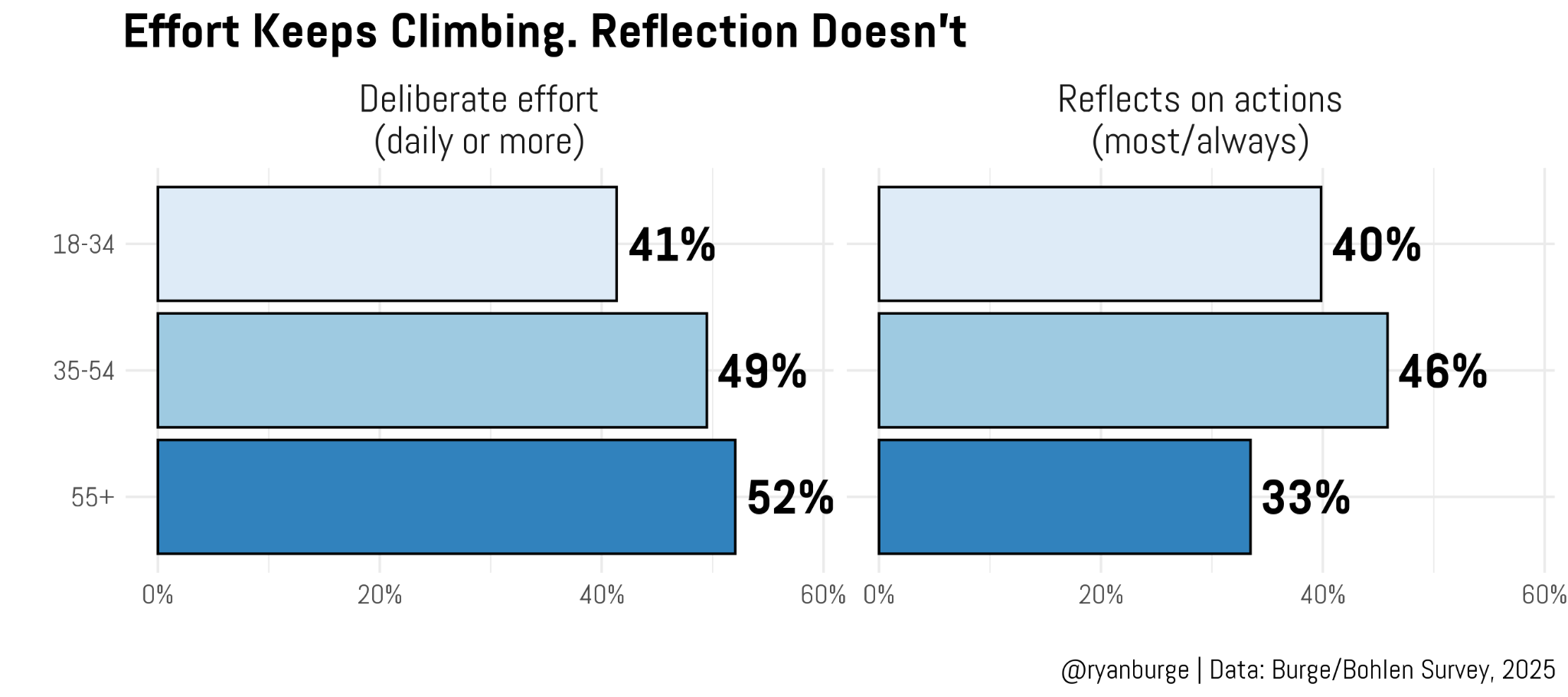
The graph on the left is the share of each age bracket who said that they made a deliberate effort to improve their character on a daily basis. Again, there’s a clear upward trend. Older folks are about 11 percentage points more likely than younger adults to say that they are trying every single day to improve their character. Think about that in conjunction with the prior graph where older folks were likely to say that they were closer to the person that they were supposed to be.
Here’s a possible explanation: people who’ve spent decades consciously working on their character feel closer to the person they want to be. Trying harder and feeling more arrived can genuinely go together. In other words, all that hard work is actually translating to a perception that they are making moral progress.
But what’s also interesting is that older folks are clearly less likely to ruminate on their actions frequently. Among those who were 55 or older, only ⅓ of them said that they were reflecting on their behavior most of the time or always. So it seems like something important happens as we age: we try hard to be better people, and lots of us feel like we are getting closer to that goal. However, older folks just let things go more easily. They don’t dwell on every single thing they said or did during the course of the day.
To this point, though, we haven’t mentioned religion. There does seem to be ample reason to believe that religiously engaged people would reflect on their actions, right? I don’t think it takes a huge leap in logic to assume that people who sit in a house of worship on a regular basis will have more opportunities to think through their behaviors during the previous week.
Because the sample size wasn’t that big, we could only divide our sample into three groups: those who are practicing religious folks (attendance at least monthly), non-practicing religious (those attending yearly or less), and then the non-religious.
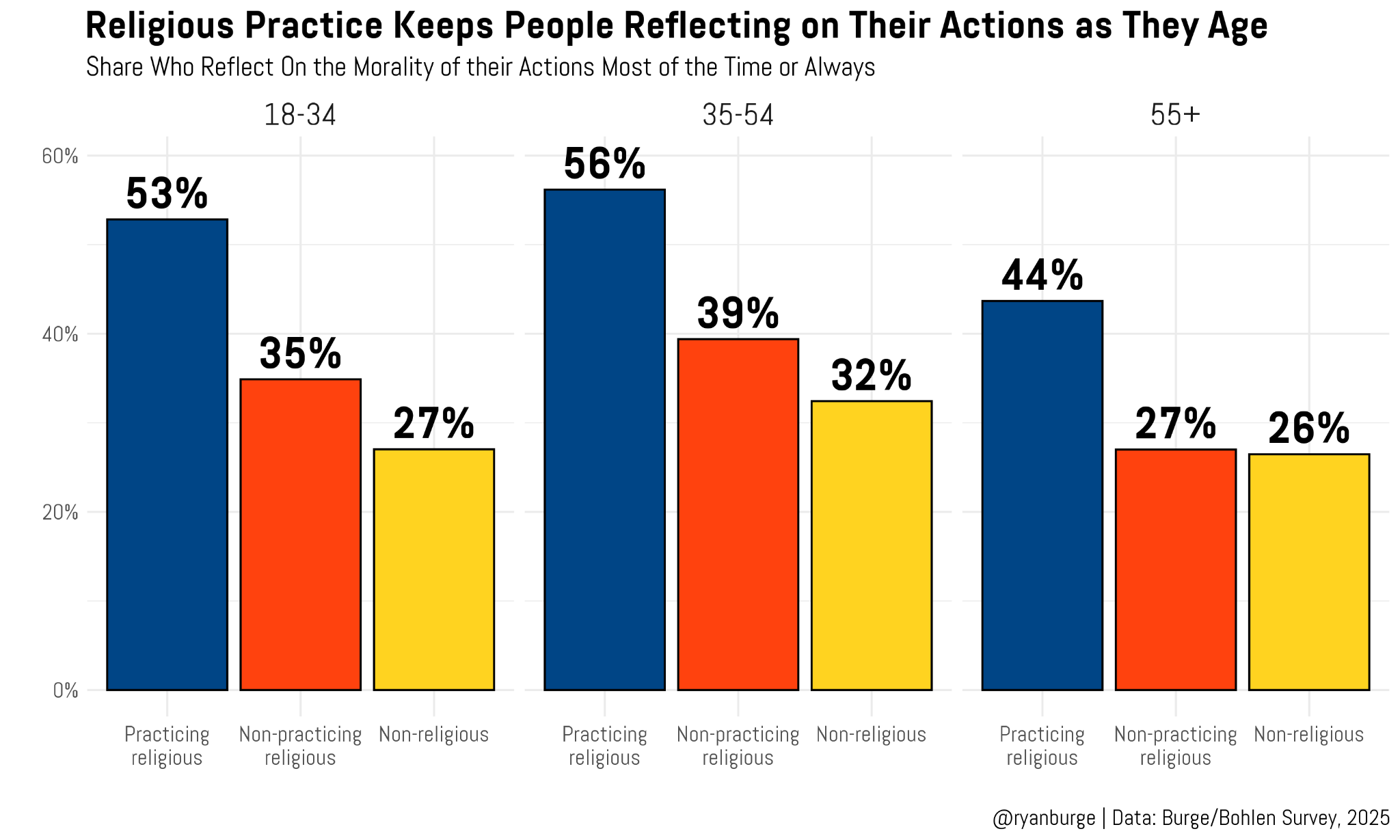
And you can see an unmistakable pattern in each of these three graphs – active religious folks are much more likely to think about the morality of their actions than those who either are non-practicing or non-religious. The gaps among the youngest adults are pretty large. Among the non-religious, 27% say that they think about the morality of their actions “most of the time” or “always.” It was 53% of those who were religiously engaged. It’s pretty hard to miss the conclusion that an hour in a sanctuary that includes some preaching does lend itself to moral reflection.
What we do want to highlight, however, is that self-reflection does tend to wane among older religious respondents. For instance, among the practicing religious people who are under 35, 53% were thinking about their actions constantly. It was 44% among those who were 55 or older. There was also an 8-point drop among the non-practicing religious respondents, too.
Let’s do the same basic analysis but now make the dependent variable that first question we analyzed: How close do you feel you are to being the kind of person you ought to be, morally speaking? This is the share who said that they were “pretty close” or “already there.”
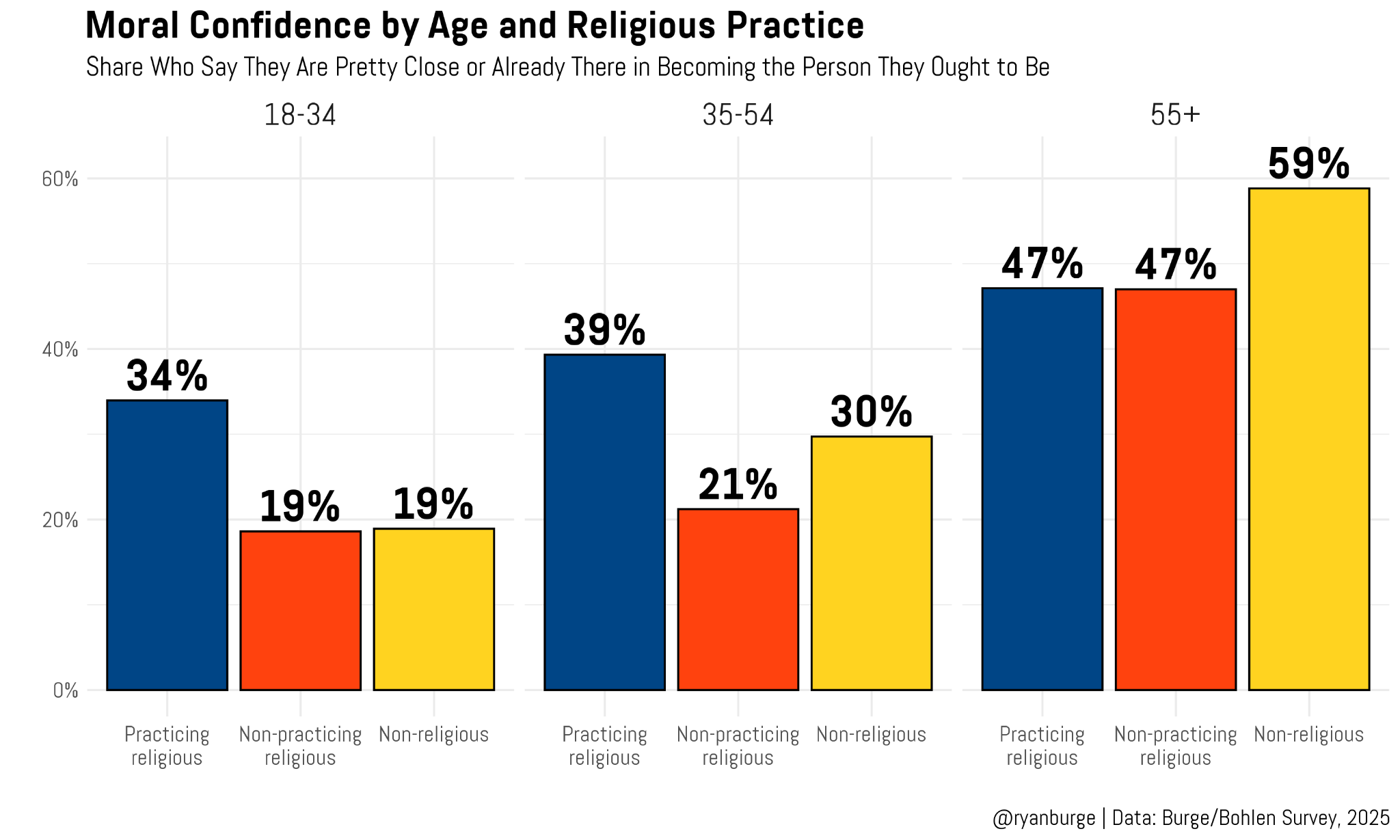
Now this is fascinating based on the previous bit of analysis! Among the youngest adult respondents, it was the most religious who were the most inclined to say that they were closer to the person that they ought to be. And the gap is pretty large – 19% among the non-religious and non-practicing for 34% among the young adults who attended church at least once a month. The one big change in the middle-aged bucket is that the non-religious are much more likely to say that they are closer to the person that they ought to be than their younger counterparts (19% → 30%).
However, the data for the oldest adults is just an entirely different story. The percentages are much higher across the board, regardless of religiosity. But the bigger shift is that now it’s the non-religious who are more likely to feel like they are the person that they are supposed to be. Among older nones, nearly 6 in 10 say that they are “pretty close” or “already there.” It’s 47% among the other two groups.
To finish up this post, we thought it would be fun to combine two metrics into a single bit of analysis: moral confidence minus actual reflection. A negative number means people are doing more soul-searching than their confidence would suggest; a positive number means their confidence has outrun the habit of checking their own behavior.
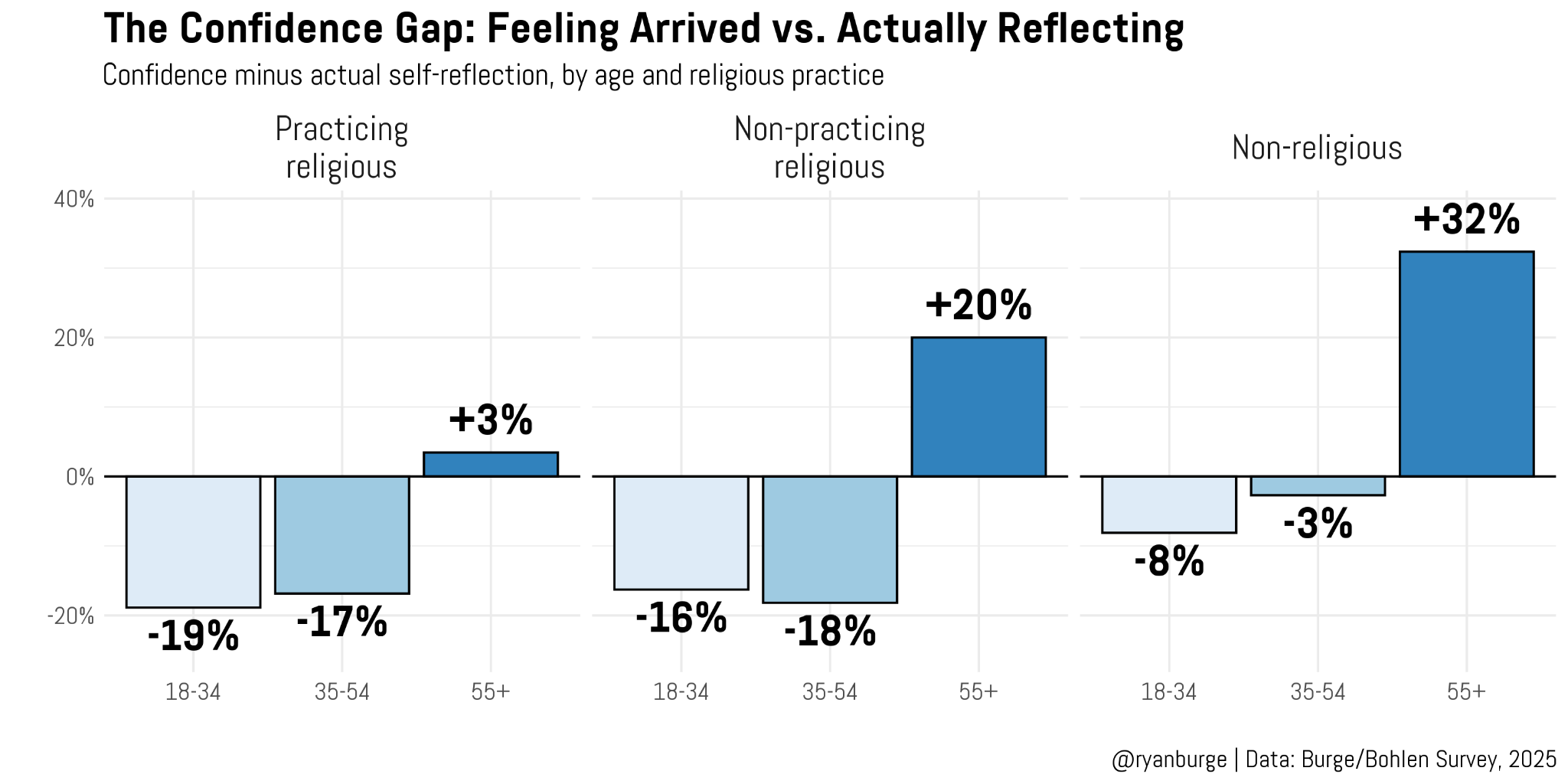
This is where it really becomes apparent who is engaging in a whole lot of soul-searching while not feeling super comfortable with their moral position. Among young adults, the bars are very much in the negative territory for the religious respondents. They are far away from the person that they want to be and they are reflecting on their actions frequently. Among young nones, those two metrics are pretty equally balanced.
For middle-aged respondents, the metrics for the religious are basically in the same spot. There’s a lot of moral dissatisfaction happening there. They are constantly monitoring their behavior and not really feeling like they are landing in a good spot. Meanwhile, the number for middle-aged nones moves in a much more positive direction. They are growing content with their moral character and not scrutinizing every action.
The results for the oldest people in our sample indicate that everyone seems to be growing more content with who they are, but it’s not the same level of contentment across all three groups. Among the religiously active, the number is still solidly negative. However, among the oldest nones, it’s easily the most positive. No one seems to be closer to feeling that they have “arrived” in a moral sense than a non-religious retiree.
Now, of course, the issue looming over all of this is that everything is self-reported and subjective. The first question, “How close do you feel you are to being the kind of person you ought to be, morally speaking?” does not presuppose that there’s some type of ideal moral plane that we can achieve through self-improvement. Everyone’s ideal for morality is probably just a bit different. And that may be why older nones are in a different spot on these metrics compared to religious folks.
If you’ve ever been a part of a church community, you have probably been admonished hundreds of times to become more Christ-like. That same theme runs through basically every religious tradition. Does that create a different (possibly higher standard) to a question about becoming the person we are supposed to be? It’s hard to know.
What is self-evident from this data, however, is that self-improvement is a young person’s game. Older folks just seem happy to be where they are in life. They probably aren’t going to get obsessed with jaw-maxxing or sleep-maxxing. They just want to enjoy however much life that they have left.
Code for this post can be found here.
Ryan P. Burge is a professor of practice at the Danforth Center on Religion and Politics at Washington University.

What a great study and great questions. I don't wonder if the older respondents answers reflected something along the lines of been there, done that and they simply choose to remain happy where they are seeing no need to self improve or tend to themselves. I've met a lot of people like that. There answers range from "I go to church every Sunday" (as if simple attendance is a stand in for I'm a good person) to I'm happy where I'm at, I don't worry about that anymore.... you get my drift. Whereas the under 55 group actually is invested in questioning whether their behavior actually does affect others, including themselves. Just a thought. Big thanks to Anna and thank you Ryan for the collab.
It surprised me that the religiously practicing young and middle aged were more likely to think they are pretty close or already there to becoming the person they ought to be. I would have thought the more you seek to become like Jesus, the farther you understand you are. (Most religious in America are Christians so other religions would have a negligible effect.) Does this sentiment track with anyone else?