


I’m a bit enamored recently with the life of Ernest Hemingway. He was obviously a tremendous writer, maybe one of the finest in our country’s history. But he also lived a life that could charitably be described as “chaotic.” He moved constantly, was married four times, struggled with alcoholism his entire life, and suffered at least a dozen serious concussions from plane crashes and car accidents.
As you can probably guess, his financial situation was equally tumultuous. He was paid the modern-day equivalent of $55,000 for writing a 3,000-word piece for Collier’s magazine in 1944. He also sold tens of thousands of copies of his books during his lifetime. But he was always teetering on the verge of insolvency. In The Sun Also Rises, one of the main characters, Mike Campbell, seemed to echo the author’s own sentiments when asked, “How did you go bankrupt?” Mike responded, “Two ways — gradually, then suddenly.”
That’s a line I think about a whole lot when I’m talking to churches about the future of their local congregation and their larger denominational tradition. I cannot emphasize this point enough — we are in a lull right now. While most major denominations have been experiencing decline for a while, their ship has remained seaworthy. Yeah, some water will lap over the sides every once in a while, but there are still enough buckets and enough laborers to toss it back into the ocean.
Here's the Demographic Formula For Growing Churches

A couple of months ago, I wrote a post about Outreach’s list of the fastest growing churches in the United States. I extracted the data from the 2021 list and then did some statistical analysis to try and understand how a few demographic factors related to church growth. Needless to say, it got a lot of traffic. It's clear you all wanted to read more about this topic.
That won’t be the case in a very short time horizon, and I don’t think many people realize just how quickly the buckets and the workers are going to disappear.
Let me start making that point with a graph you’ve seen before — just a simple age distribution of the 20 largest denominations in the Cooperative Election Study. (These aren’t the 20 largest denominations in the United States; they’re just the groups respondents choose most often.)
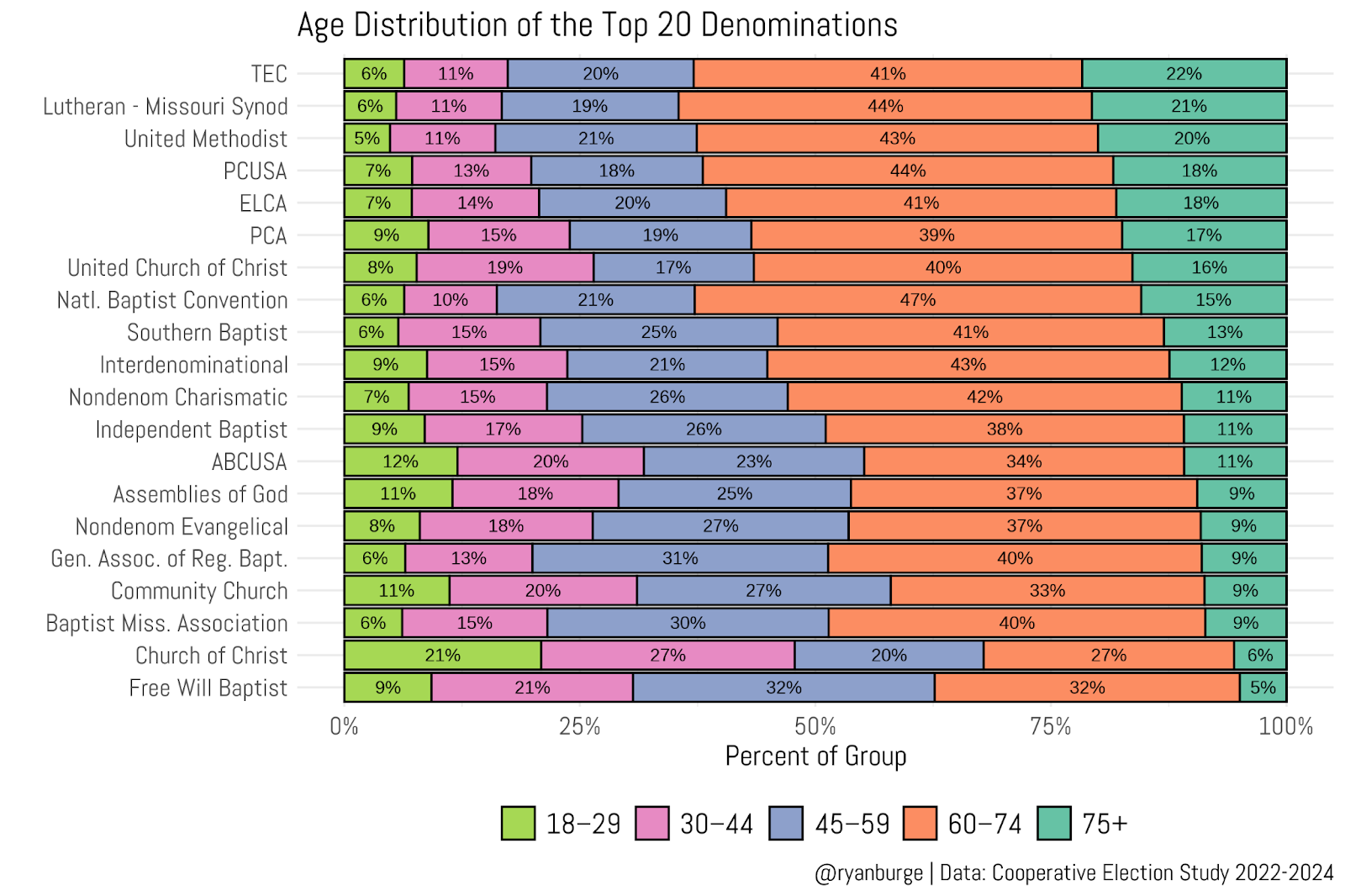
Here’s one point I need to make here (and will reiterate later): this is only adults. There are no large-scale surveys of children in Protestant denominations. I wouldn’t even know how to begin thinking about undertaking something like that. Just pondering how to get it through my university’s Institutional Review Board makes me shudder. But this data does give us a good sense of what the 18-and-older population looks like right now.
This should come as a shock to no one who is vaguely aware of American religion — Episcopalians are old. In fact, two-thirds of their adult members have celebrated their 60th birthday. In contrast, just 6% are under the age of thirty. Put simply: for every young adult Episcopalian in the pews this Sunday, there will be about ten retirees. Oof.
And they aren’t alone in this. The Lutheran Church–Missouri Synod is in almost exactly the same spot. So are the United Methodists, the Presbyterian Church (USA), and the Evangelical Lutherans. You basically see a whole bunch of mainline Protestants clustered at the top of this graph.
But let me also point out that some big evangelical groups aren’t exactly swimming in young adults, either. For instance, just 6% of Southern Baptist adults are under the age of 30. That’s no different at all than the Episcopalians. Only about one in five are under the age of 45. The Assemblies of God is doing a bit better here, but their numbers are still pretty anemic — 11% in the 18–29 bucket and 19% in the 30–44 age group.
Let me now configure the data into a pretty straightforward metric: the share of each of these denominations who belong to the Baby Boomer generation (born 1946–1964).