


Whenever you think about the very largest churches in the United States, what denominations come to mind? I think that most of you, if you’ve been following along with this newsletter for any amount of time, would think of non-denominationalism. Maybe a Southern Baptist church. And the data says that this is largely the case.
I’ve written about the Outreach 100 list before – it’s the best dataset of the largest churches in the United States. Among those, half describe themselves as non-denominational, 15% are Southern Baptist, and 20% ID as independent Christian or “other Baptist.” The Assemblies of God has about 5% of churches on the list, but the next in line are the Methodists at just 1.8%.
Yeah, there’s just not a whole lot of discussion of really big United Methodist Churches for a very good reason – there aren’t that many of them. But that gives me even more motivation to study this subset of American Christianity. Thankfully, the United Methodists have an easily accessible table listed on their website with the title “Largest 100 Churches by Membership.” I wanted to use this list because it offers a glimpse into a problem that plagues a lot of churches, especially in the mainline: their membership rolls are bloated with folks who haven’t attended a service in decades.
I’m going to explore that in just a minute, but let me start by just showing the 25 largest UMC congregations in terms of total membership.
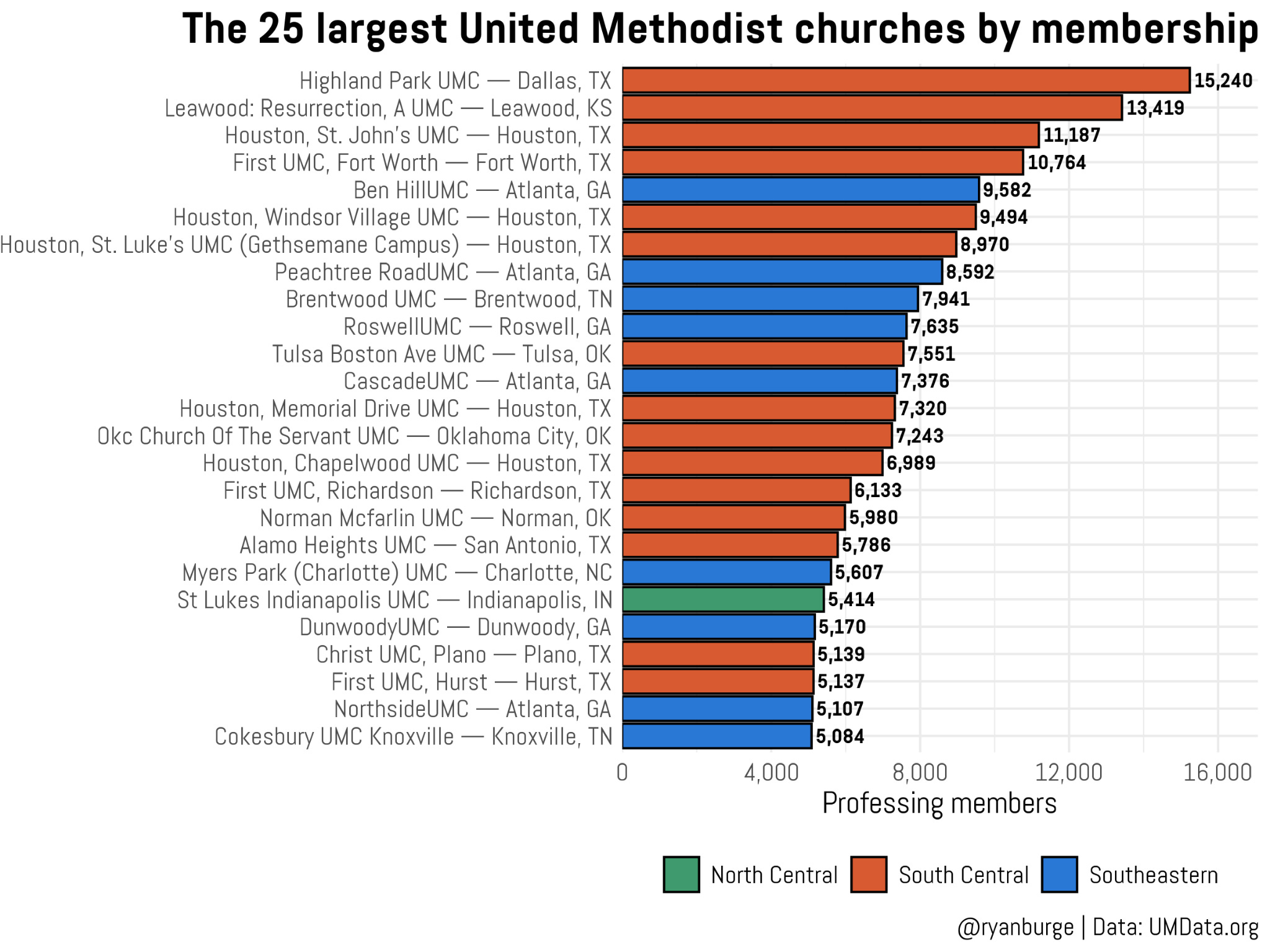
The very largest United Methodist Church in terms of membership is in Dallas, Texas – it’s Highland Park. They report a total membership of just over 15,000 folks. Next in line is a church that you all might be hearing about quite a bit more in the months to come: Resurrection Church in Leawood, Kansas. The reason for that is that their senior pastor is Adam Hamilton, who is running for the United States Senate in Kansas. Their church’s membership boasts 13,419 members.
There are a total of four churches that have at least 10,000 on their membership file but most of these churches on the list are in the 5,000-7,000 range in terms of membership. I also color coded these churches based on their current jurisdiction. The United Methodists love their bureaucracy and there are multiple layers of organization in the UMC. There are five total jurisdictions in the United States and you can see that South Central shows up quite a bit on this graph.
To give you a better sense of geography, here’s a count of the number of times each state shows up in the top 100 list.
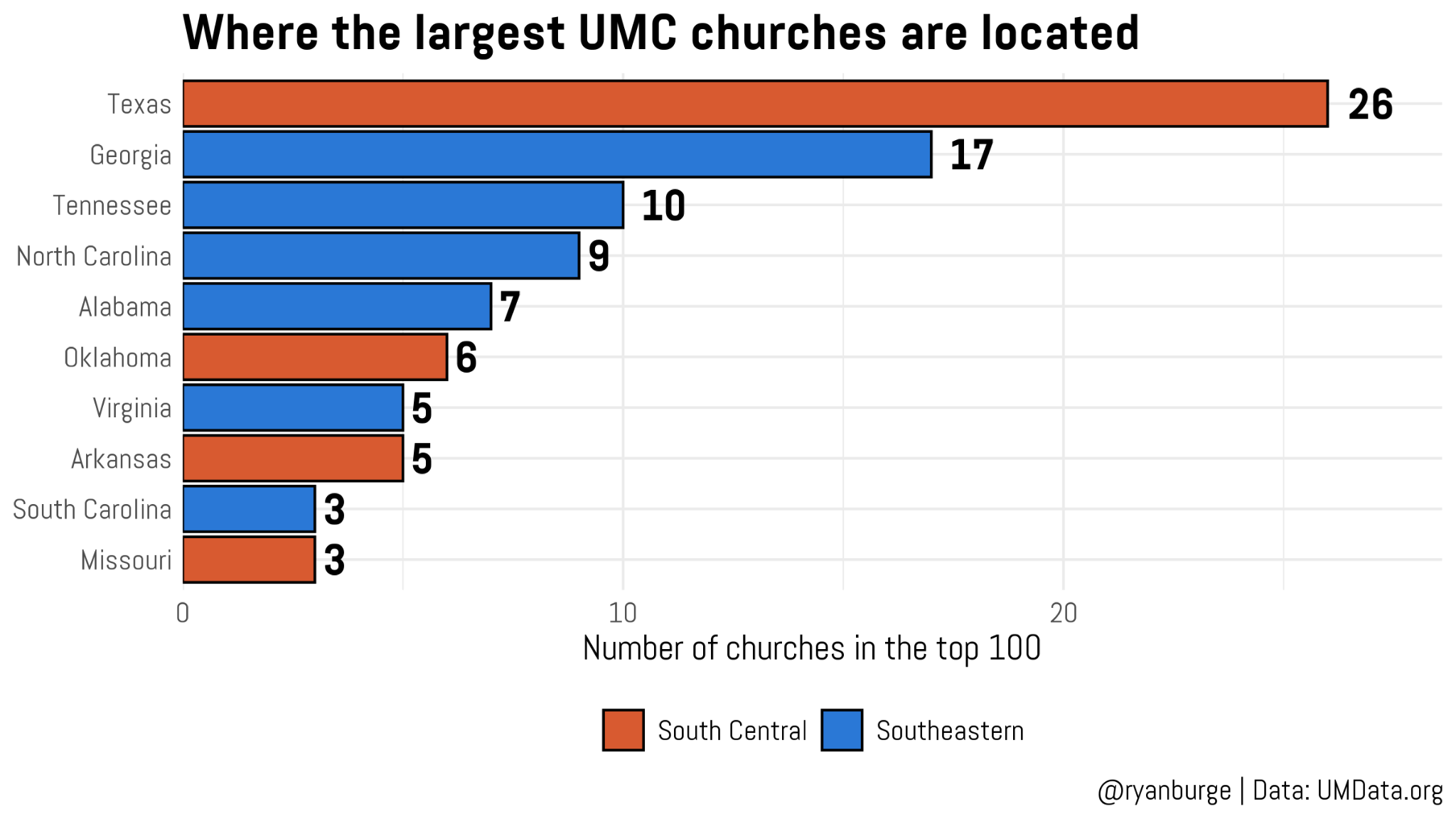
It’s pretty apparent where the biggest United Methodist Churches are located: deep in the heart of Texas. Over a quarter of the largest churches can be found in the Lone Star State. The biggest concentration, by the way, is around the Dallas-Fort Worth area. But then you have another seventeen churches that can be found in Georgia. Every single one of them is a short drive from downtown Atlanta. You don’t find a lot of big churches (UMC or otherwise) in the rural parts of the United States.
The rest of this list is pretty concentrated in the South. You’ve got states like Tennessee, North Carolina, and Alabama. The states that are the furthest north are Virginia and Missouri. But you don’t see any states in the top ten that are clearly in the North or the West. The locus of power of the UMC is actually pretty similar to the Southern Baptists – the Bible Belt.
To make that even more plain, I geocoded the location of every single church in the top 100. Then I used those coordinates to build an interactive map of the biggest United Methodist Churches. Each church is represented by a circle that you can click on to provide additional information. It gives you the name of the church, the total membership as well as their average attendance.
