


Are you a social scientist who wants to do an experiment related to religion and politics and need some funding to make that possible? I have partnered with the team who is organizing Survey Experiments for the Scientific Study of Religion to help publicize this program. You can read about it below, along with a link to apply for funding.
And expect some of the posts on Graphs about Religion in 2027 to use data collected through this research initiative.

We are excited to announce that January 11th, 2027 will be the next deadline for submissions to the Survey Experiments for the Scientific Study of Religion (SESSR) project. SESSR is supported by a grant from the John Templeton Foundation and provides the opportunity for social scientists to field religion-related survey experiments on a probability sample of U.S. adults at no cost to them. For more information, see www.sessr.org
What do we do with the time that we have? That’s one of the most important questions we face, in my estimation. It’s certainly something I struggle with on a day-to-day basis. I have a really hard time taking a vacation that lasts more than four or five days because I feel a deep sense of guilt that I’m not doing enough with my life. It’s that pesky Protestant work ethic that I will never be able to shake. And don’t try to lecture me about it in the comments, either. Many have tried and many have failed to convince me to work less.
I am, for better or worse, very deliberate about how I spend my time because it’s such a precious commodity. And my fatal flaw is that I think other people are as thoughtful about such matters as I am. So whenever I hear someone say, “I just can’t make time for that,” what I actually hear is, “I am choosing to use my time on something I prioritize more.” I want to believe that people are parsing out their values when they make a decision about going on vacation, attending a concert, or staying at home with their kids.
And I want to believe that lots of people are very thoughtful when they make a decision of whether to attend a local house of worship each weekend. But I also know that this decision is not made purely randomly by each person. There are certain factors that make someone more inclined to get up on Sunday morning, put on some nicer clothes, and make the drive to their local church.
Educated people are more likely to be weekly attenders than those with a lower level of education. That comes through when looking at this data from Pew.
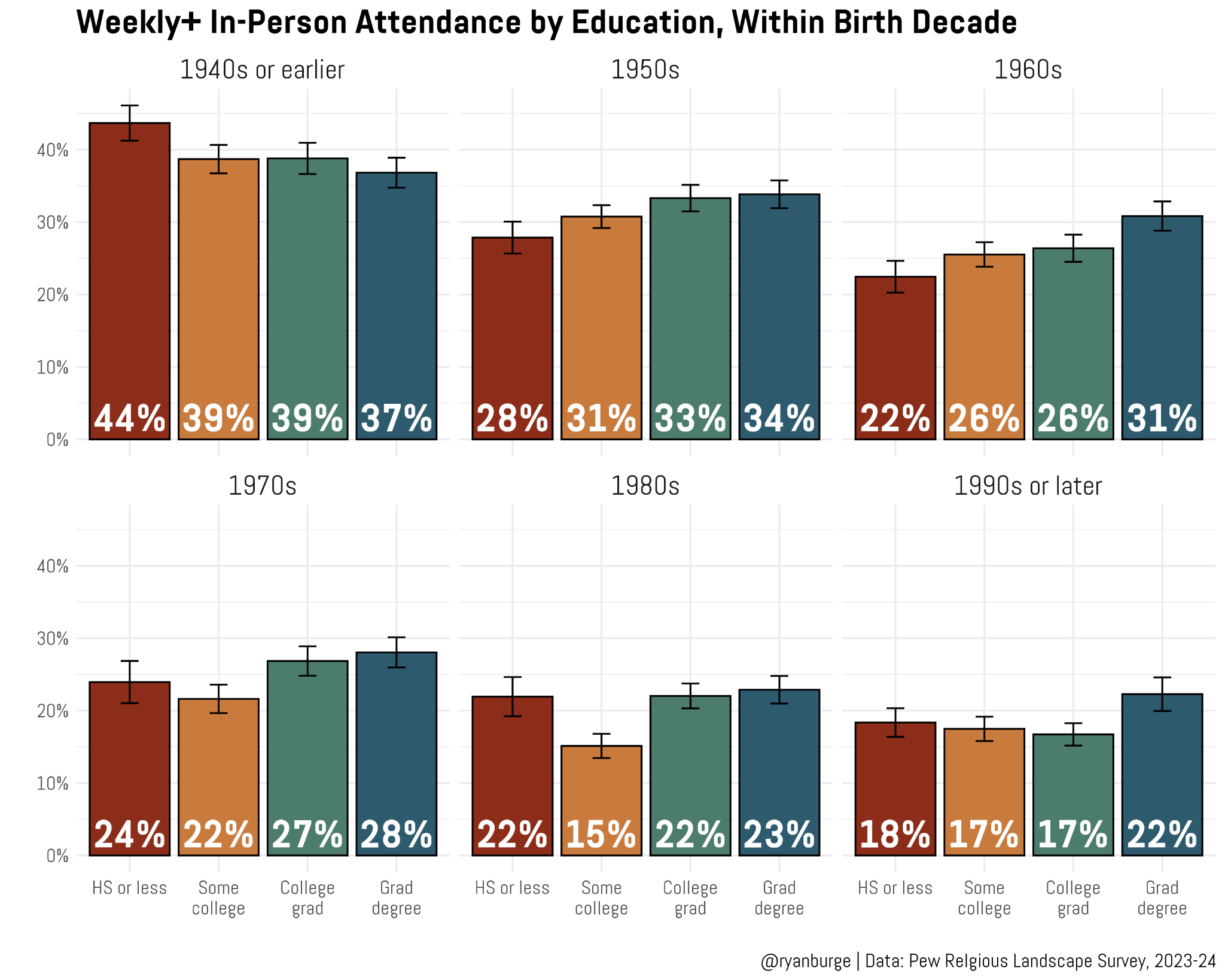
Now, I must admit that the positive association between education and attendance is age-dependent, to a certain degree. For the very oldest Americans, the relationship between the two factors is actually negative: educated folks are less likely to be weekly attenders than those who stopped at high school. But that’s the only age cohort where that’s the case.
For those born between 1950 and 1979, the line goes up in a pretty clear way. From left to right, the increase is six points for those born in the 1950s, nine points for those born in the 1960s, and four points for those born in the 1970s. The last two birth cohorts are a bit more of a mixed bag. For those born in the 1980s, the line is flat. It may be tilting up for the very youngest adults, but I think I am going to reserve judgment on that until more data comes in.
You can see the overall trend, right? Educated folks go to church more often than those with less education. I’ve posted this finding many times on social media. It garners a lot of discussion, as you can probably guess. One common refrain is that those at the low end of the educational spectrum don’t attend as much because they are working and thus there’s a scheduling conflict. It’s a possibility worth some serious reflection, and trying to examine that claim will make up the rest of this post.
Lucky for us, the Pew data included a question about employment status and gave five options ranging from working full-time to being retired.
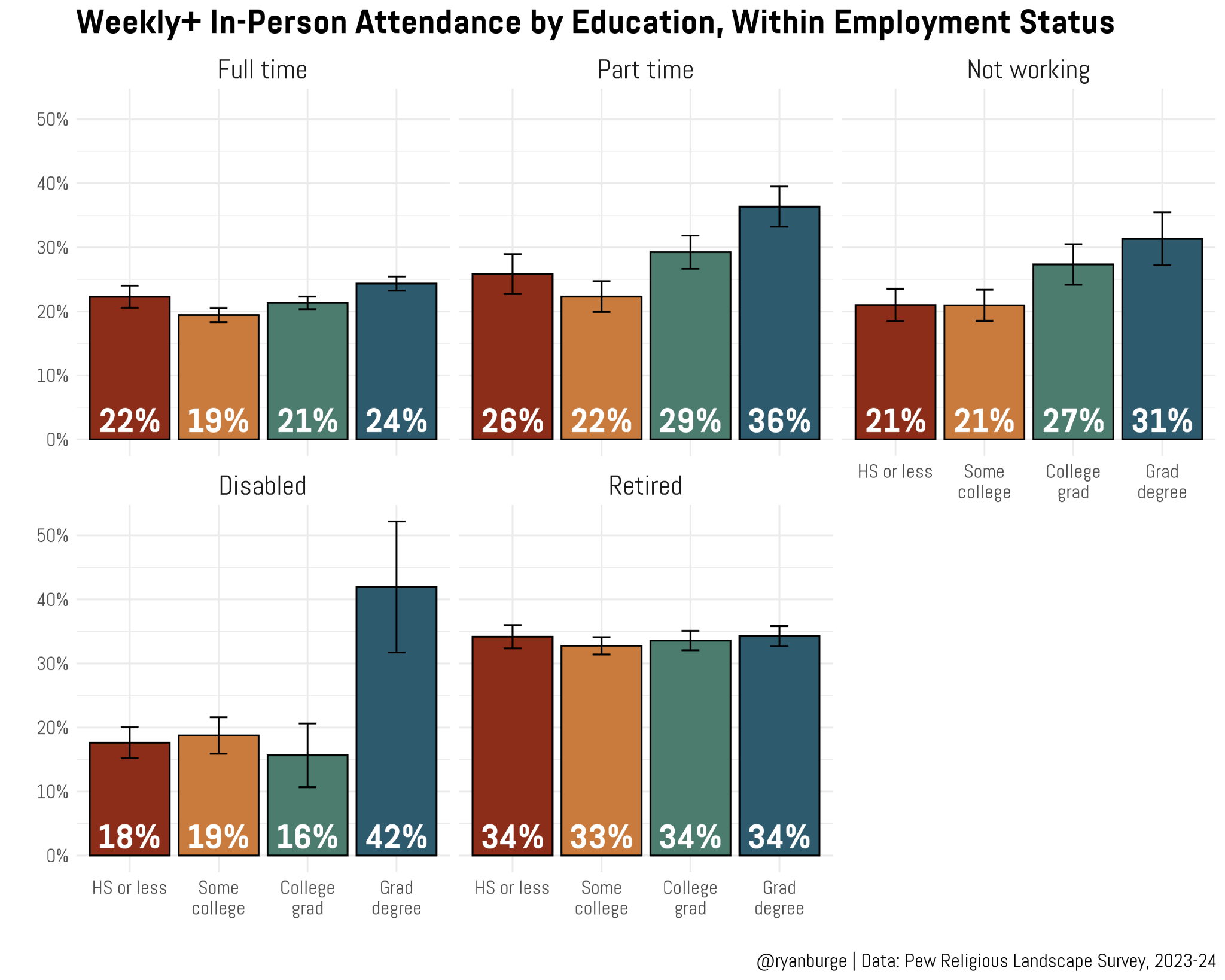
For full-time workers, those with graduate degrees are just as likely to be weekly attenders as those who stopped at high school. But for part-time workers, the most educated are much more likely to go to church on an average weekend—a full ten percentage points. That’s a massive difference. That ten-point gap is also there among folks who are not working at all. For those with a high school diploma or less, 21% are weekly attenders. It’s 31% for those with a master’s degree.
The graph for those who were disabled is really interesting, but you need to know that part of the problem is a small sample size—less than 800 respondents out of nearly 37,000 in the full survey. The retired sample is much larger and the result is much less spectacular: there’s absolutely no change in weekly attendance rates based on education for those who have retired.
What complicates all of this, of course, is a number of factors. One big one is that education is deeply intertwined with employment status. Simply said: less educated folks are less likely to be in the workforce compared to those working full-time.
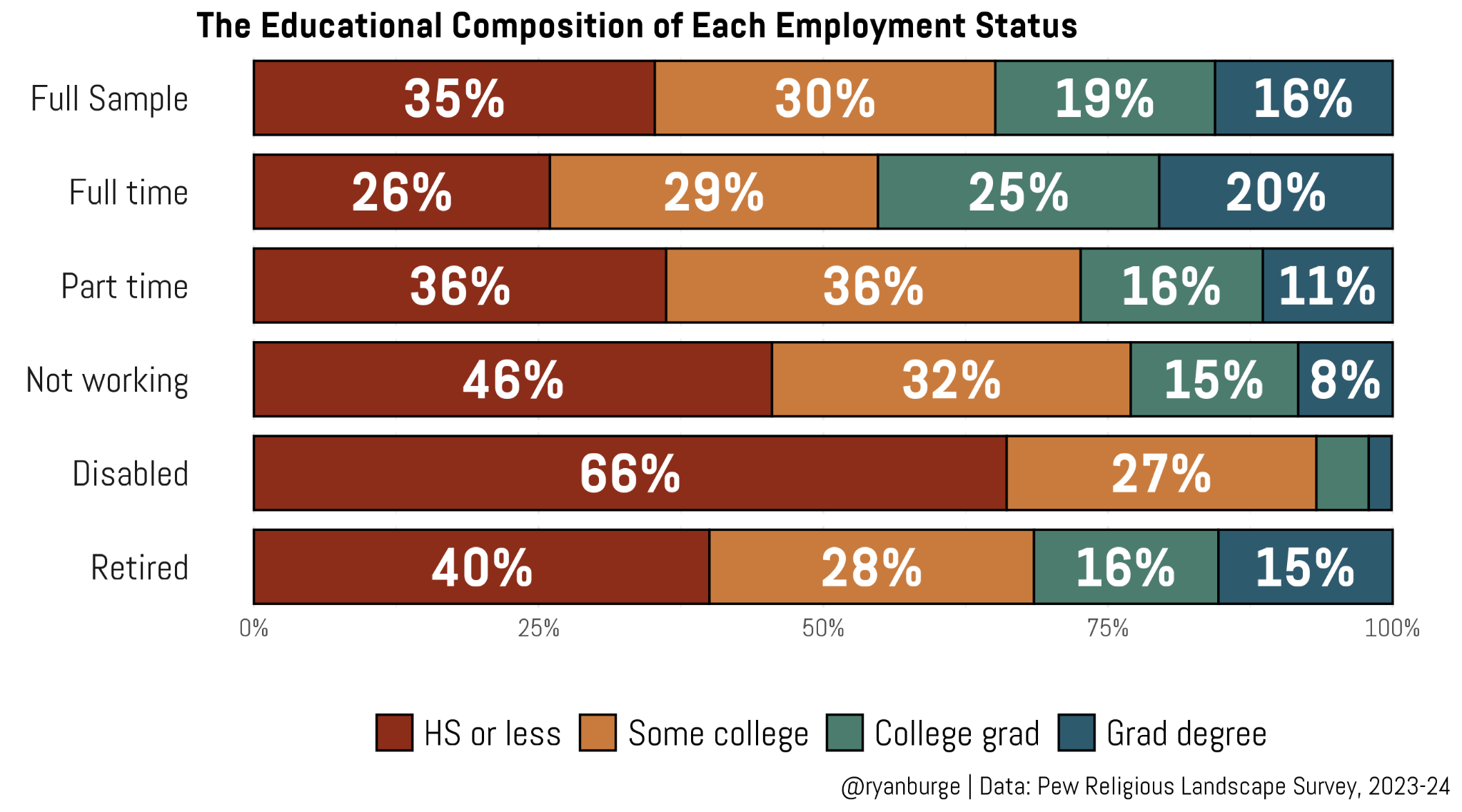
Among those who are working forty hours a week or more, 45% have at least a four year college degree. That’s ten percentage points higher than the full sample. But that’s really the only group where the mean level of education is above average. For part-time workers, just 31% have a college degree and 36% stopped at high school.
But look at those who aren’t working: 46% have no more than a high school diploma. That’s double the proportion of those who have earned a four-year degree at 23%. It’s even more severe among the disabled, where 66% stopped at 12th grade and just 7% have a college degree. Among retirees, the educational breakdown doesn’t deviate that much from the full sample. Retired folks are just slightly less educated than the average American.
But the reason for that deviation is easily explained: people who retire are typically older. They were raised at a time when not that many people were being encouraged to attend college. You see how all these things are compounding on each other now? It would be simple to test a theory about education and attendance by just looking at those who aren’t working. Those folks are not impacted by the “my work schedule makes it tough to go to church” problem. But those two subgroups have unique characteristics that could muddy our results.
Here’s why just focusing on the impact of education on attendance among retired folks is a bad idea. The most significant predictor of weekly attendance is the age of the respondent.
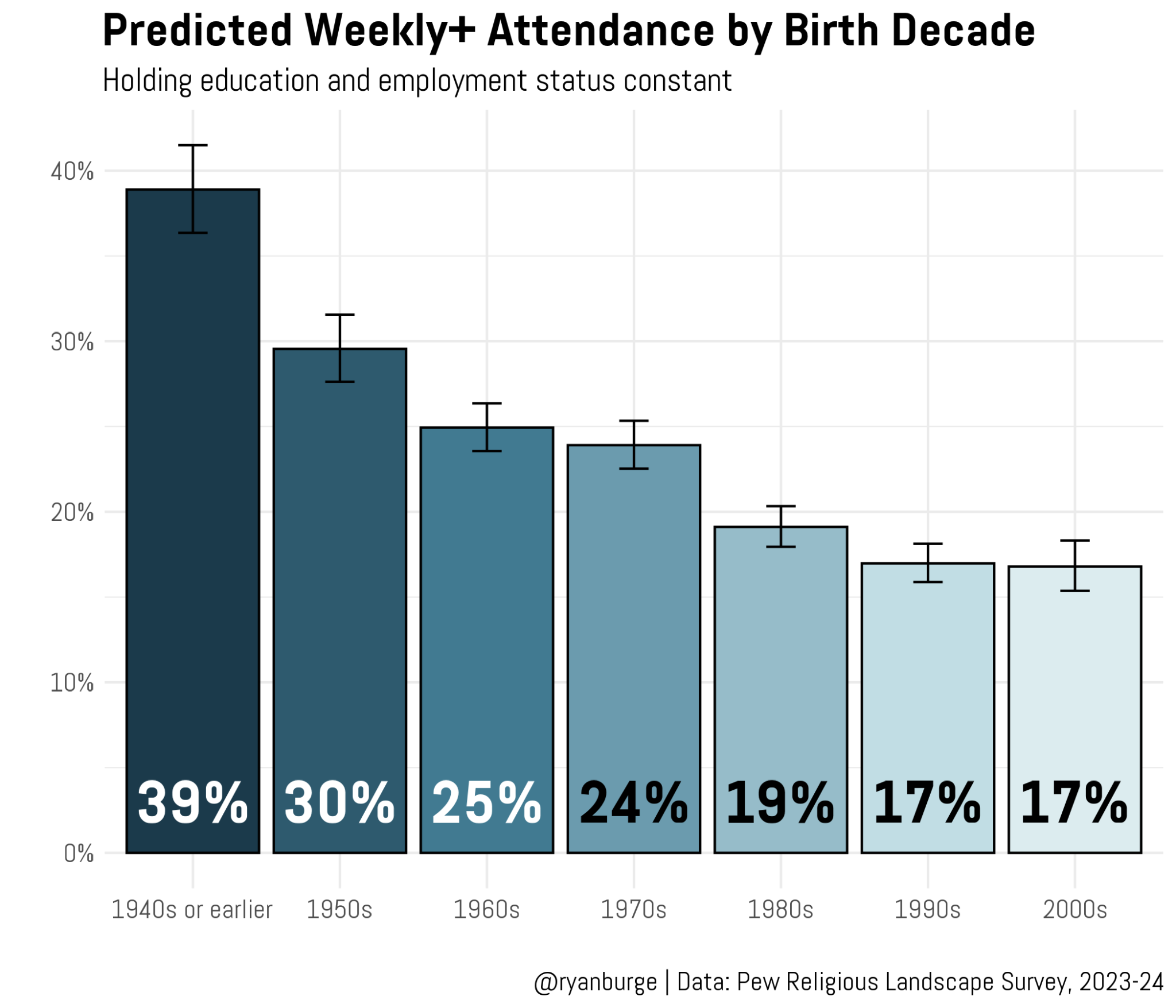
This is a really simple regression model where I held education and employment status constant and just focused on the likelihood of each generation reporting weekly attendance. This graph is about as clean as it gets: older folks are much more likely to be weekly attenders than those who are younger.
Among the very oldest respondents in the survey, nearly 40% are going to church on a weekly basis. You get to people born two decades later and attendance already dips to 25%. Among the very youngest cohorts in the data, weekly attendance rates are down to just 17%. So, if you only run your model on retired folks and you see that education does or doesn’t have an impact, you’ve got to realize that it’s age confounding the whole thing. We really need to control for age more than anything else.
So we can’t focus on retired folks because there aren’t many young retired people in the sample! It would show us nothing of value, really. So instead, I wanted to look at just three levels of employment: those working full-time, those working part-time, and those not working at all. But I am also throwing in a control for age here, so we are taking out the biggest confounding variable.
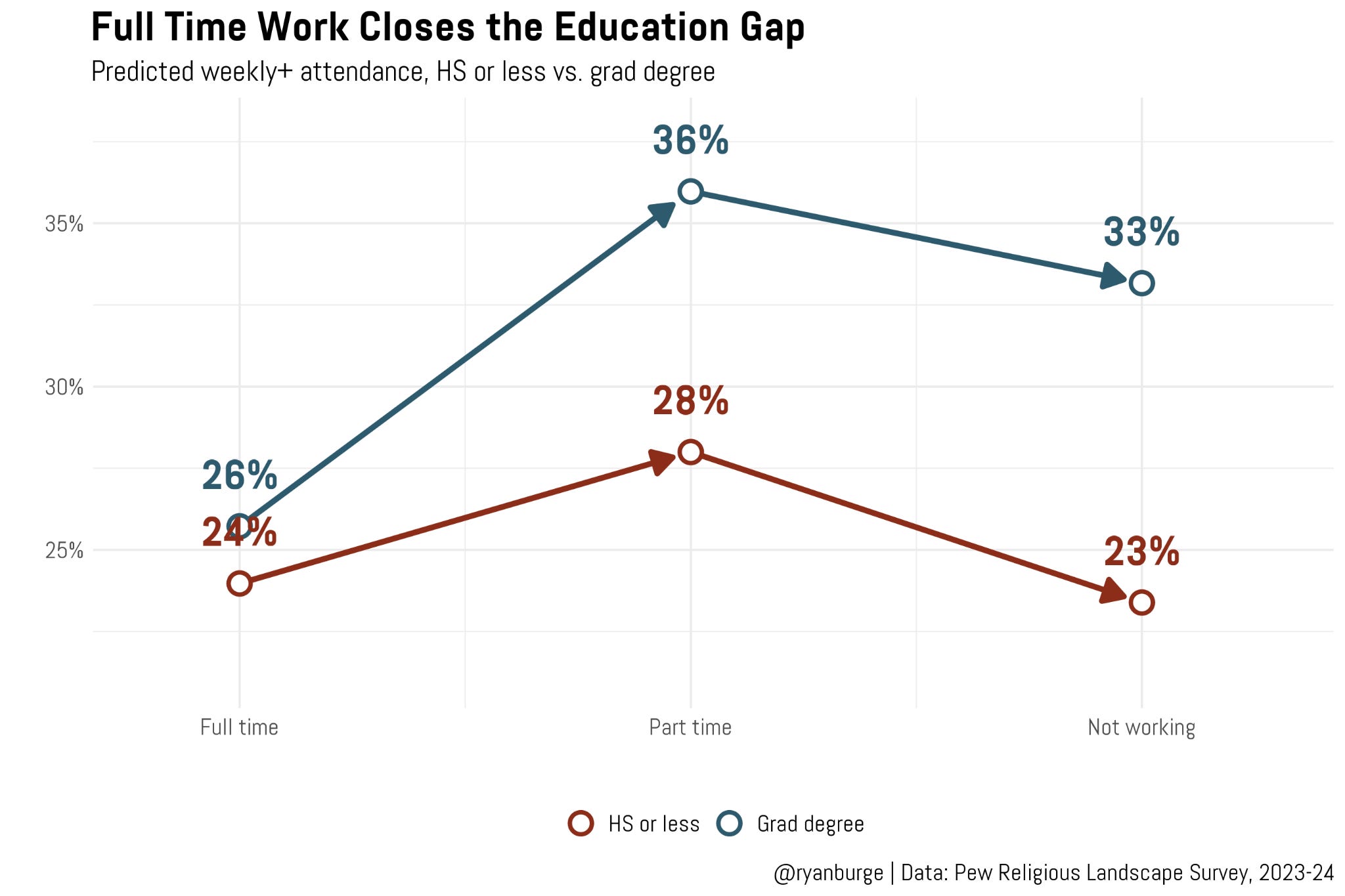
Notice which employment situation has the smallest gap between the two estimates of weekly attendance? It’s those who are working full-time. A respondent with a graduate degree working full-time is only two percentage points more likely to be a weekly attender than someone who works full-time but only has a high school degree or less. That’s not a huge substantive difference. But that’s not the case for the other two scenarios.
Among people with a high school diploma working part-time, 28% are weekly attenders. It’s 36% among those with a graduate degree. For those who are not working at all, a highly educated person is ten percentage points more likely to be a weekly attender compared to someone who stopped at high school (33% vs. 23%). These are gaps that are both statistically significant and substantively large.
Let me just reiterate this point: when we got rid of the problem of scheduling, there’s still an 8–10 percentage point gap in weekly attendance rates among the most and least educated. So, the logistical explanation just can’t explain that away. That’s not to say there aren’t other variables to consider. For instance, someone with a high school diploma who is working part-time or not working at all may have a problem with transportation. I can test that by including income as a control variable in the same model.
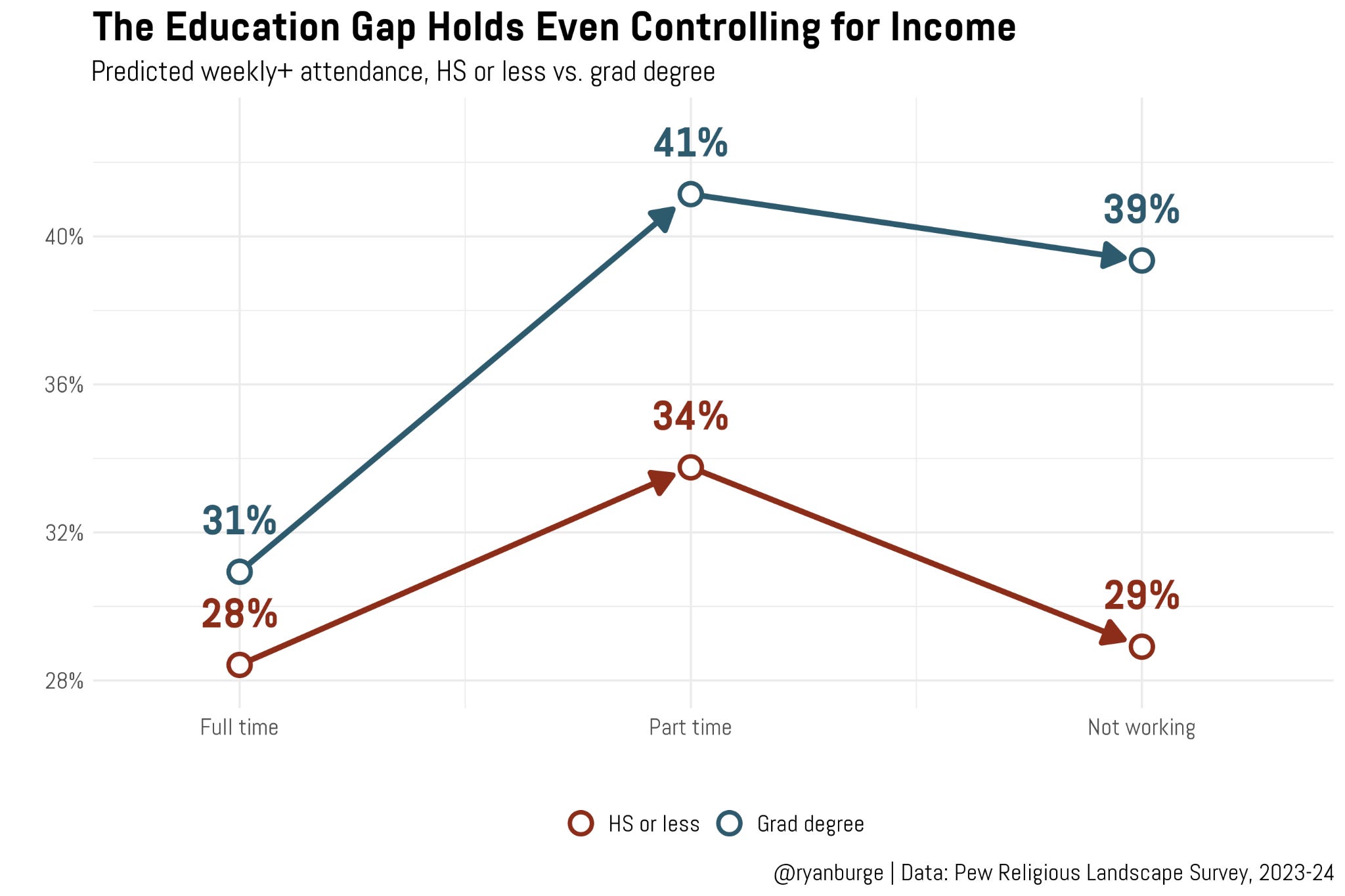
But that explanation doesn’t actually close the gap in any meaningful way. Once I added a control for income, the differences in the estimates between this model and the previous one barely changed. For those who aren’t working at all, the difference in the two estimates is still huge. For those with graduate degrees, 39% are weekly attenders compared to 29% among those with a high school diploma who are not working at all. That ten-point difference is the same as the prior graph.
And what may be even more interesting is that someone with a high school diploma working full-time is just as likely to be a weekly attender as someone who isn’t working at all. And that’s while holding income constant. So I just don’t see how we can chalk this up to an inability to get to church.
There’s one other explanation that could make all of this wash out, of course: maybe these two groups have a totally different level of enthusiasm about religion. Directly stated, “Maybe educated folks are going to church more because they are just more religious than those with a high school diploma or less.” That’s easily testable using other questions from the Pew data.
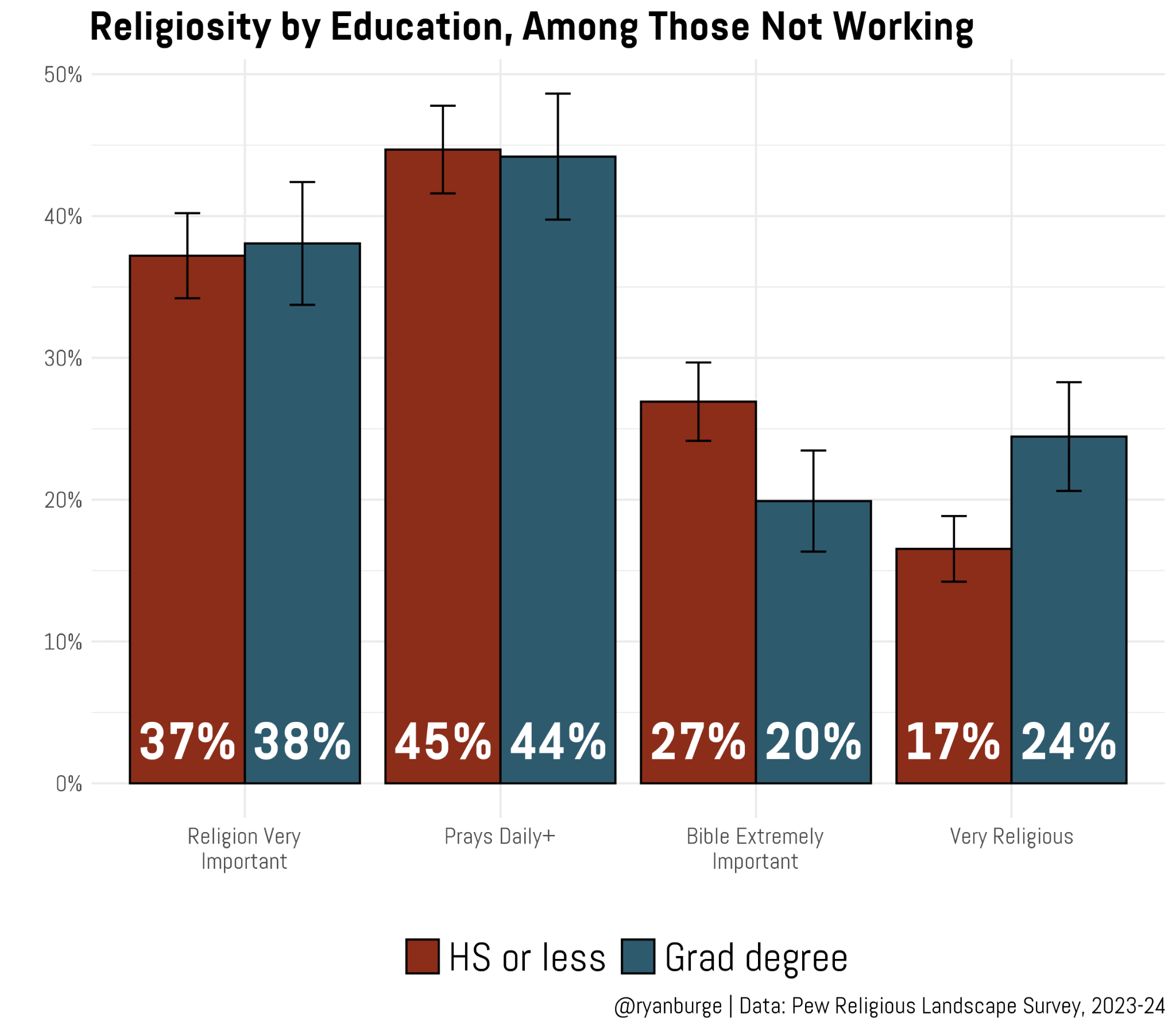
This possibility falls flat, too. If you look at the share of each level of education who say religion is very important to them, it’s essentially the same. If you compare prayer frequency between the two groups, there’s no substantive difference at all. You do see that those with less education are seven points more likely to say the Bible is very important to them, but then those with graduate degrees are seven points more likely to say they are very religious compared to those with a high school diploma.
Doesn’t that seem kind of like a wash to you? Because that’s the impression I get from this data. I don’t think we can really say that one of these two groups is just more enthusiastic about religion than the other one. I just don’t think religiosity is a ready-made explanation, either.
None of the obvious explanations hold up. It’s not that less-educated Americans have less free time. In fact, there’s a bunch of time-use data that actually shows the opposite: the less educated actually have MORE leisure time than those with college degrees. It’s not that work is keeping them away; the gap shows up (and grows) the moment work stops, not the other way around. And it’s not because the less educated are just not that religious, because on belief, prayer, and self-described devotion, the two groups look almost identical.
What’s left is something harder to measure and probably harder to fix: showing up. Whatever it is that turns private faith into public practice, it isn’t distributed evenly across education levels and that gap seems to widen, not narrow, once the excuse of a job is gone. That’s worth some very serious reflection.
I opened this by saying “I don’t have time” usually means “I’m choosing something else.” I expected that logic to hold here—that the education gap in attendance was really a gap in priorities. It isn’t. These two groups want the same thing, believe the same thing, and pray at the same rate. The gap isn’t in what they value. It’s in what they do about it. That’s a stranger, and frankly more unsettling, finding than the one I went looking for.
Code for this post can be found here.
Ryan P. Burge is a professor of practice at the Danforth Center on Religion and Politics at Washington University.

Ryan has written about the "nones" before and how a substantial number of them has dropped out of everything: School, work, church, etc. That seems to be the largest factor at work here. Government programs or family members have enabled this along with inexpensive sophisticated entertainment options (from drugs to games to videos) and the result is an increasingly large number of people who are not well socially, mentally, emotionally or financially. This does not describe all "nones" but an increasing number of them.
Nice post thanks!
Going to church requires discipline, either self-discipline or communal discipline.
- People who go further in education, on average, have more self-discipline.
- People in denominations with communal discipline attend church the most regularly, even though they often lack education. The classic example is Jehovah's Witnesses.
I think that this is the one finding of Charles Murray's work that's really insightful. There's a class of people who can continue to thrive despite the lack of externally-imposed systems of meaning or social norms (i.e. without a culture). Then there's everyone else who can't. Church attendance is one metric for this, and there are many others.