
I’ve always been under the impression that people have a very different approach to belief. Some can listen to a sermon where the pastor speaks with certainty and conviction about salvation through Jesus alone and feel completely compelled by that message. Folks like this tend to lean toward black and white thinking. They like structure and order and believe that the Bible provides them with a perfect guidebook for how to live their lives in almost every circumstance.
Others could hear that same sermon and can’t wait for the altar call to begin — not so they can head down front and make a public commitment to Jesus, but so they can get out of there as soon as possible. As they hear the pastor pound the pulpit and speak with such resolve, the question that keeps coming up in their head is, “How is this guy so sure that he’s right?” These are folks who are often consumed by doubts and second-guessing, and they struggle to know what “right” is in many situations because of their inability — or unwillingness — to just embrace certainty.
I think about the nature of belief a lot and have always wished I could wrap my head around it in an empirical way. Asking questions in this area is hard. No one ever seems to like the response options to a query about what folks believe about God, or evolution, or the existence of the soul. We all hold positions that seem to land between two response items instead of being perfectly captured by one of them.
Well, I was tinkering around in the Pew Religious Landscape Survey the other day and came to the conclusion that it contains more questions about belief than anything else I have available, and it was fielded to a larger sample to boot. I was wondering if I could begin to model dimensions of faith — hoping to clearly identify whether there are two, three, or four ways that people seem to orient themselves to belief items.
I think I’ve stumbled upon something that may be helpful in understanding belief among American adults.
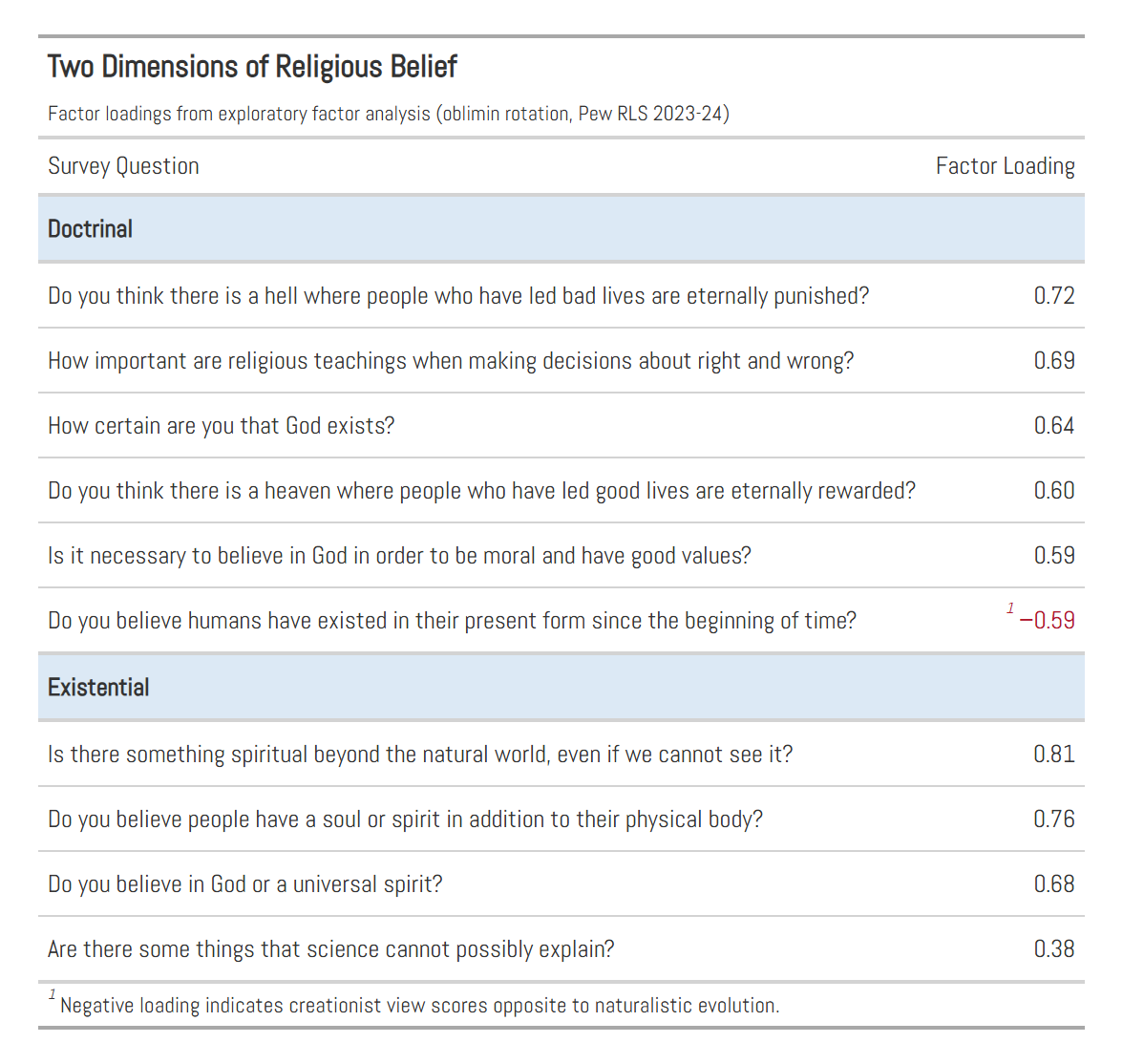
Here’s how I did it. I pulled ten belief items into an exploratory factor analysis, which is a statistical technique for understanding how a group of items “hang” together. What I ended up with is two dimensions that made the most sense.
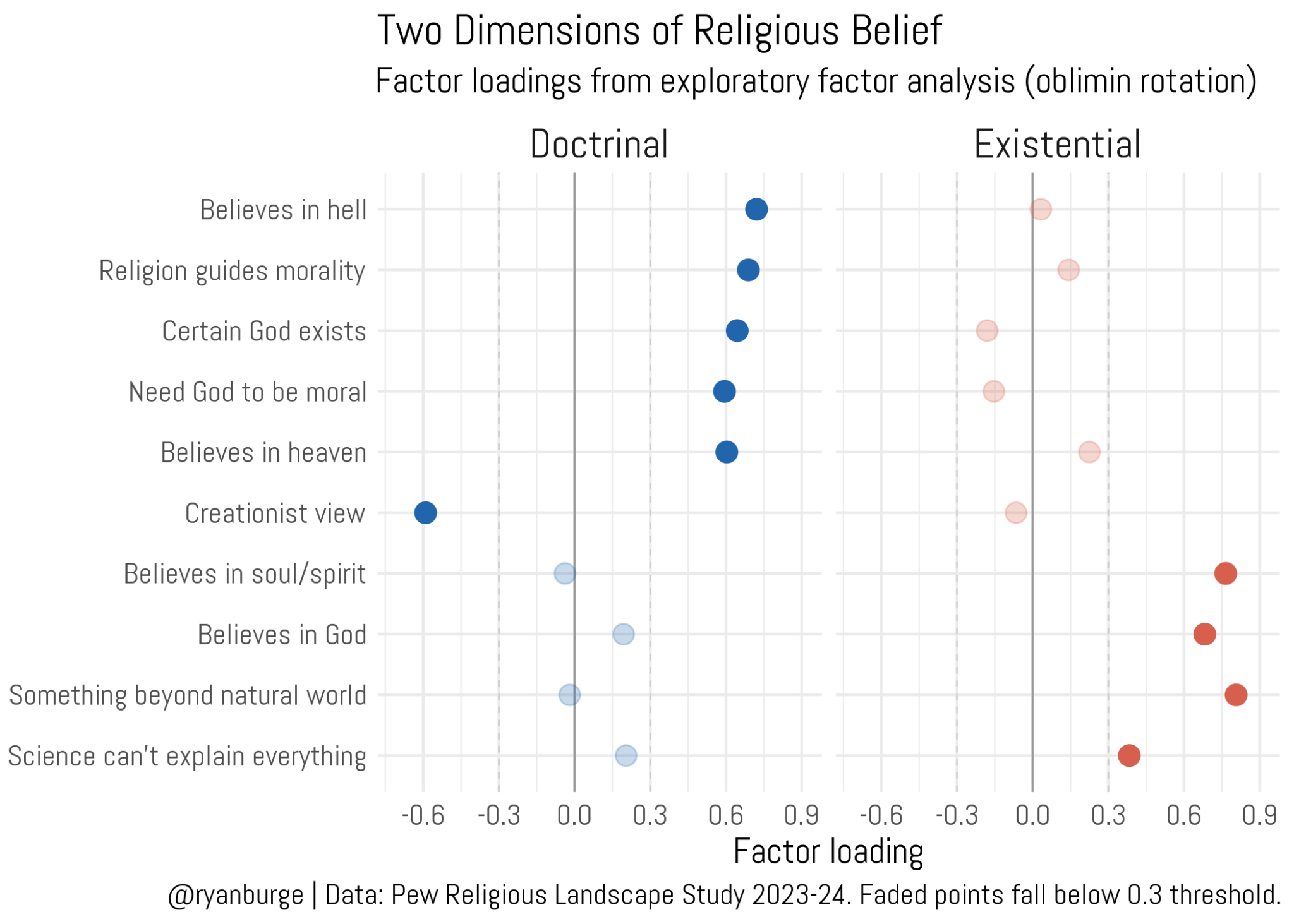
The first dimension is what I’ve come to call “doctrinal commitment.” The items with the darker blue circles all loaded on the same factor and it was pretty clear they were focused on propositional claims — the kinds of questions that show up in creeds and catechisms. Folks who are sure that people who don’t believe in God can’t be moral will score high on this dimension. There were six items that fit the bill here.
The second dimension focuses on what I’d call an existential understanding of faith. To be a little colloquial, these are the “woo woo” aspects of religion and spirituality. They tend to focus on the idea that we all have spirits and that we can’t be entirely certain God really exists in a concrete, definable way. When I looked over the data, I got the distinct impression that these are folks who would say things like, “I just feel that we are all connected somehow.” People who load high on this dimension have a softer and more diffuse perspective on faith. They aren’t bound by a specific doctrine or creed.