


If you’ve been around my work at all, you know very well that the relationship between education and religious attendance cuts against the prevailing view. If you walked up to the average American and asked them, “Who is more likely to go to church this weekend — a person who earned no more than a high school diploma or someone with a graduate degree?” I bet that the vast majority of those being quizzed would choose the person with less education.
Here are three different datasets, all collected in a pretty similar time frame, that just test that relationship.
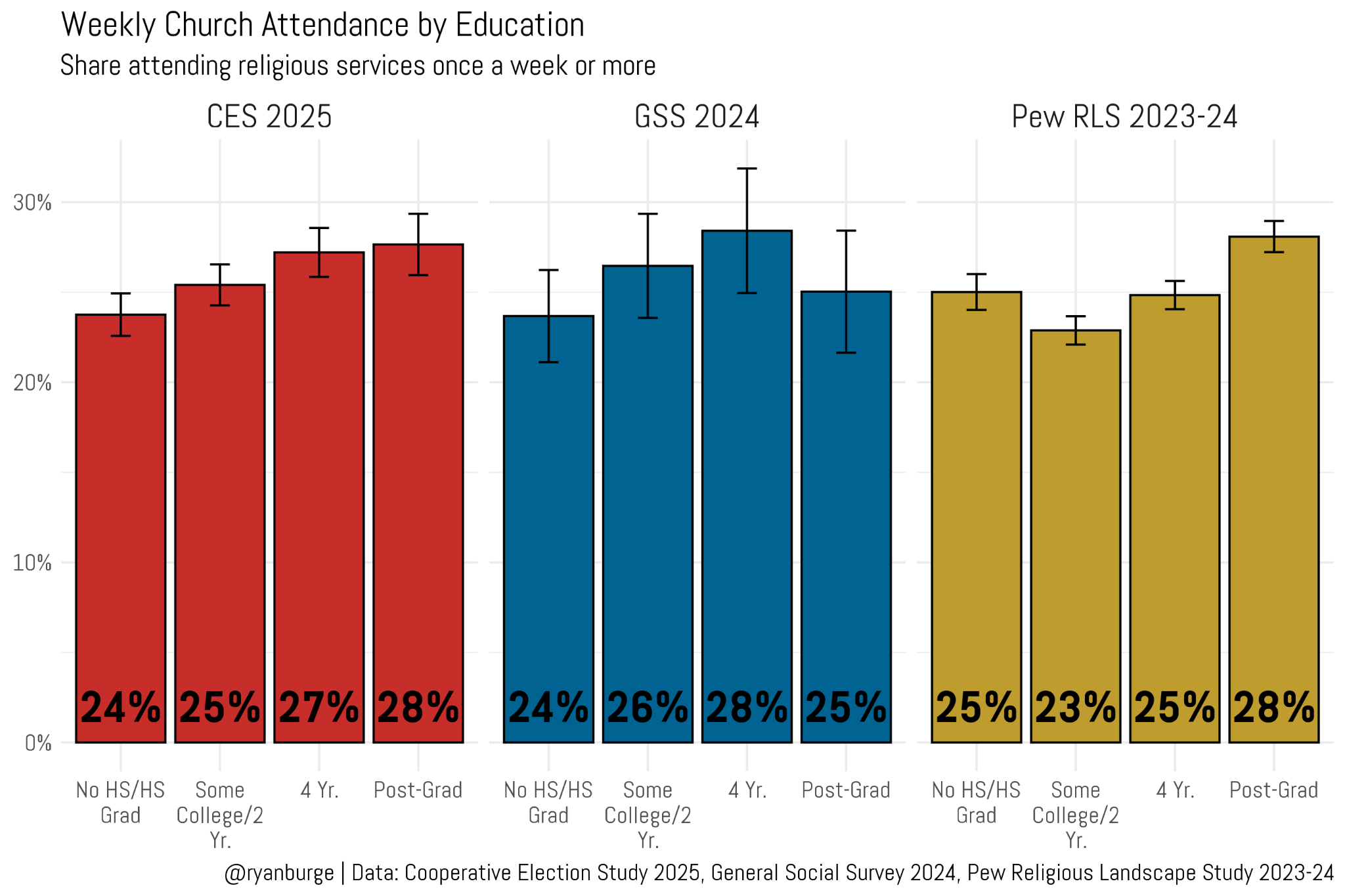
You can see that in the Cooperative Election Study, the relationship is a positive one: an individual with a graduate degree is four percentage points more likely to attend a house of worship weekly compared to someone who stopped at high school. In the General Social Survey, there’s not a clear pattern at all. It’s 24% among high school grads compared to 25% among those with a graduate degree. That’s inside the margin of error.
In the 2023-2024 Pew Religious Landscape Study, the relationship is not clearly linear. Attendance is 25% among those with a high school diploma or less, then it dips slightly among those with some college credits, only to rise among those with a four-year degree and go even higher for folks with a master’s degree. Among the most highly educated in Pew’s sample, 28% go to a house of worship on a weekly basis.
Dropping Out Of Everything

One of the most important pieces of social science published in my lifetime is Robert Putnam's Bowling Alone: The Collapse and Revival of American Community. I probably reference it at least once a week when speaking to reporters, students, or other social scientists. Its premise is simple: people aren’t joining stuff anymore—social clubs like the Elks,…
Thus, it’s empirically false to say: people with less education go to church more. There’s zero evidence of that in the best data we have. It’s also accurate to say that the relationship is likely mildly positive — those with higher education are more likely to be frequent worship attenders. It’s not a huge difference, but it’s persistent.
Now let me simplify and expand this using Pew’s Religious Landscape Survey because they also included a question about frequency of attendance at online worship.
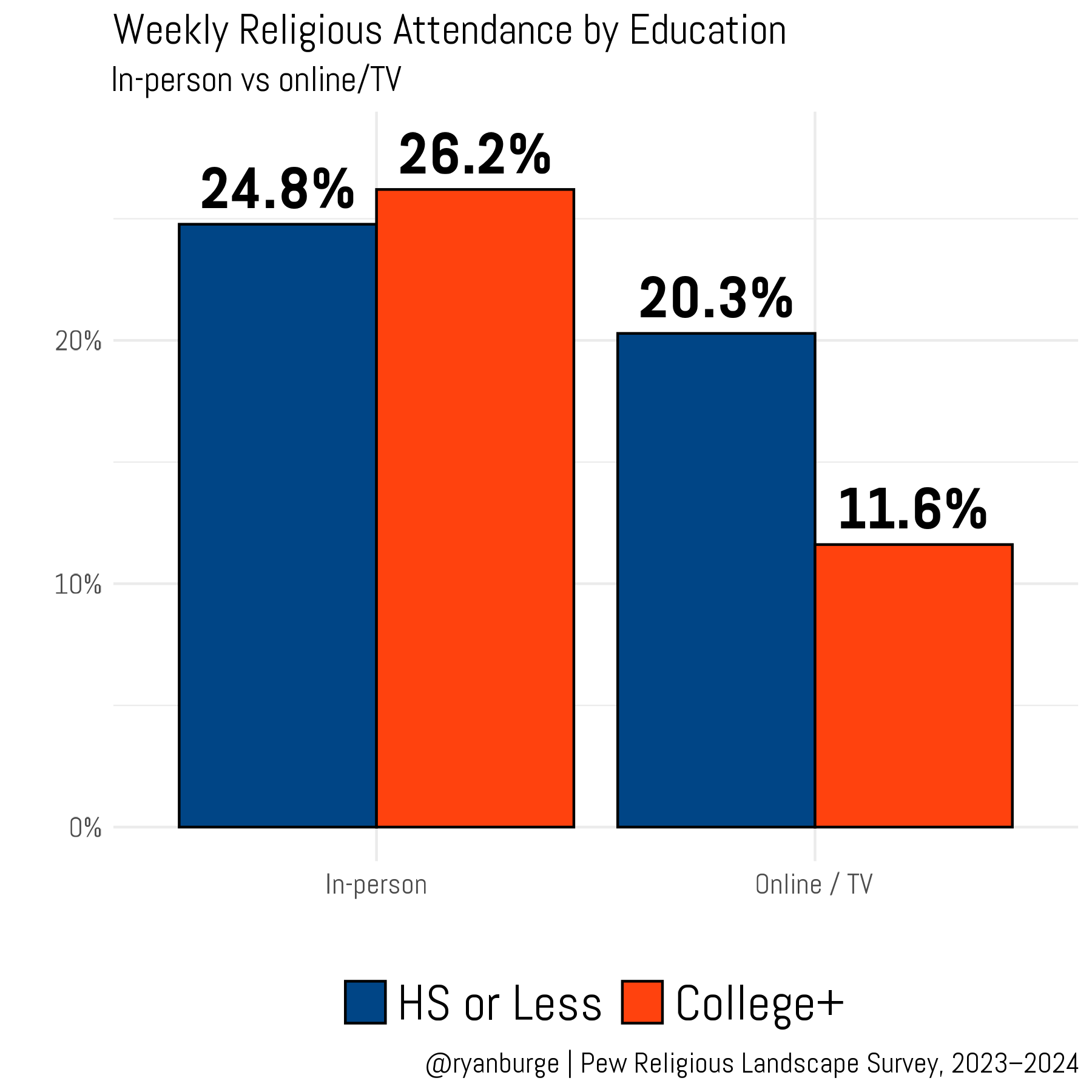
The bars on the left should come as little surprise based on the previous graph. Among folks who have at least a four-year college degree, 26.2% attend a house of worship weekly. For those who stopped at high school, it’s 24.8% — a difference of just 1.4 points. But look at the online attendance difference. For those whose education stopped at high school, 20.3% say that they watch a service online every week. The college-educated crowd is much less inclined to participate this way: 11.6%.
Now wherever I post either of the above graphs on social media, I get the same comment over and over again. People believe that the discrepancy can best be explained by the fact that those without a lot of education have to work on the weekends, while those with a college degree work a traditional Monday through Friday schedule.
I must admit that the data from the Bureau of Labor Statistics that addresses this is incredibly muddy. Which frustrates me to no end. And I don’t know of any survey that asks about this possibility directly. So that’s where the best part of my job kicks in — I have to get creative. One possibility was to just limit my sample to those who are retired. That would absolutely control for the “working on Sunday” confounding variable.
The problem with that is: people who are retired are old. When they were growing up, educational access was much different than it is today. Thus, people with a four-year college degree (let alone a graduate degree) were a very specific type of individual. It wasn’t just a general cross-section of the American public who went to college in the 1970s. I had to set that idea aside.
I wanted to attack the problem from a different angle. After doing data analysis for nearly twenty years, I’m pretty convinced that education really runs on the same causal tracks as being pro-social. Educated folks are just more likely to be engaged in all kinds of social activities. They serve on school boards. They volunteer at their local library. They’ve just built a thicker, more robust social network than those who stopped at high school. I’ve used this phrase a lot — “Dropping out begets dropping out” — and I really do believe it’s true.
But after poking around the data a whole bunch for this post, I’m convinced of something very important. If a person at the lower end of the educational spectrum can become a regular churchgoer, it opens a door for them to engage in much more pro-social activities. And it will actually make their lives better and close that “drop out” gap in some very meaningful ways.
