



This post has been unlocked through a generous grant from the Lilly Endowment for the Association of Religion Data Archives (ARDA). The graphs you see here use data that is publicly available for download and analysis through link(s) provided in the text below.
One of the books I’ve read in the last couple of years that has really stuck with me is Jonathan Haidt’s The Righteous Mind. It’s a distillation of a lot of his work on how people manage to puzzle their way through tricky moral situations. For instance, he discusses the classic Heinz dilemma.
A man’s wife is dying. A pharmacist has a drug that could save her, but charges far more than Heinz can afford. Should Heinz steal the drug?
Some people would say that stealing is always morally wrong, even if it’s done for a noble cause. Others contend that the ends justify the means in situations like this. Stealing may not be morally acceptable, but letting someone die is even worse.
So how do people decide what the right thing to do is? What cognitive resources do they tap into to justify their actions—or their inactions? And do non-religious folks have a different mental framework when it comes to morally complex issues compared to Christians, Jews, or Muslims?
The Pew Religious Landscape Study, which is hosted at the Association of Religion Data Archives, includes a four-question battery that begins with the following preamble: How important are each of the following to you when making decisions about right and wrong? The items listed are religious teachings and belief, logic and reason, practical experience and common sense, and scientific information.
Here’s how the entire sample respond to each of these four:
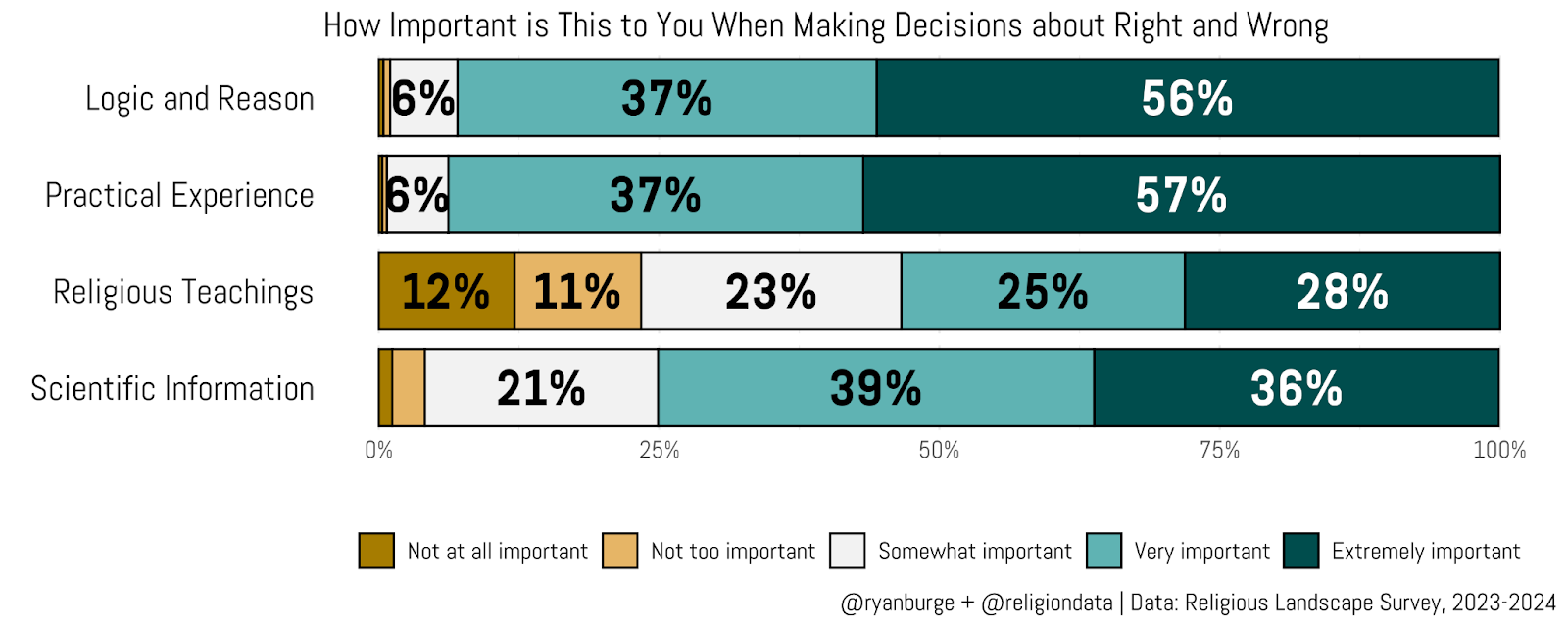
You can quickly notice that “logic and reason” and “practical experience” are easily the most popular responses in the survey. A clear majority (about 56%) say these two factors are extremely important when making decisions about what is right and wrong. Another 37% say they are very important. It’s fair to say that almost all Americans tap into these two resources when faced with having to work through something difficult.
You know what doesn’t show up nearly as much? Religious teachings. Only 28% of respondents said that leaning on their theological background was extremely important to them, and another 25% said it was very important. By contrast, about a quarter said that religious teachings were not too important or not at all important when they were faced with difficult moral questions.
Leaning on scientific information was quite a bit more popular than religion. In total, three-quarters of Americans believed that science was extremely or very important when making moral decisions. That’s 22 points higher than religious teachings. And only 4% of Americans chose the bottom two options for this question—the lowest share for any of the four statements.
Let me explore this a bit more deeply by calculating the share of each birth decade who said that each of the four statements was extremely important to them.
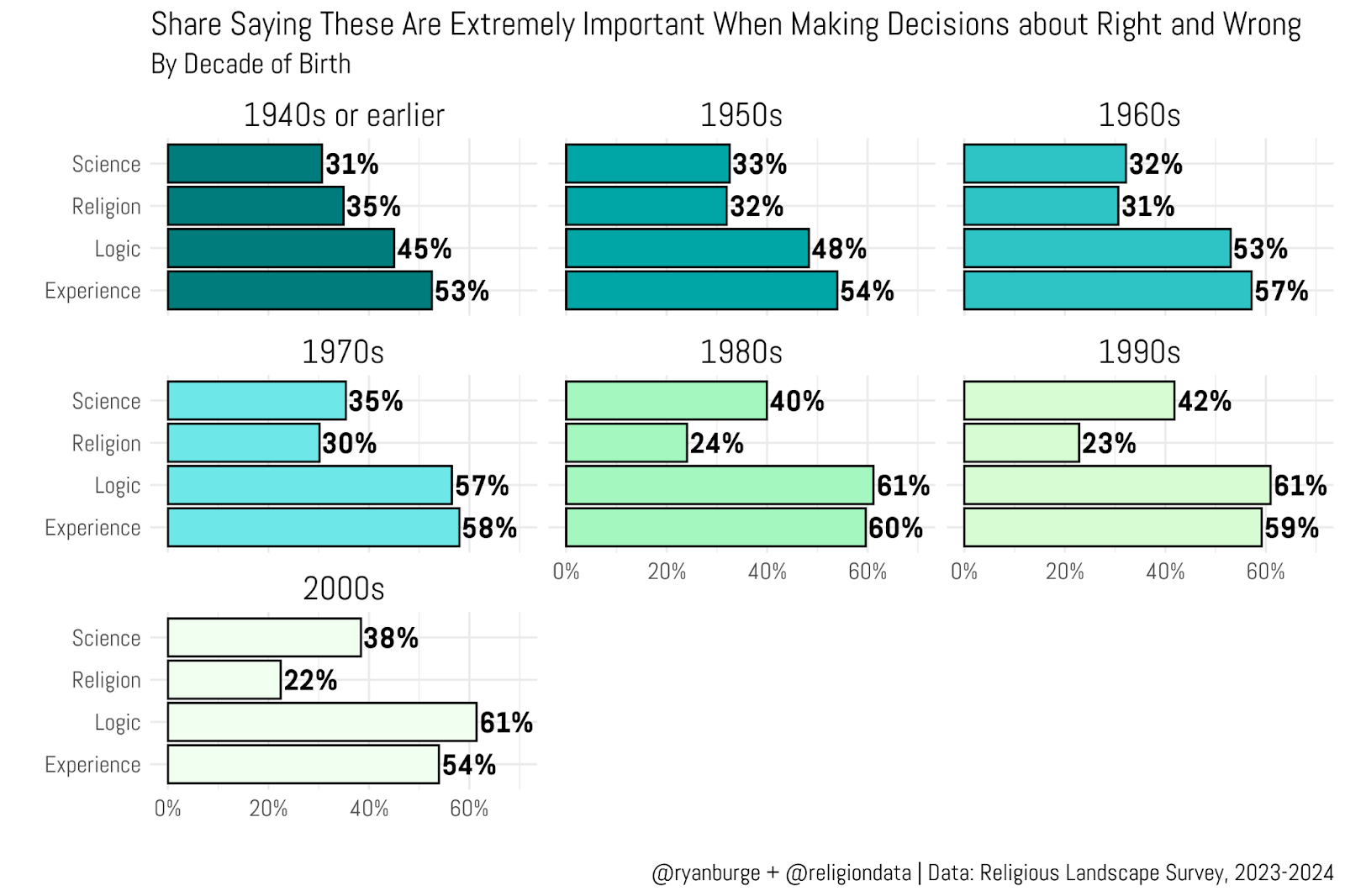
If you look across the top row of graphs, what you find is a lot of similarity in the mental frameworks of people born in the 1960s or earlier. The most popular option is “life experience,” which makes sense given that those in these birth cohorts have had decades under their belts. The second most popular choice is logic and common sense. Both science and religion are about equal with each other—roughly a third of each cohort says they are extremely important.
But notice what happens with the “science” responses as you move from older cohorts to younger ones: the share continues to increase. You can see this clearly in the second row of graphs. Among those born in the 1970s, 35% say scientific knowledge is extremely important when making decisions. For those born two decades later, that figure rises to 42%. At the same time, the percentage who rely on religion drops from 30% to 23% between these two cohorts.
Let’s bring religion into the mix now.
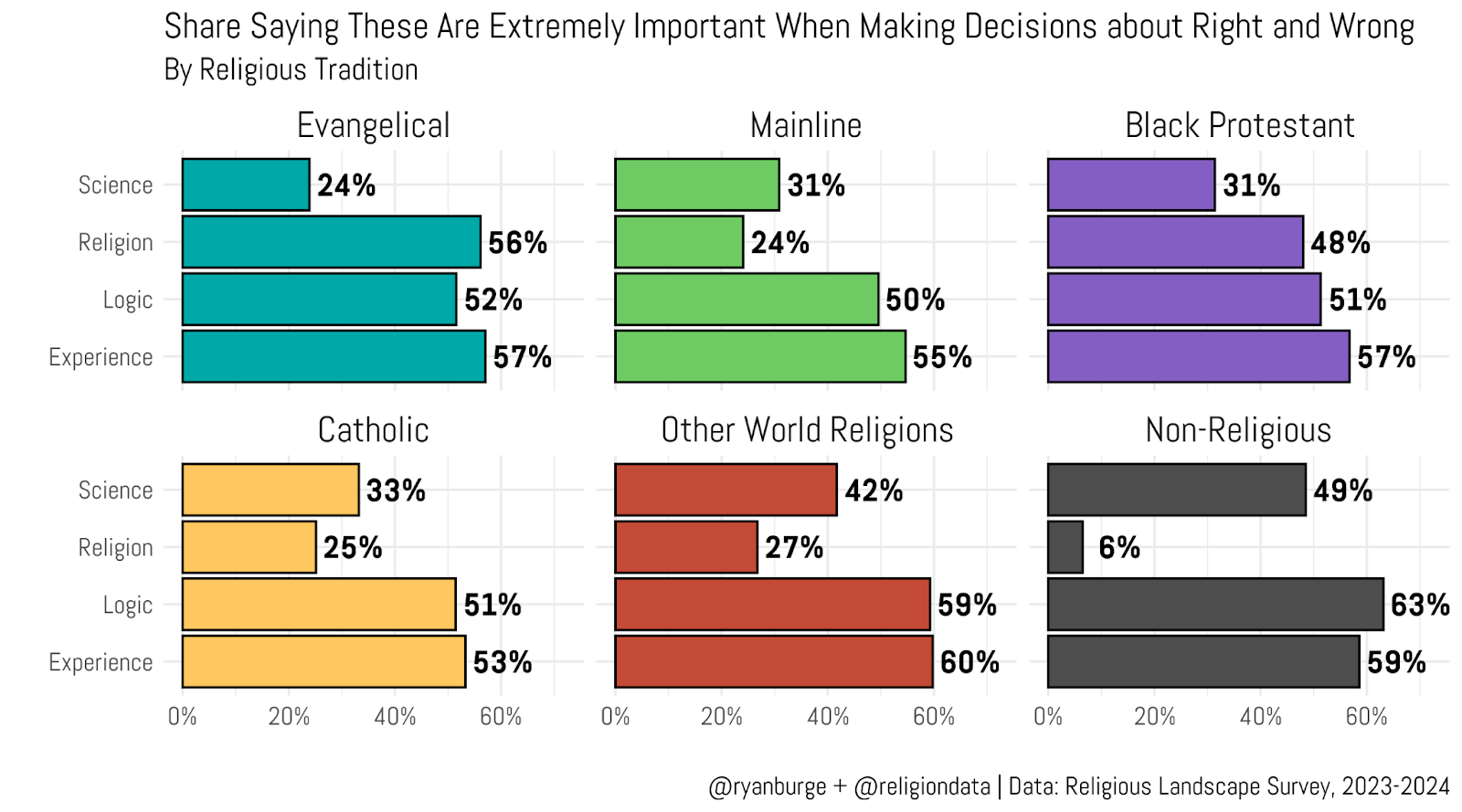
For those who follow this newsletter, it should come as no surprise that evangelicals prioritize their religious convictions over other sources when making decisions. In these data, 56% of evangelicals said that religious teachings were extremely important when it came to helping them make difficult moral decisions. The only other group that comes close is Black Protestants, at 48%. Compare that to mainline Protestants and Catholics, where the figure is just 25%. This pattern is reminiscent of what I showed in a previous post about the religious beliefs of clergy.
How Certain Are Clergy of their Faith?

This post has been unlocked through a generous grant from the Lilly Endowment for the Association of Religion Data Archives (ARDA). The graphs you see here use data that is publicly available for download and analysis through link(s) provided in the text below.
What’s striking as well are the results for the question about using scientific knowledge to make decisions. Given our understanding of evangelical theology, it would logically follow that evangelicals would place less emphasis on science. But what stands out is that no Christian group leans on science all that heavily, either. Among Catholics, the share who say scientific knowledge is extremely important is only nine points higher than among evangelicals. Even among the non-religious, just 49% said that scientific knowledge was extremely important.
That last graph got me wondering: can I identify distinct types of mental frameworks that Christians use when making difficult moral decisions? To explore this, I put together a very simple k-means clustering algorithm based on these four questions. Nothing fancy here—I just guessed at four clusters. As you’ll see in a minute, I really only found two that were especially intriguing.
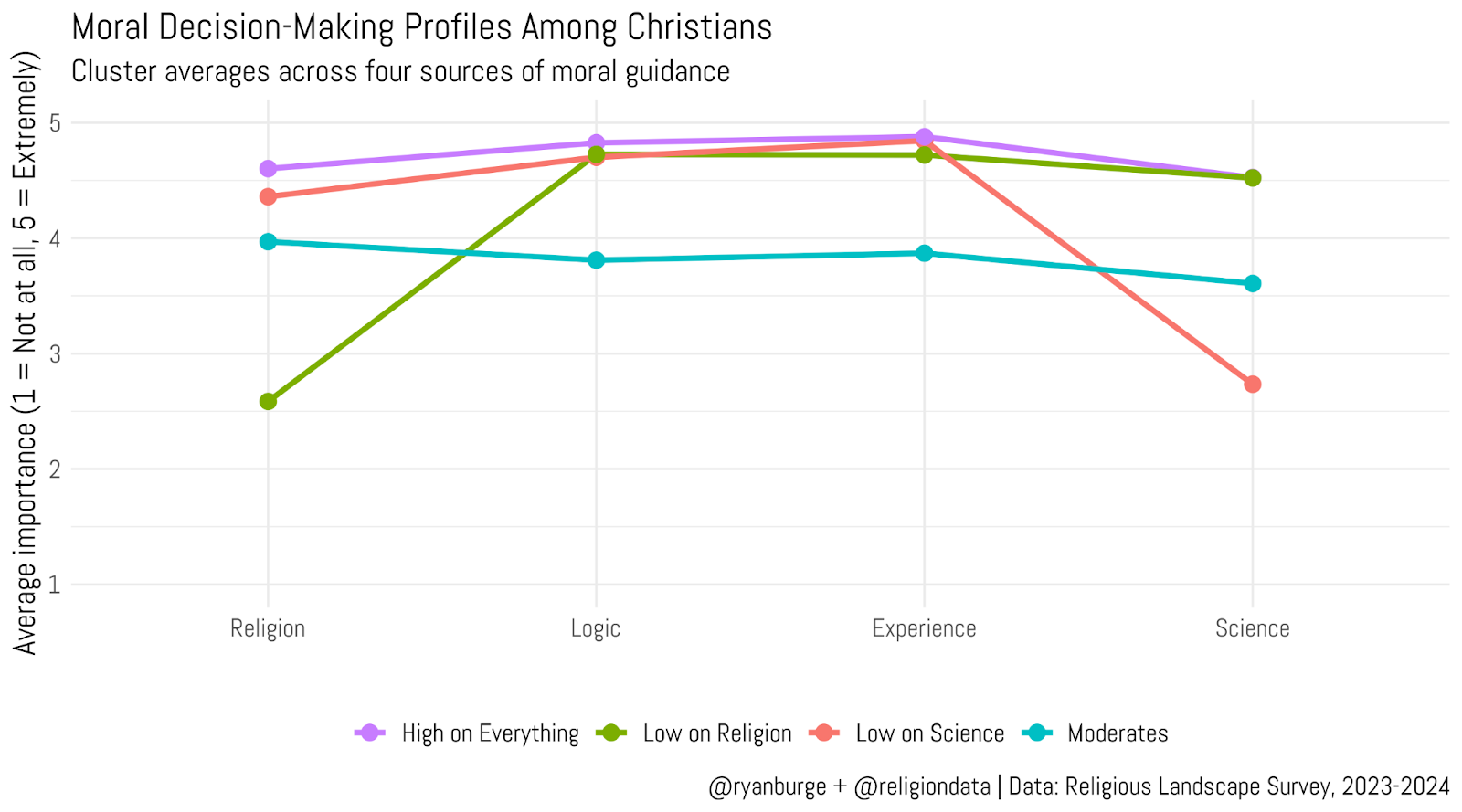
One of the clusters was made up of Christians who simply chose “extremely important” for all four statements. That’s not all that exciting. Then there was another cluster who didn’t think that any of the four were especially important. Together, those two groups accounted for about 70% of all Christians in my sample. Again, I don’t find either group especially illuminating.
But the other two groups really did pique my interest. One was a group I labeled “low on religion,” shown by the green line in the graph above. They rate logic, experience, and science as very important in how they make decisions. However, when it comes to religion, their average score is only about 2.5 on a five-point scale. This group made up 17% of my Christian sample.
The other notable group consists of Christians I describe as “low on science.” They score religion, logic, and experience very highly, but then rank science much lower—just 2.7 out of 5. This was the smallest of the four clusters, representing 13% of the Christian subsample.
I find these two groups fascinating because they appear to locate their moral reasoning along very different axes. One group seems to take their religion seriously and, when confronted with a difficult choice, thinks, “What does the Bible say about this?” The other group of Christians appears to pay much less heed to the theology of their faith tradition.
I want to explore the differences between these two groups over the rest of the post. First, let me show the distribution of Christian traditions in each of these two clusters.
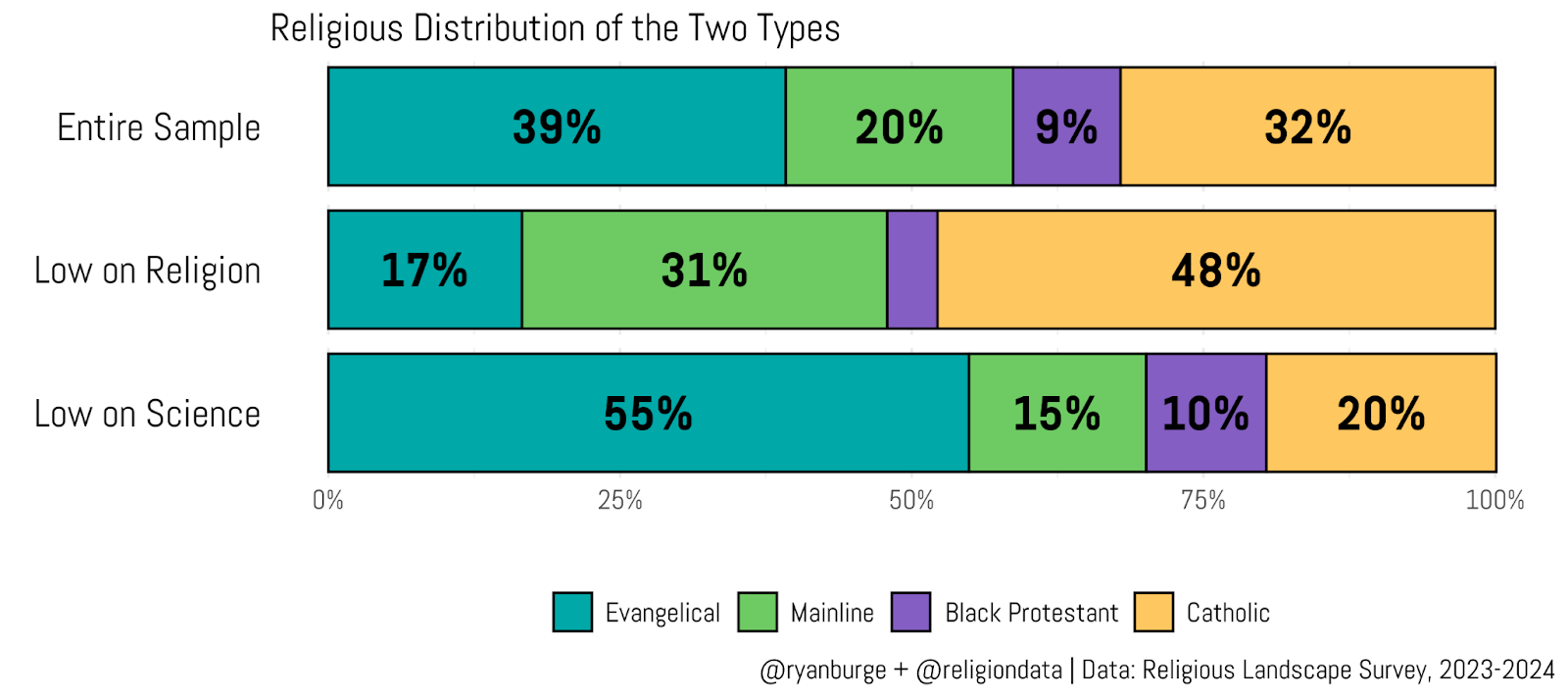
This is where the picture really came into sharp focus for me—these clusters are being generated from totally different sectors of Christianity. For the group that places a lot of emphasis on science, Catholics and mainline Protestants are way overrepresented. In my full sample of all Christians, 20% were mainline and 32% were Catholic. Among the cluster that was low on religious foundations, those figures jump to 31% mainline and 48% Catholic.
For the cluster that didn’t put much weight on science, evangelicals were dramatically overrepresented. Among all Christians, evangelicals made up 39% of the sample. In this “low on science” subset, a whopping 55% were evangelicals. Again, this tracks well with what we already know about how evangelicals navigate their lives—there’s a strong emphasis on faith and less enthusiasm for scientific discoveries.
You can also see a really noticeable difference when comparing these two clusters in terms of educational attainment.
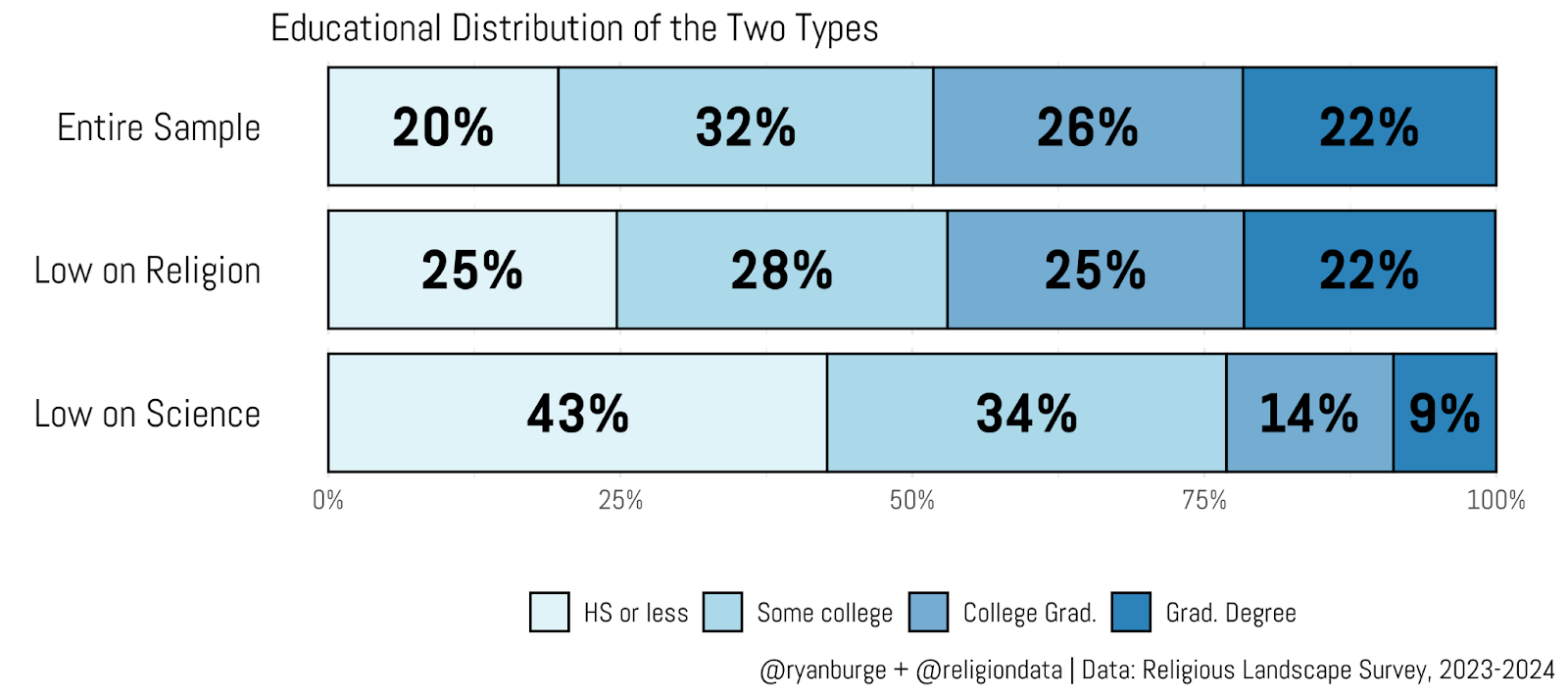
For the cluster that didn’t think religious teachings were all that important when making moral decisions, the distribution of educational attainment doesn’t deviate much from the full sample of Christians. For instance, 22% of both the overall sample and this “low on religion” cluster had earned at least a graduate degree. In total, 47% of this group held a bachelor’s degree or more—just one point lower than the full Christian sample.
But for those who placed much less emphasis on science, educational attainment was markedly lower than in the rest of the Christian sample. In this cluster, 43% had stopped at high school, which is a whopping 23 points higher than the full sample of Christian respondents. By contrast, only 23% had completed a four-year college degree—about half the rate of the full Christian sample.
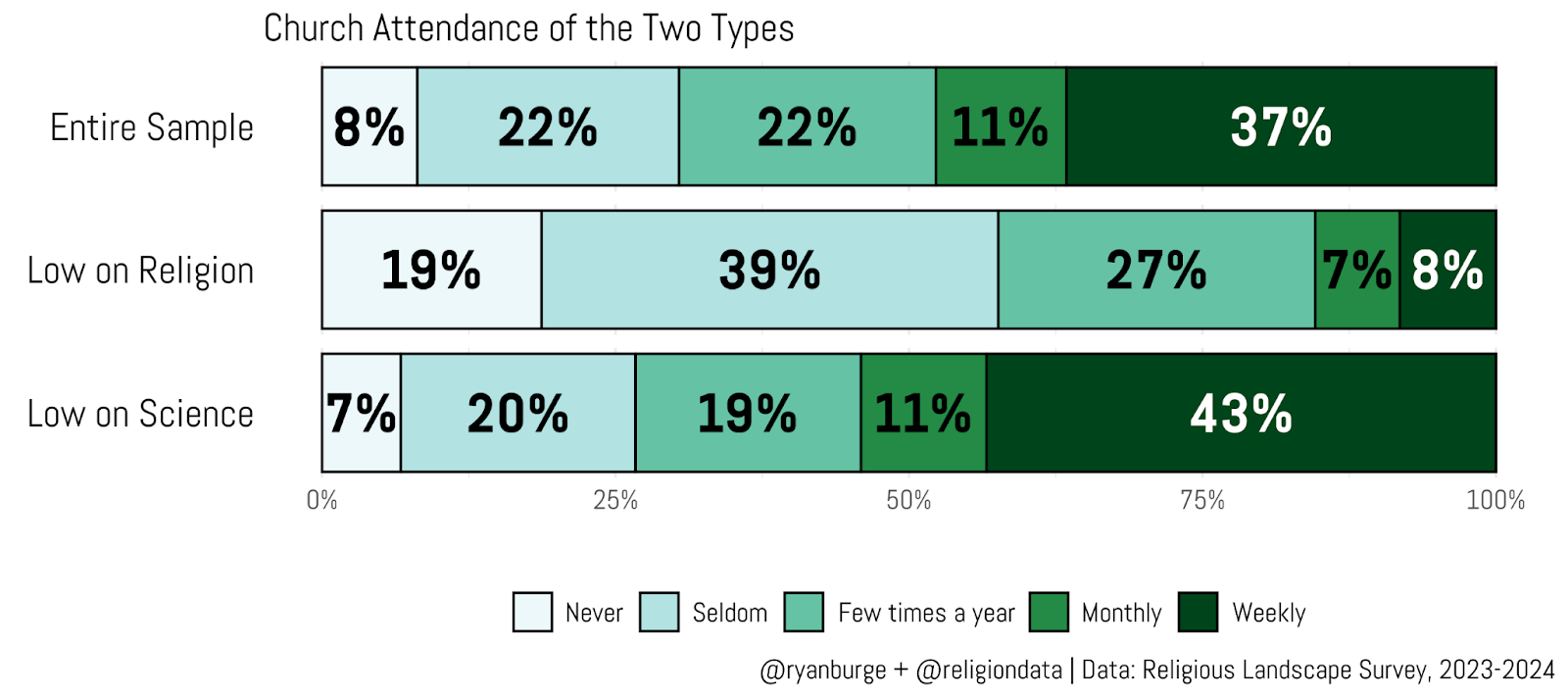
Looking at church attendance across these two clusters is even more fascinating. The folks who don’t lean on scientific knowledge very much are highly religiously active—43% report attending church every week. For those who don’t put much emphasis on religious teachings, attendance is far more infrequent. In fact, among this cluster, 58% say they attend religious services less than once per year, while only 8% report going every single week.
So what do we see when we compare these two clusters?
Moral Absolutes or ‘It Depends’: How Americans See Right and Wrong

The more I think about what religion means, the more that I think that there are just two camps of people in the United States. Some folks draw bright lines around what they think is right and wrong. In evangelical circles, there’s an oft uttered phrase, “The Bible says it. I believe it. That settles it.” They just have a really clear sense of what is a…
1. Low on Religion.
This group is disproportionately made up of mainline Protestants and Catholics. Their level of educational attainment closely mirrors that of the full Christian sample, but their church attendance is strikingly low.
2. Low on Science.
The majority of this group consists of evangelicals (55%), with relatively few mainline Protestants or Catholics. Their level of educational attainment is noticeably lower than the rest of the Christian sample, and they are much more likely to be frequent church attenders.
I think the evidence here points to a clear conclusion: not everyone is a Christian in the same way. Evangelicals (and, to a lesser extent, Black Protestants) stand apart from Roman Catholics and mainline Protestants. The former group takes their faith very seriously. Not only do they attend church frequently, but they have deeply internalized the theology of their tradition. For a sizable share of other Christians, faith does not play a central role in how they make moral decisions.
It may sound like an obvious statement, but sometimes it needs to be said again: religion doesn’t mean the same thing for everyone.
Code for this post can be found here.
Ryan P. Burge is a professor of practice at the Danforth Center on Religion and Politics at Washington University.

May I say as a scientist that leaning on "science" as the basis for moral judgements is absolutely bonkers, and points to the quasi-religious worship of expertise that's currently popular in the West.
The whole point of science is that its conclusions are tentative and subject to revision, while the whole point of a moral judgment is that it's actually true. The whole point of science is that it's giving us a mechanistic model for how things work, not what we should do with that information.
I could study the mechanism of a poison to make an antidote for people who are poisoned, or because I want to more effectively poison people. Science will give me information that would serve either end. It will absolutely not tell me toward what end my poison discovery should be directed.
I would be interested to know how many scientists think that science is the basis for moral judgement.
As always, another interesting study. This one quote really caught my attention: "For a sizable share of other Christians, faith does not play a central role in how they make moral decisions."
Seems like a reflection of a personal subjective vs objective theological paradigm being acted out.