


On my public Facebook page I receive (and this is not an exaggeration) about 900 comments a day. That’s a lot to process, and honestly only a small fraction feel truly instructive or insightful — maybe less than 10%. A good chunk are people using the comments to air grievances about politics or religion, and another sizable group is asking for the data source, which is always listed in the bottom right of the graph.
But there’s one category of comment that’s become its own genre. Here’s how it usually goes. I’ll post a graph on mainline Protestants — seven denominations, five election cycles of data, a chart I’m genuinely proud of. And the replies come in fast:
“Where are the Catholics?”
“Why do you ignore the Baptists!?”
“What about Latter-day Saints?”
I get something like 100 of these a day. But one group shows up with a consistency I can set my watch to: people who are upset that Orthodox Christianity isn’t in the graph. And in my experience, it’s almost always young men making this particular complaint.
So this post is for them. Let’s actually dig into the widely held belief that American Orthodox Christianity is experiencing a huge surge in converts. Short answer: that’s a really hard claim to test with survey data, for a simple reason: there just aren’t that many Orthodox Christians in the U.S. to begin with. (Though judging by my comment section, a lot of the converts have found their way to me specifically.)
The dataset I’m using is, by any objective metric, the best survey available for exploring migration patterns around Eastern Orthodoxy: the Pew Religious Landscape Survey. It’s a probability-based design, it was conducted fairly recently (2023–2024), and it has a huge sample size — nearly 37,000 respondents.
Let’s start with a simple calculation of retention across a bunch of different religious groups.
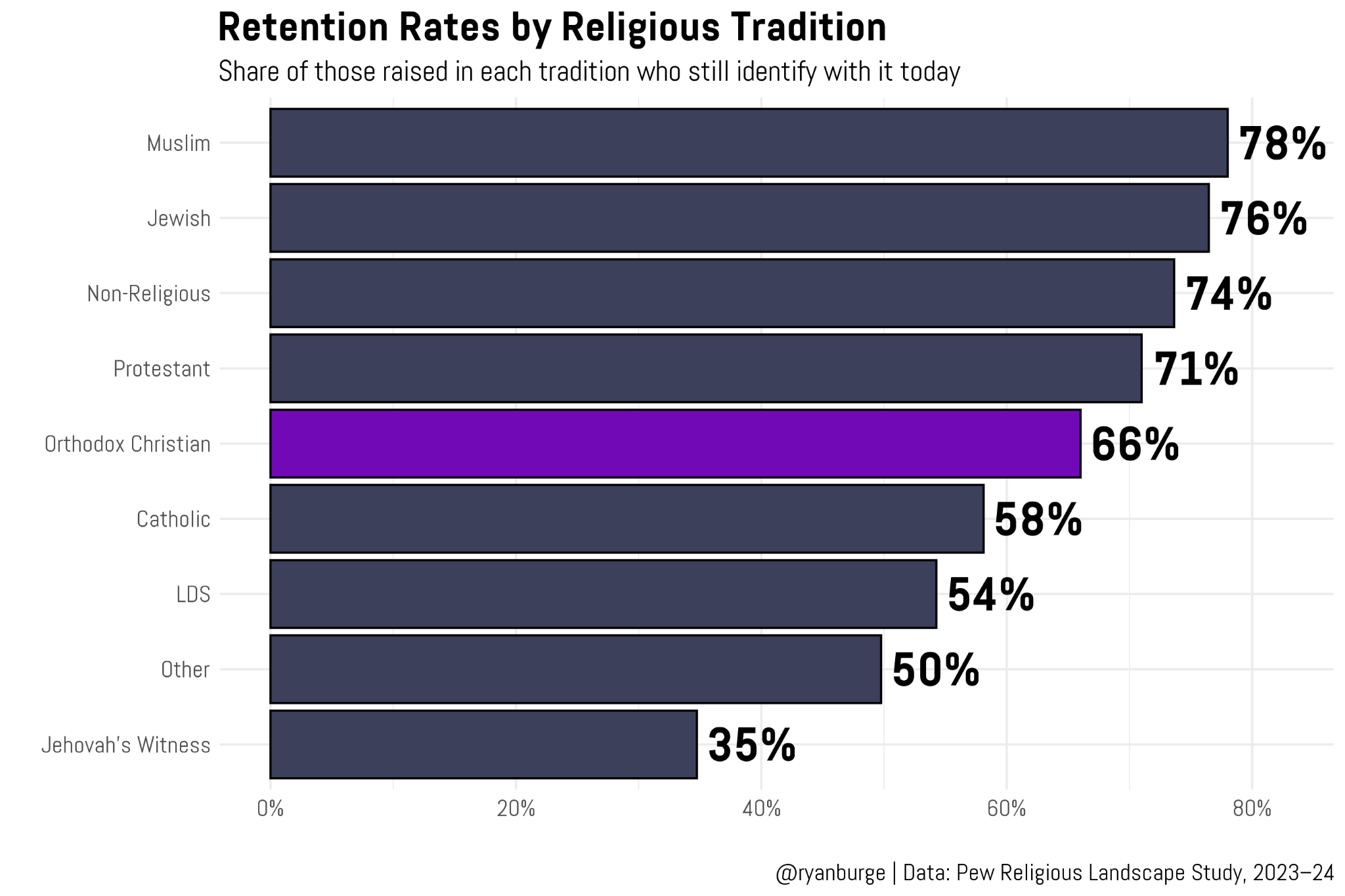
The groups with the highest retention rates are Muslims and Jews. In both cases, over three-quarters of people raised in the tradition still identify with it in adulthood. That’s a strong number — about ten points higher than the overall retention rate across all religious groups. Right behind them are the non-religious: if you’re raised without a faith tradition, there’s a 75% chance you’ll stay non-religious as an adult. That’s one of the more important findings in the Pew data — the “nones” identity has become very sticky.
The Orthodox land right in line with the full sample’s retention rate. For every three people born into the faith, one leaves. That’s roughly consistent with the other larger Christian groups — Protestant retention is five points higher, and Catholic retention is eight points lower, at 58%. So there’s nothing here suggesting Orthodox Christianity is especially good at keeping the next generation. It’s, by an objective measure, pretty average on this front.
Let’s go one layer down and compare retention among older Americans to younger ones. I focused on a smaller handful of groups here because of sample size limitations.