



This post has been unlocked through a generous grant from the Lilly Endowment for the Association of Religion Data Archives (ARDA). The graphs you see here use data that is publicly available for download and analysis through link(s) provided in the text below.
There’s this interesting little pattern that happens with large polling firms, the media, and people like myself. The polling outfits will have collected some information about changes in American religion that they want to disseminate to the larger public. They will send a draft of their results to a bunch of trusted journalists with the express instructions that the data should not be published until the embargo is lifted, usually in a couple of days. That gives those reporters a bit of time to look over the data, talk to a few academics and then publish their story when the data becomes widely accessible.
Sometimes, the reporters will call me. It usually goes something like this,
Reporter: Hey, have you read the new data from (insert polling firm here)?
Me: Nope, I haven’t seen it.
Reporter: Oh, it’s embargoed right now, but can you provide a bit of analysis or commentary on these results?
Me: Briefly tell me what the new data says, please.
Then, I have about thirty seconds to collect my thoughts and provide some context to readers about how this new result fits into long running trends we know about American religion. It’s a semi-regular occurrence in my world and it always gives me a chuckle because, seemingly out of the blue, I get several media requests in a very short window of time. I do really like talking to my journalist friends, though, because we inevitably start discussing all kinds of other stuff.
I distinctly remember that happening in 2021 when Gallup released a report with the headline, “U.S. Church Membership Falls Below Majority for First Time.” They had been tracking religious membership all the way back into the 1930s and it had remained above 70% of the sample through the mid-1980s. But then the share of Americans who were members of a congregation just kept dropping. Eventually landing at 47%. It’s certainly a “canary in the coal mine” kind of number.
I just looked through the archives and I don’t think that I’ve ever actually written about membership as a measurement of religiosity. But the ARDA has uploaded Pew’s newest Religious Landscape Study. It contains a pretty simple question, “Are you personally a member of a church, synagogue, mosque, temple, or other house of worship?” In the full sample, just 37.4% of folks indicated that they were members of a house of worship. That’s a full ten points lower than Gallup’s data from 2021.
There is so much to explore with this question in order to figure out what factors drive church membership and the impact church membership can have on something like religious attendance.
Let’s start by just doing a generational analysis of church membership. The Religious Landscape Survey only affords us the ability to look at age through the lens of “decade of birth” but that’s more than sufficient to generate a portrait of how age impacts church membership.
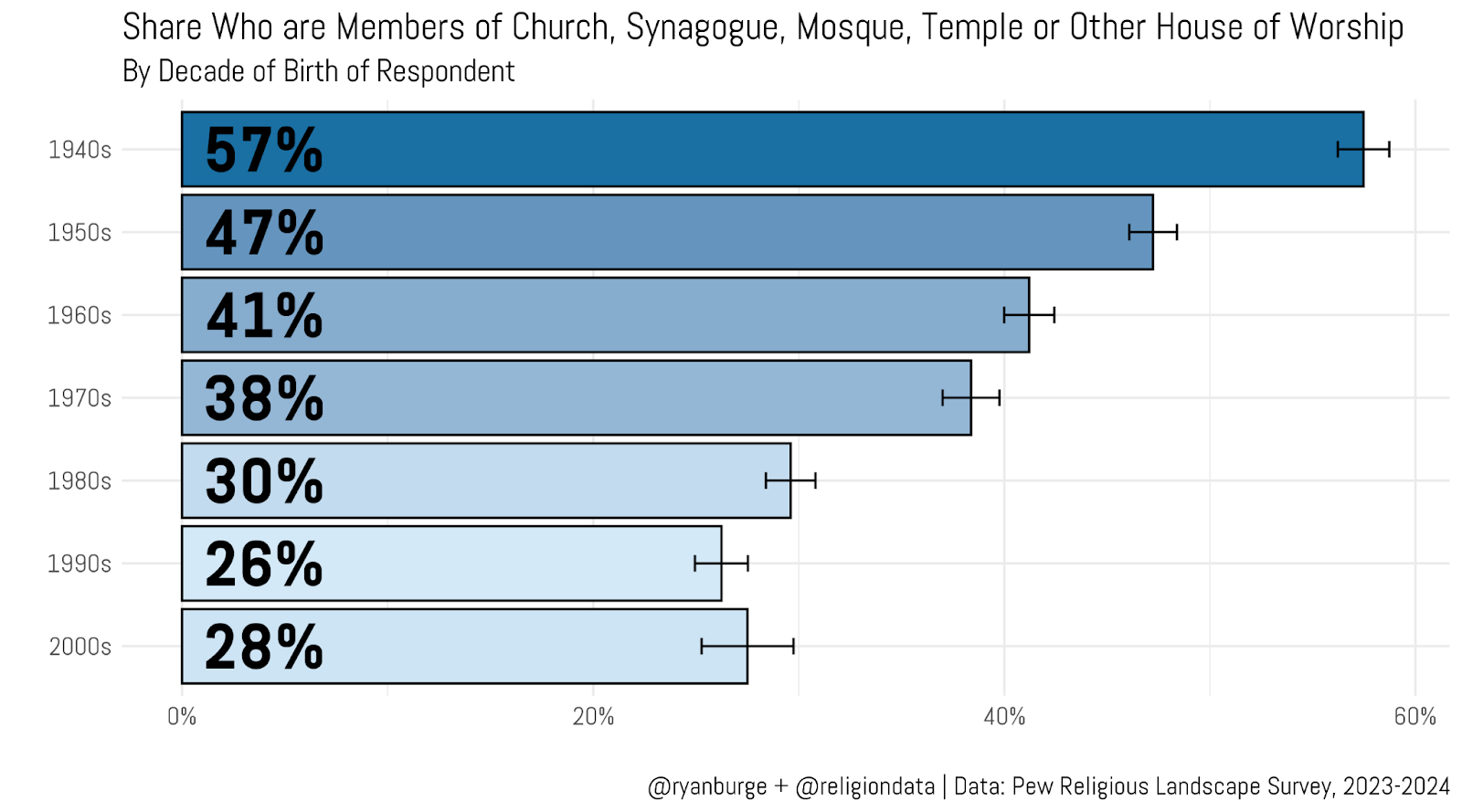
I don’t think anyone is going to be surprised to see that older folks are much more likely to be church members than younger adults. Among people born before 1950, nearly three in five say that they are on the membership rolls of a church, synagogue, mosque, etc. But among folks born in the 1950s, a majority are not members of a local congregation. The numbers only decline from there.
Among respondents born in the 1970s, membership rates drop to just 38% and then there’s this really noticeable inflection point in the data. For respondents born in 1980 or later, the share who are members of a house of worship drops to 25-30%. There is a bit of variation between the decades, but not a whole lot. I think it’s fair to say that the “floor” on this metric seems to be around 25% or so. Maybe the youngest adults will drop below that as they age through the life course, but it seems like the free fall has largely abated.
However, any casual social scientist will look at the above result and say, “Of course membership drops among younger cohorts, they are a lot more likely to be non-religious.” And that’s correct, empirically speaking. So let me control for that reality by just excluding the non-religious and running the same analysis.
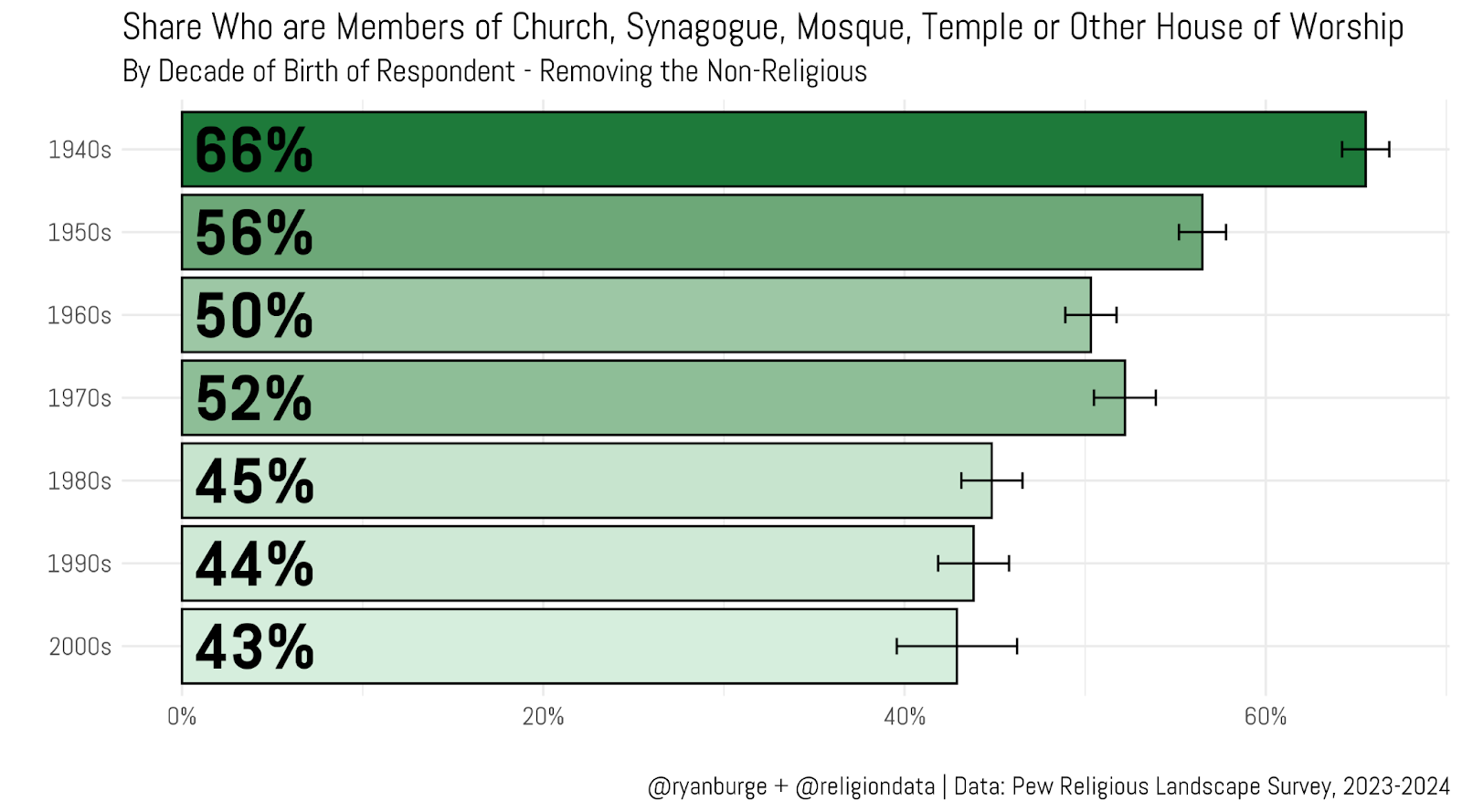
These numbers are quite a bit more robust than the prior graph. Here, church membership rates stay above 50% for folks born in the 1970s or earlier. That’s a noticeable uptick from the first graph. But the same general trend does seem to appear that we discussed before: older folks are more inclined to become members at a house of worship. That’s not so commonplace among younger respondents.
I mean, think about this simple fact: among religious people (of any faith background) born in 1980 or later a majority are not members of a church, synagogue, mosque, etc. It definitely feels like membership has fallen out of favor with younger folks, regardless of their faith background.
Let me show you the same analysis but for the Protestants and Catholics in the data.
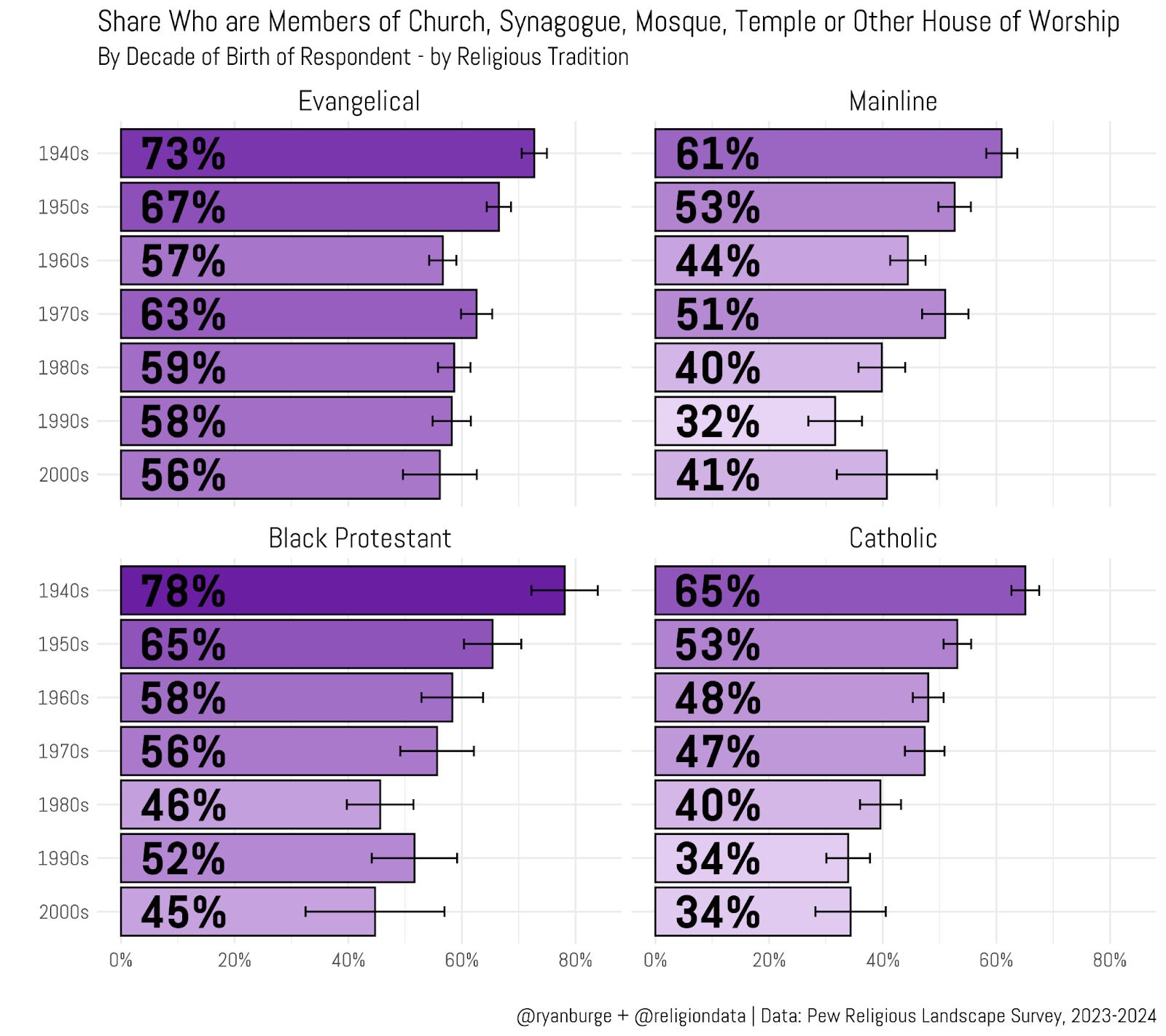
So, the way that this works is that people are asked to indicate their religious “family” and then we use a scheme called RELTRAD to sort them into the appropriate categories. From these results, it does look like a whole bunch of people say that they are Protestants or Catholics but then also indicate that they don’t have a membership at a local church.
That’s certainly the case for both mainline Protestants and Catholics. I mean, neither group has particularly high membership rates. For mainline Protestants, the trend line is a bit less linear. However, I think we can plainly state that a majority of younger Methodists and Episcopalians are not actually members of any local church. For Catholics, the trend line is in a pretty clear direction: downward. Among Catholics born before 1950, two-thirds are members of a local parish. For Catholics born in the 1990s or later, it’s much lower. I think it’s fair to say that younger Catholics have a different conception of membership than older Catholics or Protestants.
Evangelicals and Black Protestants to a lesser extent seem to buck this trend, though. Membership is just high across the board for these two groups. Even among the youngest evangelicals, a majority are members. That’s nearly double the rate for Catholic young folks.
Attendance has to be part of this puzzle, though, right?
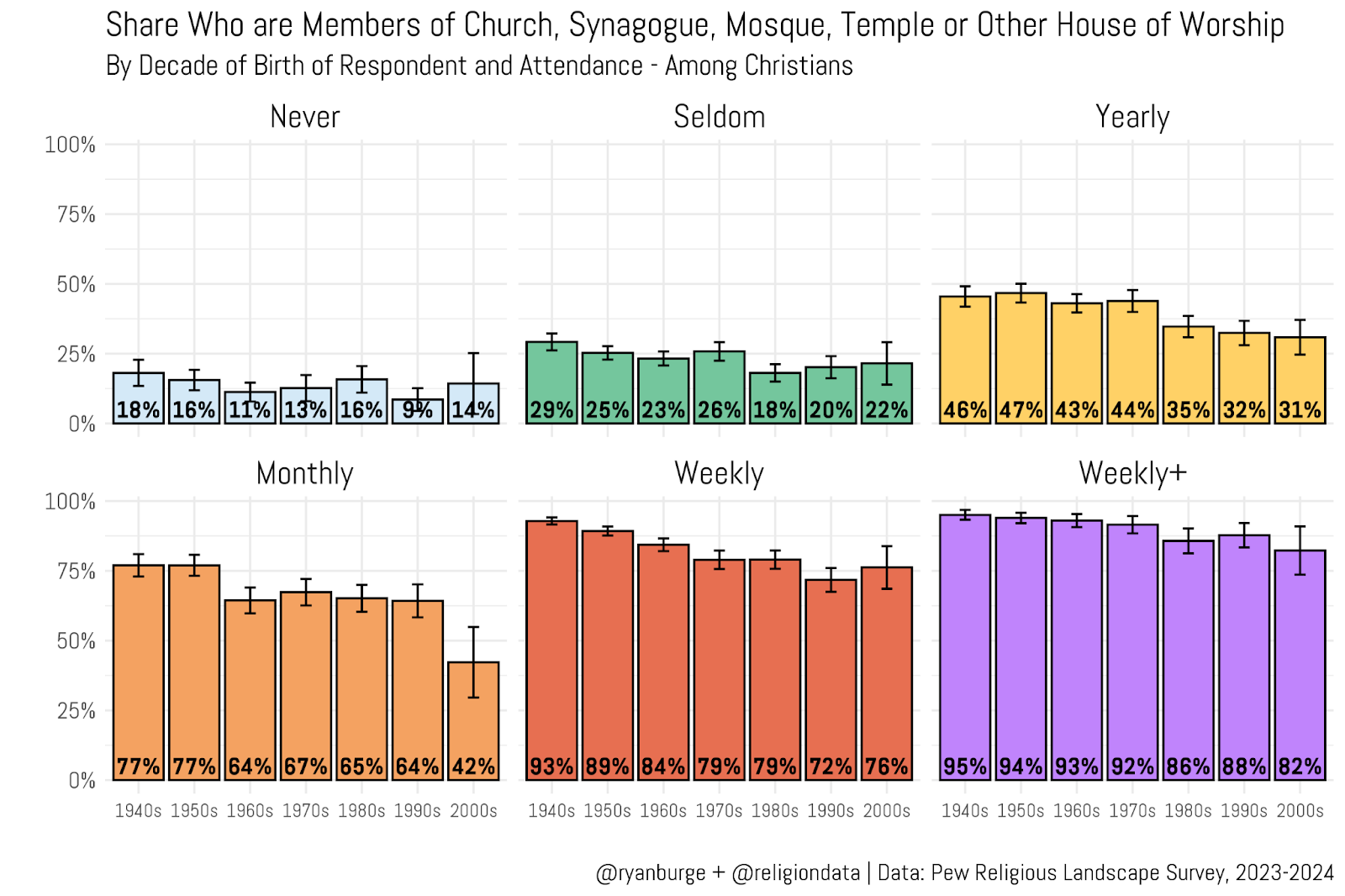
It absolutely is a huge part of this puzzle. The more someone goes to church, the more likely they are to indicate membership at a church. For never attenders, membership rates are just 10-15%. It rises to 30-45% among yearly attenders but then jumps up with each successive increase in attendance in a pretty discernible way.
For older weekly attenders, 85%+ of them say that they are members of a local congregation. That share does slip a little bit for the younger respondents, though. Among Christian folks born in 1990 or later and who attend weekly, the share who are members is closer to 75%. You also see that among those who attend multiple times per week. That’s a truism that clearly shines through in this data: younger people are just not as inclined to join a church compared to their parents and grandparents.
I wanted to really zoom in on the question of: what factors tend to drive up membership and which ones go in the opposite direction. To do that I threw a bunch of variables in a regression that predicted membership and then visualized the “odds ratio” for each one. If the odds ratio is 1.0, that means that it has no impact on membership. If it’s 1.5, that means that it increases membership chances by about 50% above the baseline.
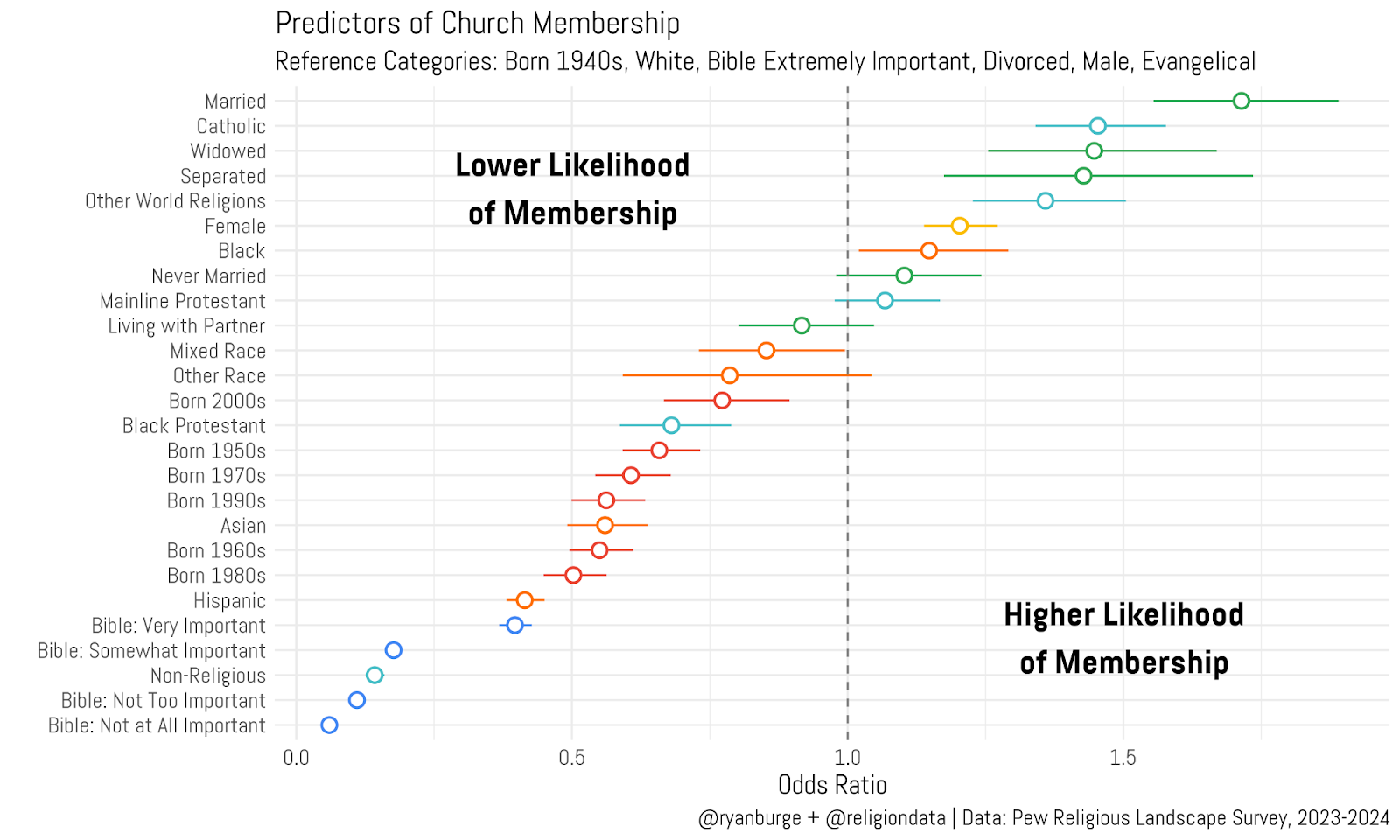
The important thing to know here are the “reference cases” listed in the subtitle above. For instance, the odds ratio for folks who are married is about 1.7. But that is in comparison to people who are divorced. Said simply, holding a bunch of stuff equal, a married person is about 70% more likely to be a church member compared to a divorced person. You can also see that women are about 20% more likely to be church members compared to men, all things being held equal. Also, Black people are slightly more likely to be a church member compared to white people.
However, there are a number of factors that lead to a lower likelihood of being a church member. The data indicates that both Asians and Hispanics are about 50% less likely to be members compared to white folks. The data also indicates a strong negative relationship between age and membership. Among people who are born in the 1980s, they are 50% less likely to be a church member compared to someone who was born in the 1940s (the reference category).
However, I know that a lot of pastors and ministry leaders read this newsletter and want to be even more specific about the relationship between church attendance and church membership. So here’s what I did. I just pulled together a hypothetical average person: a married, white, female, evangelical born in the 1970s who finds the Bible very important. Then I cloned that person into an exact replica. Person A is a member of a local congregation and Person B is not a member. What’s the likelihood of Person A being a weekly attender vs Person B?
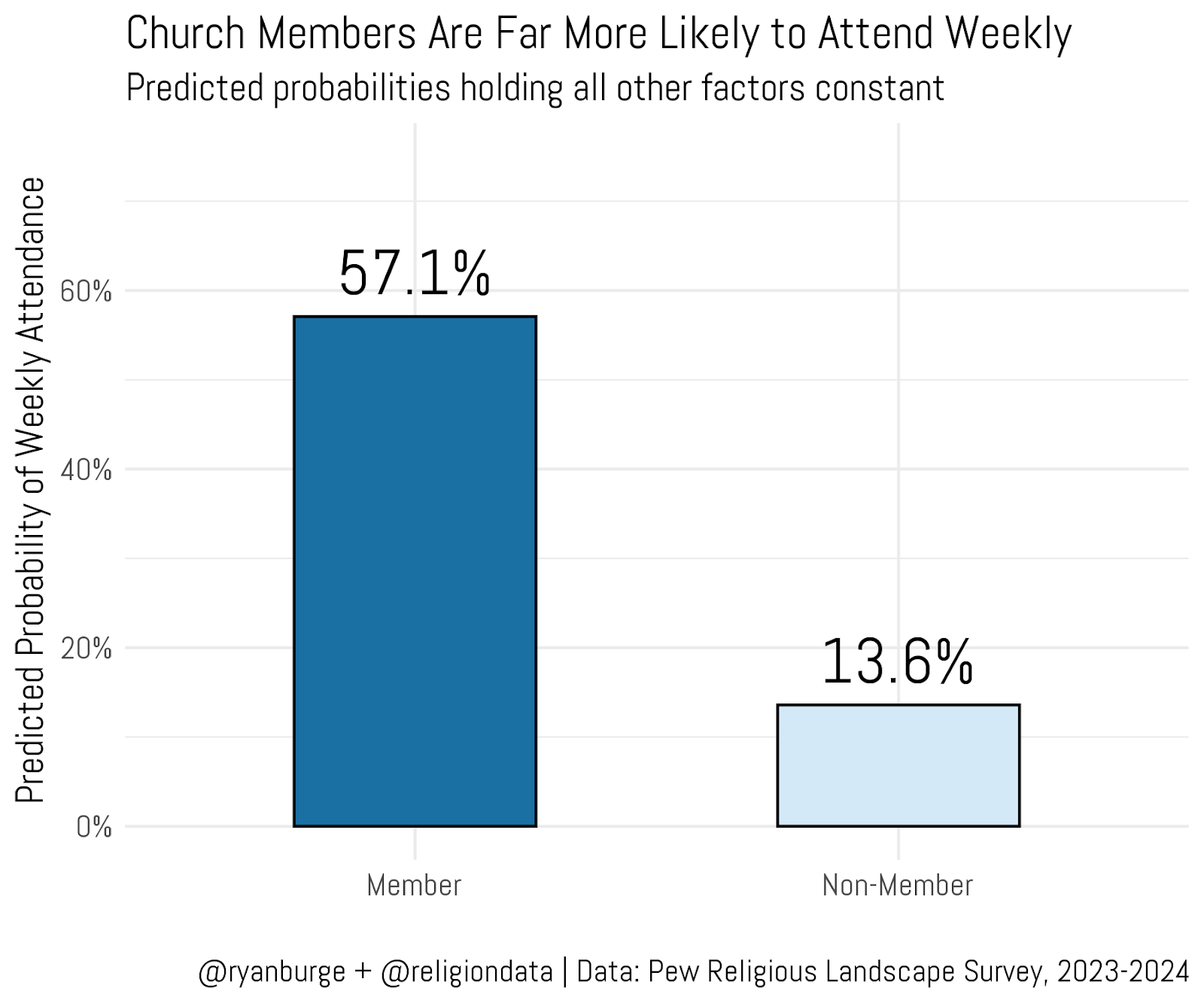
The answer is a real chasm! Person A is represented in the dark blue bars on the left. The data indicates that there’s a 57% chance this person attends a church on a weekly basis. The light-blue bar on the right is the exact same person except the only difference is that she is not a member of any congregation. The data predicts that there’s only a 14% chance this hypothetical person is a weekly attender. That church member is about three times more likely to come to church every week compared to the non-member. That’s a huge difference.
So, what have we learned here about membership in a local house of worship?
1. Young people are not too keen on joining organizations. That’s even among young people who still identify as religious. Which means that church membership is going to inevitably decline in the decades to come.
2. Evangelicals and Black Protestants seem to do a better job at pushing membership than their mainline and Catholic counterparts.
3. Several factors predict church membership: marriage, age, and gender all exhibit strong, positive relationships with membership.
4. Being a member of a local house of worship is incredibly predictive of being a regular attender at a church, synagogue, mosque, etc. This data indicates that a member is three times more likely to be a weekly attender compared to a non-member, even after controlling for all kinds of other factors.
This does feel like another example of Robert Putnam’s Bowling Alone thesis. The long term trends in American civil society is in the direction of “not joining stuff.” That was true for the Elks, the Moose, and bowling leagues several decades ago. That same social phenomenon is hitting houses of worship now.
Code for this post can be found here.
Ryan P. Burge is a professor of practice at the Danforth Center on Religion and Politics at Washington University.

I have always heard that having children motivates people to join a church, or go back to church. Does your research support that claim?
Ryan, by observation and asking around, I saw the percentage of people connected with and semi-regularly attending congregations who were also members dropping by the early 1980s. Some of it was generational lifestyle changes and less felt need to commit to membership and wanting to be a part but not be expected to volunteer or give financially, some of it coincided with the contemporary congregation movement and changing approaches to membership, and some with the move from denominational congregations to nondenominational congregations and the thought "I like this congregation, but maybe I should not join" as I am Methodist, Baptist, Presbyterian etc in heritage. In my current congregation of membership, there are a whole list of things you are not allowed to do if you are not members. My wife and I started a new life group, and lost some members when we asked them to do certain things (like teach or handle the group database through the church software) and found out our congregation would not let people do this if they were not members. We actually then lost these people to the group as they were offended. Currently, we have slipped a non-member into the teaching team without letting the larger congregation system know we have done this. "Don't ask. Don't tell!" George