


There’s a running joke in American religious life that goes something like this: ask ten Catholics what the Church teaches on a given issue, and you’ll get eleven different answers. It’s meant to be affectionate, a nod to the big-tent nature of a tradition that has managed to hold together nearly a billion people across wildly different cultures, languages, and political contexts. But like most jokes, it contains more than a little truth.
The Catholic Church is one of the most doctrinally specific institutions in the world. The Magisterium — the Pope, Cardinals, and Bishops — has issued detailed guidance on everything from the mechanics of salvation to the appropriate use of birth control to how often a faithful Catholic should receive the sacrament of Reconciliation. These aren’t suggestions. They are, in the Church’s own framing, the authoritative teachings of an institution that believes itself to be guided by the Holy Spirit.
Are Catholic Converts More Hard Core Than Cradle Catholics?

Here’s a religion and politics story from the 2024 election that I hadn’t really thought about until recently - J.D. Vance, Trump’s pick for vice president, converted to Catholicism in 2019. His religious timeline began as a nominal evangelical during his childhood, dabbling with atheism in his college years and then joined the Catholic Church in his mid-thirties. When asked about this event by Rod Dreher, Vance
And yet, anyone who has spent time around American Catholics knows that the distance between official Church teaching and the lived experience of the average Catholic in the pew can be considerable. This isn’t a new observation — sociologists of religion have been documenting it for decades. But it raises a genuinely interesting empirical question: just how Catholic, in the doctrinal sense of the word, is the average American Catholic?
This is actually a pretty hard question to answer because most surveys of American religion are “general purpose.” They ask about things like religious attendance because that’s fairly universal across traditions, but they aren’t going to dig into the weeds of specific Catholic beliefs and practices. However, I managed to stumble upon a dataset called the American Catholic Laity Poll. It was conducted a while ago (2017), but I think it can still offer us insights into the specific practices and beliefs of Catholics.
For instance, this survey asked specifically about the act of Confession: “How often, if ever, do you participate in the Sacrament of Reconciliation (Confession)?”
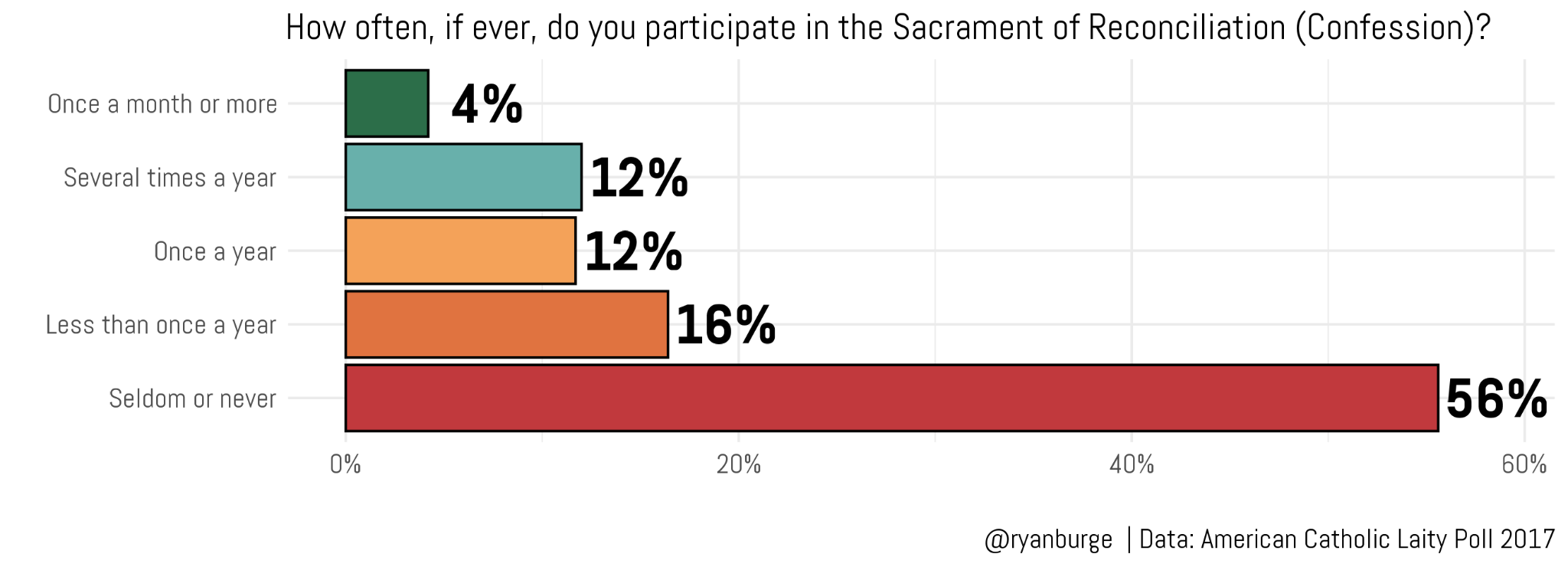
The typical Catholic isn’t walking into the confessional booth with any regularity. In fact, just 4% of Catholics say that they go to confession once a month or more. For comparison, the percentage of Americans who attend religious services multiple times per week is in the 6-8% range. In actual numeric terms, there are about 2-3 million American Catholics who go to confession a dozen times per year.
In contrast, a clear majority (56%) describe their confession attendance as “seldom” or “never.” Another 16% indicate that they are going into the booth less than once a year. That means almost three-quarters of Catholics haven’t gone to confession for a very long time. It’s just not part of normal religious practice for most American Catholics.
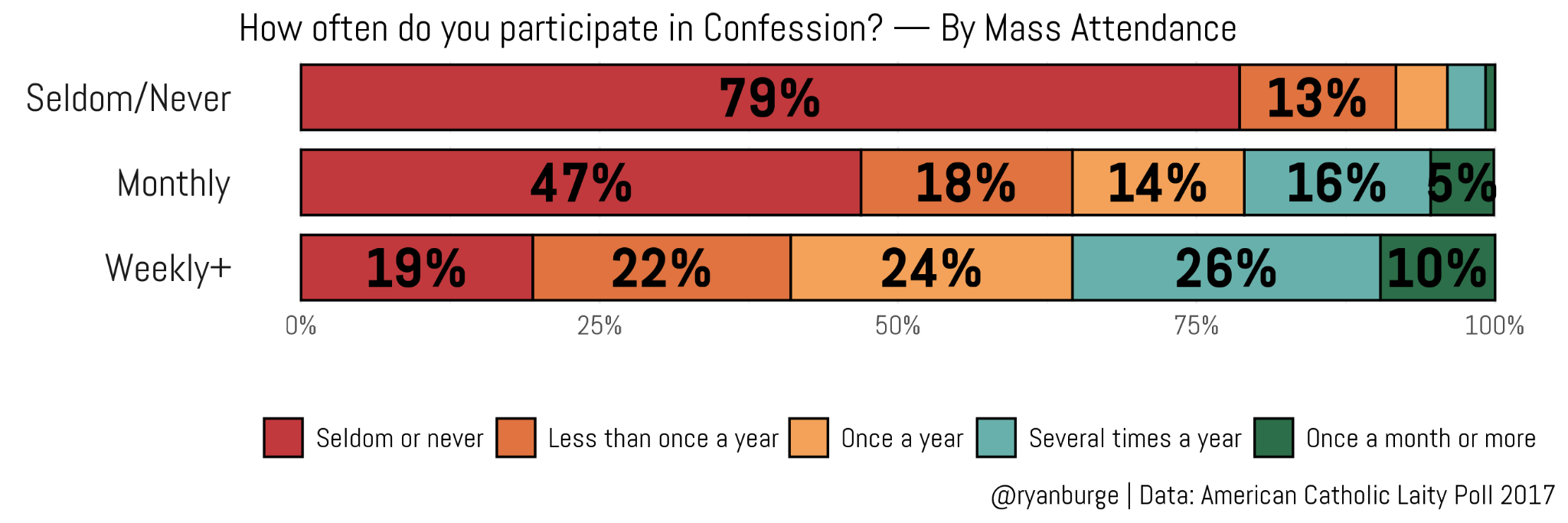
Of course, I had to break that down by the Mass attendance rates of the Catholic laity. We could easily assume that more Mass attendance leads to more confession participation, but it’s nice to confirm a hunch with actual numbers. In this case, there is a positive relationship between both religious behaviors. Among weekly attendees, 36% say that they go to confession at least a few times per year, and a majority go at least once every twelve months.
But among those who go to Mass less often, confession is not a regular part of their religious routine. Among monthly Mass attendees, almost two-thirds indicate that confession happens seldom, never, or less than once a year. For those who don’t go to Mass much, confession is just not happening at all — 79% say that they never or seldom go. For those wondering, 42% of Catholics are in the never/seldom category for both Mass attendance and confession participation.
Another Catholic distinctive is the concept of the Magisterium. It’s the idea that the leadership of the Church is the authority on matters related to doctrine, practice, and views on controversial political issues. There are two intriguing questions on the survey worth exploring:
1. Catholic bishops often speak out about politics and elections, as well as about policy issues like healthcare, immigration, and foreign affairs.
2. Catholics can disagree with aspects of Church teaching and still remain loyal to the Church.
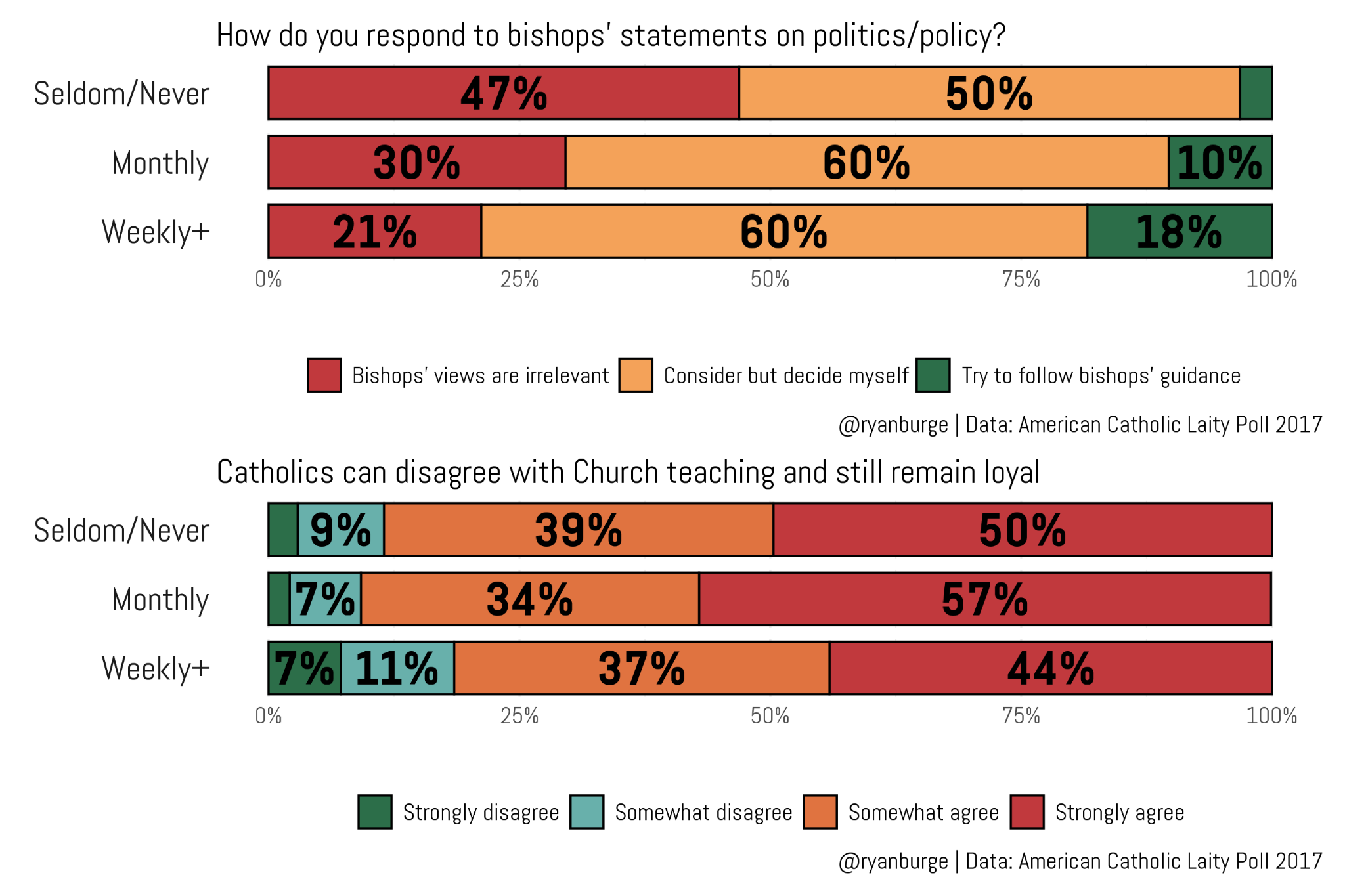
It’s pretty clear from the graph above that the average rank-and-file Catholic does not feel beholden to the teachings of the bishops on issues related to politics and policy. In the full sample, only about 1 in 10 Catholics said, “I try to follow the bishops’ guidance and instructions on political and public policy matters.” The modal position was clearly the middle path: “I consider what the bishops have to say about politics and public policy, but ultimately I make up my own mind.” However, note that among those who don’t go to Mass much, nearly half say the bishops’ views are completely irrelevant to them.
On the question about whether Catholics can disagree with the Church’s teachings and still be loyal, the differences between those who go to Mass every week and those who don’t go at all are pretty small. Even among the most religiously active Catholics, a strong majority (81%) agree that “Catholics can disagree with Church teaching and still remain loyal.” Among those who go less often, it’s north of 90%. So, it looks like the average Catholic extends a whole lot of grace and flexibility to their brethren.
Let’s take this a step further, though. I wanted to create a “conformity index” based on a whole bunch of questions from this survey of Catholic laity. I pulled together an additive index that touched on four broad areas of investigation: behavior, belief, moral authority, and institutional allegiance. I put them all in the table below so you can see the detailed question wording.
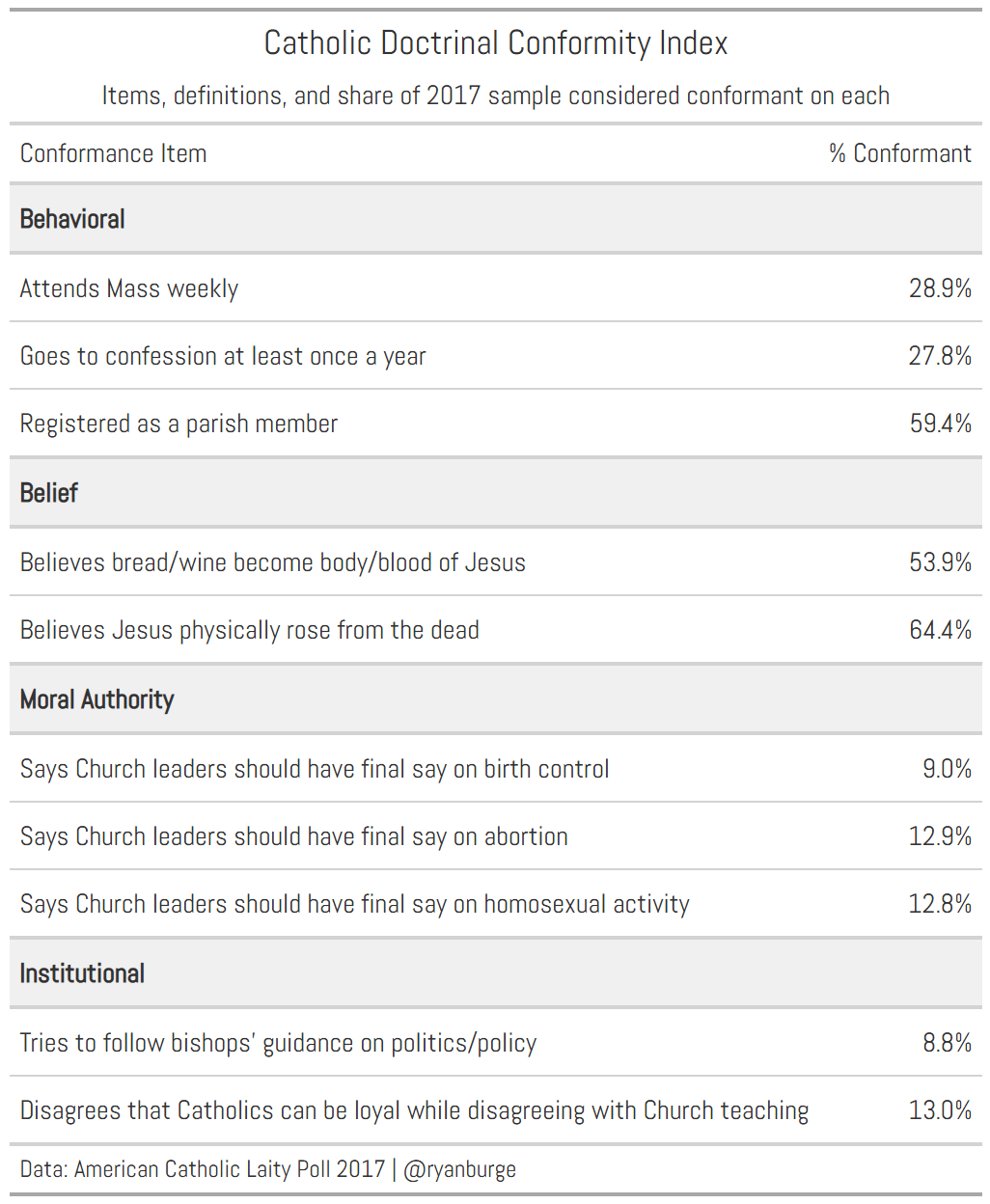
Some of these factors have a fairly high “conformity score,” like being a registered parish member (60%) or believing in the physical resurrection of Jesus Christ (64%). But there are other questions where only a very small percentage of Catholics conform. For instance, only 9% of Catholics say the Church has the final say on birth control issues, and only 13% say the same regarding abortion.
I indexed each respondent on a scale of zero (meaning conforming on no items) to 10 (conforming on all ten listed in the table above). I visualized the distribution in the graph below. The mean conformity score for the full sample was 2.9/10.
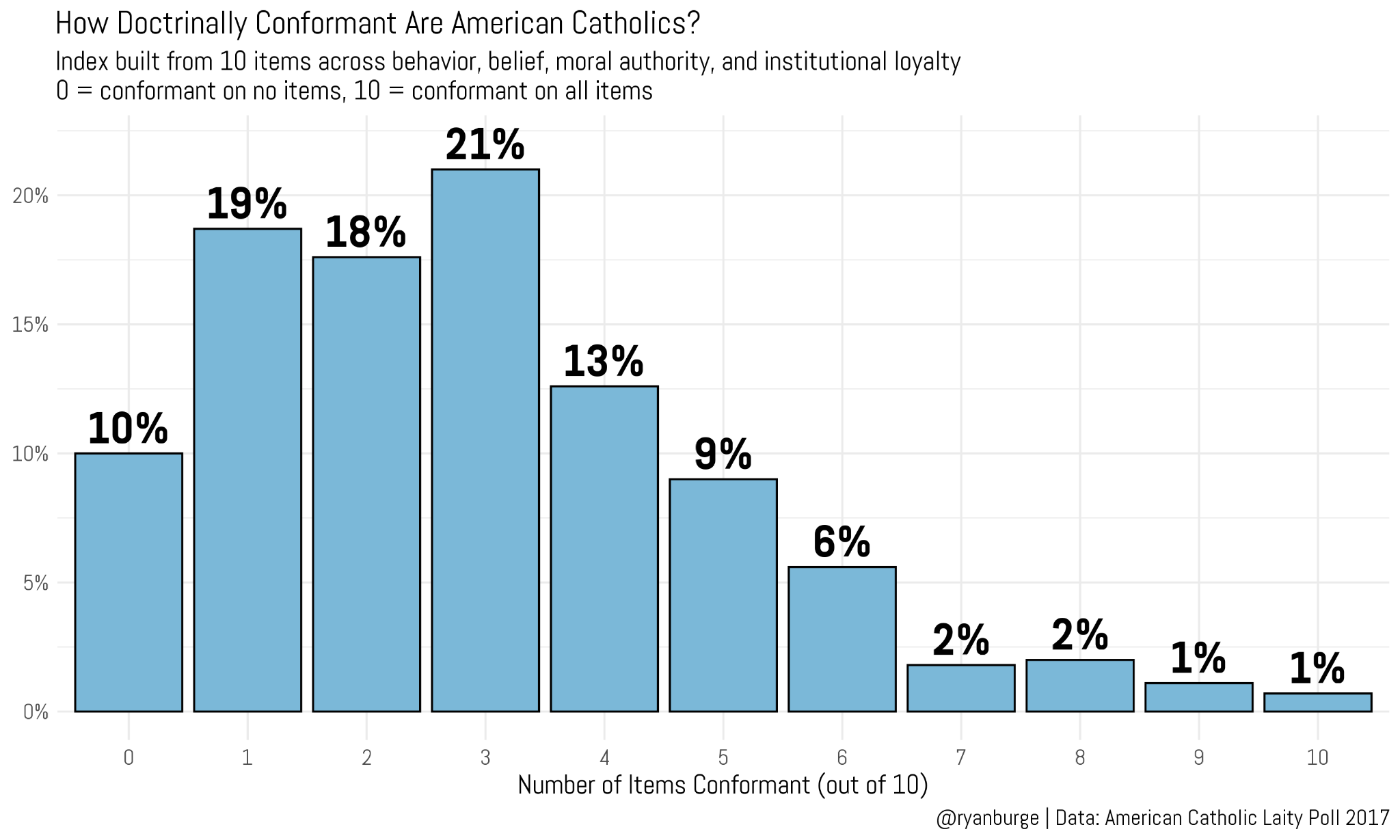
Nearly 30% of Catholics scored a zero or one on the Catholic conformity index. Half of them scored between zero and two. In contrast, only 6% scored at least a seven. As you can quickly tell from the bar graph, the modal score was 3/10, followed closely by 1 and 2. In other words, the average Catholic is not regularly engaging in practices or holding beliefs that are distinctly Catholic.
Of course, that varies noticeably when I break it down by the average level of Mass attendance. (I do understand that one of the items in the additive index is about Mass attendance, so this does confound things a bit — but I still think it’s a helpful way to think about committed Catholics vs. cultural ones.)
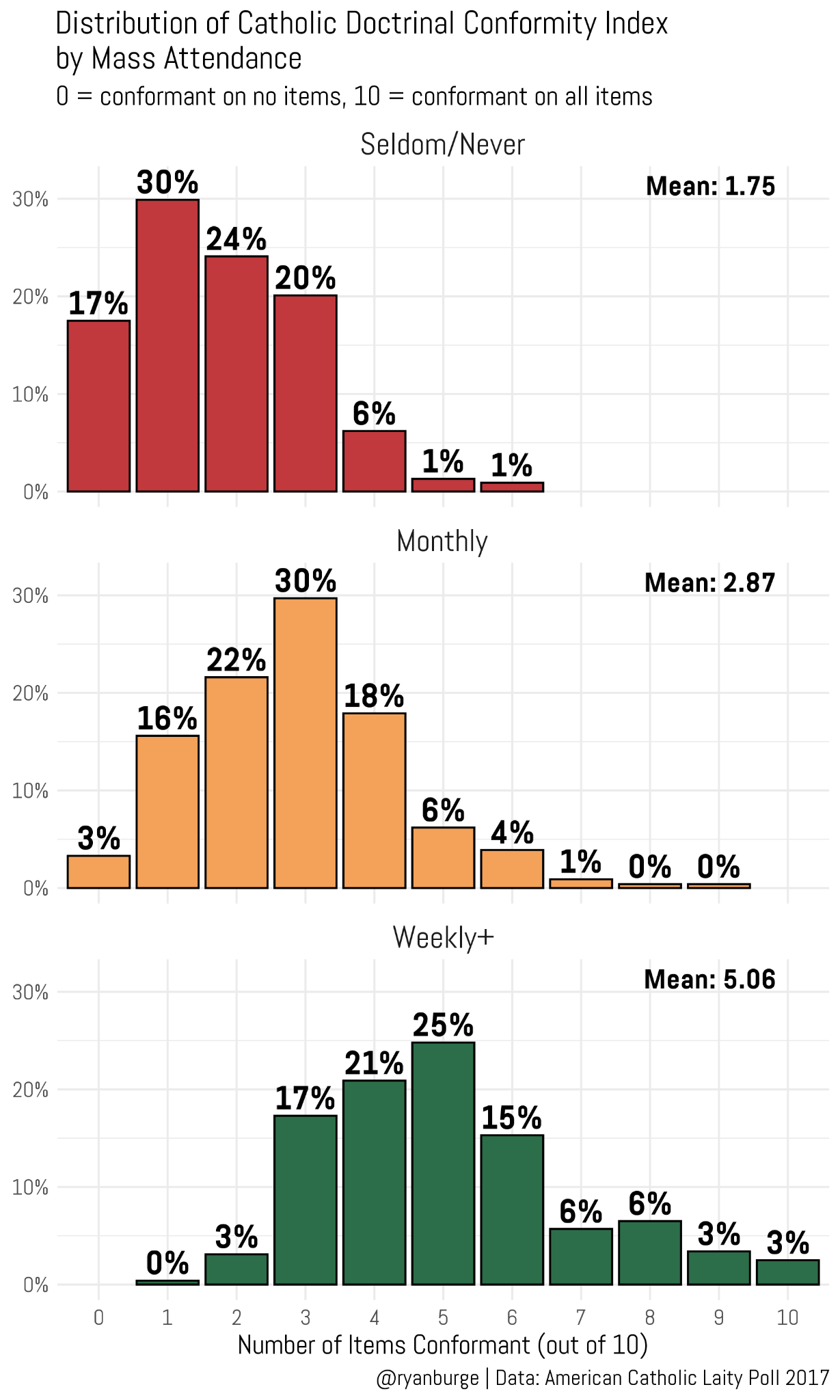
Among Catholics who don’t go to Mass much, the mean score on this scale is just 1.75 and the modal score is one. The average Catholic represented by the red bars at the top of the graph is really not that Catholic in any meaningful way. I would love to see how the typical Protestant scores on this scale and compare it to never-attending Catholics, but alas, I am data-limited here.
For Catholics who report monthly Mass attendance, the mean is a full point higher (2.9) and the modal score is 3 out of 10. You can still see that the bars are heavier on the left than the right, though. Over 40% of monthly attending Catholics score no higher than a two on this index.
What about the most active Catholics? Well you do clearly see a much higher mean (5.1). Which is nearly double the rate of the monthly attendees. This graph is fuller on the right side of the plot than the left side. Among weekly Mass attenders, 18% score at 7-10, three times the rate as the full sample of Catholics. There’s no doubt that this group has the highest level of conformity to Catholic doctrine and behavior.
I thought you all would appreciate some more granularity on this one, so I recreated the table from above but I did it for each level of Mass attendance.
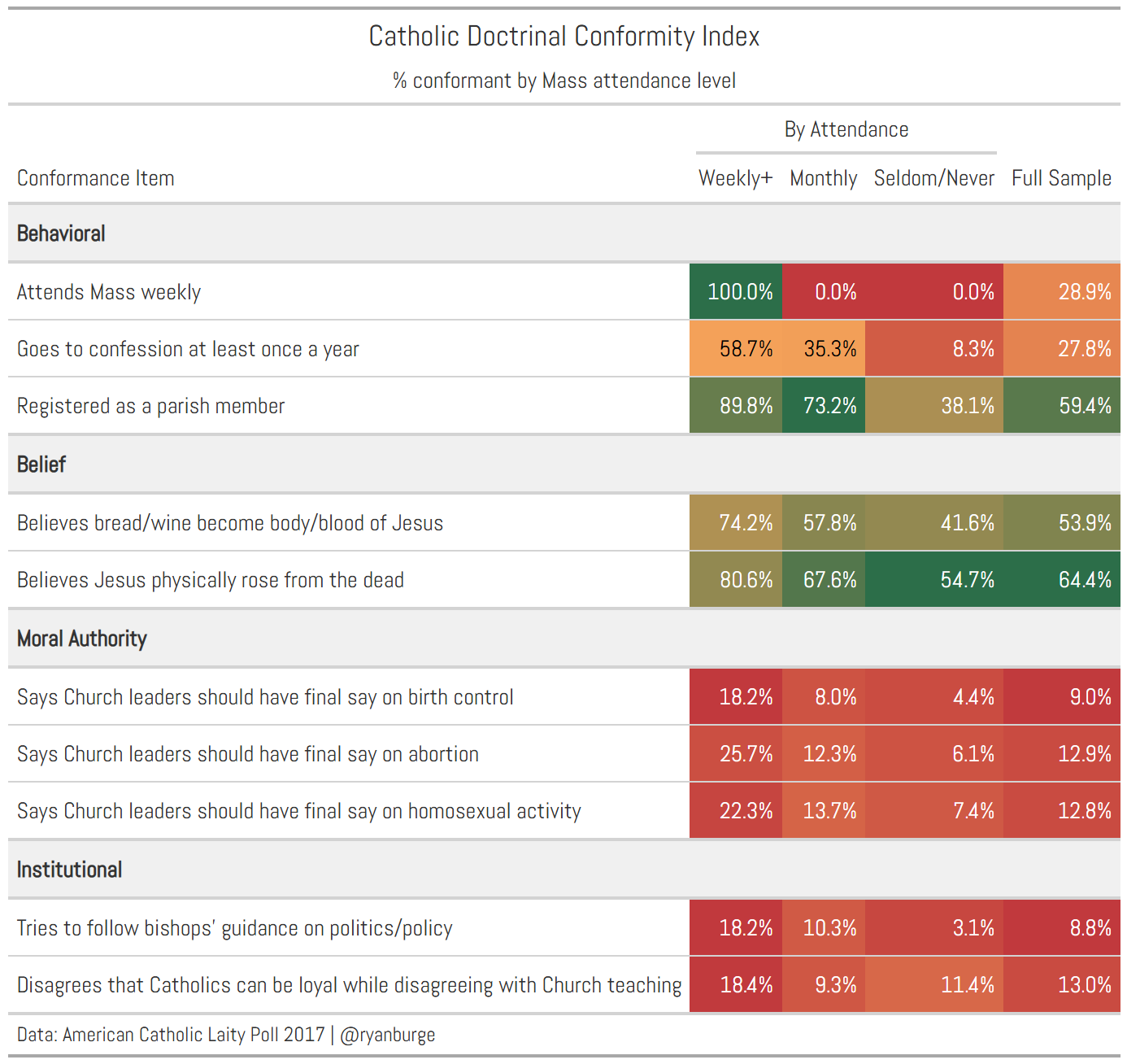
In terms of behavior, you can clearly see that those most active in attendance are also the most likely to engage in regular confession and be registered as parish members. There’s also a clear gradient on beliefs. For instance, 74% of weekly attendees believe in transubstantiation, compared to 42% of those who attend Mass seldom or never. The gap on belief in the death and resurrection of Jesus was 25 percentage points as well.
A Pope Who Doubts? - The Role of Certainty in the Lives of Catholics

This post has been unlocked through a generous grant from the Lilly Endowment for the Association of Religion Data Archives (ARDA). The graphs you see here use data that is publicly available for download and analysis through link(s) provided in the text below.
But where Catholic conformity drops significantly is in the last two categories: moral authority and institutional fidelity. Even among weekly attendees, the scores are incredibly low. Only 26% of Catholics who attend Mass weekly say that Church leaders should have the final say on abortion, and it’s just 22% for homosexuality.
And because I am trying to be more innovative, I built a whole widget that allows you to “choose your own adventure” in determining what percentage of Catholics are conforming to the Church’s teachings.
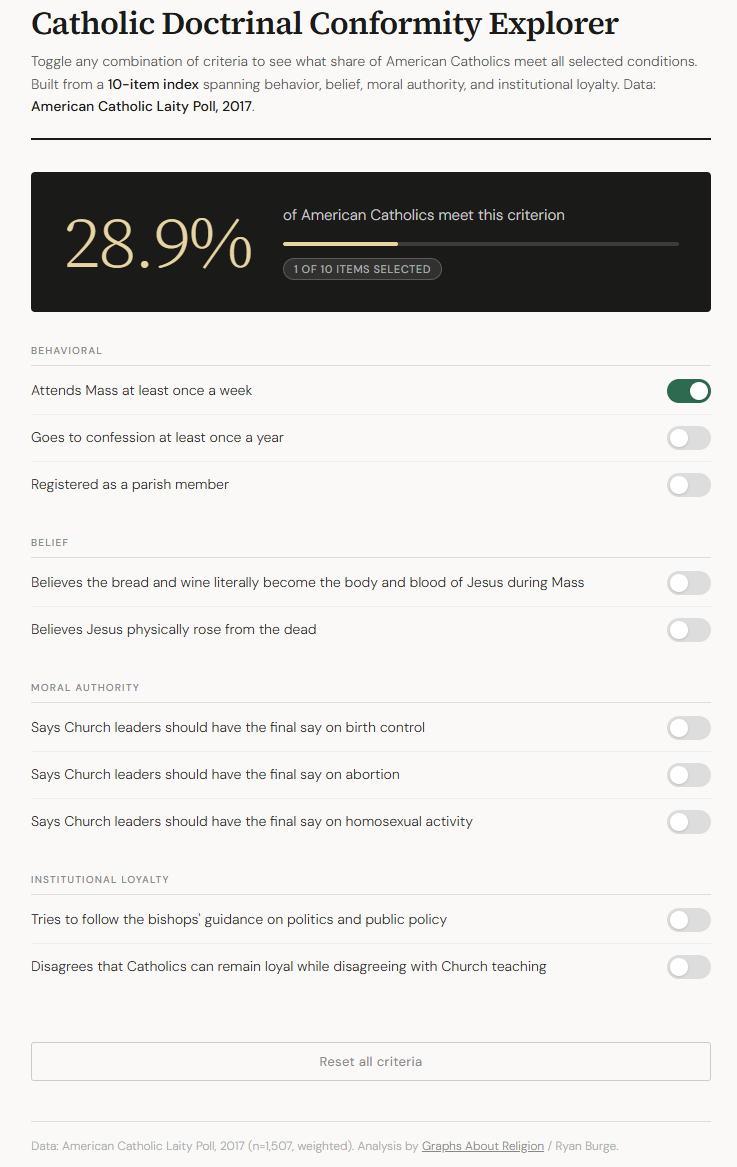
That widget can be accessed by clicking on THIS LINK.
You can test combinations to your heart’s content. For instance, the widget indicates that the share of Catholics who attend Mass weekly and go to confession at least once a year is 17%.
How average is the typical Catholic? I think the answer depends, at least in part, on how often they go to Mass. If they rarely show up to Church on the weekend, they don’t hold to a lot of distinctively Catholic behaviors or beliefs.
If they attend church on an average Sunday, they are more inclined to go to confession and to believe in the resurrection of Jesus and transubstantiation. But even among these folks, individualism still dominates their decision-making. They don’t defer to the Church’s authority on matters of public policy, and they don’t look askance at other Catholics who question the Church, either.
What this data convinces me of is that in the phrase American Catholic, the most important word is probably the first one, not the second.
Code for this post can be found here.
Ryan P. Burge is a professor of practice at the Danforth Center on Religion and Politics at Washington University.

A fabulous posting and so rich in information that I could comment on it (or generate questions!) to the point of being a nuisance! Well done.
This is one point that stood above so many others: "Believes bread/wine becomes the body/blood of Jesus -- 53.9%." What? To me and my understanding of Catholicism, this idea of the Eucharist is a defining theological tenet of Catholicism. How can a person be a Catholic and not subscribe to this most-essential Catholic sacrament? Hence, the essential role of the priest, who is the only person allowed to officiate at the observance of this sacrament. And only about 54% of Catholics believe it to so?
There is a dissonance, one of many on the table above, that makes me wonder if leaving the RC church has become easier than ever. The membership and attendance numbers sure seem to support this supposition.
Since converting to Catholicism, I've tried to make it more of a practice to find things to be grateful about every day. This morning, Ryan delivers with a widget that allows me to cross-tabulate Catholic conformity to my heart's content. Thanks, Ryan! I'm grateful for you.
Again, though, oh how I wish there were questions about whether one should follow the Magisterium on the Church's various social teachings, not just the stuff about sexuality.