


This post has been unlocked through a generous grant from the Lilly Endowment for the Association of Religion Data Archives (ARDA). The graphs you see here use data that is publicly available for download and analysis through link(s) provided in the text below.
I don’t listen to podcasts that much anymore, but I still have a couple that I check out on a regular basis. One that’s still in my queue is from the New York Times and it’s called The Interview. You can probably guess the format of the program. What I appreciate about it, though, is that their guests don’t just fall into simple categories. I mean, they do have actors and musicians like everyone else. But they also interview people that may not be as famous. For instance, they had Father James Martin appear on the program back in February.
I really appreciate when they bring on someone who is really well known in a specific corner of the world, but is completely foreign to me. That was the case about 18 months ago when they interviewed Dr. Lindsay C. Gibson – a name I had never heard of. She wrote a book called Adult Children of Emotionally Immature Parents: How to Heal from Distant, Rejecting, or Self-Involved Parents. Here’s what is astounding about the book: it has sold more than 1.5 million copies. And I had no idea it had even existed.
The book is more than a decade old, but it’s seemed to get a second life on social media. Some accounts will post quotes from the book and then overlay them with text exchanges with their parents that perfectly illustrate what Dr. Gibson is talking about.
It seems like a huge part of the discourse surrounding people my age is how they are dealing with the relationship they have with their parents. That book and Dr. Gibson came to mind when I was scrolling through a recent survey posted on the Association of Religion Data Archives website – the Pew American Trends Panel Wave 137. The stated purpose was, “to evaluate the relationships between parents and their adult children.” That seems fun, right?
What I really like about this panel is its overall design. There are basically two subgroups inside the survey: U.S. adults who are either a parent of at least one 18- to 34-year-old or who are themselves ages 18-34 and have at least one living parent. So we can actually check perceptions on both sides of this debate using one data source.
For instance, one question to the younger sample was: “Overall, to what extent do you think your parent(s) prepared you to be an independent adult?” Parents were asked how well they had prepared their children to be an independent adult, too.
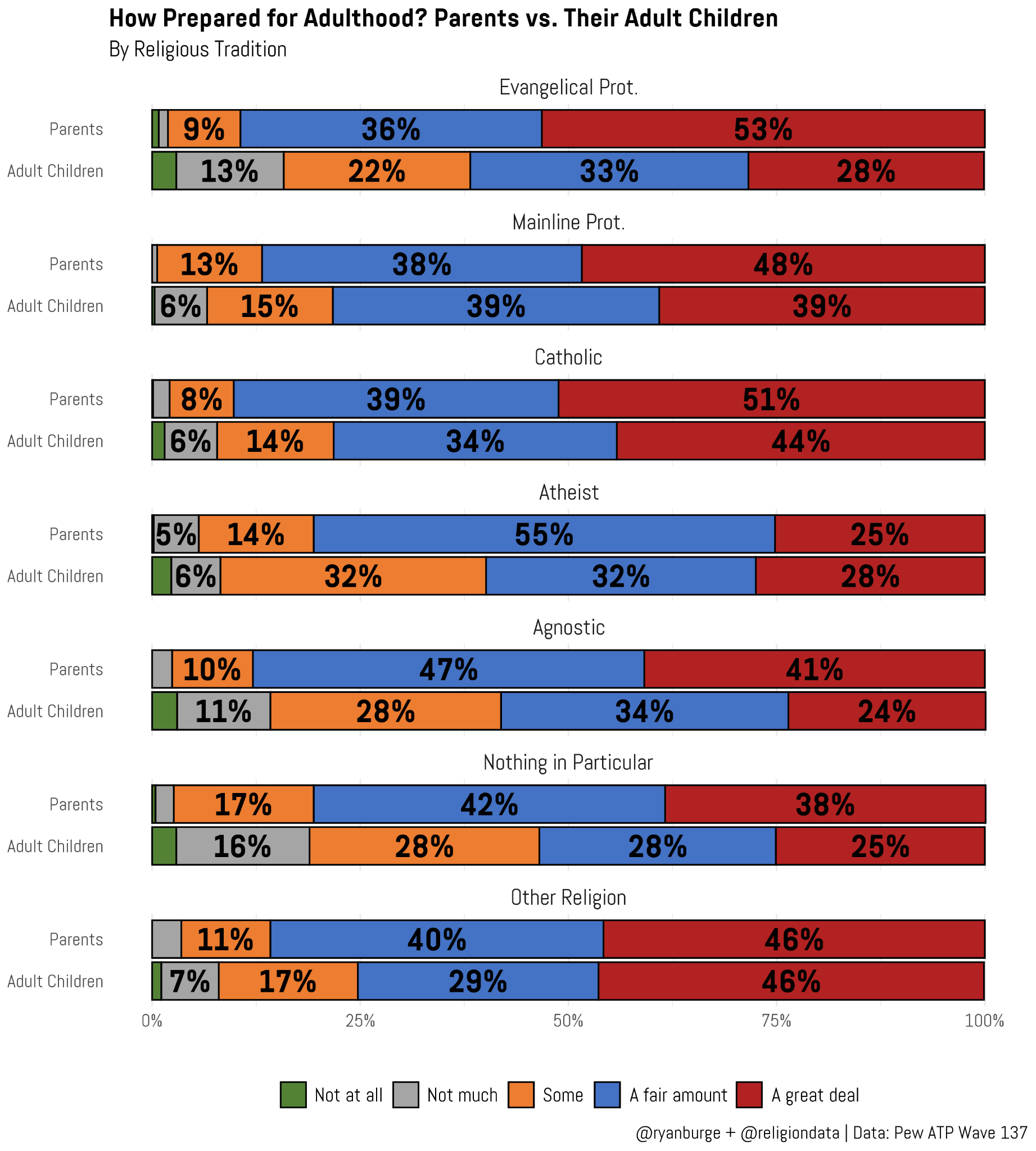
The broad finding is that parents overwhelmingly felt like they did a really good job in preparing their kids to be adults. I mean, across the board that sentiment is shared by at least 80% of parents. Which makes sense, doesn’t it? Very few parents want to admit their helicopter tendencies made them feel better at the expense of their own child’s independence. Atheist and nothing in particular parents score a bit lower than this, but they are still at 80% in the “fair amount” or “a great deal” options.
On the other hand, the young adults in the sample are not as inclined to feel like they were raised in a way that taught them independence. The group that scored the absolute lowest on this was those who claimed no religion in particular. Just 53% of these people said that they were well prepared to enter into adulthood.
I have a theory about why that’s the case based on my other work, The Nones, where I did a deep dive into the non-religious. The “nothing in particular” folks are often at the very bottom of the socioeconomic spectrum. And I am wondering if these young adults felt that their parents were largely absent from their childhood because they were constantly working or worrying about making ends meet.
However, the biggest takeaway of all for me is the gap between parents and children on the level of preparedness for being an independent adult. You can see it in the first graph, but I wanted to make it even simpler.
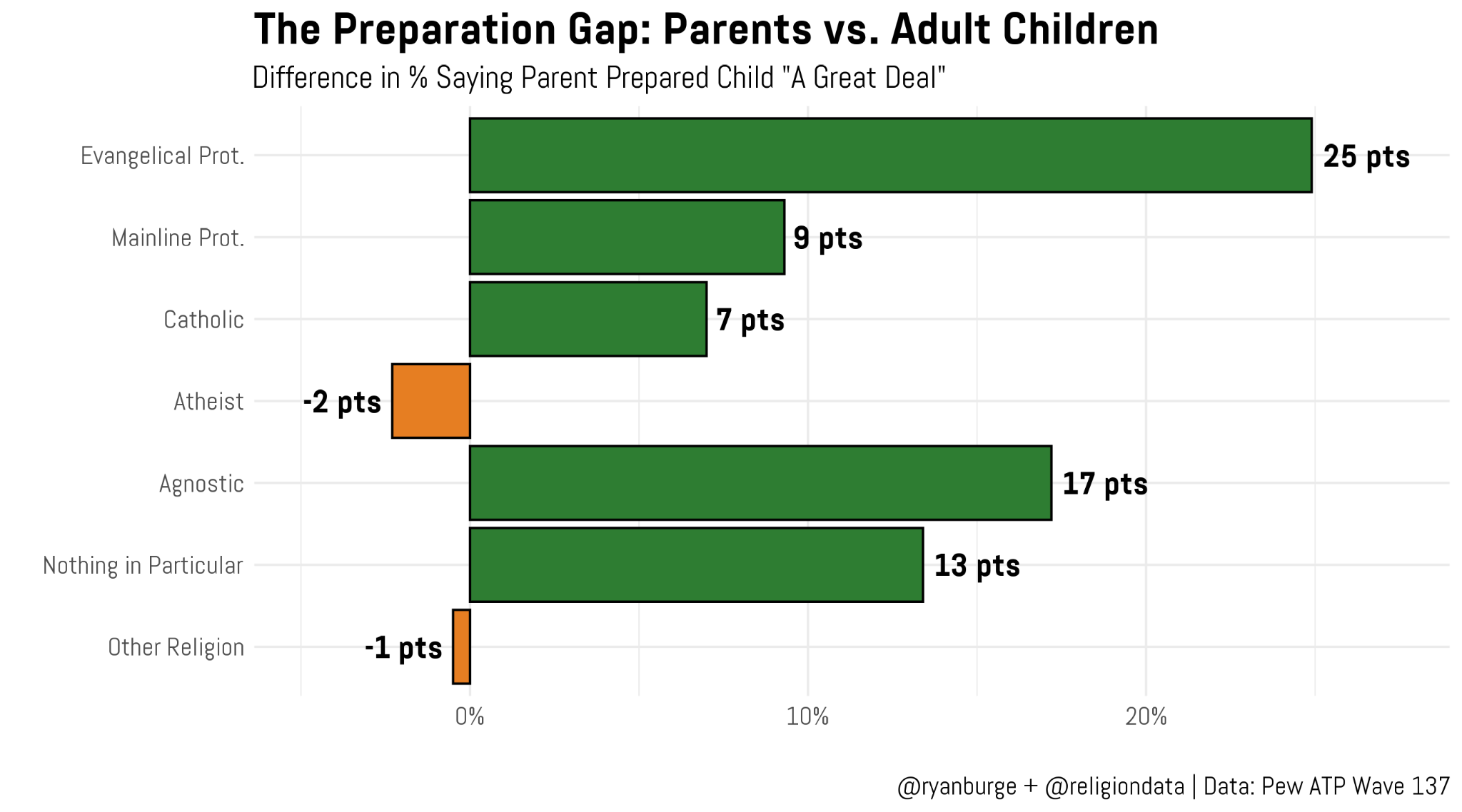
Among evangelical parents in the sample, 53% of them said that they did “a great deal” to make their children independent adults. Evangelical children were not so enthusiastic. Only 28% chose the “great deal” response. That’s a total gap of 25 percentage points, which is the largest of any religious group in the data. What’s even more interesting are the two groups in second and third place: agnostics and nothing in particular with gaps of 17 and 13 points respectively. It’s very rare to see evangelicals be so close to the nones on any metric.
Among mainline Protestants and Catholics, the gap was much smaller: 9 points for the former and 7 points for the latter. The big reason for that is that the young adult sample was much more inclined to say that they were very well prepared for being an adult. One interpretation from this data is that evangelical young adults may have felt sheltered by their parents. However, I don’t think that same concept carries over into agnostics and nothing in particulars. So I really don’t know what to make of this.
There were other ways to explore the friction between parents and kids, though. The survey included a battery of questions to the young adults that started with this preamble, “How often do you and your parent(s) disagree about each of the following?” and then included eight options ranging from financial choices, to religion, to raising children.
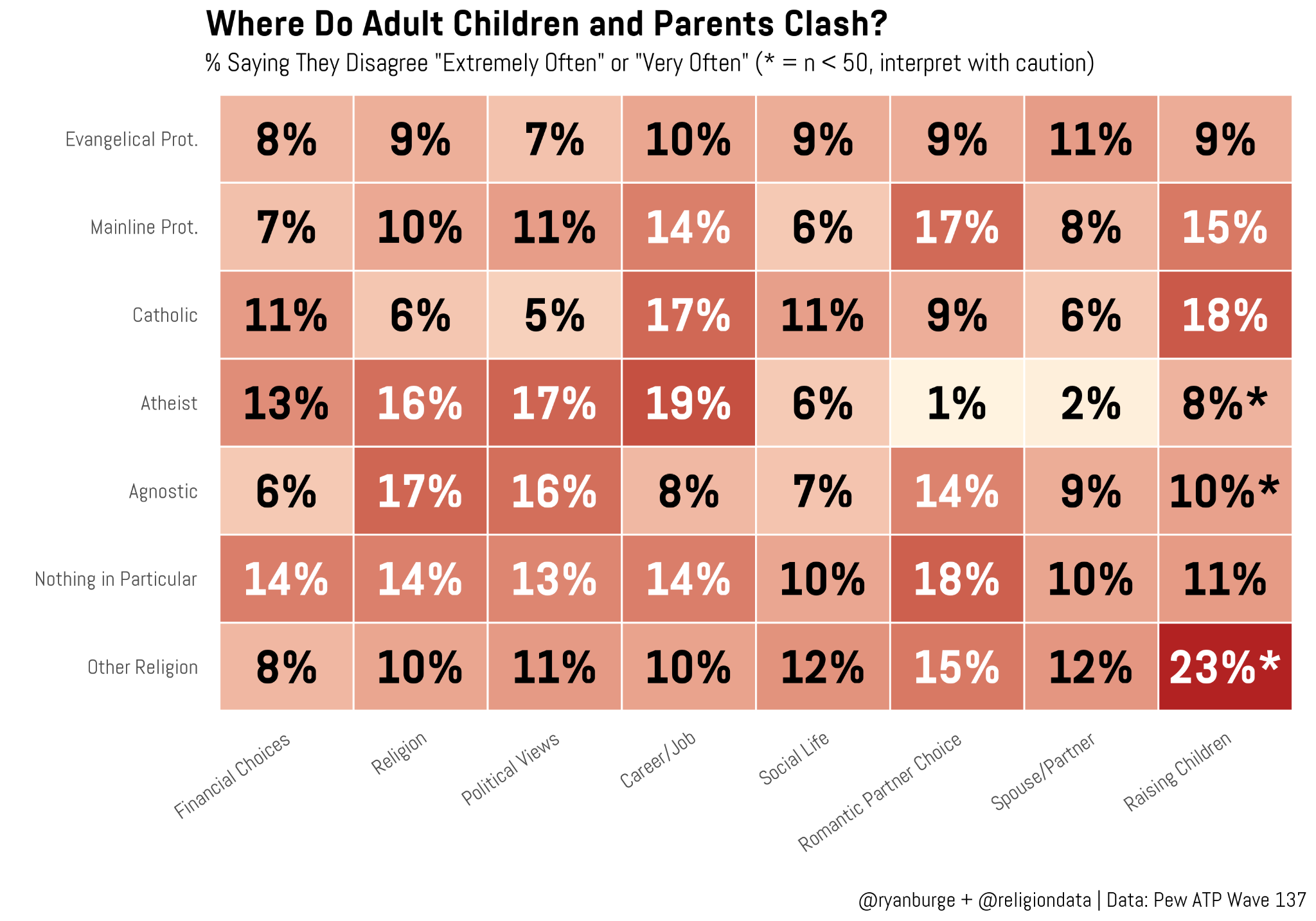
The overarching conclusion that I came to when looking over all these results is that kids just aren’t arguing with their parents over that much. There’s only one square in the entire heatmap where more than 20% of respondents chose the extremely or very often option. In most cases it was in the low teens. So, the narrative about a lot of conflict between parents and their adult children just doesn’t find empirical support here.
There are a couple of findings that I do want to flag, though. One is that evangelical young adults aren’t fighting with their parents that much. In most cases it was 10% or less across the full range of issues. For mainline Protestants, there were a number of questions where the percentages were in the mid-teens like raising children, career, or romantic partners.
It’s pretty clear that the nones tend to have a lot more friction with their parents. Especially on the left half of the heatmap. Topics like religion, politics and career elicit a lot of disagreement among atheists and their parents. There’s also friction when it comes to the choice of romantic partners for agnostics and nothing in particular.
The results from the prior analysis got me wondering if a lot of the friction among the nones was because they were raised religious but then became atheist, agnostic, or nothing in particular as they moved into adulthood. Unfortunately, there weren’t any questions on the survey to assess that line of inquiry. But there was a question that could hint at that possibility. It asked young people, “Would you say you can be your true self around your parents?”
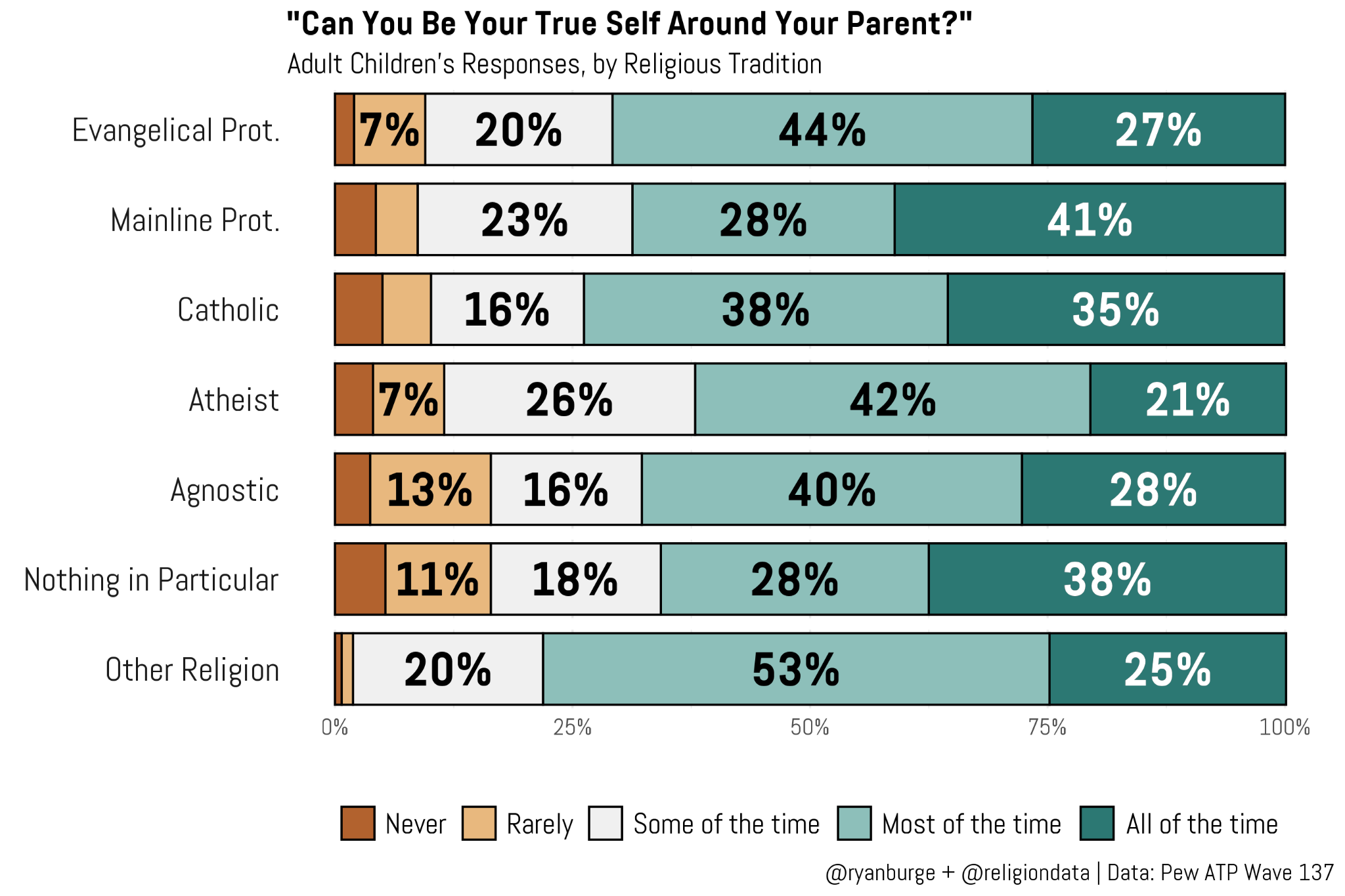
It’s absolutely fascinating to me which groups score the lowest on the “all the time” metric. It goes in this order: atheist, other religion, evangelical, agnostic. That’s pretty usual, right? I do think that this is pretty clear evidence that young adult atheists probably don’t feel super comfortable about their parents because there’s a religious mismatch. That makes sense for agnostics, too.
But how do we make sense of that evangelical result? I don’t really know what to make of this one. One possibility is that their brand of evangelicalism may be a bit more moderate than their parents? When I was at an evangelical college a lot of my friends would tell stories about how they would have to hide their new tattoos or proclivity to say a swear word or two from their parents who were much more buttoned up. Maybe that’s what is going on here. It’s surely not the case with mainliners or Catholics.
I wanted to finish up here by focusing on a three question battery that asked those young adults how often they actually communicated with their parents in three ways: phone/video calls, text messages, or seeing them in person. I thought this provided a good proxy to answer the question: do these young adults have a good relationship with their parents?
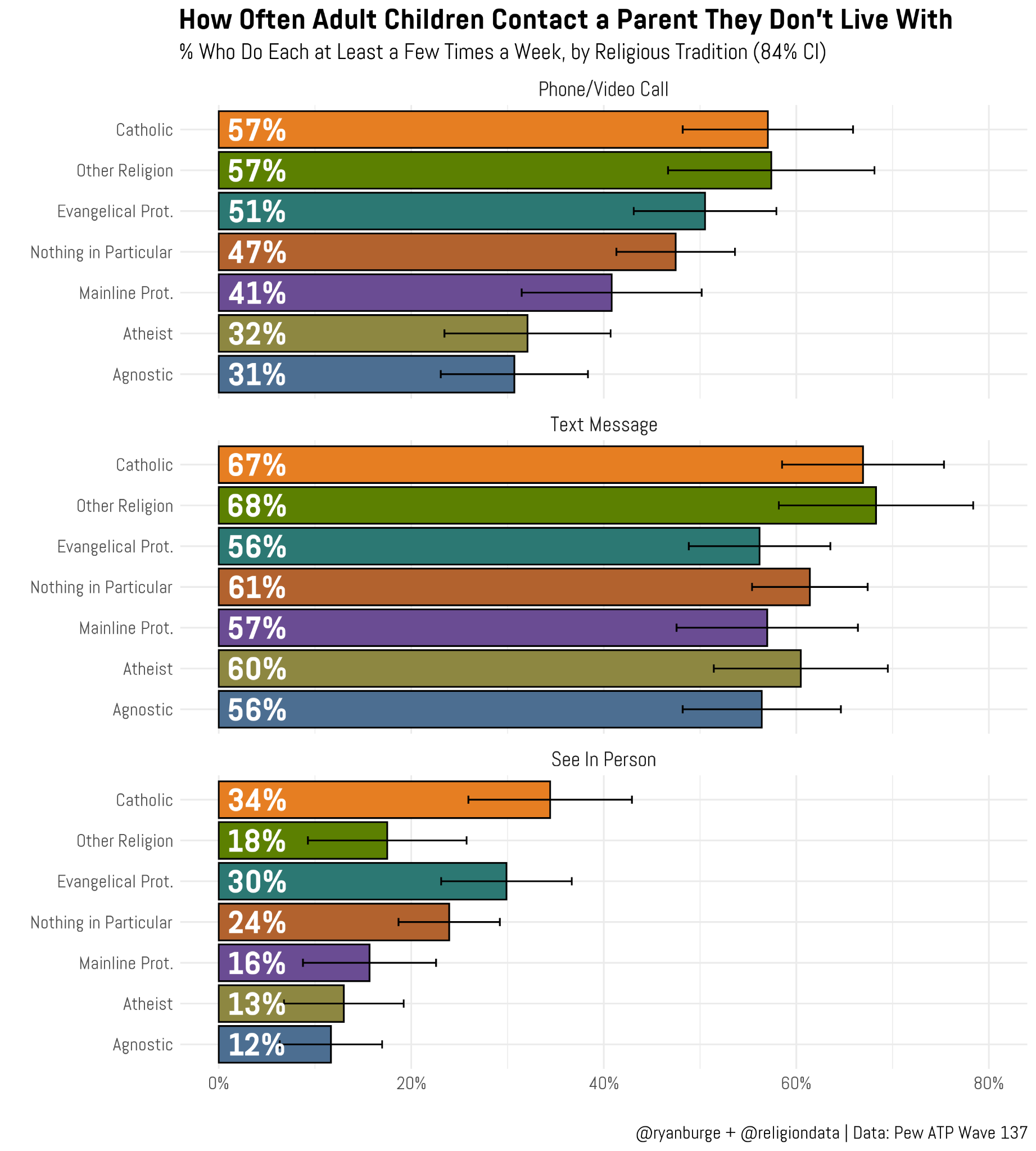
I was really surprised to see which of these questions generated a clear difference in response rates and which ones didn’t. For instance, there’s just not a ton of variation when it comes to texting parents once a couple times a week. About two-thirds of Catholic young adults text on a regular basis compared to 56% of agnostics. Those differences aren’t statistically significant.
But notice which groups are always on the top and bottom of each graph? Catholics are always at the top when it comes to communicating and agnostics are at the bottom. The gap on phone/video calls is huge between the two groups: a total of 26 percentage points. There’s also a bit of a divergence when it comes to visiting in person. A Catholic is almost three times more likely to see their parents on a weekly basis compared to an agnostic.
I tried to poke around on the question of why Catholics were so much more communicative. At one point I thought it was because a huge share of Catholic young adults in this sample were Hispanic. That drove a big difference in seeing their parents in person but Hispanic Catholics were actually less likely to call or text their parents compared to white Catholics. So it doesn’t explain everything.
Looked at in totality, there are some clear patterns that emerge. Evangelicals, agnostics, and nothing in particular young adults are way less likely to say that they were well prepared to be an independent adult compared to their parents. These three groups were also more likely to say that they couldn’t be totally comfortable around their parents, either. That’s something to really think about.
If I were to use these results to point toward a religious group where parents and children have a better relationship, it’s Catholics. As the last graph showed – Catholic young adults always lead when it comes to talking to their parents on a regular basis. Catholics run neck and neck with mainline Protestants on feeling comfortable around their parents and not having lots of friction around difficult issues, too.
Does religion cause this directly? It’s hard to know. It’s easy to posit that certain religious beliefs are intertwined with specific parenting styles. Which can sometimes generate hard feelings and distance when those children move out of the house. But switching also has to play a role here, too. Kids who were raised evangelical but became agnostic are likely going to clash with their parents more frequently than young people who have been Catholic their entire life.
But, above all, I don’t see any strong evidence here that animosity is widespread between parents and children. Young adults generally feel that they can be themselves around their parents and the amount of conflict I see in the heatmap is pretty minimal.
This is probably another case of social media amplifying the minority view. Think about a video where the person says, “I generally like my parents. We fight a bit here and there, but I really do feel grateful for having a relationship with them.” That’s probably not going to get a lot of shares, right?
Code for this post can be found here.
Ryan P. Burge is a professor of practice at the Danforth Center on Religion and Politics at Washington University.