


Back in November, I wrote a post that I knew was going to cause a stir because it answered one of the most burning questions in my mind: “How Big is the Political Divide Between Mainline Clergy and Laity?” The Public Religion Research Institute had done a wonderful survey of pastors in the mainline Protestant tradition, and it allowed me to actually document, with as much accuracy as possible, the political differences between those who stand in the pulpit and those who sit in the pews of the local Episcopal or United Methodist church.
It became one of the most widely read posts on my newsletter, and I still get asked about it on a near-weekly basis. The findings are pretty much what most people guessed: mainline clergy are way more politically and ideologically left-wing than their congregants. For instance, 45% of mainline clergy are liberal Democrats, compared to 24% of people sitting in the pews. And the laity are three times more likely to be conservative Republicans compared to their pastors.
How Big is the Political Divide Between Mainline Clergy and Laity?

My new book releases on on January 13, 2026. It’s called The Vanishing Church: How the Hollowing Out of Moderate Congregations Is Hurting Democracy, Faith, and Us. Please pre-order a copy on Amazon or Baker Books (where it’s currently 40% off with free shipping).
There was some pushback, of course. Any time you write something that gets read tens of thousands of times, it’s going to happen. Some of it was actually really thoughtful, though, and I wanted to focus on one specific criticism that I hadn’t wrestled with too much: mainline clergy have a unique mix of demographic factors that make it difficult to compare them to the folks sitting in the pews. Namely? Almost all mainline clergy have graduate degrees. In the PRRI sample, over 90% of them had an MA or more.
That’s a critique that I want to tackle head on in this post, but let me walk you through a bit of data exploration before we get there.
What I discovered by poking around the archives at ARDA was that PRRI had replicated some of the questions on the mainline clergy survey in other data collection efforts. For instance, they have often included this question: Is America a Christian Nation?
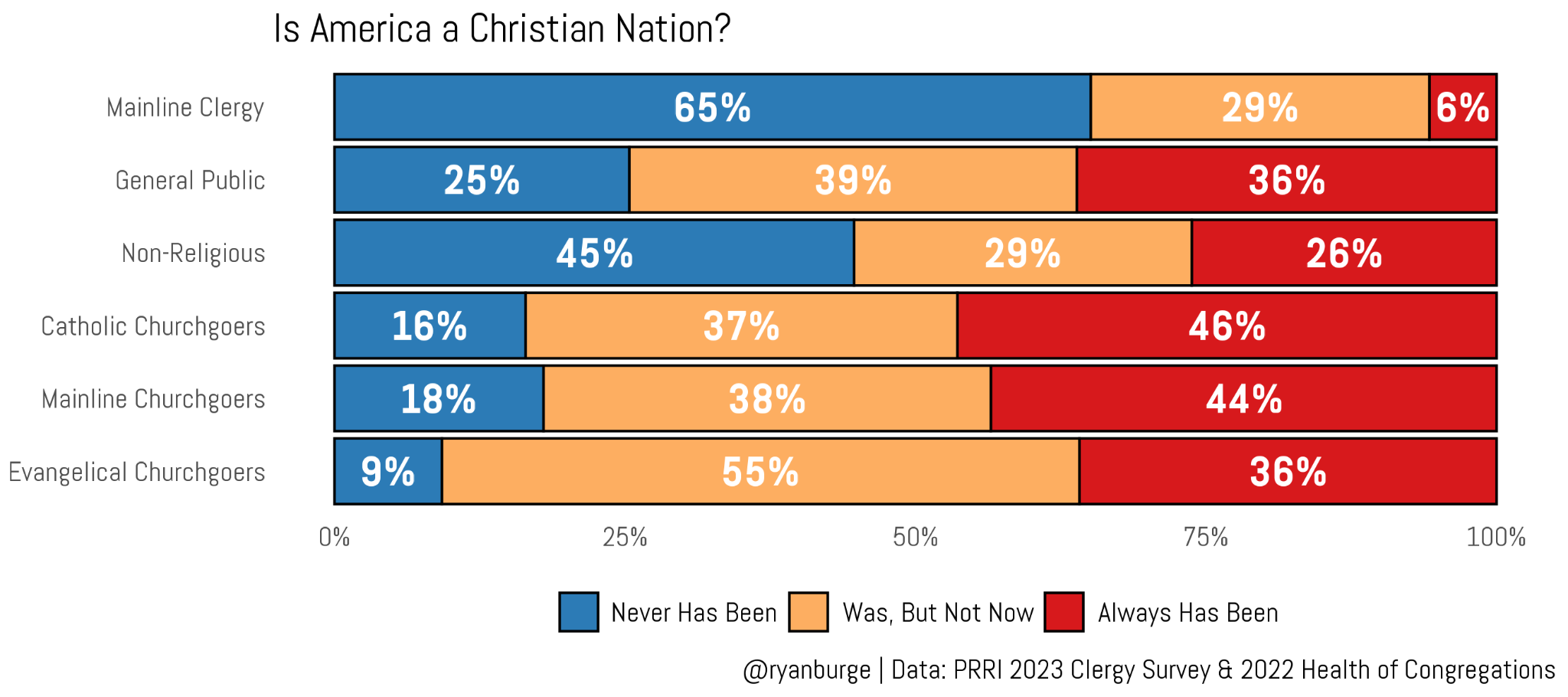
Among mainline clergy, only 6% said that America has “always” been a Christian country. Is that high or low? I wanted to compare those mainline pastors against a bunch of different reference groups, which is what I did in the graph above. And guess what? That’s incredibly low compared to almost everyone else in American society.
In the full sample of the general public, 36% of people agreed that America has always been a Christian country. Heck, even among the non-religious, it was 26%. The numbers are particularly higher among Christian churchgoers, too. Among mainline churchgoers, 44% say that America has always been a Christian country. That’s seven times the rate of their clergy.
So the differences that I made plain in the prior post about ideology and partisanship are not just confined to those two questions. The data says that the mainline leadership holds views on topics like this that are far out of step with almost all other groups in the United States.
But let’s zoom out to a whole question battery that was included in that mainline clergy survey as well as another PRRI instrument - the 2022 Health of Congregations study. Its total sample size was nearly 5,900.