



This post has been unlocked through a generous grant from the Lilly Endowment for the Association of Religion Data Archives (ARDA). The graphs you see here use data that is publicly available for download and analysis through link(s) provided in the text below.
And if you want to listen to me on WBUR talking the closure of my church last year, you can do so at this link.
Merry Christmas to everyone! I know you are probably busy wrapping presents, getting the car loaded up to travel, or preparing a Christmas feast that will happen in just a few hours. But it’s also Thursday — and I’ve never missed my weekly production schedule (and I don’t plan on altering that for the foreseeable future). Just so you know, I am not sitting up on Christmas Eve making graphs and ignoring my family. I’m actually writing this one up the week before Thanksgiving.
But I did find some really interesting data about celebrating the Christmas season. It’s posted on the Association of Religion Data Archives (ARDA). The survey comes from the Public Religion Research Institute (PRRI), and it was fielded in December of 2016 to about 1,000 American adults.
How Thankful Are Americans for Their Blessings?

First and foremost, happy Thanksgiving to all. It’s probably my favorite holiday. It’s low key, the weather usually isn’t too terrible, and it doesn’t require all the preparation and work that goes into Christmas. Sitting around, eating too much, and watching some football is not a bad way to spend a day.
It’s got a nice little section on Christmas that I thought would be fun to poke around in, and I do think there are some nice data nuggets here. There was a question battery that started with this statement: “Which of the following holidays are you celebrating this December?” It included a bunch of potential options, and folks could select all that they were celebrating.
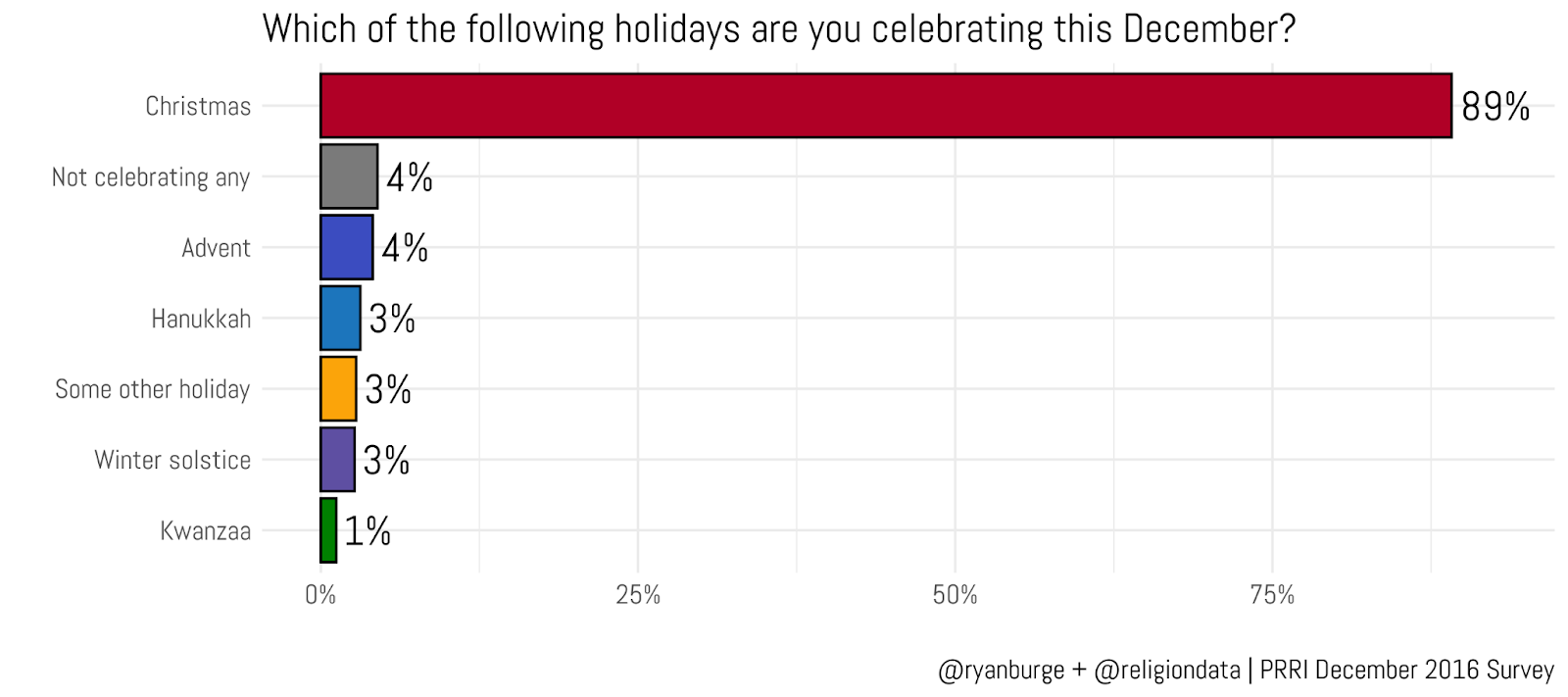
It should come as no surprise that Christmas was easily the most popular event in December. In this sample, 89% of respondents said they were going to celebrate the holiday. But when it comes to other events that happen in December, there’s not a whole lot of observance happening.
For instance, just 4% of people said they were going to celebrate Advent, which may seem strange because it’s the part of the Christian calendar that leads up to Christmas. It’s commonplace to talk about Advent in Catholic and mainline churches, but I guess it’s just not top of mind for most Americans. Other events like Hanukkah, the Winter Solstice, and Kwanzaa aren’t part of many folks’ holiday plans either. (By the way, there were only 22 Jews in the sample, so I can’t do any specific analysis of that population.)
I also can’t fail to point out that 4% of people looked at all the options for December holidays and selected “not celebrating any.”
But because Christmas is the only holiday that a large share of people say they celebrate, it’s worth looking at how that varies by religious tradition.
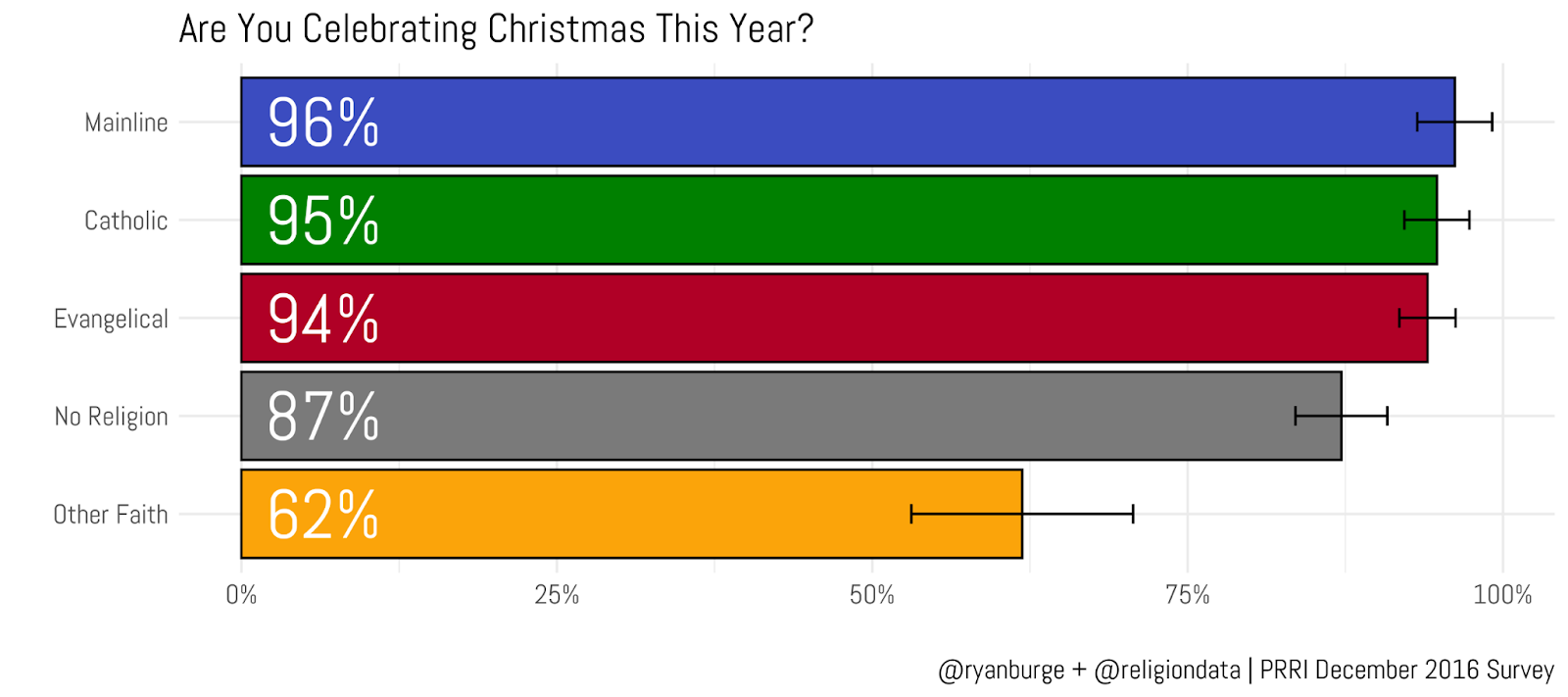
I know that no one will be gobsmacked by the fact that about 95% of Christians said they will be celebrating Christmas this year. Note that there’s no statistically significant variation between Protestants and Catholics on this, either. Christians celebrate Christmas regardless of whether they are evangelical, mainline, or Roman Catholic.
But here’s one of those data nuggets I mentioned before that was interesting to note: 87% of non-religious folks said they were celebrating Christmas. That’s only slightly less than the Christians in the sample (maybe less than five points given the confidence intervals). This is indicative of the idea that Christmas is not seen as an exclusively religious holiday.
To drive home that point, I wanted to show you the responses to the question: Thinking of the way you personally celebrate Christmas, is it a strongly religious holiday, somewhat religious, or not too religious?
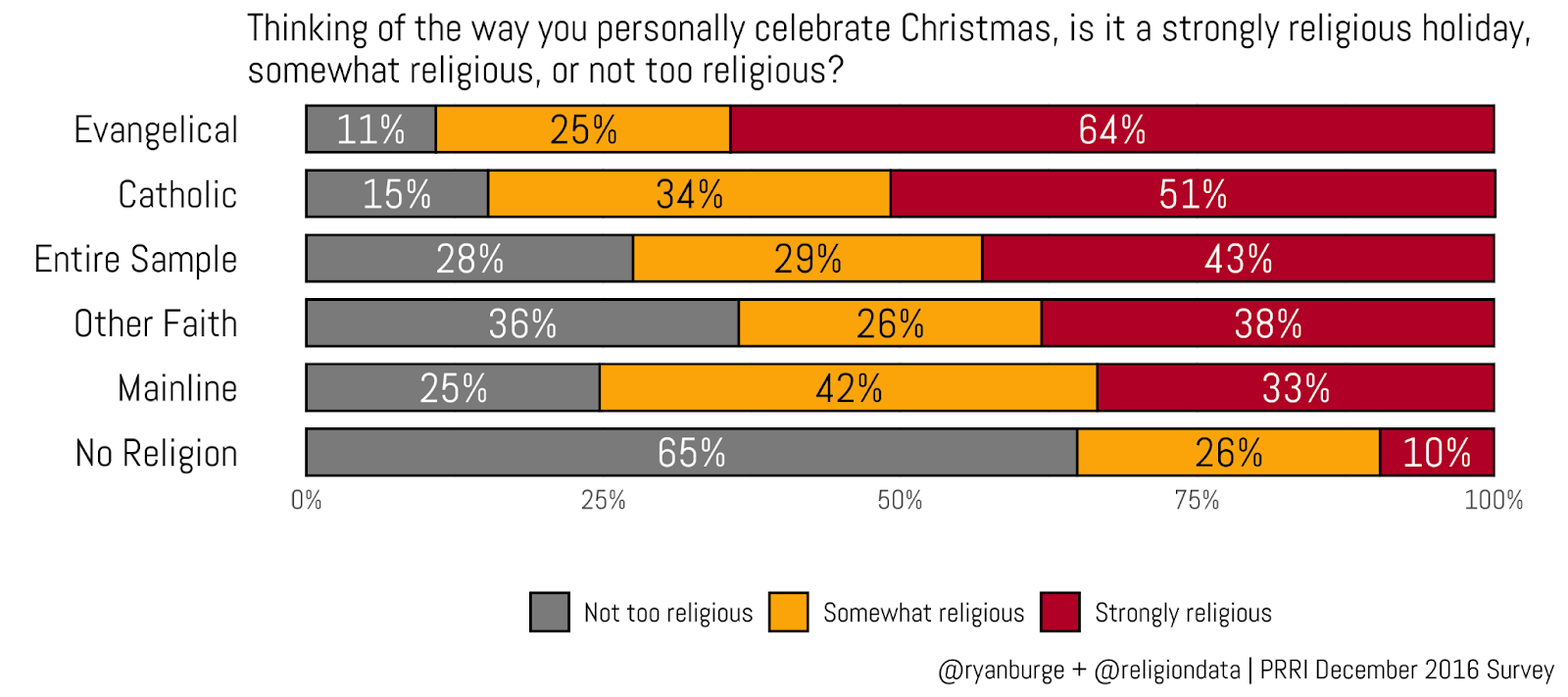
Among evangelicals in the sample, about two-thirds said that Christmas was a “strongly religious” holiday. Just ponder that one for a second, by the way. Evangelicals are typically the group that take their faith more seriously than anyone else, and still one-third of them don’t celebrate Christmas with a deeply religious undertone.
Catholics are just a bit behind evangelicals, with a bare majority (51%) saying that Christmas is strongly religious. But those are the only two groups in the sample that were above the national average. Among all adults, 43% say that Christmas is strongly religious, while 29% say that it’s somewhat religious and nearly the same share indicate that it’s not religious at all.
The one that really stands out to me is mainline Protestants. Just one-third of them report that Christmas is a strongly religious holiday. In contrast, the plurality (42%) say that Christmas is only a somewhat religious event. That was easily the highest share of any of the faith groups, including the non-Christian groups.
Then, there was one more question about Christmas that I think is helpful in looking at how the holiday has been celebrated over time. It asked, “Thinking about when you were a child, how, if at all, did your family celebrate Christmas?”
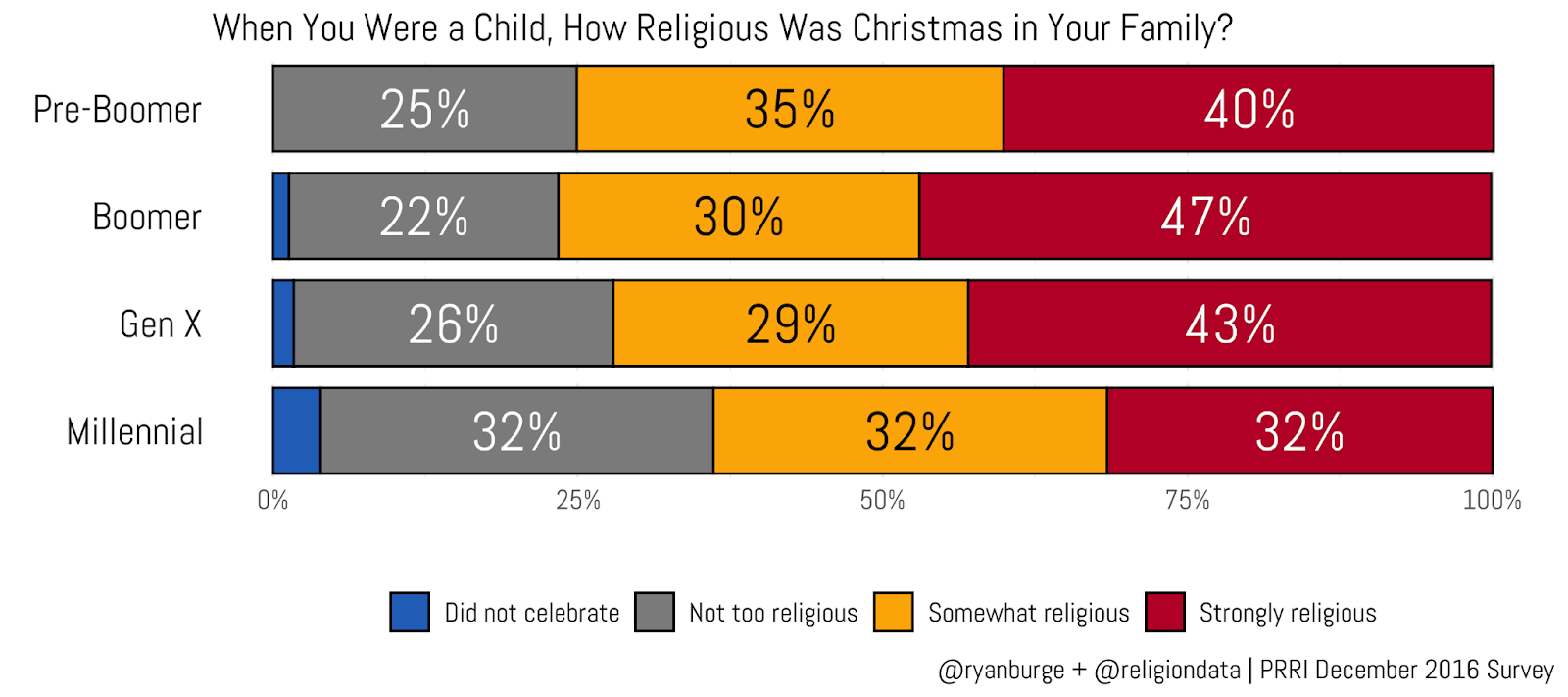
I broke this down into birth generations so that it would help paint a picture of what Christmas was like over the last hundred years or so. This is the best approach I have to explore a question like: Has Christmas become more secular over time?
And, honestly, I don’t know if the data gives a clear answer to that question. For instance, among folks born before 1946, about 40% report that Christmas was a strongly religious holiday when they were a child, and nearly the same share (35%) said it was only somewhat religious. What jumps out to me is that for both Baby Boomers and Gen X, their childhood Christmas experiences were more religious in nature. I don’t really know how to explain something like that.

But you can clearly see that Millennials (and a couple members of Gen Z) were noticeably less likely to report that Christmas was a religious holiday when they were kids. Among this youngest birth cohort, just 32% said it was deeply religious. That was 15 points lower than Baby Boomers. In contrast, the exact same share said that Christmas was not too religious in their childhood home. So, there’s definitely some evidence here that the Christmas season is becoming more secular over time, but not by a huge margin.
I wanted to keep this post a bit shorter today, given that all of you are so busy celebrating December 25th in religious and non-religious ways. But whatever this day means to you, I hope it gives you at least 24 hours to rest from your labors, celebrate, and reflect on the past year.
Thanks for following along with me for all of 2025. I hope you’ve enjoyed these partnership posts for Ahead of the Trend with the ARDA as much as I have, and we know that next year will be even bigger and better.
Code for this post can be found here.
Don’t forget about the holiday discount - 20% off an annual subscription. You can take advantage of that here:
Ryan P. Burge is a professor of practice at the Danforth Center on Religion and Politics at Washington University.
First off: I'm a social historian and know for a FACT that Christmas became a secularized (and therefore commercialized) holiday in England in the mid-19th Century....please read A Christmas Carol.
From England, it spread rapidly, and by the '50s become a global celebration.
Secondly: I'm Jewish, and live in an area of the US (Cleveland, OH) where there are a lot of Jews (possibly the 4th or 5th largest Jewish community in the US) and the majority of us do celebrate the Christmas Season (which often coincides with the Hanukkah season, btw). Though (obviously) not in the exact way Christians do.
For us, this national holiday (as are Thanksgiving and Independence Day) is a time of in-gathering. It is a time for family get togethers. It is a time for thankfulness and gratitude.
And not surprisingly, the majority of Christians celebrate the Christmas Season as we, and countless other people around the world, do.
And, Dr. Burge....thanks for this great posting.
Always good to hear/read what you think of my comments/musings.
Be Well, Eileen Beal