



This post has been unlocked through a generous grant from the Lilly Endowment for the Association of Religion Data Archives (ARDA). The graphs you see here use data that is publicly available for download and analysis through link(s) provided in the text below.
Several years ago, Canada began a program called Medical Assistance in Dying (MAID). It’s a government initiative that’s beginning to reshape how Canadians are facing end-of-life situations. An article published in The Atlantic in August of 2025 titled Canada Is Killing Itself reports 5% of all the deaths in 2024 that happened in the country were through physician assisted suicide.
This is a topic that will garner increasing attention in the United States as medical aid in dying is already legally permissible in 13 states and Washington DC. And the March/April 2026 issue of Christianity Today includes a piece by Kristy Etheridge titled, “Death is Not a Right.” Given this interest, I wanted to see if I could provide some empirical background on how views of suicide have changed over time, particularly across the religious landscape in the US.
Cafeteria Catholicism?

This post has been unlocked through a generous grant from the Lilly Endowment for the Association of Religion Data Archives (ARDA). The graphs you see here use data that is publicly available for download and analysis through link(s) provided in the text below.
The General Social Survey has been asking a four question battery about suicide (with various justifications) for decades now. Luckily, the Association of Religion Data Archives makes it easy to search the codebook for the GSS and pull out the relevant questions. They all start with the same preamble - Do you think a person has the right to end his or her own life if this person…
There are four scenarios:
1. The person has an incurable disease
2. The person has gone bankrupt
3. The person has dishonored their family
4. The person is tired of living
Here’s the share of the entire sample who supported a person’s right to end their life given the above circumstances.
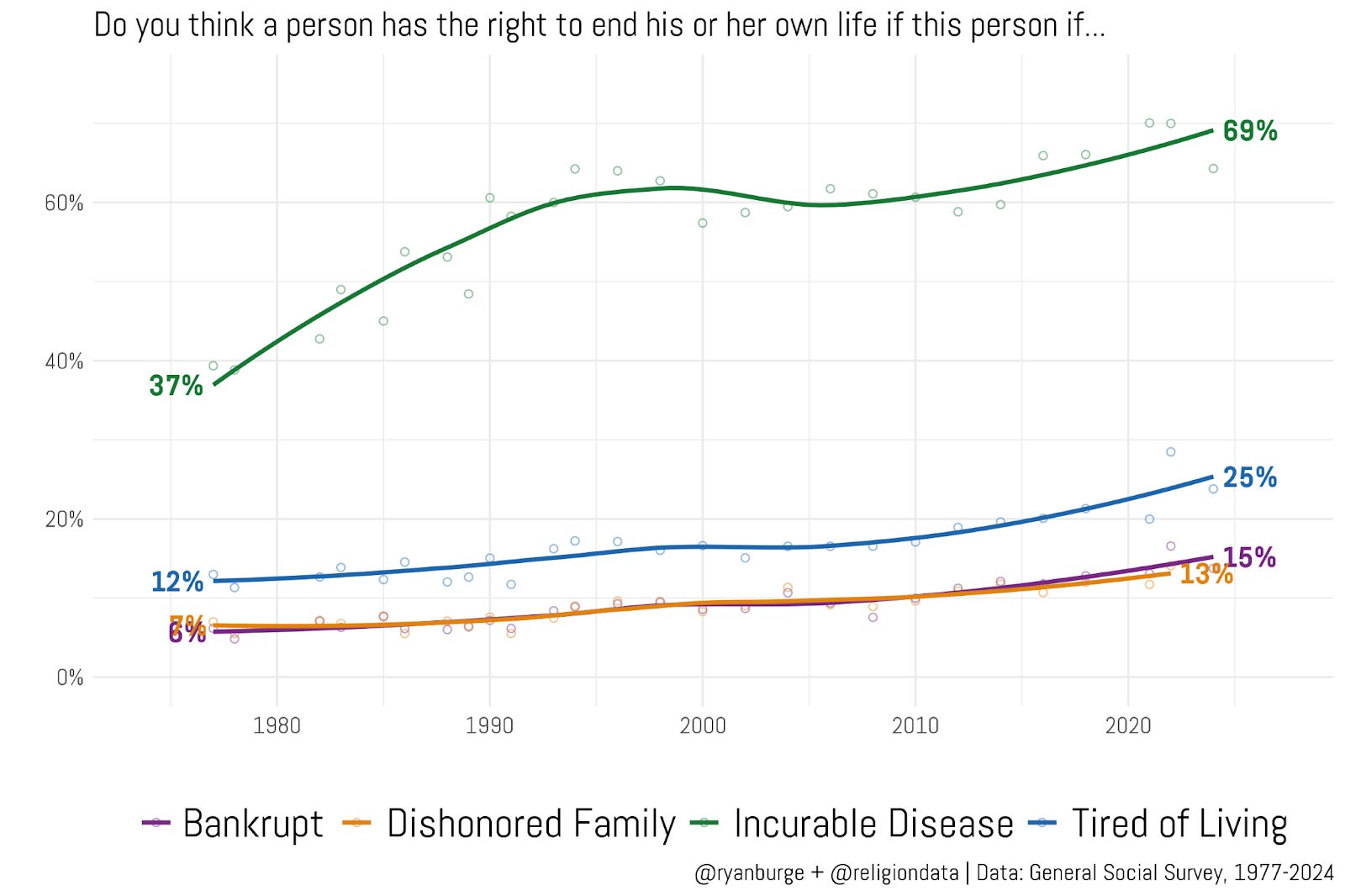
It is clear that the American public has been much more open to the idea of suicide in the case of incurable disease compared to the other three situations. In 1977, 37% of the sample supported someone ending their own life if they had a disease that couldn’t be cured. That rose quickly through the next 15 years, crossing the majority support threshold by the late 1980s and rising to 60% in favor by the mid-1990s. It stayed there for a while but then rose again after 2010 and it’s now at an all time high: 69% in favor.
The other three scenarios have never garnered anywhere near the same levels of support in the general public. The share who favors a right to suicide for people who go bankrupt or dishonor their family has never been robust: 6-7% back in the 1970s and creeping up very slowly over time to where it now stands, around 15%.
The question about suicide when a person “is tired of living and ready to die” gets a bit more support, though. It was 12% back in 1977 and that share has doubled in the last couple of decades. Now, a quarter of Americans favor an individual ending their own life if they just don’t want to live anymore.
As I was poking around this data, I had to wonder: is there some kind of combination between these four scenarios that is the most popular? Or are people pretty absolutist about this: they either favor suicide in all cases or reject it in all cases?
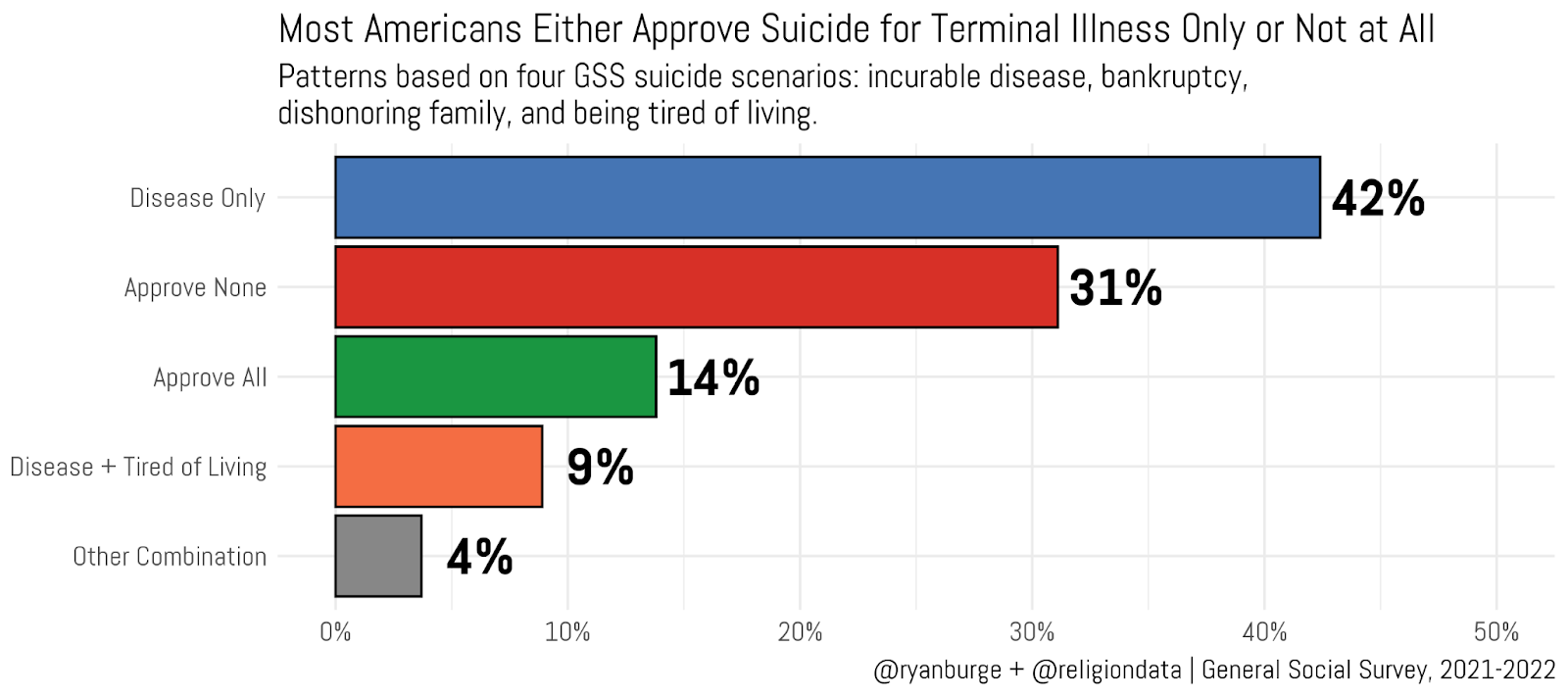
The most popular option was an individual saying that they would favor suicide in the case of incurable disease but in no other circumstances. That position comprised 42% of the sample. In second place, with 31% of the sample were folks who simply said “no” to each of the four circumstances. They were not in favor of suicide no matter the situation. That’s much higher than the portion of the sample who took a more libertarian view and would allow someone to end their life in all four scenarios previously described (14%).
The impression that I get is that most Americans do not take a “black and white” view on suicide. Only 45% of all adults said “none of the above” or “all of the above.” Instead, the clear impression that emerges for me is that there’s a lot of openness to the idea of suicide when someone has a terrible illness. So, this does feel like situational ethics.
Turning to religion, the dominant view in Christian circles is that suicide is an affront to God’s gift of life and is strongly discouraged. Both Augustine and Aquinas condemned suicide in the strongest possible terms. Protestants tend to not see suicide as an “unforgivable sin” but still a tragedy in which humans try to usurp God’s ownership of life. Both the Quran and Hadith have explicit prohibitions for suicide in the Islamic faith. I broke the sample down into larger religious families and then tracked their answer to suicide in the case of incurable disease and for people who are just tired of living.
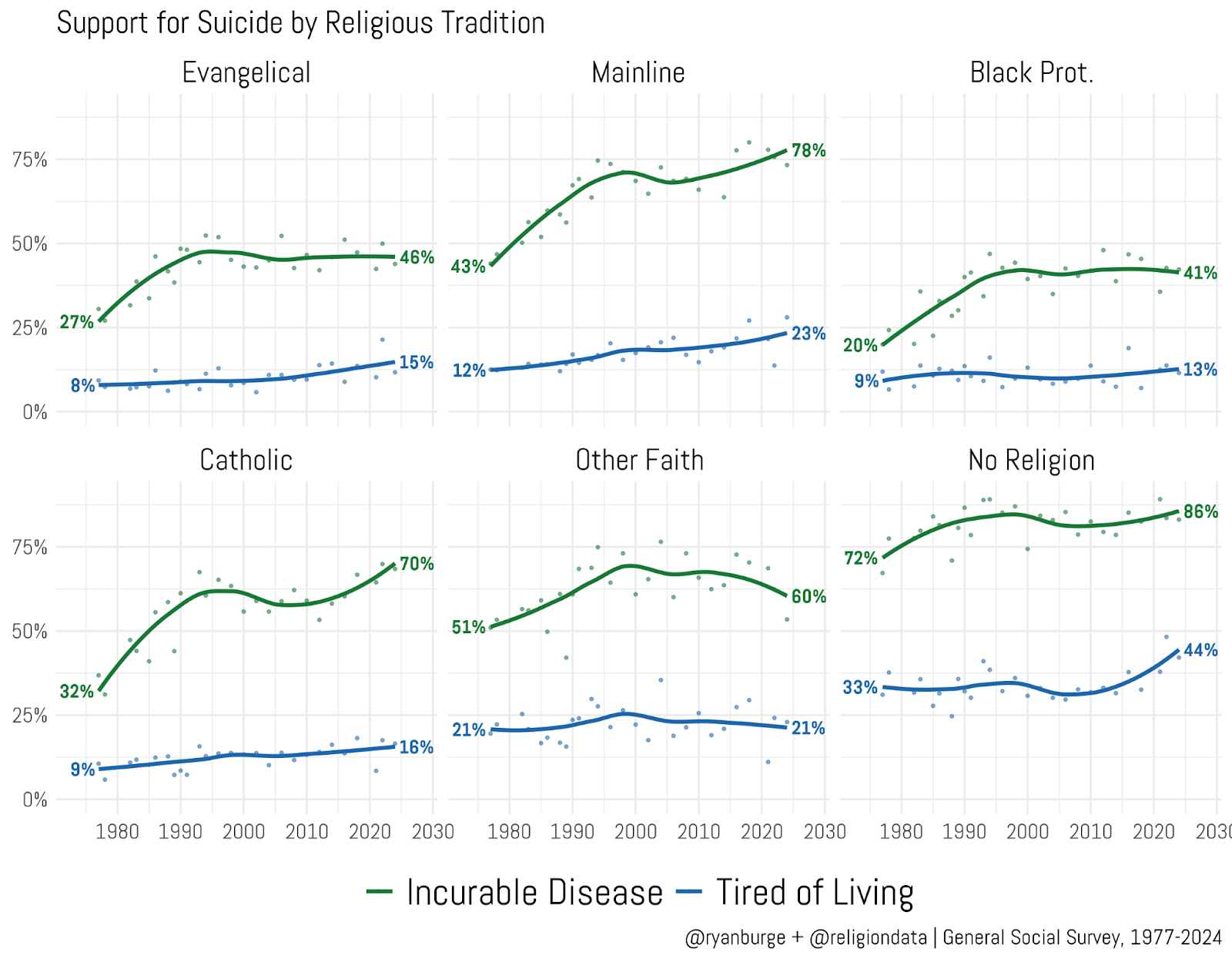
The general sense I get is that views of suicide have become noticeably more permissive over time and that’s true across basically every religious group. However, the overall level of support between groups can vary quite a bit. For instance, only 41% of Black Protestants support suicide when there’s an incurable disease. That figure for evangelicals is only slightly higher at 46%. Those two figures stand in stark contrast to mainliners at 78% and Catholics at 70%. This is a divide I see time and time again when I look at all kinds of questions: Black Protestants and evangelicals are very similar while mainline Protestants and Catholics tend to have similar views.
The non-religious are easily the most supportive of suicide in both these cases. In the “incurable disease” scenario, it’s overwhelmingly in favor: 86%. Even in the situation where the person just doesn’t want to live anymore, nearly half of the non-religious would allow suicide in that case: 44%. It’s important to note that this figure is basically twice as large as any other group in the prior analysis. The nones certainly stand alone on these questions.
I again looked at all the combinations that can emerge when looking over these four questions about suicide, but now across the six religious traditions from the previous graph.
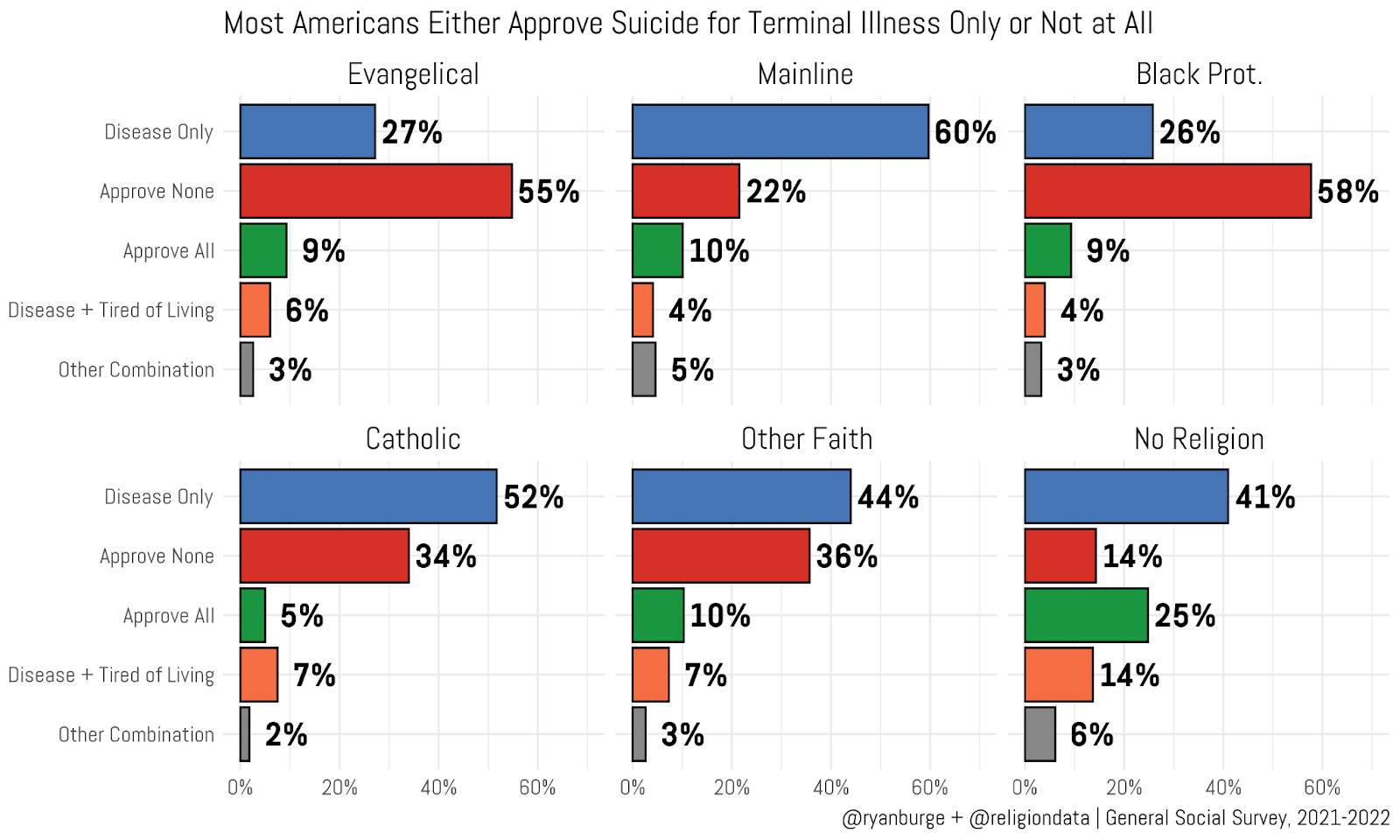
Note, again, how Black Protestants and evangelicals are pretty similar in their responses. A majority say that they do not favor suicide in any of the four scenarios. Then another quarter say that the only permissible situation is when an individual has an incurable disease. It’s amazing how these two graphs look almost exactly the same in this analysis.
Meanwhile, 60% of mainline Protestants said that they would permit a person suffering from an incurable disease to end their own life while only 22% were opposed to suicide in all four scenarios. That’s a bit different from the Catholic analysis. In the case of American Catholics, a slim majority (52%) supported suicide only in the situation in which an individual has an incurable disease. However, a third rejected suicide in all four cases. That was 12 points higher than mainliners.
The non-religious are by far the group that was the most likely to say “yes” to all four questions. A quarter of them would permit suicide in all cases. That was 15 points higher than any other group in the sample. In contrast, only 14% of the nones rejected suicide in each of the scenarios. That’s 20 points lower than any other group.
I did wonder, though, if there are differences in responses if we divide the sample by level of church attendance.
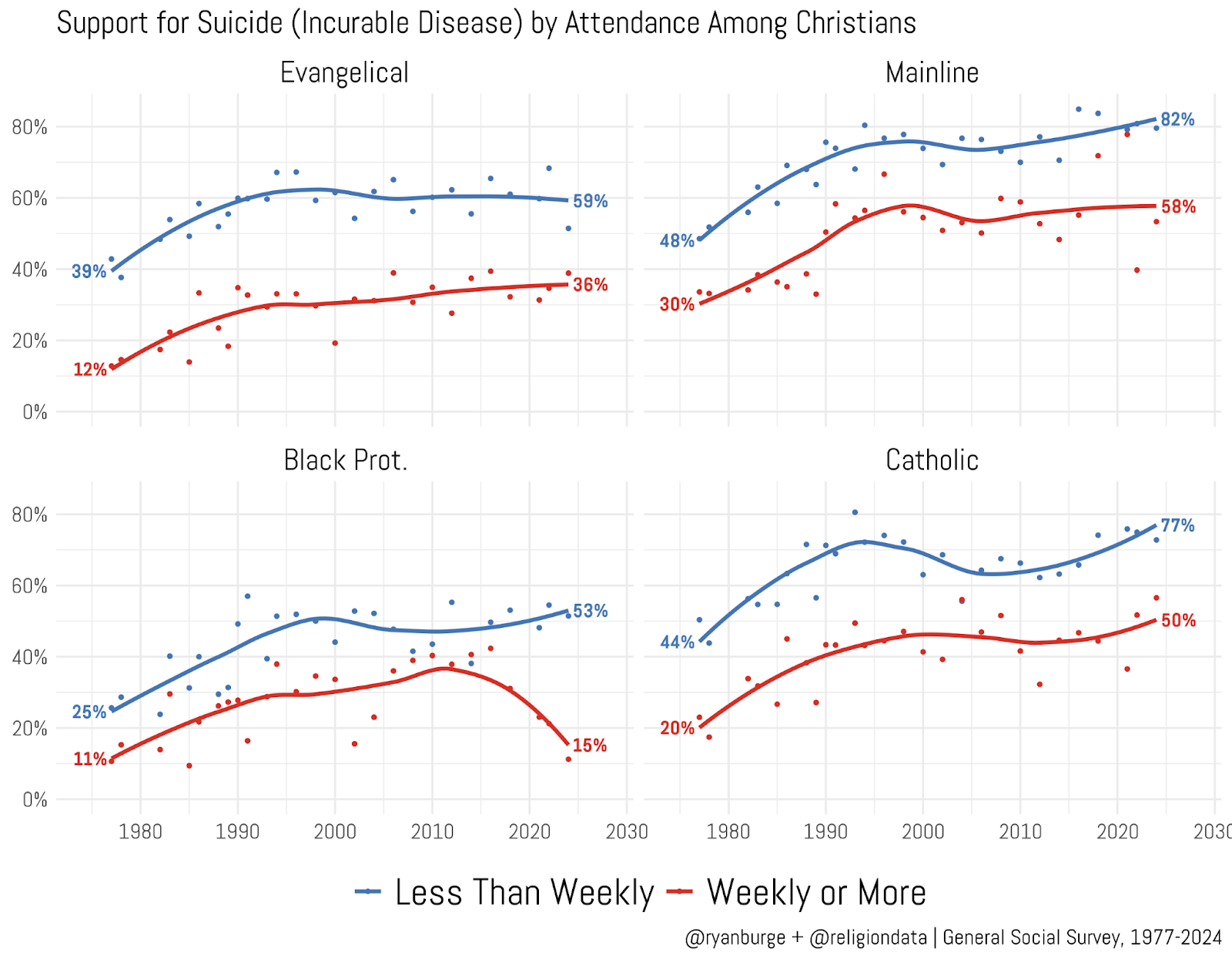
The evidence here is clear and convincing: Christians who go to church weekly or more are more likely to oppose suicide in the case of incurable disease compared to those who attend less often. The gaps are sizable, too. Among weekly attending evangelicals, support was just 36%. For those who attend with less regularity it was 23 points higher. The gap for mainline Protestants was even larger across these two attendance categories: it was 18 points back in 1977. In 2024, it had swelled to 24 points. For what it’s worth, I wouldn’t put too much stock in that result for Black Protestants - there just aren’t enough in the sample to draw meaningful conclusions.
However, I do want to highlight the bottom right graph that visualizes the Catholic response to the question about suicide in the case of incurable disease. In 1977, 20% of regular Mass attending Catholics favored suicide. It was 44% of those who didn’t go to Mass with that same regularity. However, the 2024 figures are much higher. Among weekly attenders, support had risen to 50% while it was 77% among Catholics who didn’t go to Mass every week.
Finally, how might Christian groups think about assisted suicide compared to other “life” issues? To probe that a bit further I added two questions to the mix. One asked folks if they supported abortion if the woman wants one for any reason. The other asked, “Do you favor or oppose the death penalty for persons convicted of murder?”
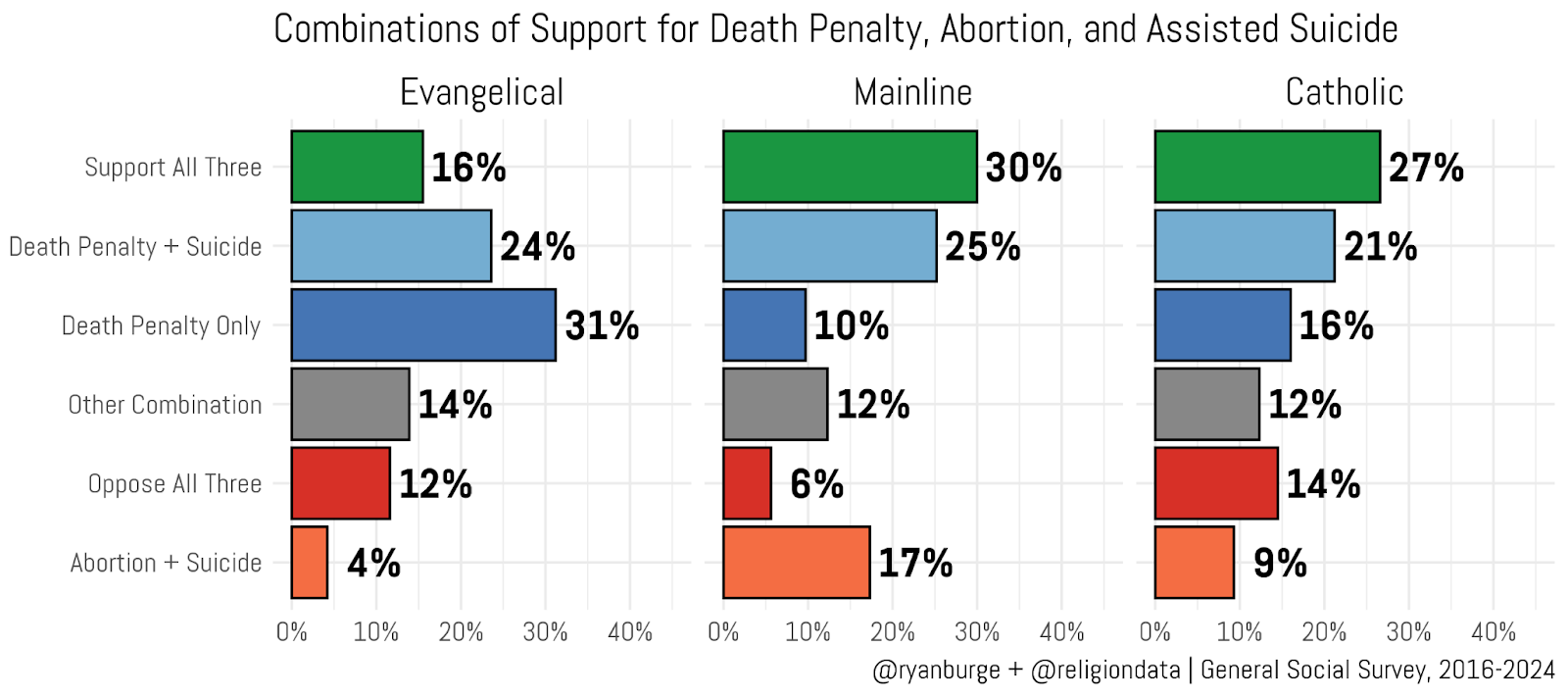
I love this graph because none of these three groups looked the same. (I excluded Black Protestants because of sample size issues.) For instance, the most popular combination for evangelicals was support for the death penalty but rejection of abortion and assisted suicide. This cluster represented 31% of evangelicals. The next popular response was support for both the death penalty and the right of an individual to take their own life if they had an incurable disease.
For mainline Protestants, the most popular option (30%) was support for assisted suicide, the death penalty, and access to an abortion. A slightly smaller share (25%) favored the death penalty and assisted suicide but not access to an abortion. What really jumps out to me for the mainliners, though, is that 17% of them supported abortion and assisted suicide but not the death penalty. That was easily the highest of any group.
What about Catholics? Well, the Catholic Church teaches that life should be protected in every possible way. Thus the official position would be opposition to all three. However, only 14% of Catholics are in agreement with the Church on these topics. Nearly double that share (27%) hold positions on assisted suicide, abortion access, and the death penalty that all stand in direct opposition to their church’s teachings.
How Do Americans Feel About In-Vitro Fertilization?

This post has been unlocked through a generous grant from the Lilly Endowment for the Association of Religion Data Archives (ARDA). The graphs you see here use data that is publicly available for download and analysis through link(s) provided in the text below.
So, what to make of all of this? It appears that the American public has shifted in the direction toward permissiveness toward suicide if someone is struggling with an incurable disease. That has clear majority support now. However, beyond that, there’s quite a bit more resistance to other possible scenarios. It seems likely that if a referendum on the topic was placed on the ballot in every state, but limited assisted suicide to those facing an incurable disease, it could pass in almost all of them. It would face some opposition in regions of the country with high concentrations of evangelicals, but it might still garner majority support.
This seems like a topic in which religious arguments are not carrying the day. Instead, views have consistently liberalized over time. The more I look at data on issues like this the more I realize that the average American’s view is quite libertine: let people make up their own minds about how they want their lives to end.
Code for this post can be found here.
Ryan P. Burge is a professor of practice at the Danforth Center on Religion and Politics at Washington University.

This was really interesting for me to read, especially since I am an AND because of a life limiting illness. Why is it that Canada always seems to take a more Holistic approach to many medical areas, including the ability to decide their own death.
Yes I do absolutely fully appreciate the moral and ethical issues attached to the issue. I digress, long and short of this one is that once again we're just proving we're all a host of contradictions. Ryan, thanks for this. Couldn't have come on a better day.
Perhaps "tired of living" is too mild a phrase to prompt support. What about "doesn't find living worthwhile" or "finds living intolerable?" And "assisted suicide" also seems a little biased given the negative connotations of "suicide" (mental illness). As a Canadian, I'll use MAID. An interesting one would be: Support medically assisted dying if the person had decided to voluntarily suspend eating and drinking (VSED)? It is reported (e.g., by palliative care workers) to be a peaceful way to go. The choice is not "MAID vs live" when there are alternative ways to die like VSED (MAID vs starve to death) or "accidental overdose," including other forms of killing oneself that are normally classified as suicide, which is elevated in older people, especially men.