



This post has been unlocked through a generous grant from the Lilly Endowment for the Association of Religion Data Archives (ARDA). The graphs you see here use data that is publicly available for download and analysis through link(s) provided in the text below.
The amount of cynicism in the world is sometimes hard for my mind to grasp. I really struggle watching TV shows and movies that have a really bleak view of the world. I don’t want to watch The Golden Girls all the time (although it is a really great thing to put on the TV right before bed), but I just can’t spend a lot of my time meditating on the evilness of the human experience over and over again. I think it’s bad for my soul, to be honest.
The internet only makes it worse. During the college football playoffs, the Indiana Hoosiers went on an absolute heater. They were playing out of their minds. In the semi-final game against Oregon, they blew them out of the building, winning by 34 points. On the first play from scrimmage, an Indiana player (D’Angelo Ponds) intercepted a pass and ran it back for a touchdown. After the game had ended, an equipment manager from Oregon found Ponds on the sideline and presented him with the ball that he had intercepted to start the game. It was an absolute class act.

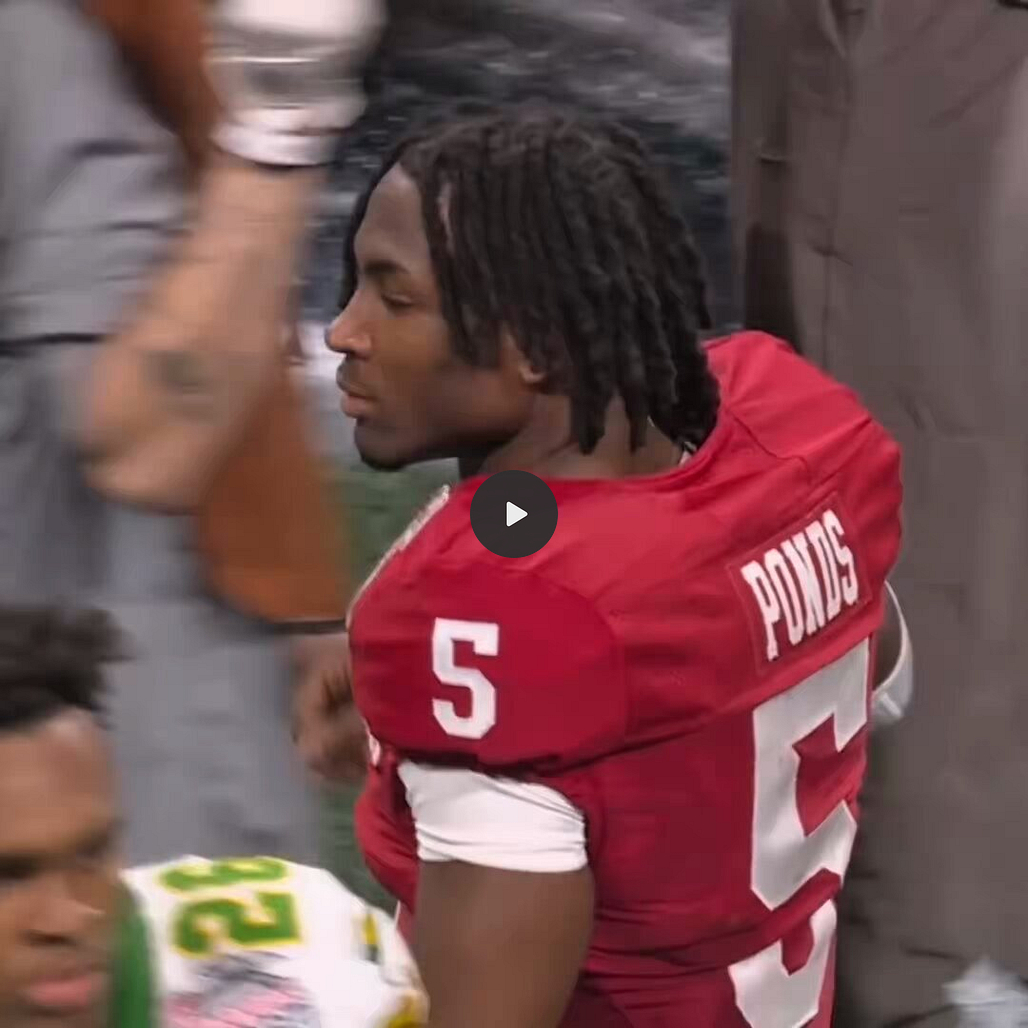

While most of the comments were positive, a few of them were so incredibly cynical.
“Staged. Only doing it because of the cameras and for clicks”
“He’s just doing that in the off chance that they get Ponds to enter the portal and transfer to Oregon next season”
The Religion of America's Young Adults

There’s a lot of helpful data here for folks who work with youth, young adults, and college students. If you fit that criteria, get in contact with me and I can provide a discount code for 20% off an annual subscription.
It almost feels like there is a growing group of people who can see no goodness in the world. And that viewpoint is being celebrated and amplified on social media.
I get the foreboding sense that Americans just don’t trust each other anymore. They think that everyone is selfish, cruel, and without a moral compass. People don’t start a company to build a great product; they do it to make themselves a fortune. Politicians don’t run for office because they want to make life easier for their fellow citizens; they do it because they are power-hungry.
Well, the other day I was browsing the codebook for the 2024 General Social Survey on the Association of Religion Data Archives and was reminded of a really pertinent question to this discussion. It simply asks:
Generally speaking, would you say that most people can be trusted or that you can’t be too careful in dealing with people?
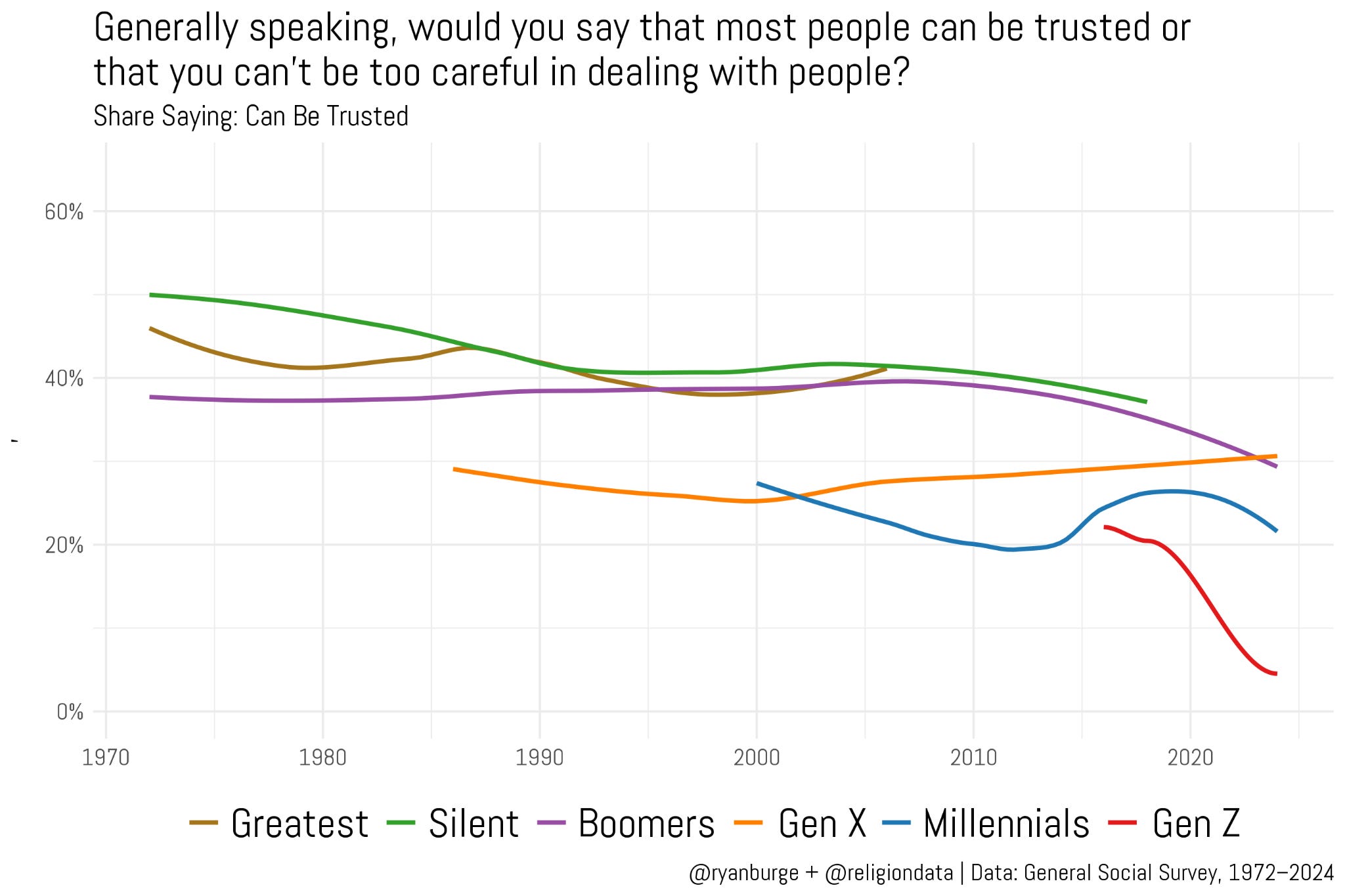
You know what, I am kind of surprised at how stable these lines are over time. It does look like there has been a decline in people saying, “others can be trusted,” but it’s a pretty subtle shift. For the Silent Generation, it declined ten percentage points across about five decades of data. For Boomers, it was rock steady from 1972 through 2010, then it dropped noticeably in the last couple of years.
But check out Generation X. If anything, their level of interpersonal trust has actually gone up over time, and now it’s at basically the same level as Boomers. Back in 2010, the gap between those two lines was ten percentage points. I need someone to explain that to me. And, while you are at it, figure out what’s going on with Millennials. I think trust is up, but it’s not a clear pattern.
Then, that Gen Z line is pretty easy to figure out: trust started out low and has only slipped from there. It was slightly above 20% in 2018. Now, it’s in the single digits. Oof. There’s no generation that is less trusting of other people than Gen Z.
I do feel like I need to zoom in on the last couple of years of data, though. Just to make this point plain.
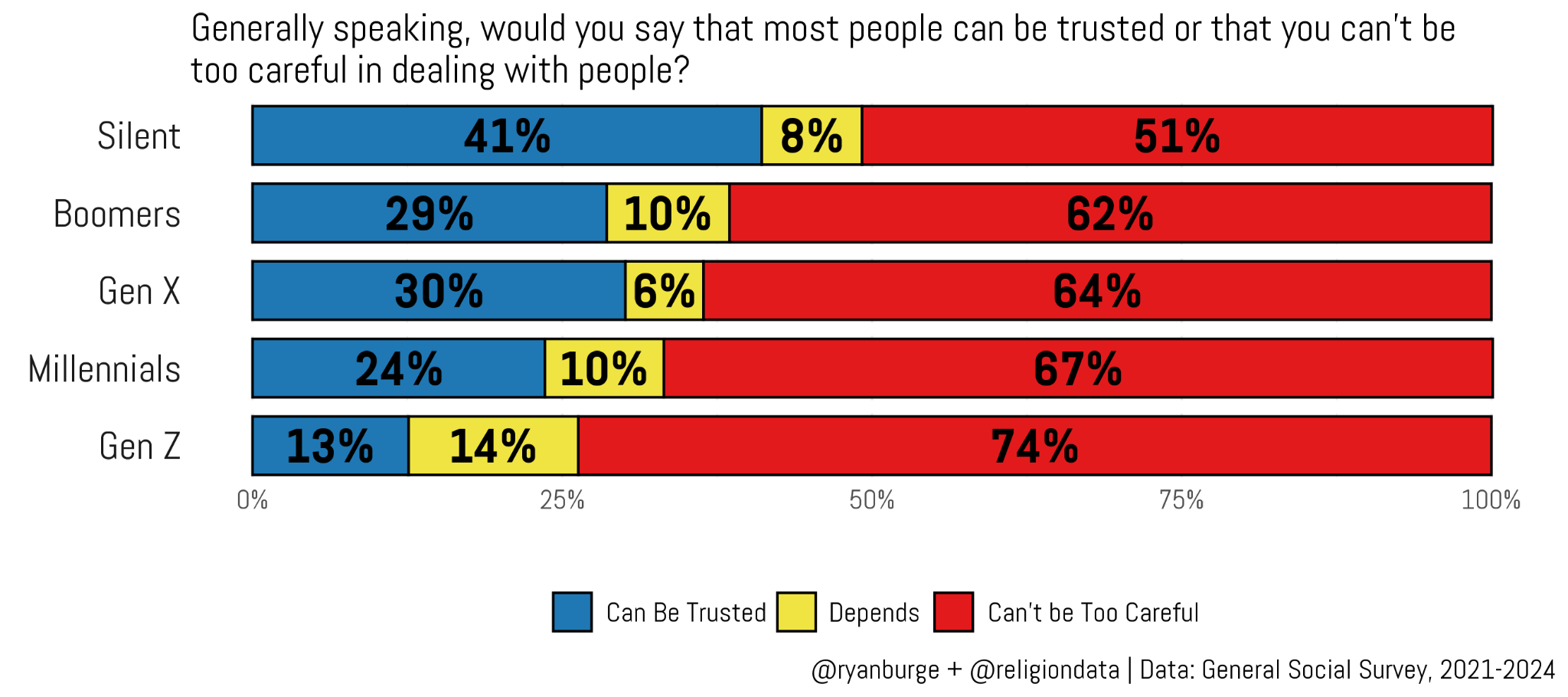
I think this graph does a better job of showing the complete picture when it comes to interpersonal trust. Look at the middle three generations: Boomers, Gen X, and Millennials. The share who say that “you can’t be too careful in trusting other people” is really similar: 62%, 64%, and 67%. It’s not like these folks have a huge well of goodwill toward random strangers. In contrast, the share who say folks can generally be trusted is around 30% among Boomers and Gen X, but is clearly lower among Millennials at 24%.
Gen Z is just on a different planet, though. The share who can’t trust others at all is 74%; that’s seven points higher than Millennials. The share who say others can be trusted is a measly 13%. That’s 11 points lower than Millennials and 17 points lower than Gen X.
This is an empirical fact: unless they experience a significant increase in trust (which we haven’t seen in fifty years of polling data), Gen Z will be the least trusting generation in modern American history.
Okay, that’s firmly established, right? Now we get to move to the unpleasant task of trying to figure out what factors have an impact on interpersonal trust. One that absolutely looms large is education. I just divided the sample into those with a high school diploma or less and those who have earned a four year college degree.
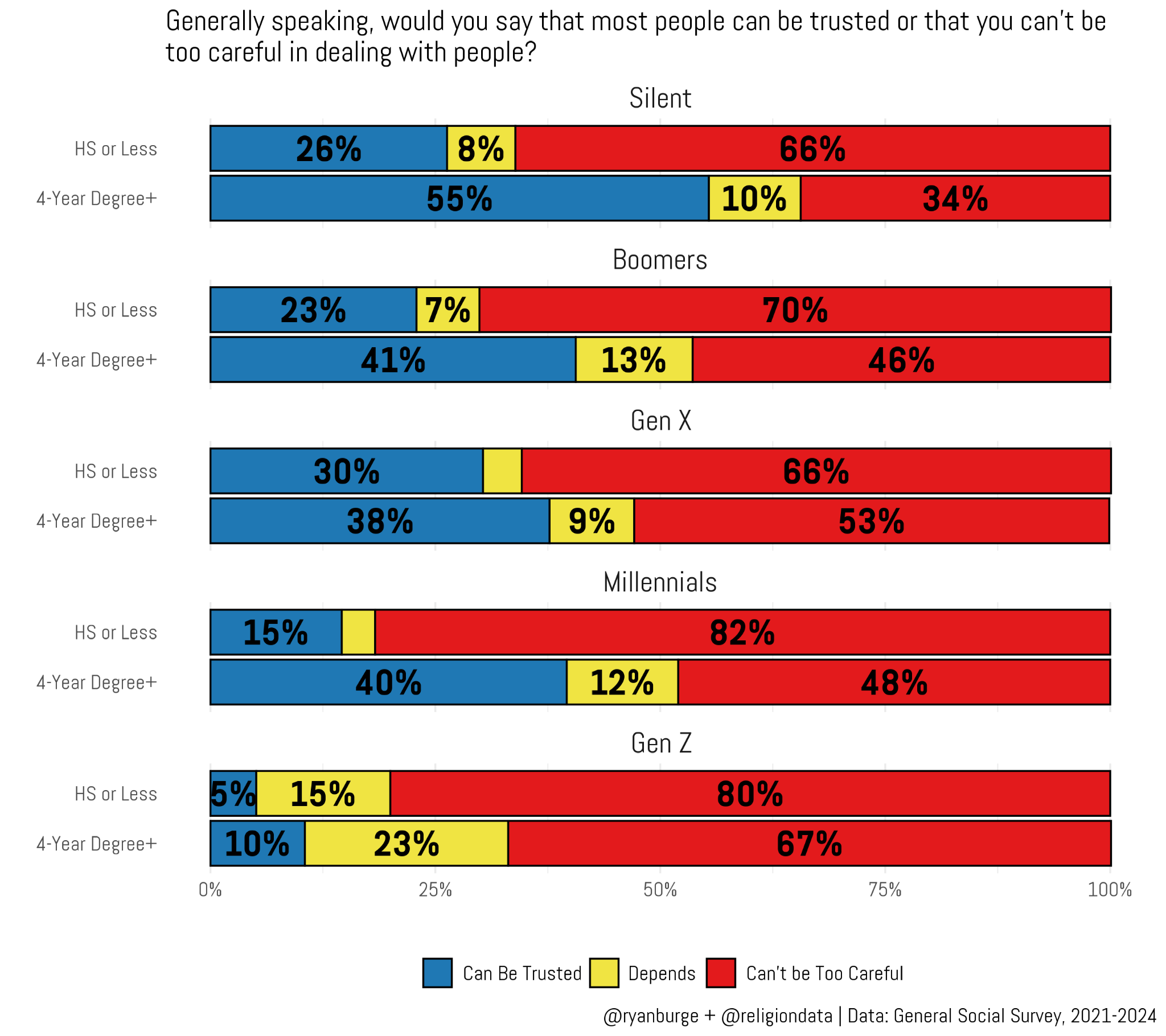
These gaps are huge, folks! The relationship between education and trust is just impossible to deny. Among Boomers with a college degree, 41% trust other folks. It’s just 23% among those who stopped at high school. For Gen X, those figures are 38% and 30%, respectively. But then they balloon back up for Millennials. Among those who stopped at high school, just 15% say that others can generally be trusted. It’s 40% of Millennials who have a bachelor’s degree.
Now, what can we make of Gen Z? Well, the first thing to note is that the baseline of trust for them is just so much lower than other generations. But the education gap is still there. Among members of Gen Z who stopped their education at 12th grade, only 5% say that other people can be trusted. But even among those who have earned a four year college degree, it’s 10%. Part of the problem here is that Gen Z is still working their way through educational attainment. So it may take a while for these education gaps to fully solidify. But even among highly educated Zoomers, trust is in short supply.
To this point, I haven’t even mentioned religion, which is an absolute travesty. We need to rectify that immediately. I do think that there are ample reasons to believe that trust is related to religious attendance. I mean, you have to be a bit more trusting to show up at a house of worship with lots of other people voluntarily, right?
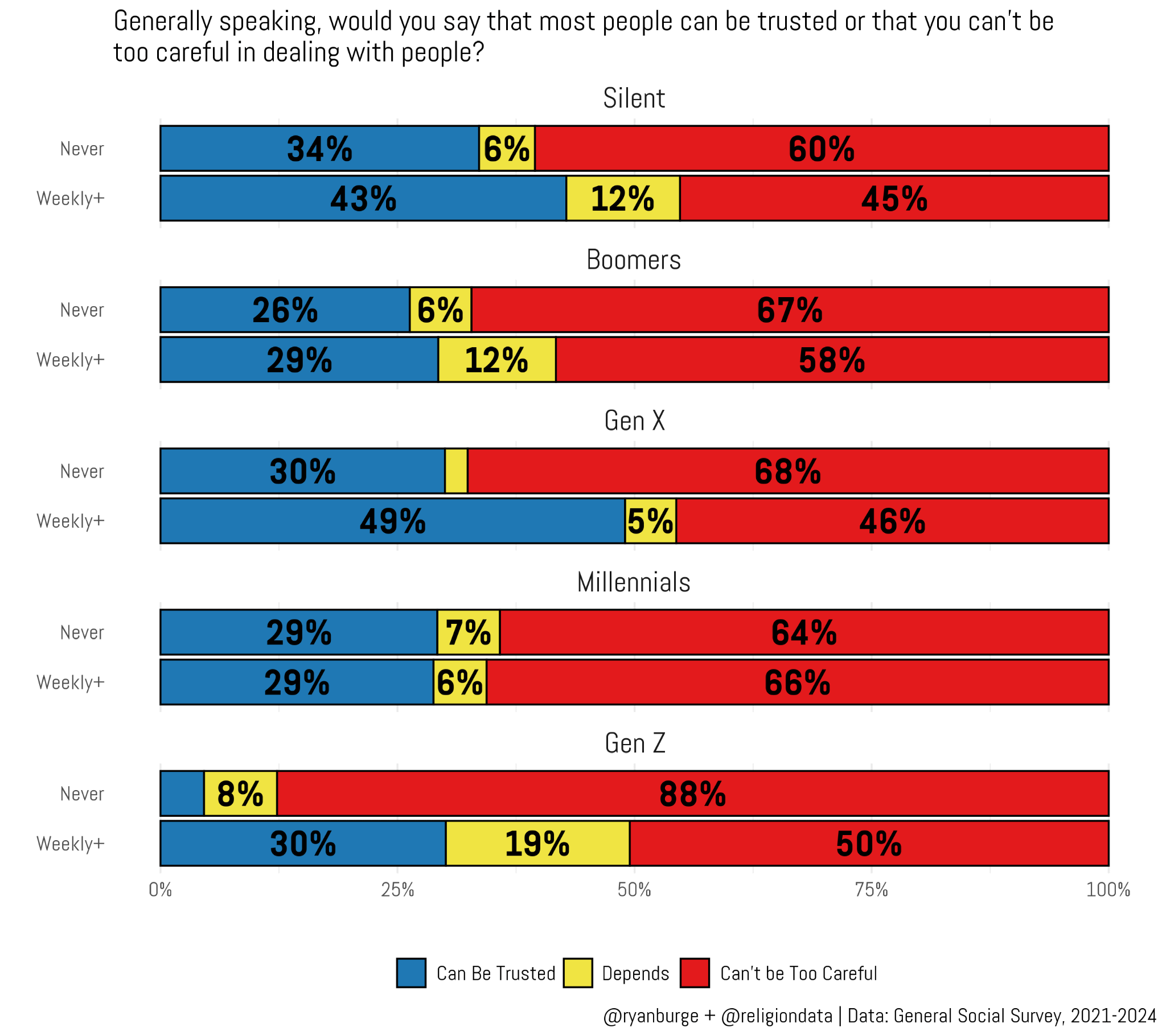
There are certainly some gaps in trust based on church attendance, but they really aren’t as large as I would have guessed. For instance, among Boomers who go to church every week, 29% say that other people can be trusted. It’s 26% of those who never go to church. The gap on the “can’t be too careful” response is a bit bigger, though: 9 percentage points.
But then if you compare Gen X and Millennials, I just have to scratch my head a bit. There’s a huge gap in trust among Gen X. Among regular church attenders, 49% say that others can be trusted. It’s only 30% of the never attenders. However, there is no gap at all among Millennials on this question. Which makes no sense to me. It’s the only generation in which religious attendance makes no difference on this question. In every other cohort, the gap is consistent and large.
I do need to highlight the huge disparity with Gen Z, though. This is the biggest gap of all. Among Gen Z folks who don’t go to church at all: 88% say that you can’t be too careful in dealing with people. It’s only 50% of Zoomers who attend church regularly. That’s a chasm. Non-religious Gen Z folks are incredibly wary of their fellow citizens.
There are a lot of moving parts here, though. Many factors can impact trust: education, income, ideology, church attendance, gender and race. I wanted to try and isolate them from each other by pulling together a regression. What I really wanted to concentrate on was comparing Gen Z to older generations to see if trust “works” differently for young adults. Man, I was blown away here.
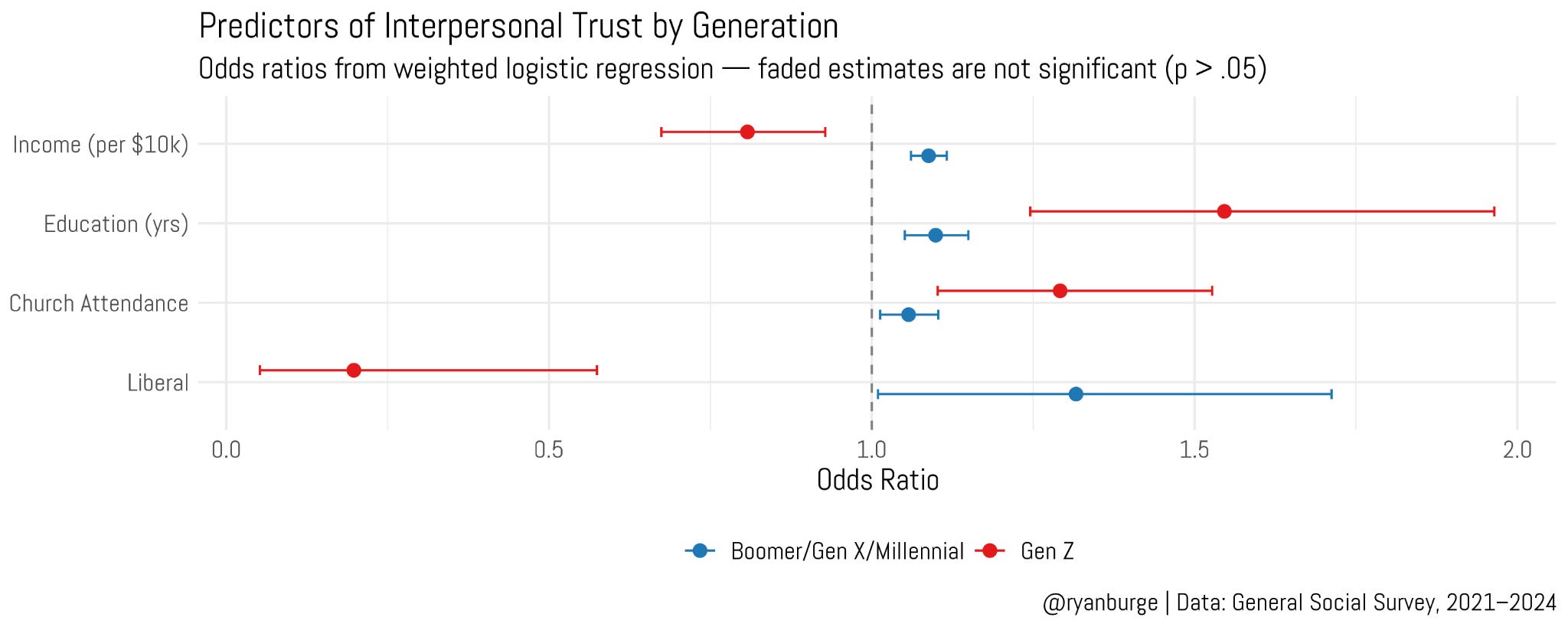
There were two factors that I identified that worked the same for the whole sample: education and church attendance. In both cases, they led to higher levels of interpersonal trust. The effect for Gen Z was larger than for older generations; that may be due to a smaller sample size. I think we can pretty much parse why education and socialization drive up interpersonal trust. It takes trust to go away to college and it also takes trust to show up to a house of worship each weekend. Non-social, untrusting folks wouldn’t volunteer to do stuff like that.
But then, the other two factors just don’t work the way I would have expected. For instance, take income. Among older Americans, higher income individuals are more trusting. For Generation Z, it’s the exact opposite. As income rises, so does distrust. And remember, that’s controlling for education. I don’t know what to make of that at all.
The other one that I will think about for a very long time is political ideology. Among older Americans who identify as liberal, they are more likely to trust other people. Among Gen Z liberals, it’s exactly the opposite. In fact, I struggled to find anything that had a more deleterious impact on trust among Gen Z than identifying as a liberal.
Now, this one has an interesting thought experiment behind it. Older Americans who are liberal are more trusting. Which makes some kind of sense. Liberalism is based on collectivism. It embraces the idea that “together, we can achieve more.” Things like universal healthcare rely on a sense of trust among large groups of people. So, yeah, I can see why liberals are more trusting for Boomers, Gen X, and Millennials.
However, why does it go in the opposite direction with Gen Z? Well, maybe liberals feel very slighted by the fact that Donald Trump has been on the ballot for president in every election in which they’ve been eligible to vote, and he’s won twice. Or it could be that they are more impacted by the cynicism of the internet than conservatives? Or maybe it’s because they report higher rates of depression and anxiety than the rest of the ideological spectrum?
Is There a Religious Revival Occurring Among Generation Z?

Is there any evidence in the data about a religious revival occurring among Generation Z? I get asked that question at least three to four times a week by reporters, random social media commenters, and folks who attend lectures and presentations I give around the country.
I am just spitballing here. But, in my mind, this may be the most important thing I’ve uncovered in my newsletter in the last few months. Trust is an absolutely essential component of a functioning democracy. Without it, we return to the Hobbesian view of the world where we can accomplish none of the higher things in life because we are constantly worried about being assaulted, kidnapped, robbed, or murdered.
If this is the worldview of Gen Z, then the future of America is in real peril.
Code for this post can be found here.
Ryan P. Burge is a professor of practice at the Danforth Center on Religion and Politics at Washington University.

Would love to see screen time as a variable, too.
Just a speculation on trust in conservative, church-going Zoomers and in liberal older adults: As you note, trust and believing in collective goals run hand-in-hand. For older cohorts, collective goals like social security, unionization, and welfare are liberal policy goals. Zoomers have never lived in that world, though--their whole lives have been in a neoliberal corporatist world where regulation of industry for the common good, or taxes to pay for common services, were not seen as liberal policy goals. Instead, 21st century liberal policy goals are increasingly atomized, to very specific groups or identities. (It's hard to imagine a more individualist policy goal than getting someone's bespoke pronouns correct, for instance.)
On the other hand, conservatives--and especially religious conservatives--are offering collectivist policies: You should be part of a faith group, and a community, with codified roles in the community that may be separated by sex. You are being asked to subjugate your individual desires to the good of the community, just like liberals arguing for higher taxes to pay for social services were asking you to do in the past. If I'm a collectivist Zoomer, where I go is to a conservative church; there isn't a collectivist liberal place for me to go. This would explain the high trust in the conservative church-attending Gen Z folks.