


There’s a quote out there that’s often attributed to the French philosopher Voltaire, “I disapprove of what you say, but I will defend to the death your right to say it.” But like a lot of quotes, it doesn’t appear that Voltaire ever uttered that phrase. Instead, it emerged from the writing of biographer Evelyn Beatrice Hall in a book she published in 1906 which tried to summarize Voltaire’s views on freedom of speech.
But regardless of the actual provenance of the words – the ideas here are incredibly powerful because the sentiment expressed is the backbone of pluralism. Under this model, tolerance is the glue that holds societies together. We may not agree on everything (or almost anything), but what we do have to hold in common is the view that people have the right to speak their minds without fear of violence or criminal reprisal.
In other words, free speech needs to be free. And this is a concept that is tested on college campuses thousands of times per academic year when student groups invite speakers to give addresses, lectures, or colloquiums on hot-button issues. Should someone be able to come to an institute of higher learning and advocate for a very fringe belief? Or is it necessary and prudent for students to stop that event by whatever means necessary?
That’s tested with a short battery of questions that were included in FIRE’s 2026 survey of over 68,000 college students from more than 250 colleges and universities all across the United States. Let me just start by giving you a broad sense of where students stand on the acceptability of suppressing free speech.
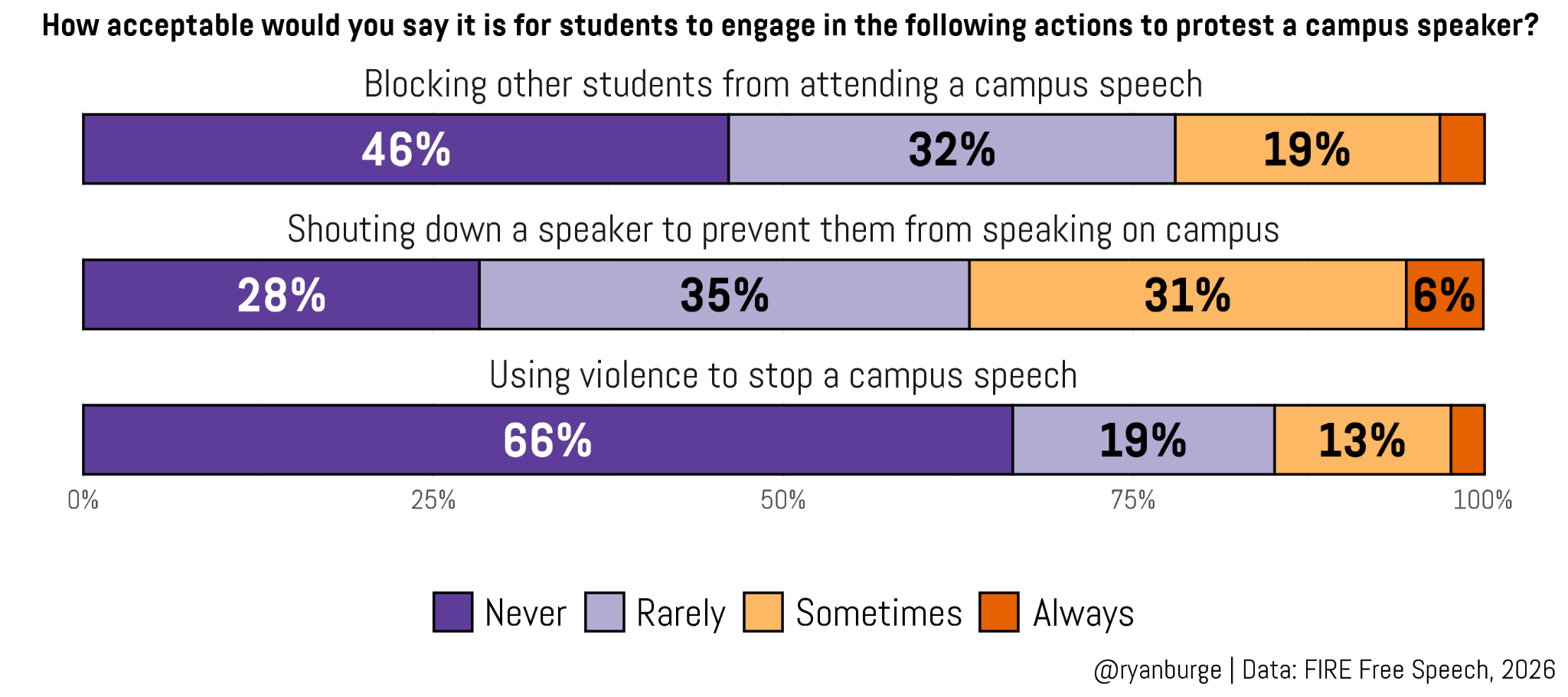
When they were presented with the statement about “blocking other students from attending a campus speech”, 22% of respondents said that action was sometimes or always acceptable. On the issue of using violence to stop a speech, that figure was 15%. So there is certainly a small but not marginal group of college students who are willing to engage in what I would describe as extreme measures to stop a speaker from voicing their opinions.
The third statement was, “shouting down a speaker to prevent them from speaking on campus” and received much more support than the other two. In fact, only 28% of respondents thought this was never an acceptable course of action and 35% said it was rarely acceptable. That leaves 37% of college students who believe that shouting down a speaker is sometimes or always acceptable.
But let’s break those three statements down by the political ideology of the college student who took part in the survey.
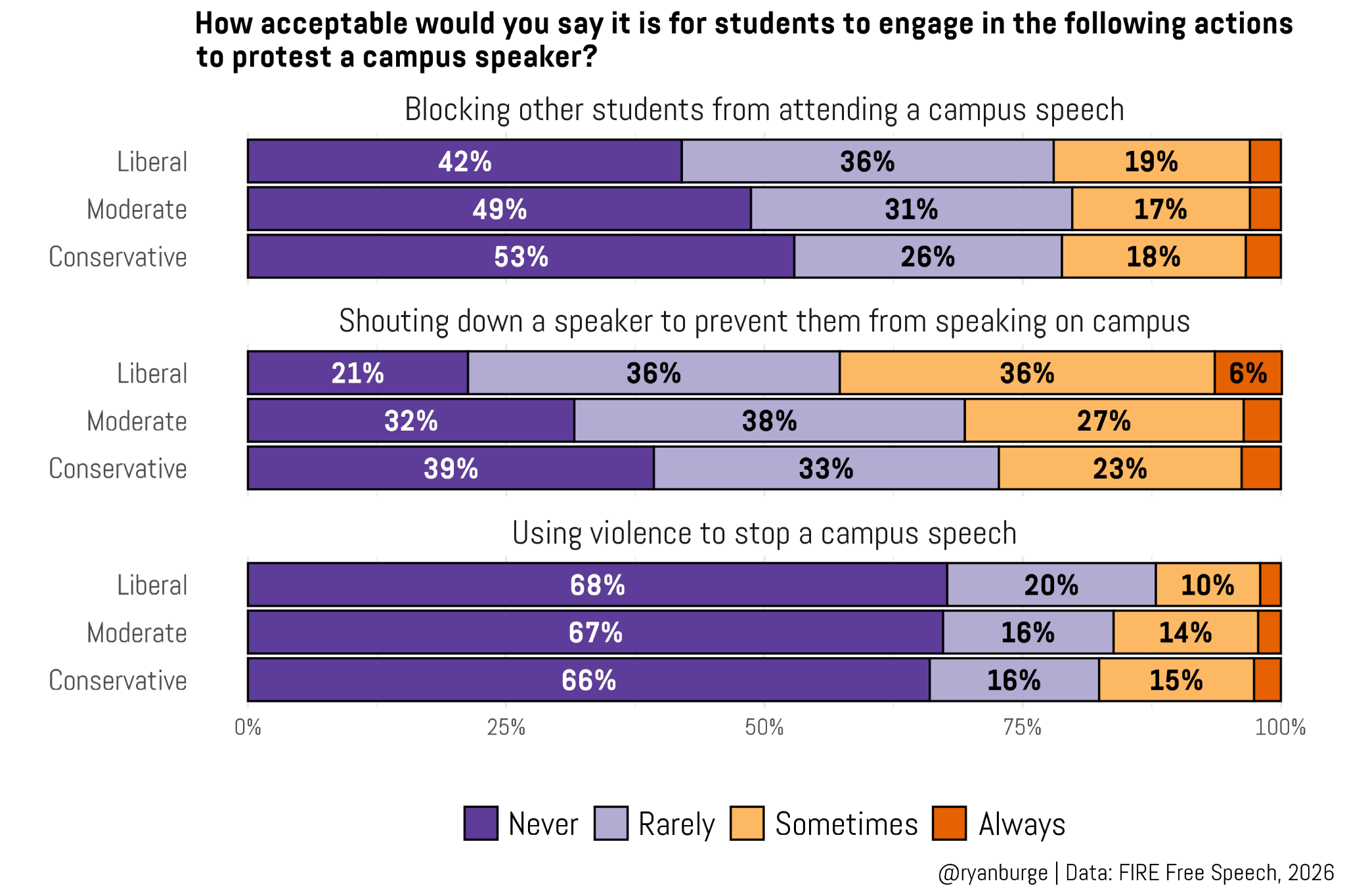
One thing that comes through in this analysis is that conservatives are more likely to say that blocking students from attending a speech or shouting down a speaker is never acceptable on their campus. For instance, in the “shouting down” scenario, 39% of conservative students said that this should never happen, it’s only 21% of liberal students. Just 28% of conservatives thought it was a behavior that is sometimes or always acceptable. Those two response options were chosen by 42% of liberal students.
What is noteworthy, though, is how ideology mattered so little when it came to the question about “using violence to stop a campus speech.” Whether I analyzed this among liberals or conservatives there was no real difference in the outcome: about two-thirds said that this kind of behavior was never acceptable. That was easily the highest share for any of the three scenarios. It’s pretty strong evidence that college students see a clear distinction between other forms of obstruction and actual physical violence when it comes to stopping a campus event.
Okay – I want to really zoom in on that question about “shouting down” a speaker, though. It clearly has the largest variation of the three. And, from my perspective, it’s the one that I seem to see the most often on social media. And let’s bring religion into the mix, now. Which traditions are the most willing to shout down a speaker and which ones aren’t?
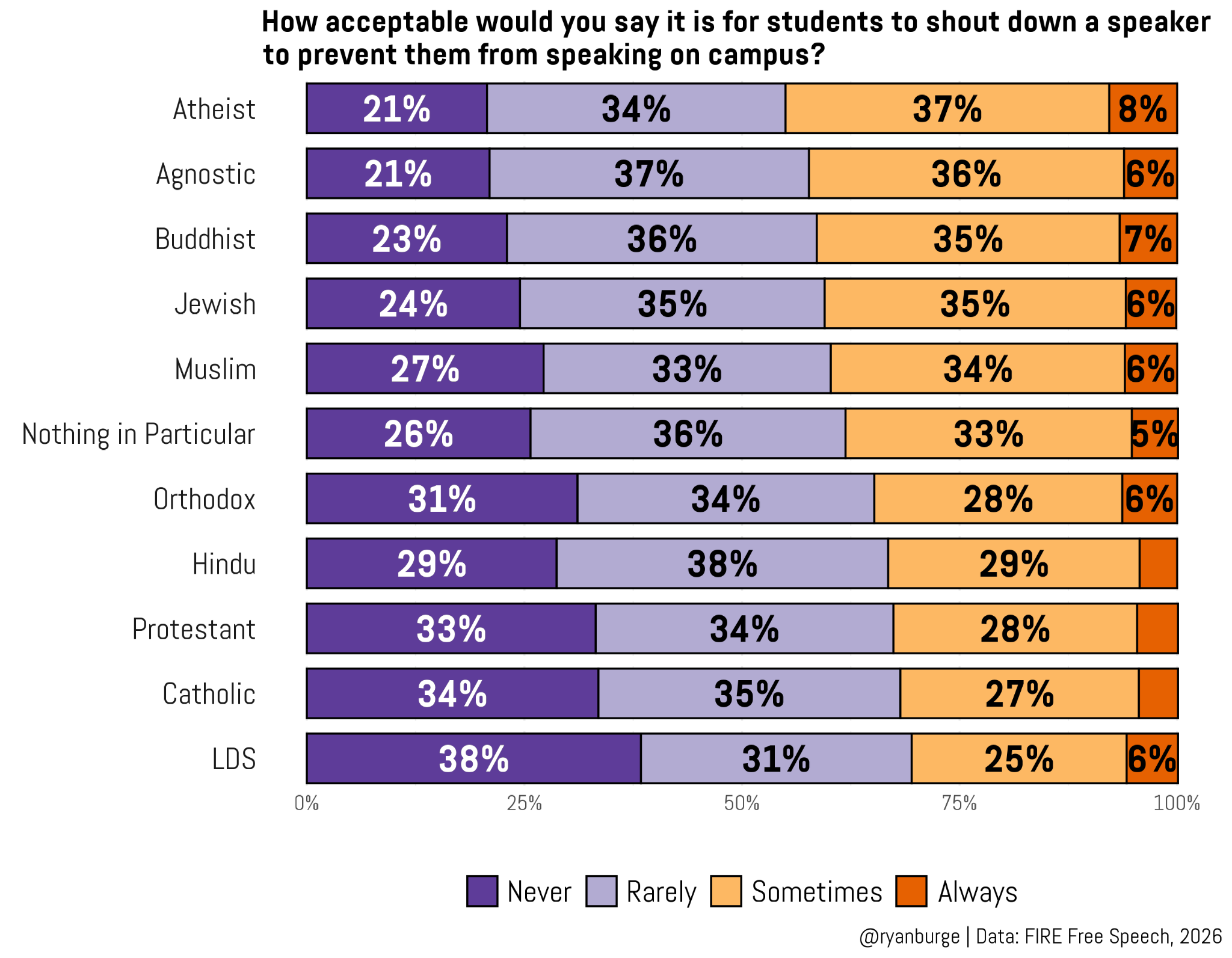
What we see in the graph is that atheists are the most likely to say that it’s sometimes or always acceptable to shout down a speaker, nearly half of them (45%) fall into these two camps. That’s about eight percentage points higher than the full sample. Then, as you go down the list you have groups like agnostics, Jews, and Muslims. Each group is above the overall mean on this question.
Which groups are the least supportive of shouting down a speaker? It’s Latter-day Saints. Among the LDS, 38% say it’s never an acceptable behavior – that’s the highest of any religious group. Then you have the two biggest groups in the survey, Protestants and Catholics. For each, at least two-thirds say that shouting down a speaker is never or rarely acceptable.
But if you have been around this newsletter for any length of time you can make a pretty easy inference about the graph – it’s really political ideology that is doing the “work” here, not really religion. Atheists tend to be the most left leaning, followed by agnostics and so on. Then, LDS are more right leaning and so are Catholics and Protestants. So, this isn’t really about religion, it’s more about politics. So let’s just pull both those factors apart in the graph below.
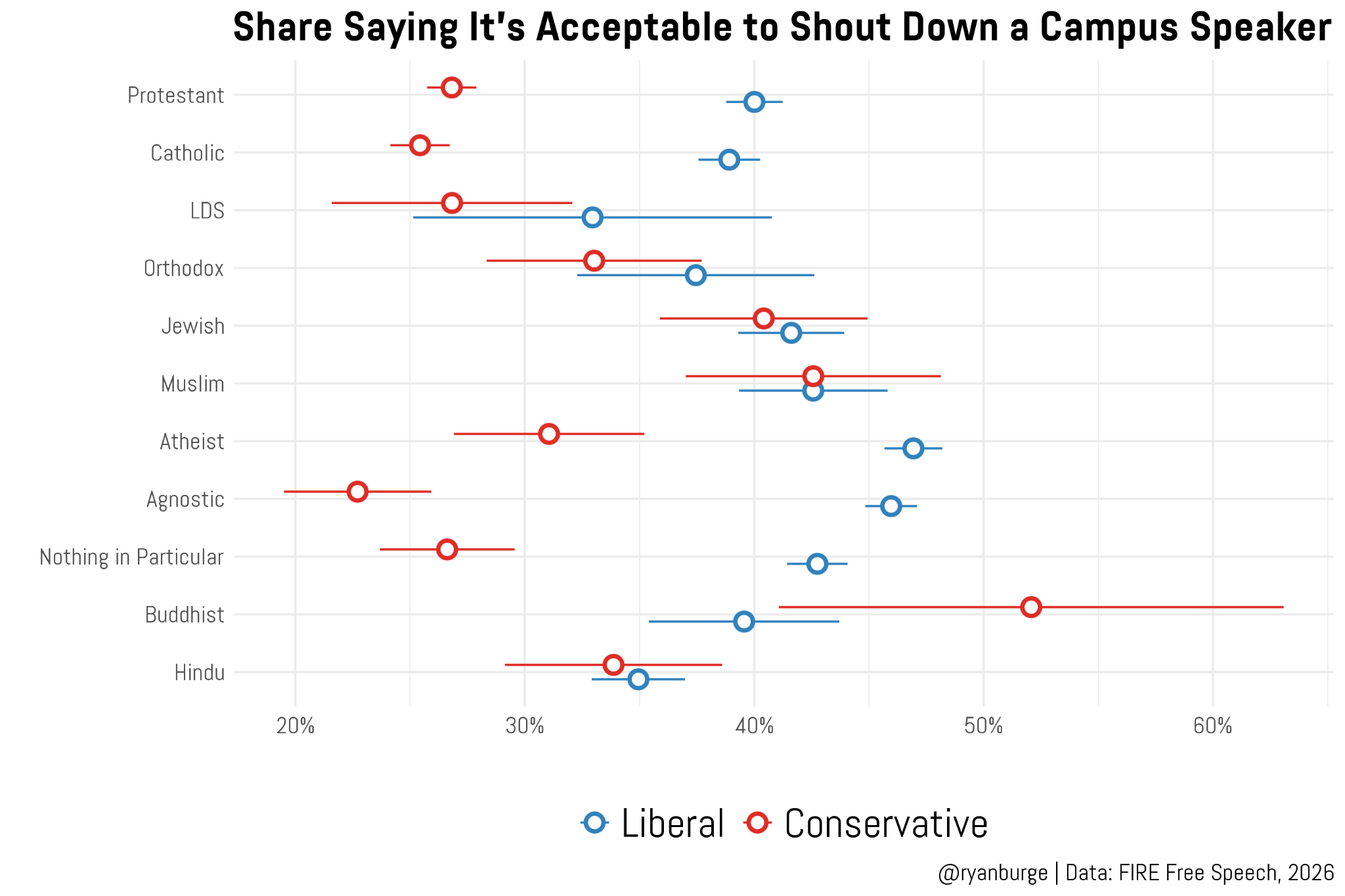
This is where some really interesting patterns begin to emerge for me. Yes, it is certainly the case that liberals are more inclined to say it’s acceptable to shout down a speaker compared to conservatives. Oftentimes the gaps between the two subgroups are sizable. The largest one, interestingly enough, is among agnostics. Among the liberals, 46% say shouting down a speaker is acceptable. It’s half that rate among conservatives at 23%. But there are big gaps for Catholics and Protestants, too. It’s only among the smallest religious groups where the differences aren’t significant, and that’s more about statistical power than anything else.
But one thing I did want to flag here is comparing liberal Protestants and Catholics to liberal atheists and agnostics. Note how the latter group is more inclined to believe that shouting down a speaker is acceptable compared to the Christians? So, yes, there is something going on here with political ideology, but it is tempered (at least in some measure) by the religious tradition of the respondent.
I wanted to go a layer down on this, though. I was specifically interested in exploring the idea that Christians who go to church more often may hold to views of free speech that lean toward toleration instead of suppression. The very first paper I ever published found just that—regular churchgoers expressed higher levels of political tolerance compared to those who attended less frequently.
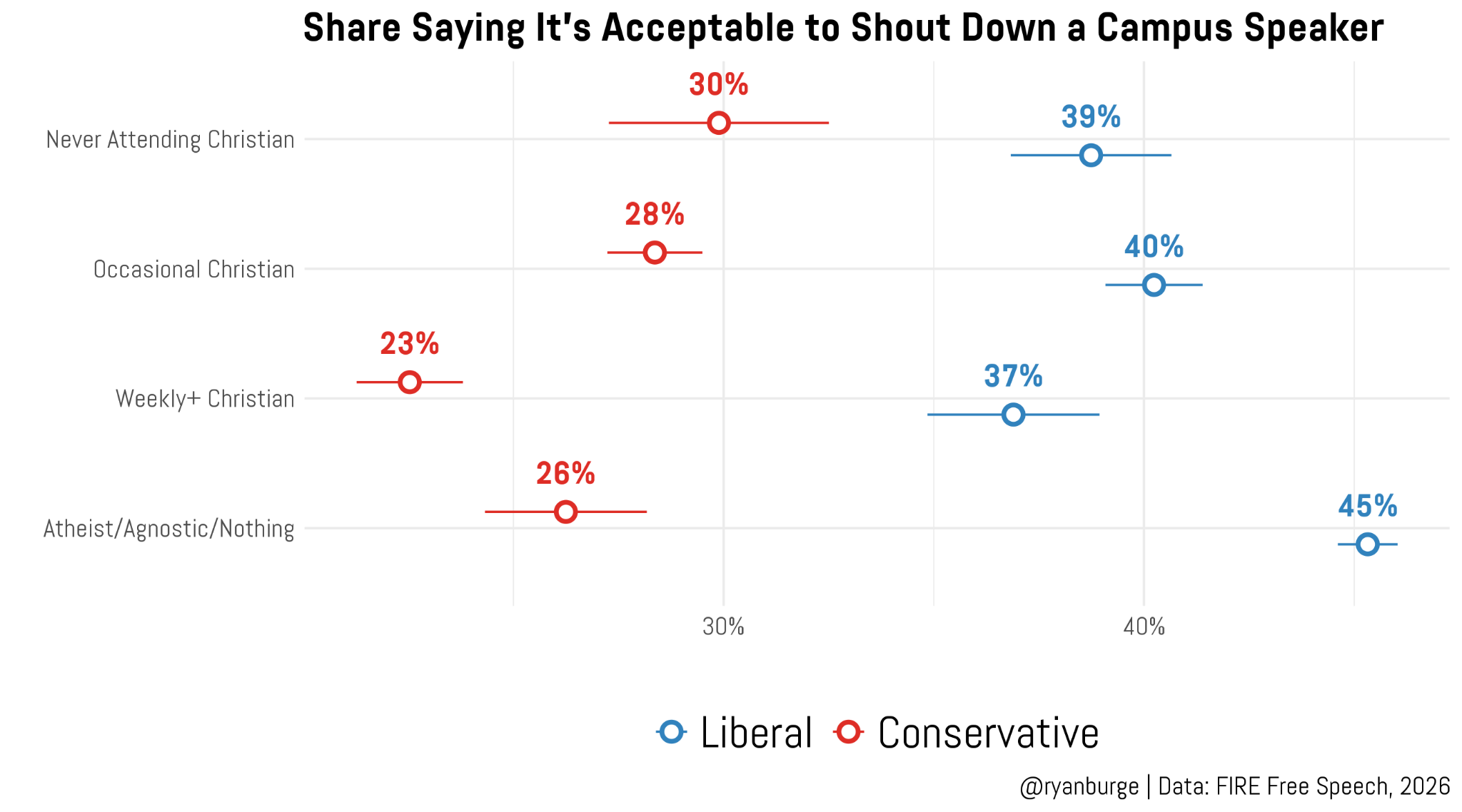
The data in that regard is pretty mixed. The throughline through this analysis is still replicated here, though: liberals are more inclined to believe it to be socially acceptable to shout down a speaker on campus compared to conservatives. The gaps between the two groups run between ten and fifteen percentage points among Christians. So, this is really a story about ideology.
But what about attendance? Well, among college students who are conservative, Christian, and attend church weekly – they are least likely to find it acceptable to shout down a speaker on campus. Only 23% indicated it was sometimes or always acceptable. But for liberal Christians, there’s really no discernible pattern when it comes to attendance. A never attender is at the same spot on the scale as a weekly attender. So I’m not sure that going to church more often automatically leads to more pluralistic views. It’s certainly conditioned on the ideology of the respondent.
There are just so many moving parts here that I’ve not explored to this point. What about the race of the respondent, their gender identity or their sexual orientation? I wanted to try (as much as I could) to really sort out what mechanisms lead to students being more open to free speech on college campuses. To do that I created an additive index of three questions from the battery I described at the beginning. Higher scores indicate a greater level of support for free speech.
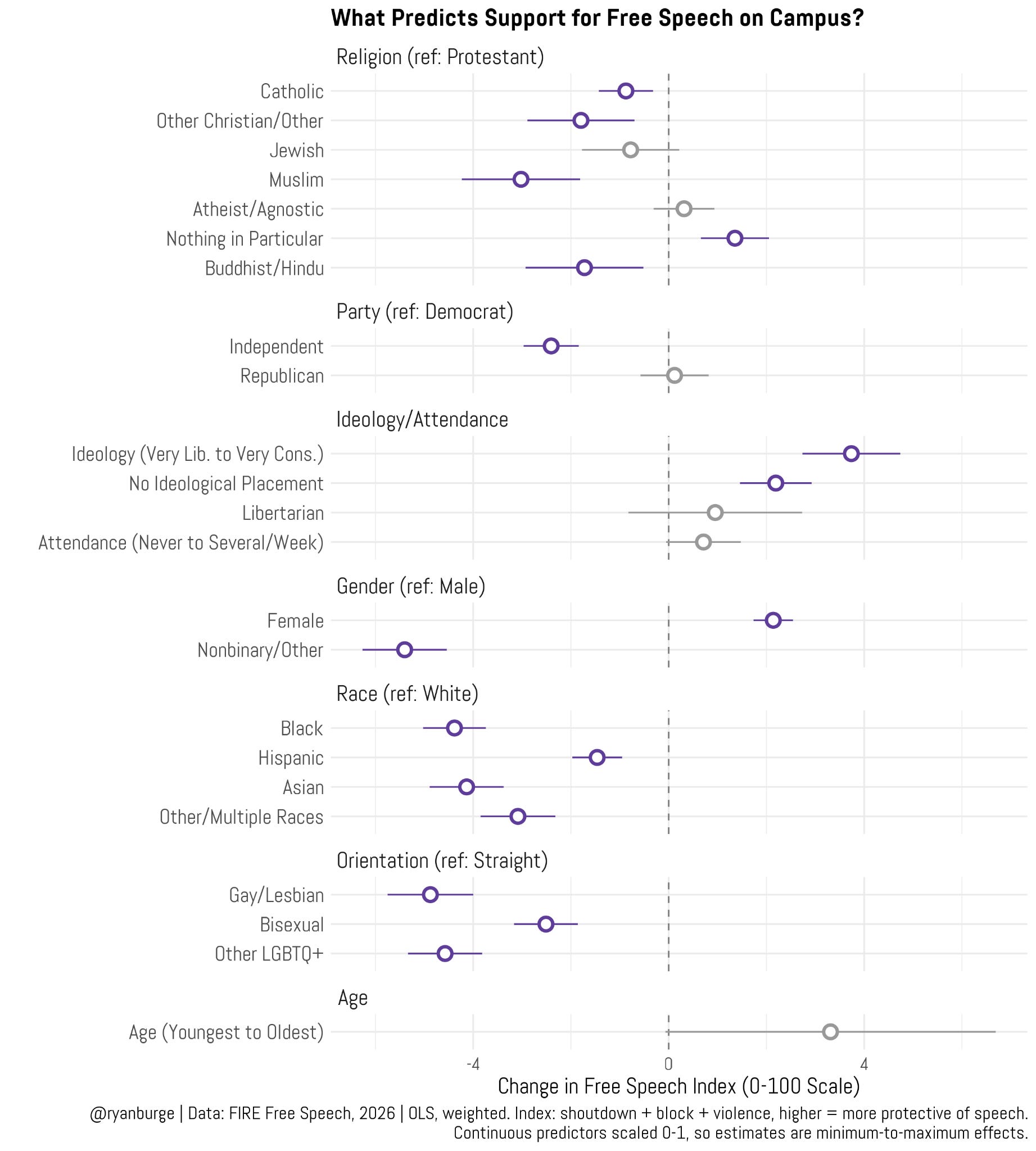
Let’s work through the results of this regression model in sections, starting with religion at the very top. The reference category here is Protestants, so if the coefficient is positive that translates to “more protective of free speech compared to Protestants.” There’s only one group that this applies to: students who identify as nothing in particular. Muslims, Catholics, Buddhists, and Hindus are all less protective than Protestants.
When it comes to politics, the result is pretty simple – when compared to Democrats, Independents are less supportive of free speech. But here’s a big surprise: in this model, there’s no difference in support for free speech when comparing Republicans to Democrats. But there’s a very good reason for that when you look down to the next section. It’s not Democrats who are less protective of free speech, it’s liberals. In all the models I ran, a conservative ideology was the most powerful predictor of protecting free speech rights. When you put both party and ideology in a model, it’s ideology that emerges.
Now, the bottom half of this graph really helped to clarify my thinking on this topic. Let me explain. Non-binary people are negatively signed – they are not as protective of free speech rights as men. The next set of coefficients indicates that people of color are also signed negative compared to white respondents. Then the section below is on sexual orientation. A non-straight person is also more inclined to find it acceptable to shout down speakers/stop someone from attending a speech than a straight person.
Do you see the pattern that emerges here? It’s incredibly consistent. The “majority” identity is more apt to protect free speech than the minoritized positions. A white, straight, cisgender person is the most protective of someone’s right to give a lecture on campus. Anyone who doesn’t fit into that mold is less supportive.
One has to wonder if the subtext of all this goes back to the old phrase, “It all depends on whose ox is being gored.” In other words, when a transgender college student is thinking of these scenarios in their minds, they are picturing that hypothetical speaker as one who says things like, “transgenderism is a mental disorder” and that’s why they are more willing to restrict speech.
So I’m not sure it’s liberalism per se that is what is leading to less support for free speech. It’s also probably tied up (at least in part) with the fact that lots of liberals are from these “minoritized” groups or at least allies to people in these groups.
I am reminded of Oliver Wendell Holmes’s dissenting opinion in United States v. Schwimmer. The case, decided in 1929, involved a woman who was seeking citizenship. However, she was a pacifist and was unwilling to affirm the section in the citizenship oath that required her to “take up arms personally” in defense of the country. Her application was denied, and she appealed to the Supreme Court. In a 6-3 decision, the Court affirmed that she could not become a citizen of the United States. Holmes vehemently disagreed, writing, “Some of her answers might excite popular prejudice, but if there is any principle of the Constitution that more imperatively calls for attachment than any other it is the principle of free thought—not free thought for those who agree with us but freedom for the thought that we hate.”
May we strive to live up to that ideal.
Code for this post can be found here.
Ryan P. Burge is a professor of practice at the Danforth Center on Religion and Politics at Washington University.

Much depends on who you invite. A popular fellow on the college circuit in my Class of '73 era was George Wallace, a man who could expect placards denouncing him as he entered a campus auditorium, and some pointed questions at the end, but no disruption of content. We all knew who is was and why people voted for him. He spoke uninterrupted. He also, as an invited guest with segregtion a settled issue, knew not to advocate for return to Jim Crow when he spoke at colleges and not to help the kitchen crew warm up the ovens when he spoke at Bnai Brith. What we have now seems a shift from expression of points of view to an intent to provoke or target segments of the audience. This occurs at both ends. The speakers are invited by a group on campus with authority or funds, chosen with the expectation they will provoke LGBT, Zionists, Islamists, or some other target as the reason for their selection. That did not happen fifty years ago, when I got to learn from Ralph Nader, Dr. Spock, an irritible Isaac Asomov, Elie Wiesel, and quite few others brought to campus because of their prior achievements, not their ability or intent to incite.
"The speakers are invited by a group on campus with authority or funds, chosen with the expectation they will provoke..."
Exactly. While free speech is a virtue, it is also a virtue for groups inviting speakers to find responsible speakers who add to the discussion rather than outrage.