


Confession time – my wife and I watch a lot of reality TV. I’ve always loved it, really. Even back to The Osbornes and Newlyweds: Nick and Jessica on MTV. When I was in college, we had Survivor night. It was always Thursday. We would gather around in someone’s apartment, watch the show, complain about who got eliminated, then walk to the Vespers service across campus. Those were great memories. We don’t get a whole lot of time to watch TV by ourselves anymore with late night practices and travel schedules, but when we settle down to watch something it’s usually from Bravo. Yes, I know – I’m a very cultured human being.
One of our all time favorite subjects for reality television was a huge family who lived in Northwest Arkansas named the Duggars. Their first iteration of their show was 14 Kids and Counting. A later iteration? 19 Kids and Counting. Of those 19 children, 13 are currently married and there are at least 40 grandchildren so far.
It’s a family that is not without controversy. Their oldest son, Joshua, had an account on the infamous cheating website Ashley Madison. He was subsequently convicted of possessing child pornography and is currently serving a 12.5 year prison sentence for the crime. Another Duggar child, Joseph, has also been arrested for molestation of a child under the age of 12. One of the daughters has accused their father of financial exploitation because he demanded that his adult children agree to be filmed for the television series without compensation. There’s a lot of drama there.
But what’s always in the background of any discussion about the Duggars is their religious beliefs. They were adherents to the Institute for Basic Life Principles – an extremely conservative evangelical organization. The IBLP, founded by Bill Gothard in the 1960s, teaches a strict hierarchy of authority in the home: children submit to parents, wives submit to husbands, and everyone submits to God. Gothard’s organization discouraged dating in favor of parent-guided courtship, promoted homeschooling through its own curriculum, and placed enormous emphasis on female modesty. (Gothard himself resigned from the ministry in 2014 after dozens of women accused him of sexual harassment.)
But the teaching that made the Duggars famous was the family’s embrace of what is often called the “Quiverfull“ ethos, drawn from Psalm 127 - children are arrows in the hand of a warrior, and “blessed is the man whose quiver is full of them.” No birth control of any kind. Every pregnancy is a blessing from God, and family size is left entirely in His hands. That’s how you get to nineteen kids.
And that’s the image that pops into most American minds when they see a family with a whole bunch of children at the grocery store or piling out of a fifteen-passenger van in the church parking lot. They assume that mom and dad are deeply devout people who are having all those kids for Jesus. It’s a tidy little stereotype. The only problem is that the data doesn’t really back it up.
Let’s start with this question, though: how many American families are large? I just looked at folks in the Cooperative Election Study who were at least 45 years old and had at least one child.
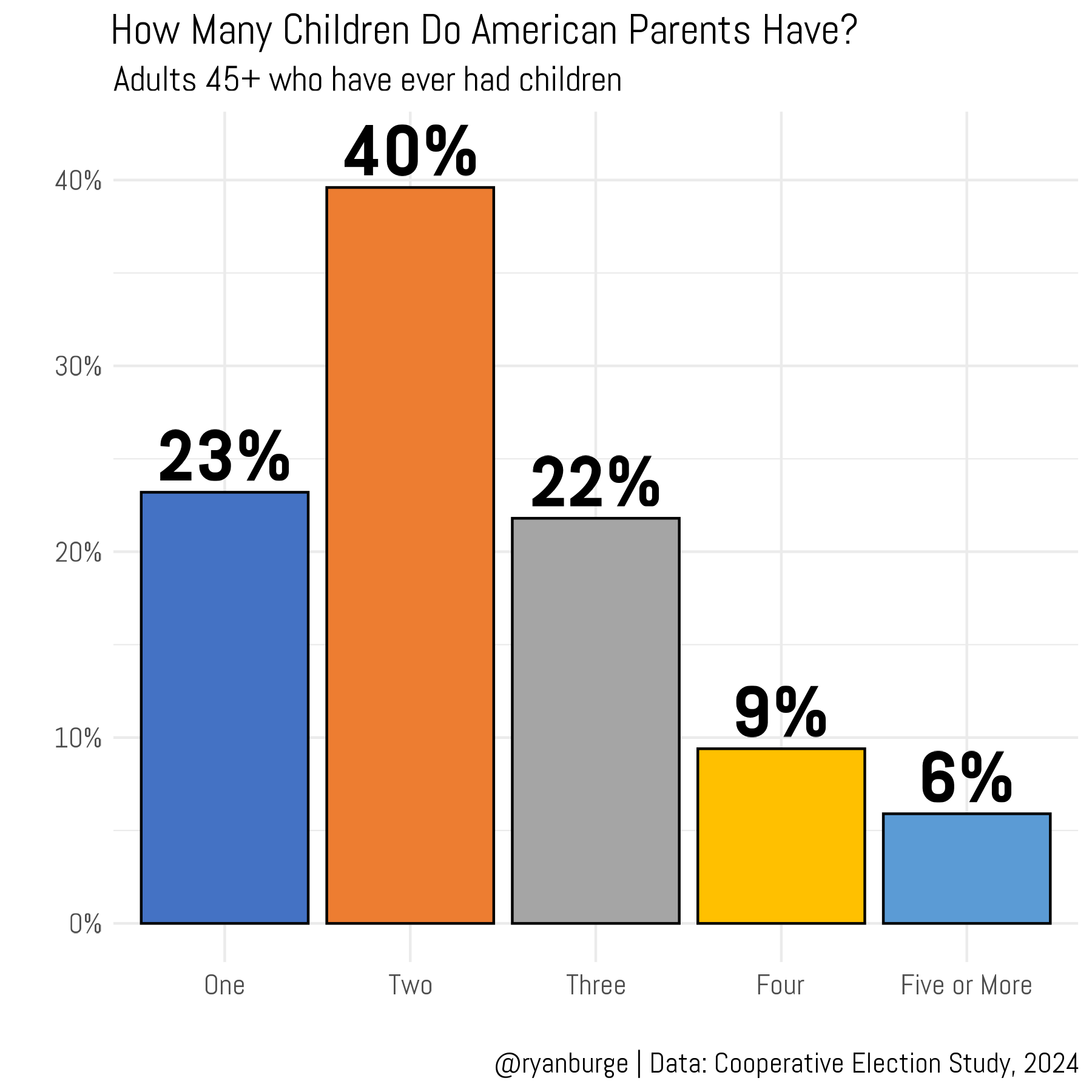
The only child family is not that widespread – less than a quarter of parents said that they had just one kid. The modal outcome, unsurprisingly, is having two children. Forty percent of households have a pair of kids and another 22% have had three children total. That means that 85% of all families have between one and three kids.
It’s pretty darn rare to have a family with at least five kids – that encompasses just 6% of all those households. Out of a total sample of 60,000, only 23,700 had ever had a child. Of that, just 113 had eight or more. That’s less than .5% of all parents. Even a family that is half the size of the Duggars is a statistical oddity.
And, of course, that is becoming even more of an outlier with each passing generation.
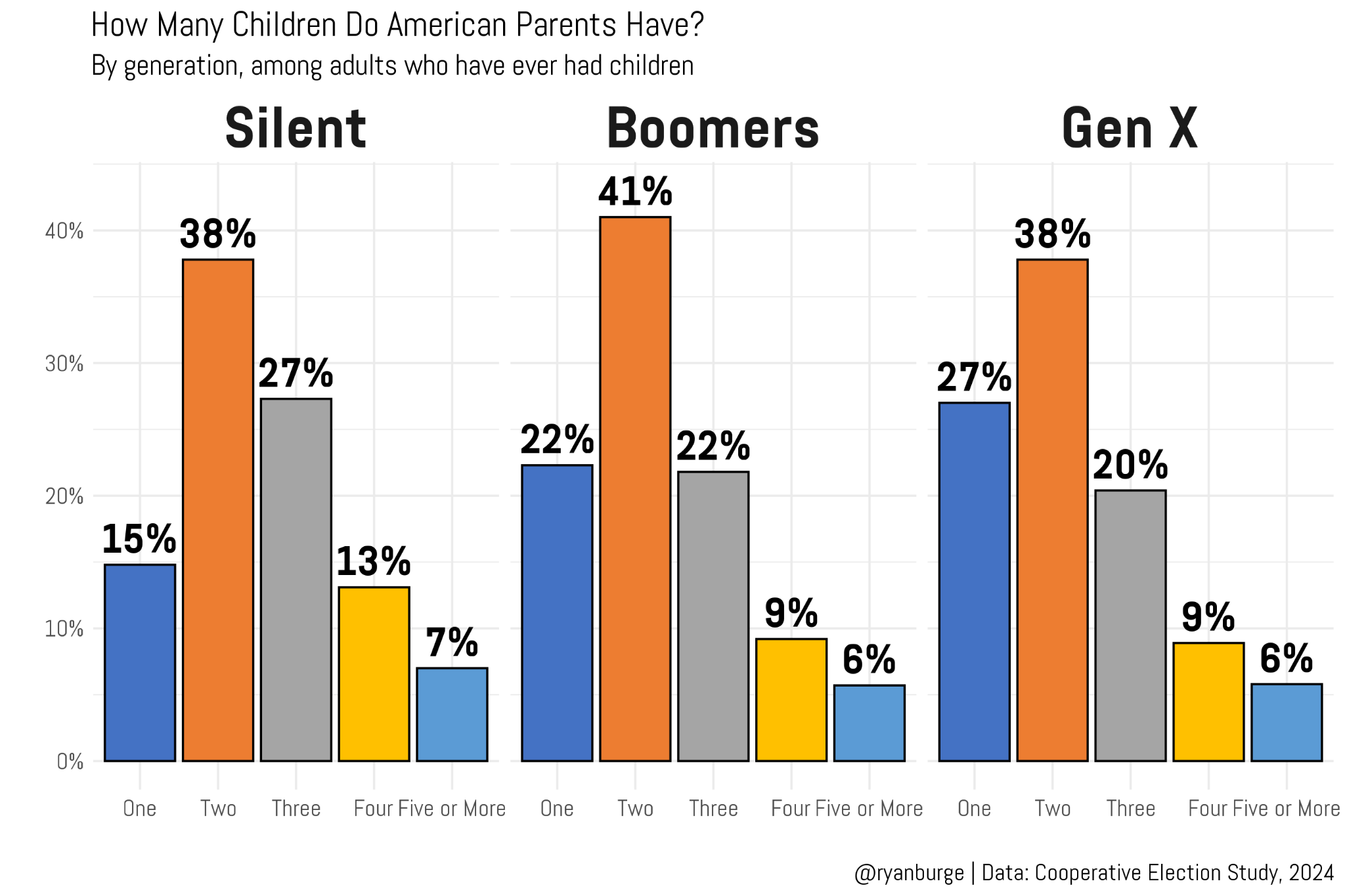
I did the same analysis across the three oldest generations in the data – Silent, Boomers, and Gen X – to see how much family sizes have changed over the last fifty years, and I was honestly a bit surprised at how consistent the results were across generations. For instance, having two kids was the most likely outcome for parents who were born in the 1930s, the 1950s, and the 1970s. In each case, that was about 40% of families. Large families are about as commonplace, too. Among Silent Generation folks, 20% had families of at least four kids; it was 15% of Boomers and Gen X.
Here’s the only difference that seems substantively significant to me: having just one child. Among the Silent Generation (born 1925–1945), only 15% of parents had a single child. It was 22% of Boomers and 27% of Generation X. And, although not all Millennials have gotten to the end of their childbearing years, when I just look at those born in the 1980s, 31% have only had one kid and 38% have had two kids. So the family size trend will just continue on.
Let’s dig into two possible explanations for this decline – politics and religion. I am going to start by just looking at the partisan distribution across family size. One caveat here: I’m only looking at people who have at least one child and we know that those on the left side of the political spectrum are less likely to have children.
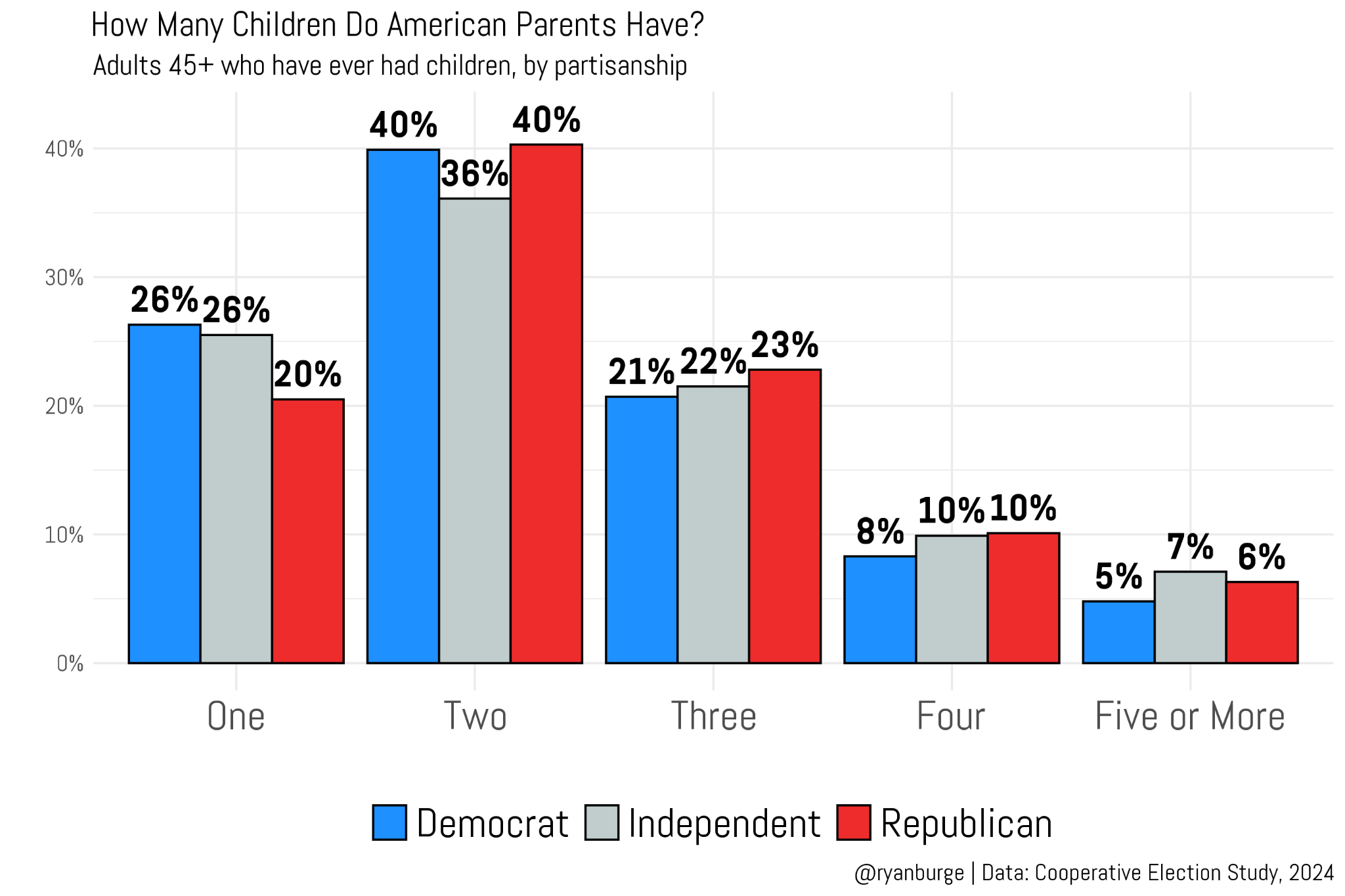
Yeah, I’m not blown away by this result. I think it’s fair to say that Democratic parents are slightly more likely to only have one child compared to their Republican counterparts (26% vs. 20%). But I wouldn’t call that a huge difference. When it comes to having two children, the partisan gap is completely nonexistent (40% of both groups have two kids). There is some evidence here that Republicans tend to have slightly larger families but, again, the differences are not huge.
Among Republicans, 39% have a family with at least three children – which is also the same percentage for political Independents, by the way. For Democrats, it’s 34%. So, yeah, there’s a substantive difference there, but it’s not like Republicans are just outbreeding Democrats on a massive scale. The average GOP family is 2.46 kids compared to 2.29 for Democrats.
What about religion? Let me show you attendance two different ways. First, this is the family size breakdown by level of religious attendance.
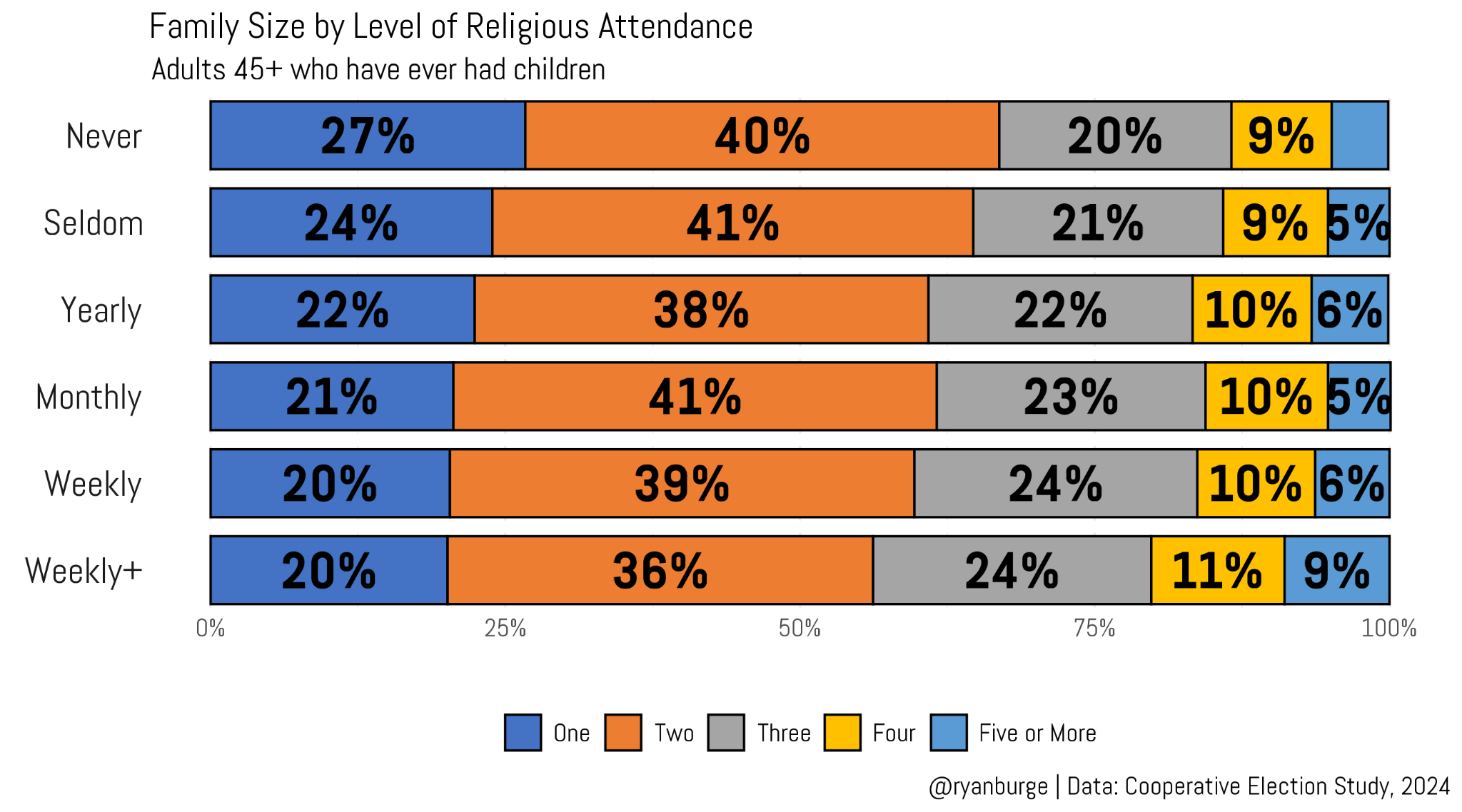
For families who never attend religious services, 27% have had only one child, while 13% have at least four children. Among those who attend religious services more than once a week, 20% have just one child and 20% have at least four. That’s not what I would describe as a substantively large difference. The idea that those super-religious families have a whole brood of kids is just not even close to what the data shows. In fact, less than 10% of them have five or more kids. They are twice as likely to have one kid compared to five-plus.
The changes are also pretty subtle once you get to the “yearly” level of attendance. 60% of families at this attendance band are one to two children and 16% are four or more. Those numbers are within five percentage points of those most devout. In other words, the perception of non-religious families having one kid while the local Baptist church parking lot is full of Sprinter vans with five car seats is not borne out here.
Here’s that same data another way – how is the religious attendance of parents of four-plus children compared to families of any size?
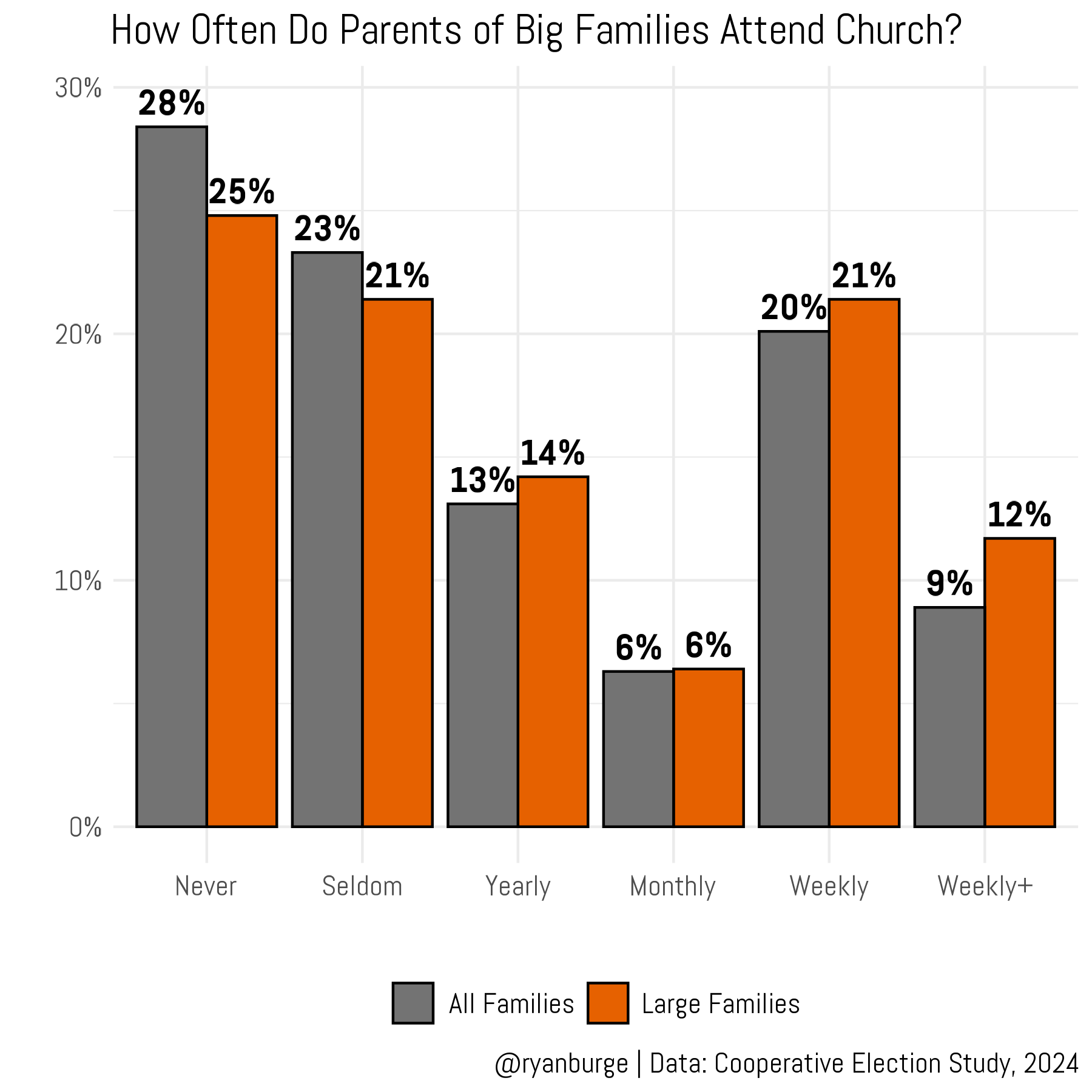
I think it’s fair to say that large families are more likely to go to church, but not by that much. Among families who have had four or more children, 33% said that they go to church at least once a week. For families of any size, the weekly attendance rate is 29% – four points lower. A slim majority of all families report that they go to church less than once a year. Among large families, the seldom/never attendance rate is 46%.
You see what I’m saying now? The religious differences between big families and all families are pretty miniscule in the grand scheme of things. All things considered, I think that the average family of four is probably three to five percentage points more likely to be attending less than once a year compared to a family of six. Embracing an approach to religious renewal by encouraging fertility doesn’t seem like a strategy that will move the needle in a significant way.
What about comparing the religious affiliation of larger families versus families of any size? That’s what I did below.
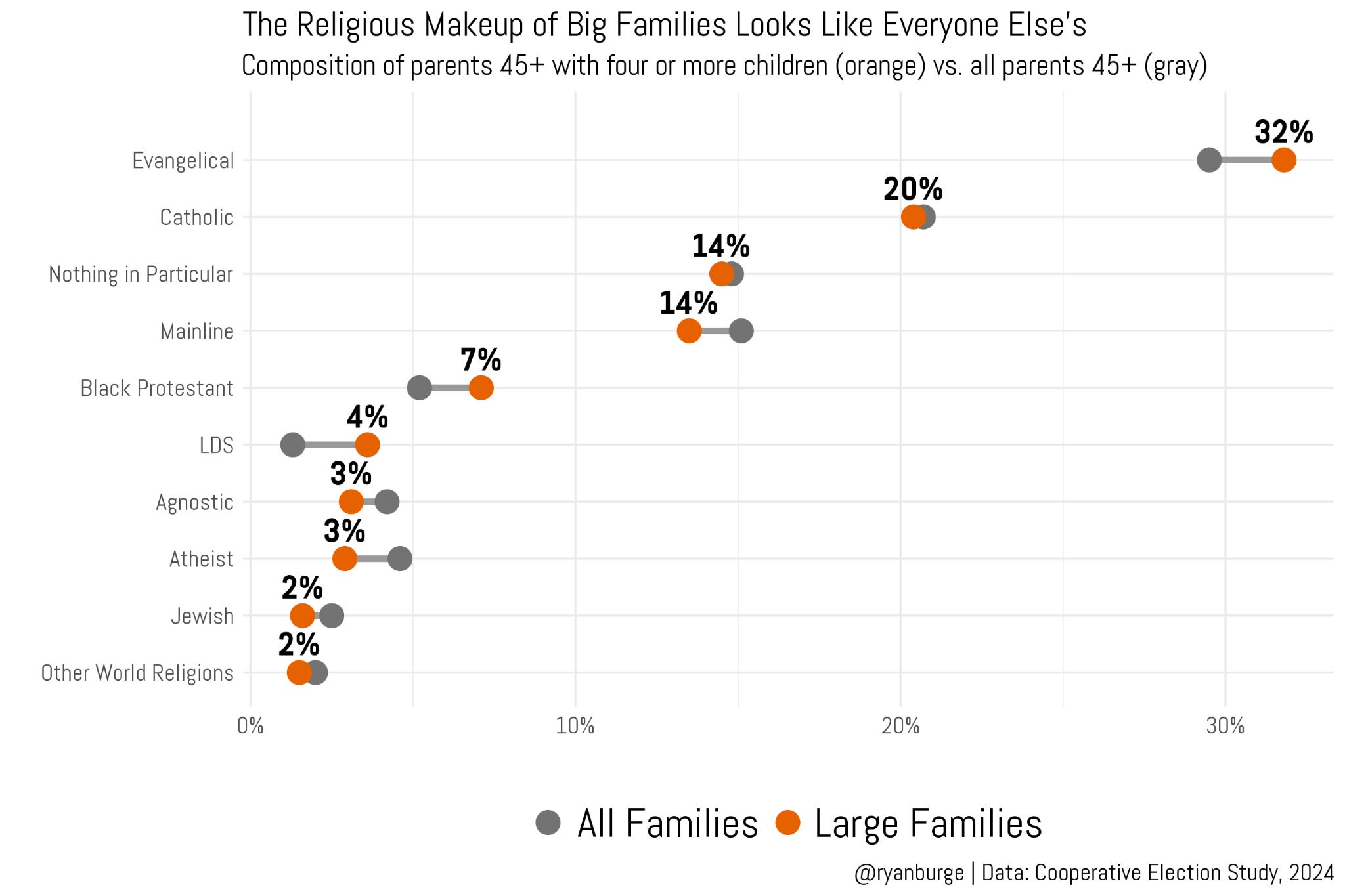
In almost every dumbbell plot, the two point estimates are almost exactly on top of each other. For instance, Catholics made up 20% of the largest families. They were also 20% of families of any size. That was also true for people who claimed no religion in particular (~14% for both family sizes). In fact, the average gap was less than two percentage points across every religious tradition.
There were a couple of outliers worth flagging. Among families of all sizes, evangelicals were 29.5% of the sample. Among the largest families, they made up 32% of that subgroup. Evangelicals are overrepresented among families like the Duggars, but only by a handful of percentage points. For Latter-day Saints, those two figures were 1.3% vs. 3.6%. So, yes, there is empirical support for the idea that LDS do have larger families, but in pure numeric terms, only about 1 in 30 families with at least four kids are members of the Church of Jesus Christ of Latter-day Saints.
Outliers have an unbelievable hold on our imaginations. We see a family like the Duggars and think that they represent essential features of that entire phenomenon. When in reality, they are outliers even among outliers. Yes, religion does seem to have an impact on the decision about the number of kids a family will have, but it’s a very minor difference.
Comparing evangelicals to atheists and agnostics – the widest religious contrast the data offers – and controlling for age, race, education, and sex, the gap is about 0.6 children. Real, robust, and the single biggest demographic divide in American family size. It’s also just over half a kid. So, yeah, religion matters here, but it’s not all that counts.
Code for this post can be found here.
Ryan P. Burge is a professor of practice at the Danforth Center on Religion and Politics at Washington University.

This is probably just my experience in a very rural white area, but it seems like most families with more than 3 children are either drug addicts or committed Christians. On surveys, they would balance or cancel each other out on church attendance, education, politics, etc.
Yeah, I'm never writing a piece about fertility ever again, folks.
If you want more of this there are literally dozens of researchers writing about it. Read them.