


If you have a “professional” Facebook page, there’s this dashboard that you can click through that offers all kinds of insights about the stuff that you post. You obviously get metrics like how many views and how long people watch your reels, but what may actually be the most interesting for me is the “engagement” tab. It tracks metrics on how many likes, shares, etc. that each post receives. I have some graphs that get a ton of discussion and almost no shares and vice versa – it’s shared widely but no one is really commenting on it. I have no idea how or why that happens.
In an average week, all my posts combine for 5,000 to 7,000 comments. Just think about that for a second. An average day is 800 comments. Some days, it tops 1,000. No human being needs to read 1,000 different people commenting on their work in a single day. If you think academic peer review is bad, imagine that times a thousand. And that’s me on Facebook every single day.
As you can imagine, most of the comments are just not even worth anyone’s time to read. But every once in a while, I get a really thoughtful one. (And by once in a while, I mean 1–2 times a month out of 20,000+ comments). I’ll just copy and paste the whole thing here because it does a good job of describing the puzzle:
“What confuses me about this data is this: We are told that higher Church attendance, specifically the frequency of attendance, directly correlates to conservative voting tendencies. And I agree with the data there. But Catholics did the opposite. They went from a solid Democratic voting bloc in the 70s to overwhelmingly Republican (58%) precisely corresponding with a dramatic long-term decline of regular attendance. I would be fascinated to learn more about this trend.”
You get the gist, right? Catholic attendance is collapsing, yet they are swinging to the right on Election Day. Those two things typically don’t go together. Let’s investigate that!
First, we have to establish two facts.
Mass attendance is declining
The average Catholic is more conservative/Republican now than in the past.
Let’s start with the attendance piece first.
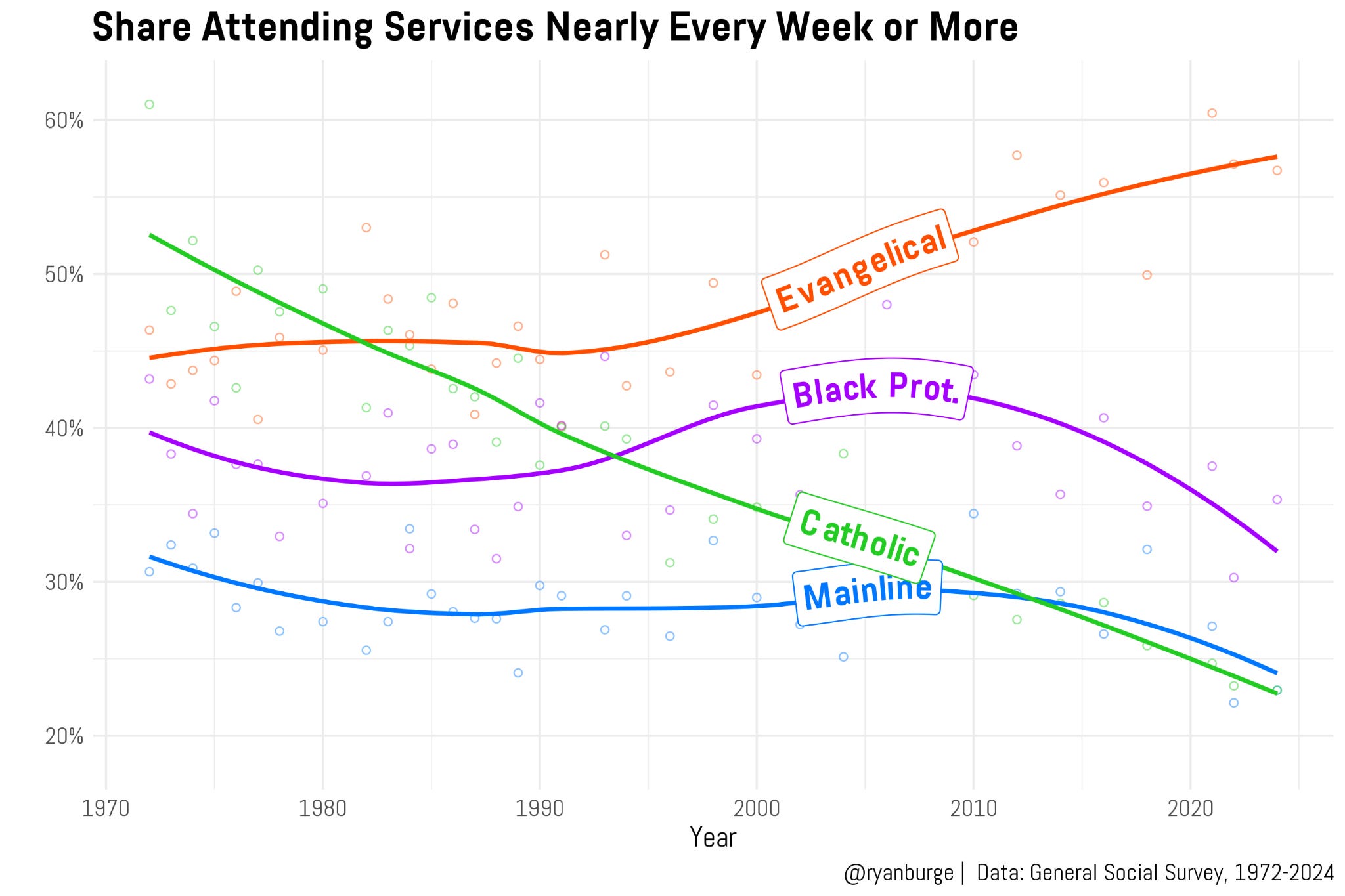
Yeah, well, that wasn’t too hard to visualize in one graph, right? I just plotted the share of Protestants and Catholics who indicated that they went to church nearly every week or more throughout the entire GSS time series. You can see that for evangelicals, attendance was pretty steady at 45% for over two decades, and then it began to shoot up around the mid-2000s. Now, over 55% of evangelicals are weekly attendees. That’s twenty points higher than any other group.
Black Protestants were in the same general neighborhood as evangelicals as recently as the mid-2000s, but that’s when the lines started moving in the opposite direction. Now Black Protestant attendance is down to 33%. A dip of 20 points in 20 years. For mainliners, attendance hovered around 30% for a very long time, but it’s dipped noticeably in the last few years. It’s around 25% now.
However, the Catholic line doesn’t really show any plateaus. Just the opposite. It’s pointing down in every single decade. In the 1970s, half of Catholics were weekly attenders. It was 46% in the 1980s and in the upper thirties in the 1990s and 2000s. But in the 2010s, it was 30%, and in the last couple of years, it is even lower: 25%. Catholic attendance has dropped by half.
Now, what about the politics piece of the equation?
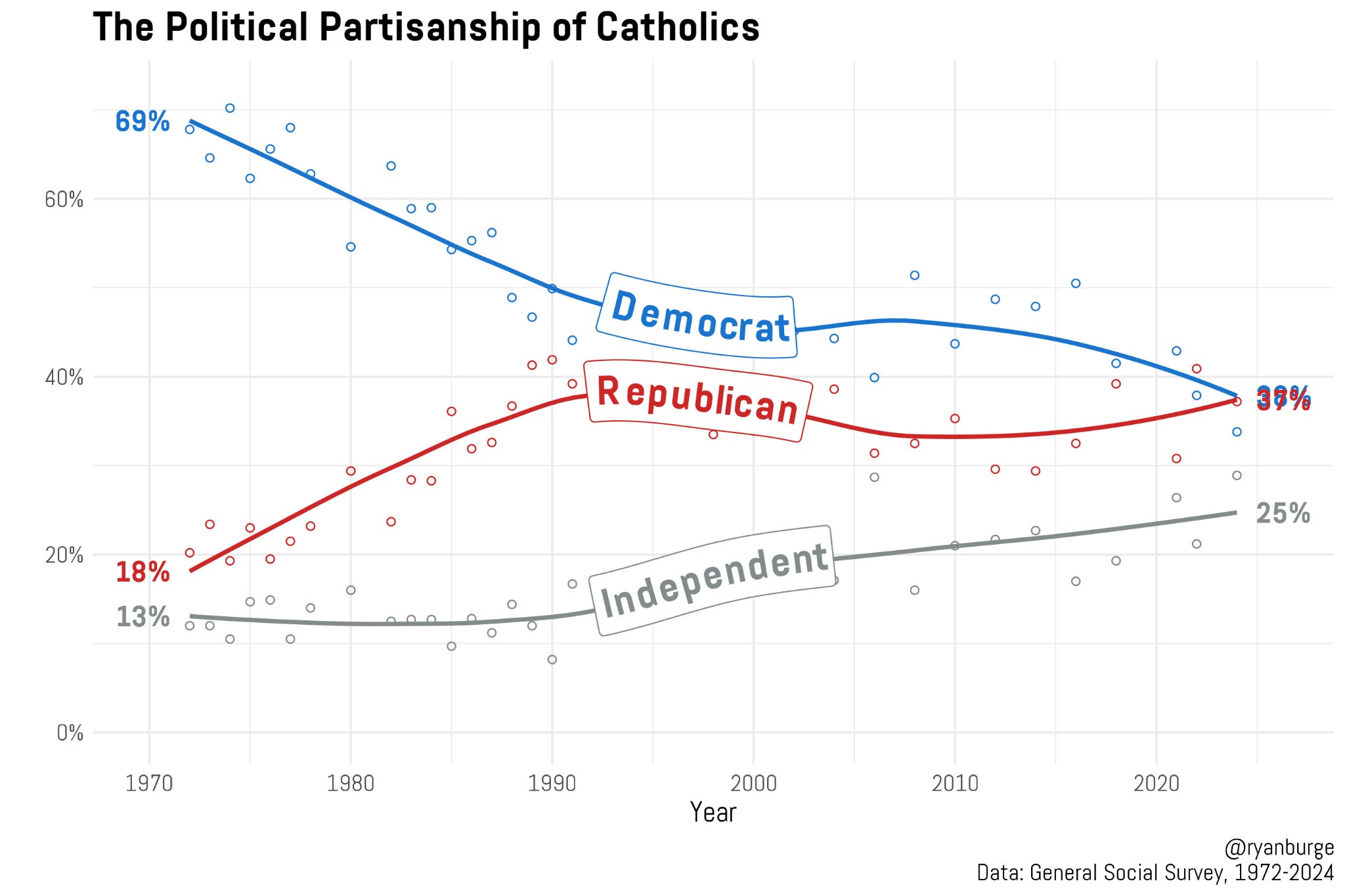
Yeah, well. That graph pretty much tells the story, doesn’t it? In 1972, almost 70% of Catholics said that they identified with the Democratic party. This was the hangover from the “Kennedy Democrat” era, of course. I wish I had data a little bit older to see how high that number actually was because the trajectory of the line makes me believe it was even higher than that a decade before.
That didn’t last that long, as you can tell. By 1980, the Democratic share was 60%. Ten years later, it was down to 50%. For about fifteen years, from the mid-1990s through 2010, the share was just about 45%. Then it started to drop again. In the most recent wave of the General Social Survey, which was fielded in 2024, the share of Catholics who identified as Democrats and Republicans was exactly the same: ~37%. That divide was fifty percentage points just fifty years ago.
So, we can pretty clearly see that both data points are proven out: Catholic Mass attendance has declined significantly, and the average Catholic is way more Republican now than five decades ago.
If churchgoing is positively related to Republicanism, none of this makes sense. Let’s try to shed some light on the situation by first dividing Catholicism up into three attendance buckets and tracking the share of each bucket who identifies as a Republican over time.
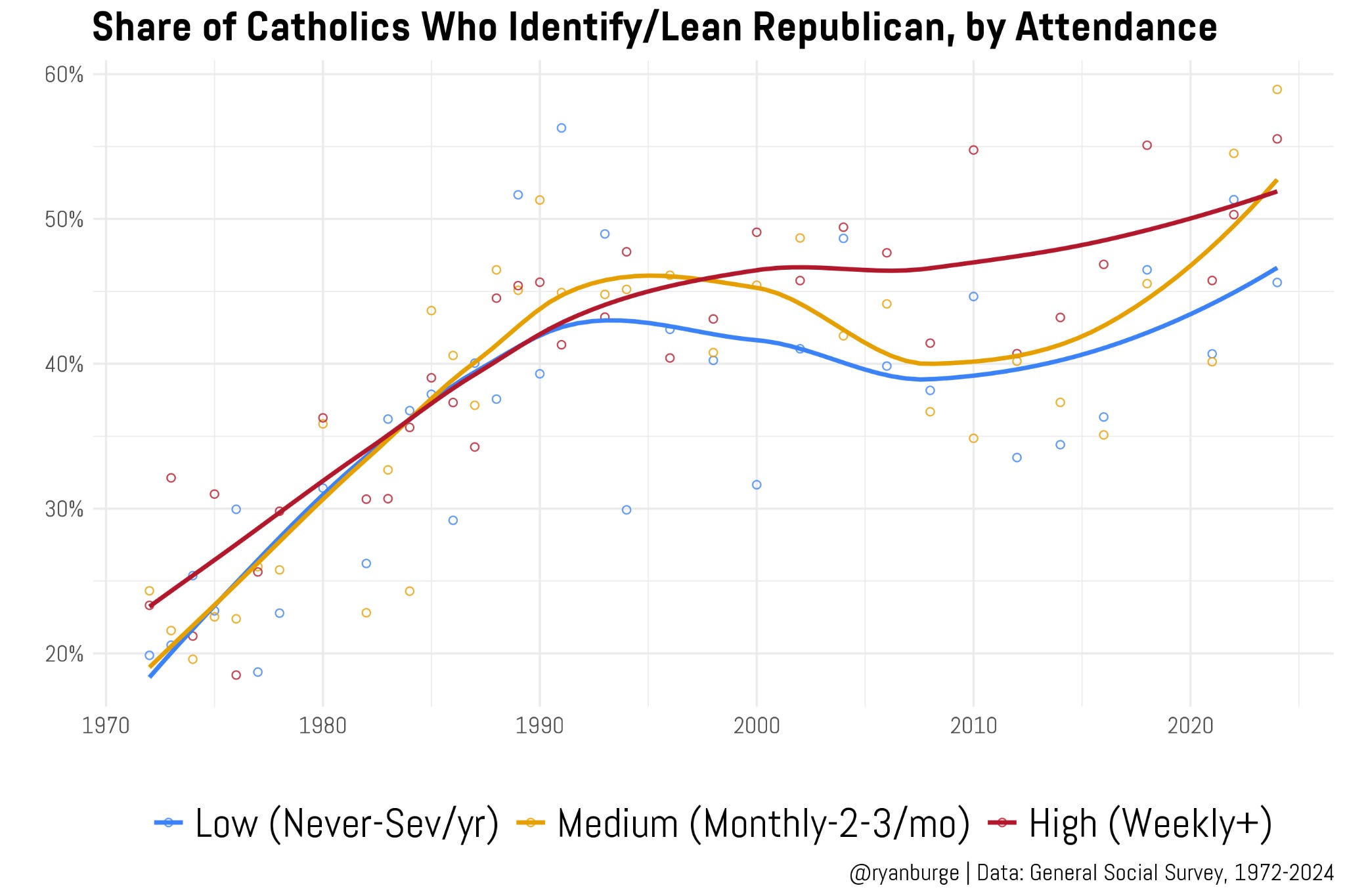
And now it’s starting to come together, right? I am actually really amazed at how well these three trend lines tend to track together for most of this time series. I mean, the three buckets are almost exactly the same from 1972 all the way through the early 1990s. All Catholics, regardless of whether they go to Mass multiple times per week or haven’t darkened the door of the church in decades, became more Republican at the exact same rate. By 1990, 42-45% were Republicans.
Now, you do see some minor deviations from the mid-1990s through the mid-2010s. During this time period, the high attenders were more Republican than their less active counterparts. In 2010, 47% of weekly attendees were aligned with the GOP, compared to 40% of those who didn’t go that much. But those gaps started to close in recent years.
In the most recent data, a slim majority of those in the medium and high attendance buckets said that they were Republicans. Among the least engaged, it was about five percentage points lower. But you can clearly see that it doesn’t matter that much how much a Catholic goes to Mass. They are headed toward the GOP at almost the same rate and trajectory.
But, I’m not satisfied with this just yet. Partisanship is one thing, actual voting behavior is another. I’ve written about this before. Lots of people will say that they are independents, when they actually support the GOP on election day. Let’s use the CES and look at actual vote choice for Republicans in both 2008 and 2024 for each attendance level of Catholics.
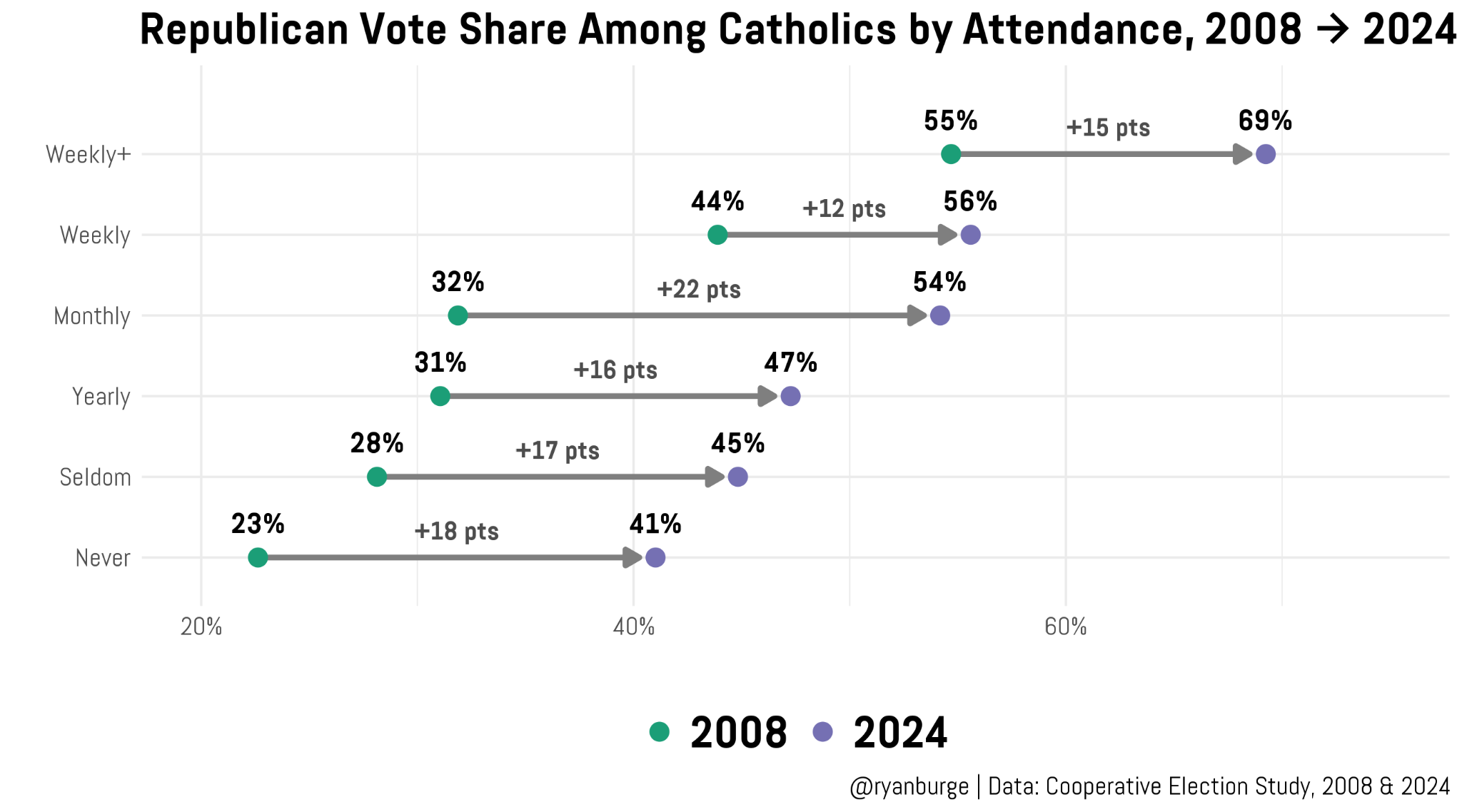
Um, yeah. Okay. That pretty much tells the tale, doesn’t it? I am pretty taken by the fact that every attendance level of Catholics was much more likely to support Donald Trump in 2024 compared to John McCain in 2008. And the movement here is not subtle. The smallest shift, interestingly enough, is among Catholics who report weekly Mass attendance. In 2008, 44% were McCain supporters. In 2024, 56% backed Trump. An increase of a dozen points. But remember – that’s the smallest change.
Look at the bottom of the graph. Those are folks who don’t go to church that much at all. Among people who identify as Catholic but report that they never go to Mass, 41% supported Trump in 2024. That was up eighteen points from GOP support back in 2008. The jump for seldom attenders is basically the same magnitude. I think this is pretty strong evidence that the GOP’s big advantage with Catholics now is because they have won over lots of less devout members of the Church.
I’ve got to point this out: those bottom two attendance buckets (never/seldom) are actually numerically larger than the top two buckets (weekly or more). So, gaining 17 points there yields more votes than gaining 14 points among the most devout.
But I can already anticipate the question coming – isn’t there a huge divide in Catholic voting behavior based on the race of the respondent? Yes. Let me illustrate that below.
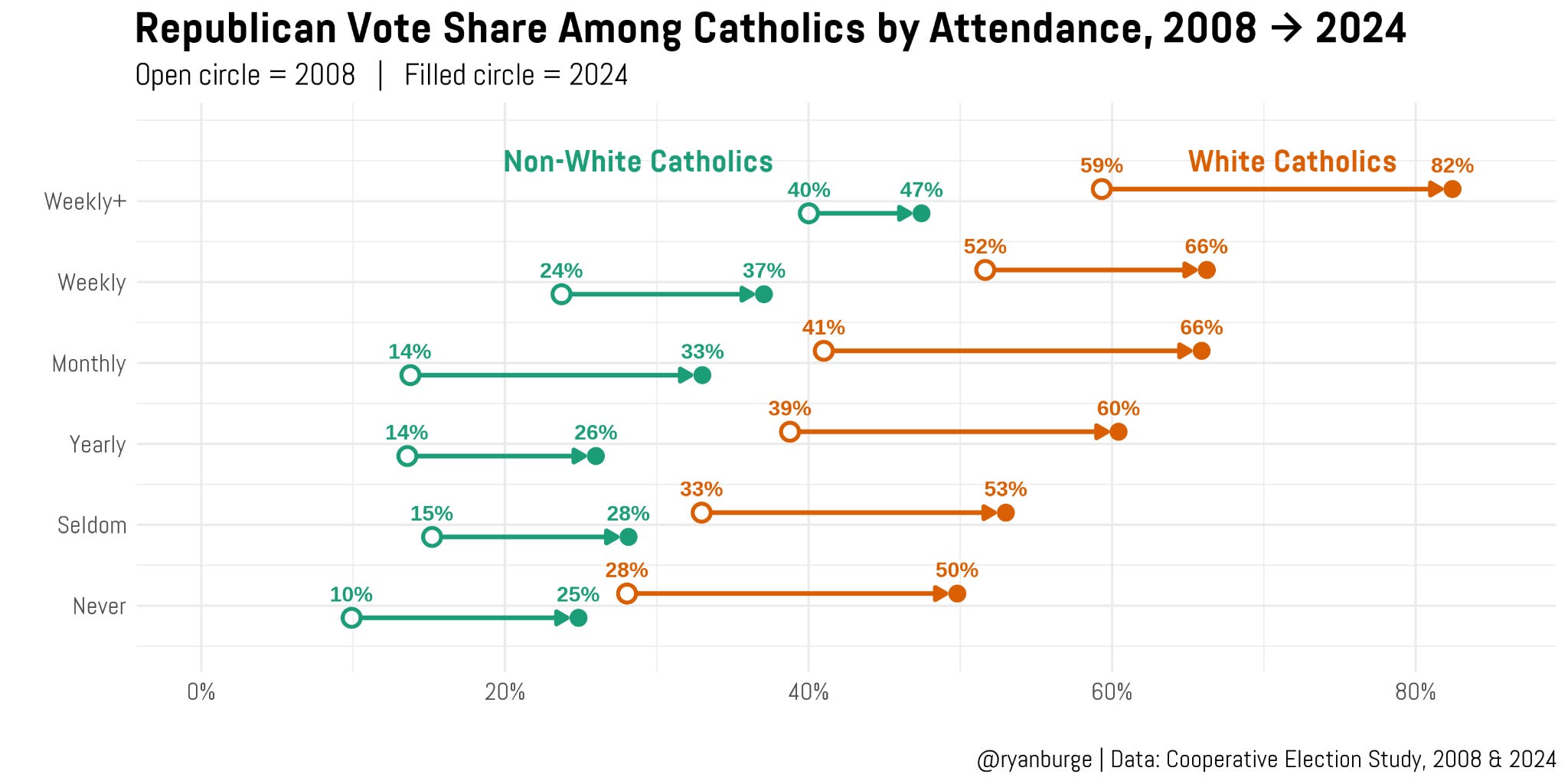
Non-white Catholics are just way less prone to vote for the GOP than their white counterparts. The gaps can be absolutely huge, too. For instance, among weekly attenders in 2024, 66% of white Catholics supported Trump. It was just 37% of non-white Catholics. The gaps typically run in the 25 to 35 point range when comparing the votes of white vs. non-white Catholics at the same attendance level. There’s a growing political divide in the Church. That’s an unmistakable fact, and it will only become more problematic as American Catholicism grows more racially diverse.
But I also need to point out this simple fact: every single arrow in the graph above points to the right. The GOP has made inroads with the Catholic church at every possible juncture. If we exclude the non-white Catholics who attend weekly+ (a very small raw number), they are doing at least a dozen points better, whether it’s low attendees or high attendees. They have made gains among white and non-white Catholics that are always in the double digits.
However, I do need to point out that the GOP gains among white Catholics are much larger than among non-white Catholics. Among monthly attending white Catholics, it’s 25 points. For non-white Catholics at the same level of attendance, it’s 19 points.
So, let’s get back to the question at hand: if Catholic attendance has collapsed, then why are Catholics much more Republican now? The answer is actually something I touched on in a piece about 18 months ago, “The Political Paradox: Why Never-Attending Christians and Atheists Are Worlds Apart.” If you don’t want to read the piece, here’s a summary:
An individual saying that they are Catholic but then also saying that they never go to Mass is actually incredibly important when understanding their politics. They still take on a Christian worldview. They still see the world as someone with Catholic sensibilities. A never-attending atheist doesn’t have the same frame of reference. From a numbers standpoint, a never-attending Catholic is 50 points more Republican than an atheist, even though they go to church the same amount.
That’s why I push back hard on someone who says, “Well, you can’t be a Christian that doesn’t go to church.” They act like that category has no empirical utility. From a political standpoint, they couldn’t be more wrong. I would go so far as to say: never-attending Christians’ shift toward the GOP is probably the biggest reason that the party has been so successful lately.
They already had a stranglehold on the diehards. Convincing the “Easter and Christmas” Christians to support the Republican party has been the key to winning elections.
Code for this post can be found here.
Ryan P. Burge is a professor of practice at the Danforth Center on Religion and Politics at Washington University.

As someone who grew up Catholic and attended Notre Dame High School, I think that practicing conservative politics with little or no church connection demonstrates the difference between holding a Christian worldview and living an authentic Christian faith; one is a philosophy, the other is a relationship.
Political parties and their attendant ideologies change over time. Is it too trite to say that maybe it wasn't Catholics who left the Democratic Party, but that the Democratic Party left the Catholics? Meaning, the Dem's evolving political agenda became an insurmountable problem for most Catholics? And conversely, the GOP's evolving political agenda became less so?
By the way, I look forward to every post. :)