


A couple of months ago, I wrote a post I knew would cause a stir — and it did. I try to avoid clickbait titles, but sometimes you just have to be blunt: When Are Half Your Members Going to be Dead? The argument was simple: Baby Boomers are propping up many of the most prominent denominations in the United States. That’s manageable for now — the oldest Boomers just turned 80, and most are still living active, socially engaged lives.
But in the next 15-20 years, that changes. As more and more Boomers receive their heavenly reward, the pews of American churches are going to thin out with startling speed. I’m not sure any denomination is truly prepared for how fast that’s going to happen.
When Are Half Your Members Going to be Dead?

I’m a bit enamored recently with the life of Ernest Hemingway. He was obviously a tremendous writer, maybe one of the finest in our country’s history. But he also lived a life that could charitably be described as “chaotic.” He moved constantly, was married four times, struggled with alcoholism his entire life, and suffered at least a dozen serious concussions from plane crashes and car accidents.
As you might expect, I got a lot of feedback on that post. Most of it was kind. But one objection kept coming up: Isn’t this just normal generational replacement? Churches have weathered this before. My answer is the subject of this entire post, but let me state it plainly at the top: what American religion will experience in the next two decades is something it has never seen before.
There Has Never Been a Generation Like the Boomers
Start here: numerically speaking, the Baby Boomers are without precedent. If you don’t believe me, read this piece by Derek Thompson and look at the first graph. The U.S. fertility rate exploded between the mid-1930s and early 1960s in a way we will never see again. You can see the downstream effects of that in the General Social Survey. All I did was calculate the generational composition of each GSS wave going back to 1972.
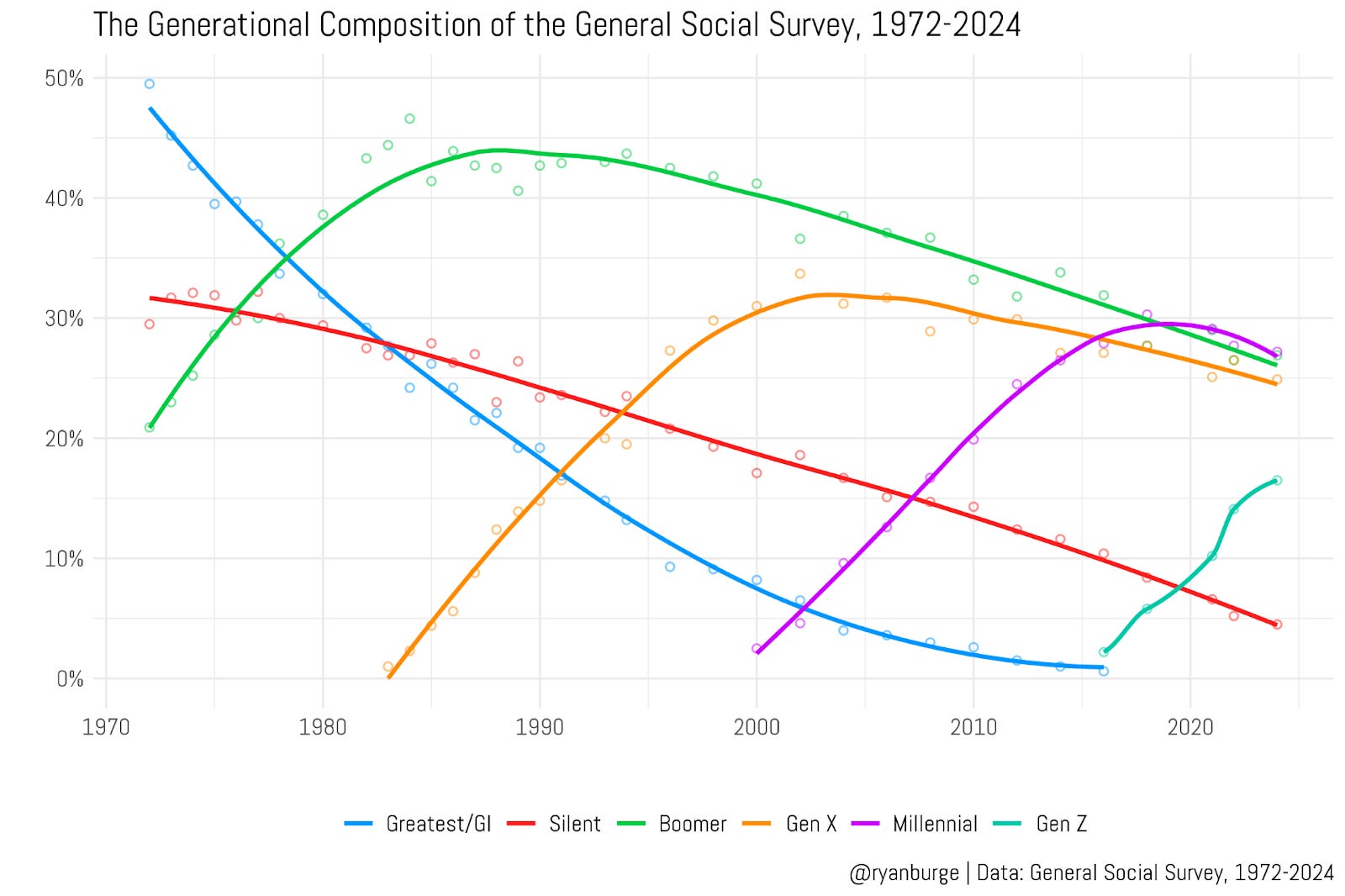
Focus on the green line — that’s the Boomers. In the early waves of the GSS, they were less than a quarter of the sample, with the Silent Generation accounting for a third and nearly half the respondents born before 1925. But watch that green line climb. By the late 1980s, Baby Boomers made up nearly 45% of the GSS sample. Pause on that for a second: one 18-year birth window representing nearly half the adult population of the United States.
The pattern is consistent across generations — a quick rise, a peak, then a slow decline. But the peak matters enormously. Boomers crested at 45%. Gen X never broke 33%. Millennials never broke 30%. There were simply millions more Baby Boomers than any generation before or after them.
Between 1980 and roughly 2022, Boomers were the largest generation in the GSS. They’ve only recently been eclipsed by Millennials.
Who’s Actually in the Pews?
So what about the people who actually show up to church? You probably already know the answer.
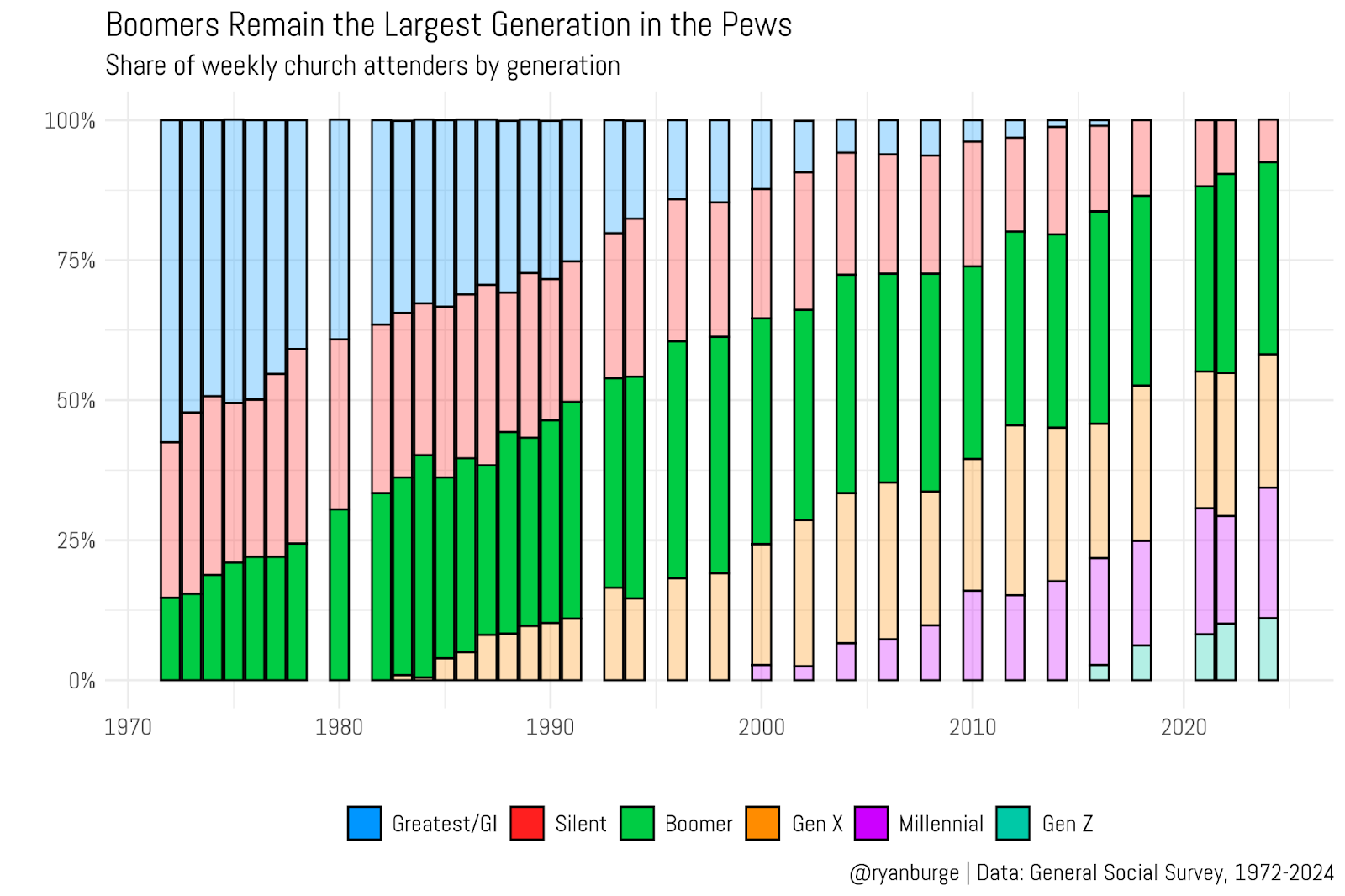
Those green bars just keep showing up. Baby Boomers have dominated churchgoing in this country for the vast majority of the last fifty years. That might seem counterintuitive — didn’t a lot of Boomers walk away from faith when they were young? Shouldn’t they be out driving RVs or sipping frozen drinks on a beach somewhere? The data says otherwise, I will get to that in a minute.
To make that even clearer, I built a bump chart. For each year of the GSS, I ranked the generations by their share of weekly attenders.