



This post has been unlocked through a generous grant from the Lilly Endowment for the Association of Religion Data Archives (ARDA). The graphs you see here use data that is publicly available for download and analysis through link(s) provided in the text below.
One of the most common critiques I hear about survey research on religion is that it flattens something that is deeply personal and profoundly complex. Questions about belief certainly fall into this trap. The General Social Survey has questions about a respondent’s view of God and the Bible that only allow a handful of response options. A common response is, “I don’t really fit cleanly into any of those boxes.” And honestly? That criticism is right on target. Asking someone “do you believe in God?” and forcing them into just a couple of potential boxes misses an enormous amount of nuance. But that’s the nature of survey research — we trade depth for breadth.
That’s why I’m always happy to see a survey that goes one step further on a belief question. The Pew Religious Landscape Survey does just that and it’s easy to see how it’s broken down on the ARDA website. It first asks, “Do you believe in God or a universal spirit?” But then the very next question is, “How certain are you about this belief?” But here’s what I really appreciate about this setup — everyone gets the second question, no matter how they answered the first one.
Which means not only can we assess the certainty of believers, we can also get a good sense of how certain non-believers are in their position as well. That distinction matters — a lot. A faith held with ironclad certainty looks very different from one held with a kind of hopeful tentativeness. And as you’re about to see, where Americans land on that spectrum varies dramatically by generation, by ideology, and by how often they actually show up to worship.
First, I’ve got to just start by laying out how the sample falls across those eight possible response options.
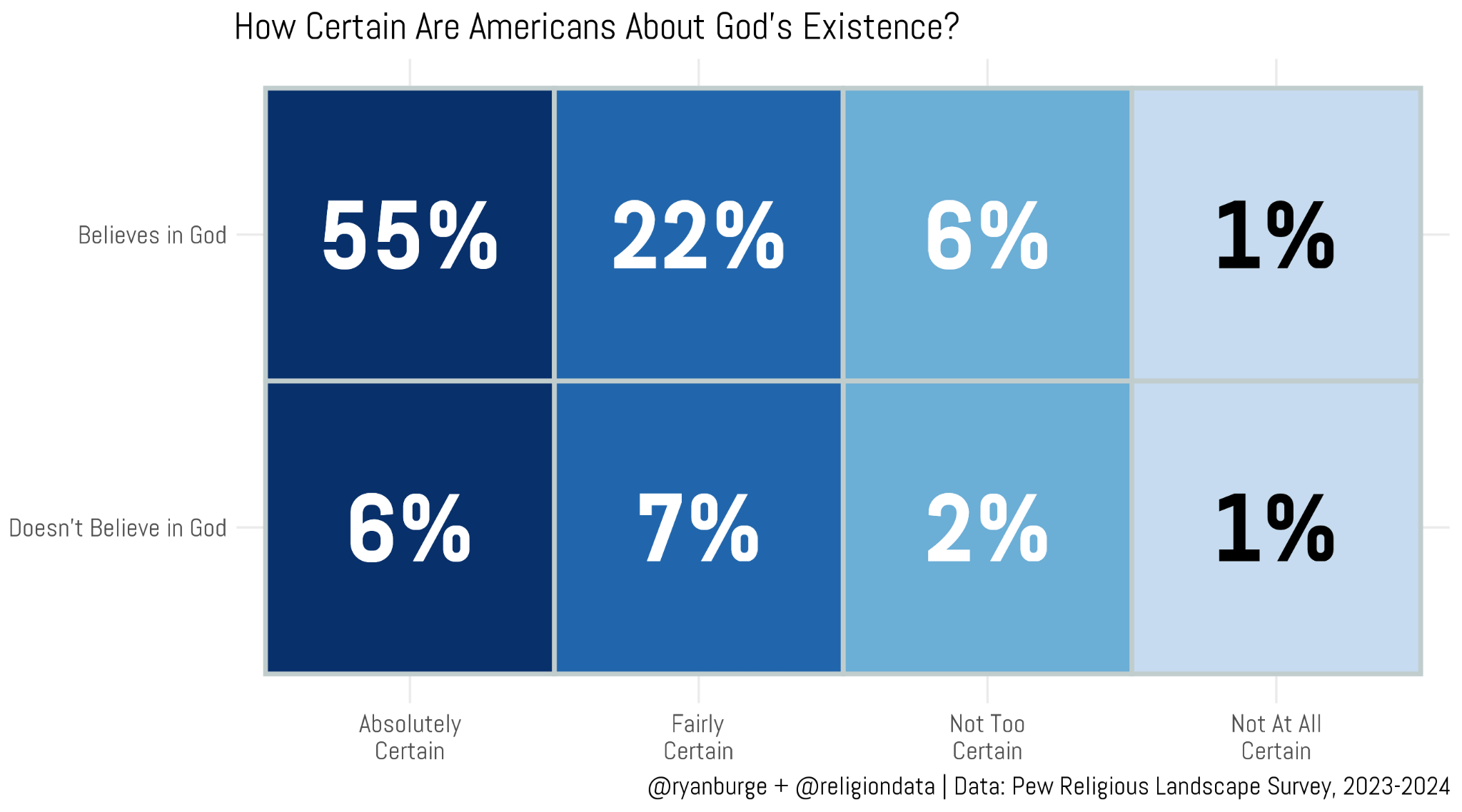
A majority of the sample falls into the “I believe in God with absolute certainty” category — that’s 55% of all respondents. Clearly, over half of Americans have a deep well of religious belief. Another 22% are in the “I am fairly certain about my belief in God” camp. That means that nearly four in five respondents score quite high on this belief metric.
The share of Americans who are absolutely certain that God does not exist is a bit less than 6%, and then another 7% say that they are fairly certain that God (or a universal spirit) does not exist. Said another way, for every person who is pretty sure that God doesn’t exist, there are six who are fairly certain of the existence of a Higher Power. Non-believers are statistically rare.
I did want to explore how much that had shifted from one generation to the next, though. So this is the same analysis but I just divided the sample into the birth decade of the respondent.
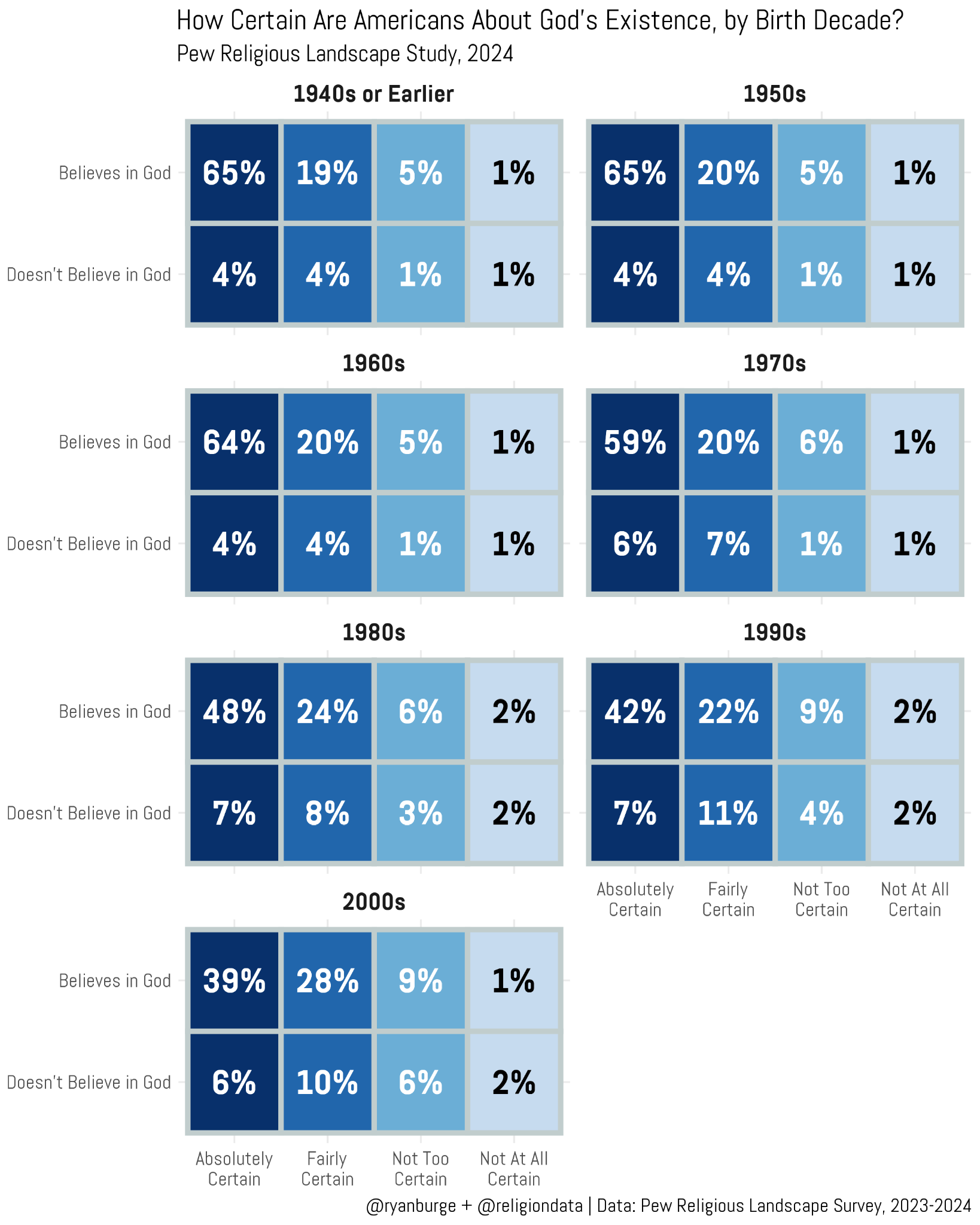
It should come as little surprise that older Americans are more likely to espouse a certain belief in God. Among those born before 1970, almost two-thirds can be found in the top left of each heatmap, and 85% are in the two squares in the top left. But that begins to erode when we move down to younger birth cohorts. The real drop off occurs among people born in the 1980s, when less than half believe in God with absolute certainty. And it declines even further from there — 42% among those born in the 1990s and 39% for folks who were born in the 2000s.
This raises the question: if certain belief drops by ~25 points, where do all those folks end up? The answer is clearly not in the “I certainly don’t believe in God” option. Even among the youngest respondents, only 6% are found in the bottom left square and a total of 16% are fairly certain or completely certain that God doesn’t exist. There’s a noticeable shift in the share of younger cohorts who fall into the “I’m fairly certain God exists” box. Which means that they aren’t sliding all the way to the other side of the spectrum. Instead, they are just moving one level down.
One thing that could be driving the differences in the above heatmaps is politics — younger folks are more likely to be ideologically liberal and older folks tend to lean conservative. Could that possibly have an impact on these results?
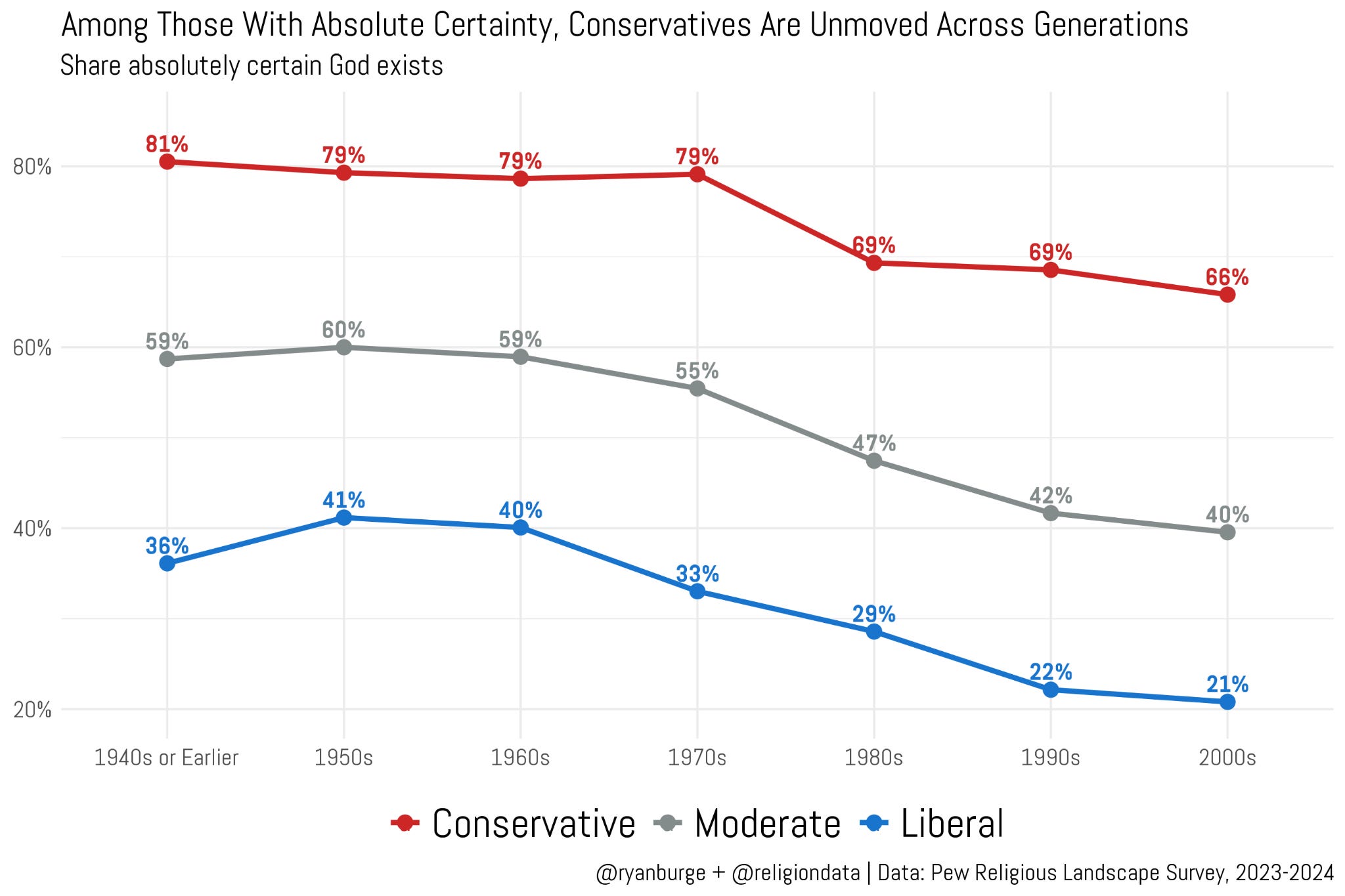
One rock solid finding from my analysis is that ideologically conservative folks are more likely to hold a certain belief in God compared to moderates and liberals. Among older conservatives, about 80% hold to a certain belief. It does erode a bit among younger conservatives, but even among the youngest adults, it’s still two-thirds of them who say, “I believe in God and I’m absolutely certain of that.”
Moderates are consistently 20 points lower than that. Among the oldest moderates, 60% are in the certain belief camp and it dips down to 40% among the youngest moderates. It’s interesting to me how the 1980s birth decade stands out as the pivotal one. For conservatives, certain belief drops by ten points while it’s 8 points among moderates.
Liberals are much lower than conservatives. The gap is consistently 35-40 percentage points when comparing one cohort to another. Among the youngest ideological liberals, only ~20% of them say that God exists and that they are certain of this fact. That’s 45 points lower than conservatives from the same age group.
But one thing to also note here – the drop in certain belief is the same size for both liberals and conservatives. It’s 15 percentage points when comparing the oldest respondents to the youngest. So, certain beliefs are eroding in a pretty consistent way from one generation to the next. It’s just that the baseline is so much lower for liberals.
I wanted to go one layer deeper on this and really try to figure out where liberals ended up on the belief continuum. I visualized that below based on the birth decade of the respondents.
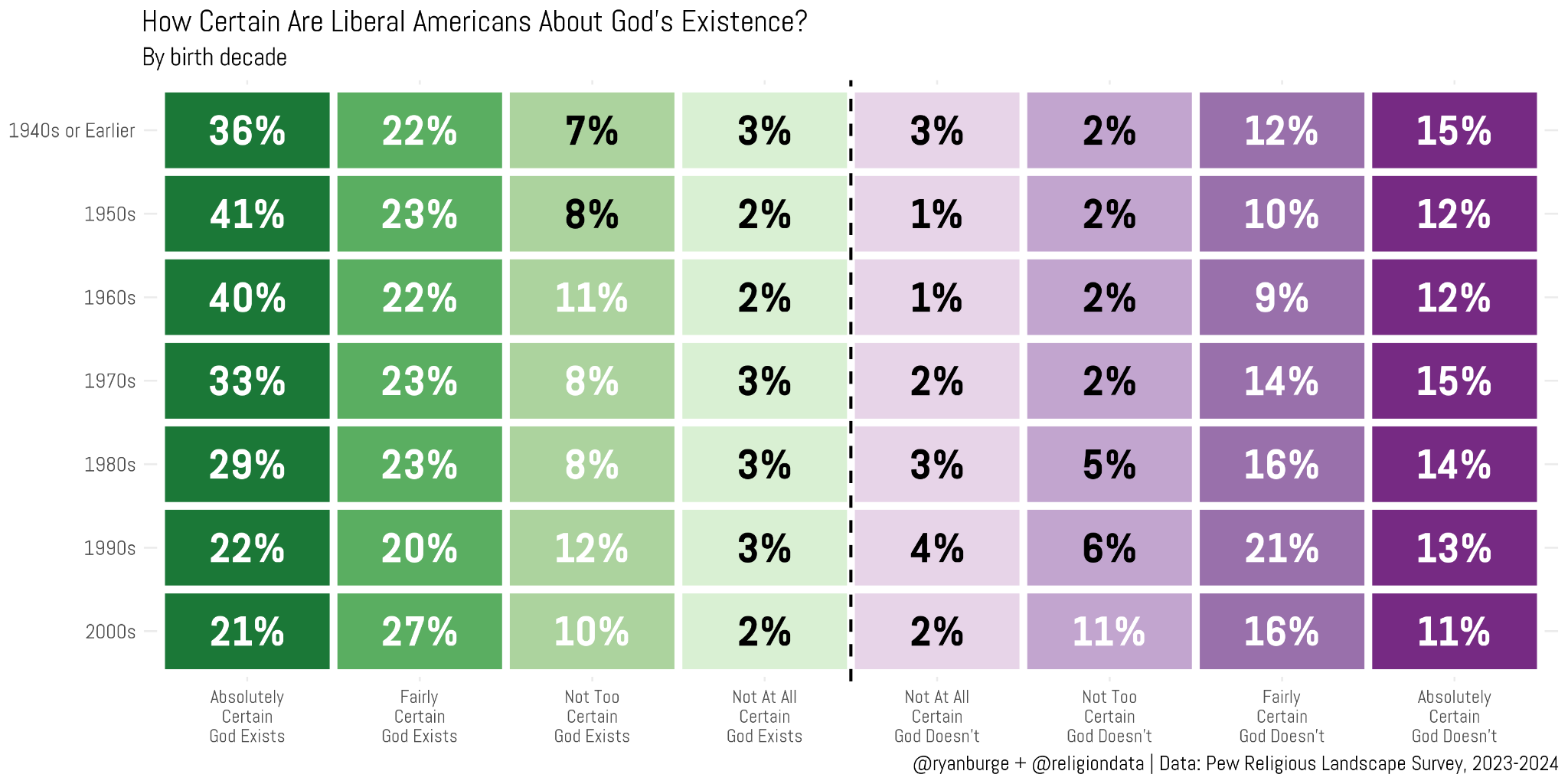
What is striking to me is that while there are a significant number of liberals on the right side of this heatmap, it’s nowhere close to a majority of them. For instance, among liberals who were born in the 1980s, 30% of them said that they were fairly certain or absolutely certain that God doesn’t exist. In contrast, 29% were certain of the existence of God. So, it’s just not empirically true that younger liberals are atheists — the data clearly says that’s not true for 70% of them.
Instead, a whole bunch of liberals can be found in the “I’m fairly certain God exists” camp. What’s interesting to me is that among those born in the 1990s, the share who are in the fairly certain camp is about the same as the absolutely certain camp, and it even reverses among the youngest liberals with 27% being fairly certain of God’s existence and 21% being completely certain.
To this point, I’ve only focused on looking at the belief question by ideology and age of respondent. There are two other dimensions of religiosity that should be explored: belonging and behavior. The most conventional measure of behavior is religious attendance. I wanted to focus specifically on folks who attend church less than once a year.
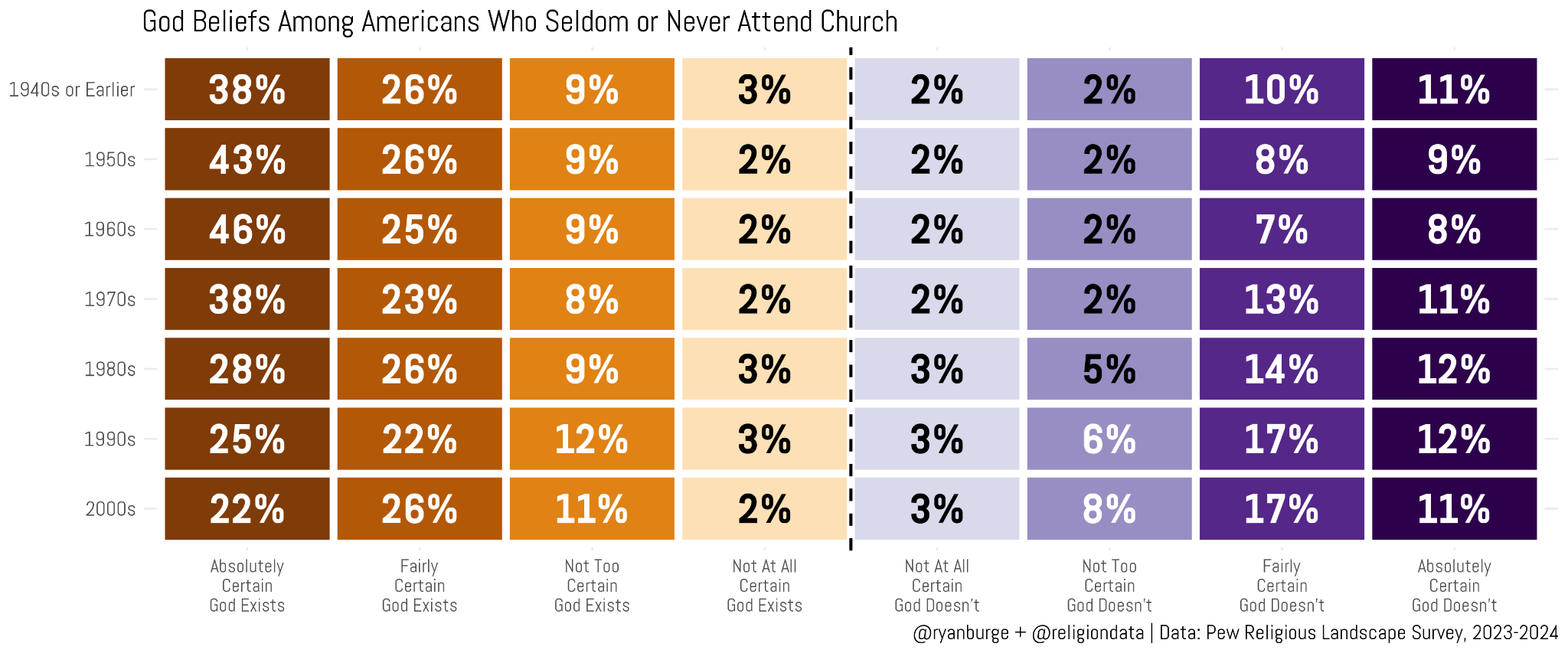
What I really wanted to sort out for us is this question: is the decline of religious behavior related to a decline in religious belief? And I think the answer is a qualified “yes.” For older Americans who don’t go to church that much, belief is still really robust. In many older cohorts, 70% of low attendees are in the top two categories of belief in God. Meanwhile, only ~20% are in the bottom two buckets. So, older Americans may not show up to church often, but there’s still a robust belief system there.
For younger respondents who seldom or never attend religious services, the level of belief is undoubtedly much lower. Among those born in 1990 or later who go to church less than once a year, 47-48% say that they are absolutely or fairly certain of God’s existence. That’s at least 20 points lower than their grandparents’ generation. However, look at the columns on the far right — even among young adults who rarely attend religious services, less than 30% of them say that they are absolutely or fairly certain that God does not exist.
If we were looking for a subgroup where atheist views would be widespread, it’s the bottom right corner of this heatmap, and even there, it’s still less than one in three.
Speaking of atheists, I wanted to just visualize how the three types of non-religious Americans (atheists, agnostics, and nothing in particular) fall on this belief continuum.
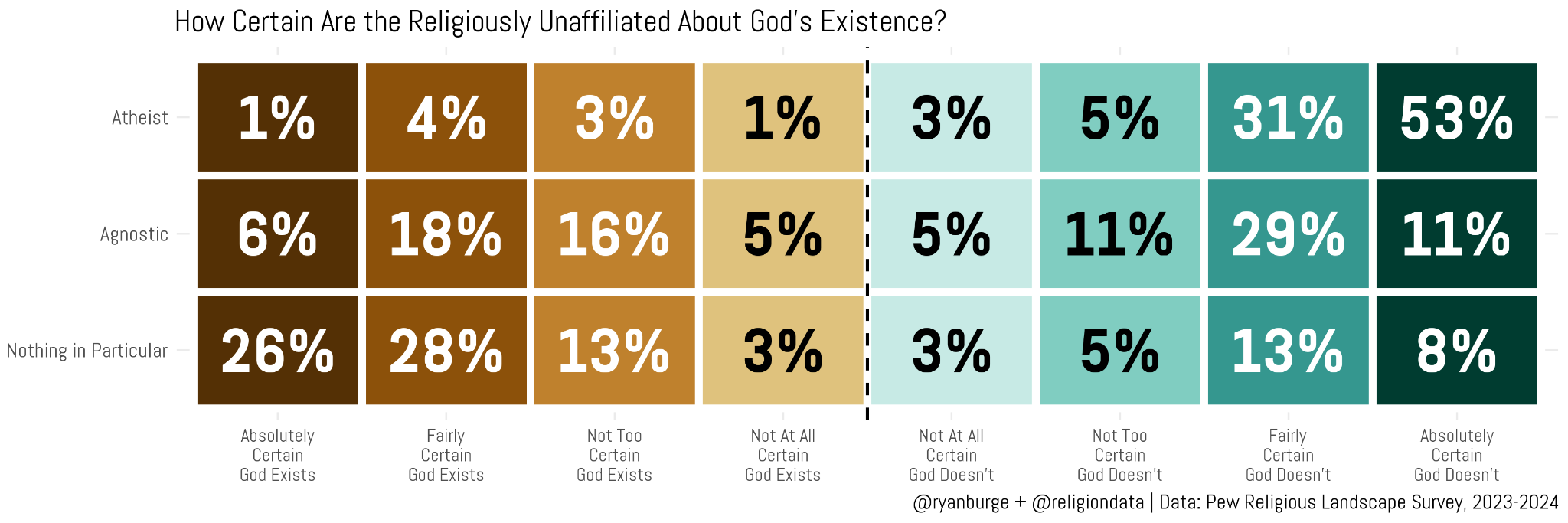
Among people who say that their present religion is atheist, 53% indicate that they are absolutely certain that God doesn’t exist and another 31% say that they are fairly certain that there is no universal spirit. Of course, very few atheists land on the left side of this graph. But that’s not the case for agnostics. In fact, 45% of them fall above the midpoint on this analysis by saying “yes” to the first question about the existence of God or a universal spirit. For comparison, only 40% fall into the bottom two boxes.
It couldn’t be more apparent, however, that “nothing in particular” folks have a much more robust belief in God than their atheist or agnostic counterparts. Among these nothing in particulars, 54% say that they are fairly certain or absolutely certain of God’s existence. Just 8% said that they were sure God didn’t exist and 13% were fairly certain of God’s non-existence.
I think that the overarching conclusion that I can derive from this data is that it’s pretty rare to find an individual who says that they have a great deal of confidence in their belief that God doesn’t exist. In the full sample, that’s just 13% of folks. Even among the youngest adults who never or seldom attend religious services, it’s less than 30% of them. The only group where this belief reaches majority status is among atheists. For agnostics, it stands at 40%.
Americans may be 25 points less likely to identify with a faith tradition today compared to 30 years ago, and over 40% say that they never attend religious services. But almost 80% of Americans agree that God or a universal spirit exists.
The United States may no longer be a country of people widely engaging in religious behavior or religious belonging. But it certainly has a whole bunch of religious believers.
Code for this post can be found here.
Ryan P. Burge is a professor of practice at the Danforth Center on Religion and Politics at Washington University.

I am addicted to your analysis. Exceptionally thoughtful and useful.
The distinction between "a personal god" and "a higher spirit" is critical. Operationally, there's very little difference between an agnostic and someone who believes "there's surely something out there" but who draws no further conclusions
In the Australian data, the population divides almost evenly into three groups: A personal god, a higher spirit, and no God/spirit. https://www.ncls.org.au/articles/is-there-a-god-or-higher-power/