


I know I have written this before, but my “perch” in the discourse is a very odd one. When I post a graph on social media, I can get hundreds of comments. A lot of them on Twitter are just anonymous weirdos. I try not to read too many of them, but I actually do find some of them kind of valuable because they can offer me insights into how random people on the internet understand my corner of the world. So, this post was inspired by a comment I got on Twitter a couple of months ago after I posted a graph of Catholics’ political ideology over the last fifty years. The upshot was simple: the Democrat and Republican lines crossed just recently.
The first comment was from one of those anonymous Catholic accounts that love to be “reply guys.”

This is a keyhole into a misconception that I see all the time in response to my work — there are lots and lots of people who believe that Catholics are just as conservative as evangelicals if you compare the “real” Catholics (aka the weekly attenders). I don’t know where this idea comes from, but it’s time for me to debunk it.
Let’s just do a couple of comparisons here between evangelicals and Catholics. I am going to compare all evangelicals to all Catholics and then compare only the weekly attenders of each group.
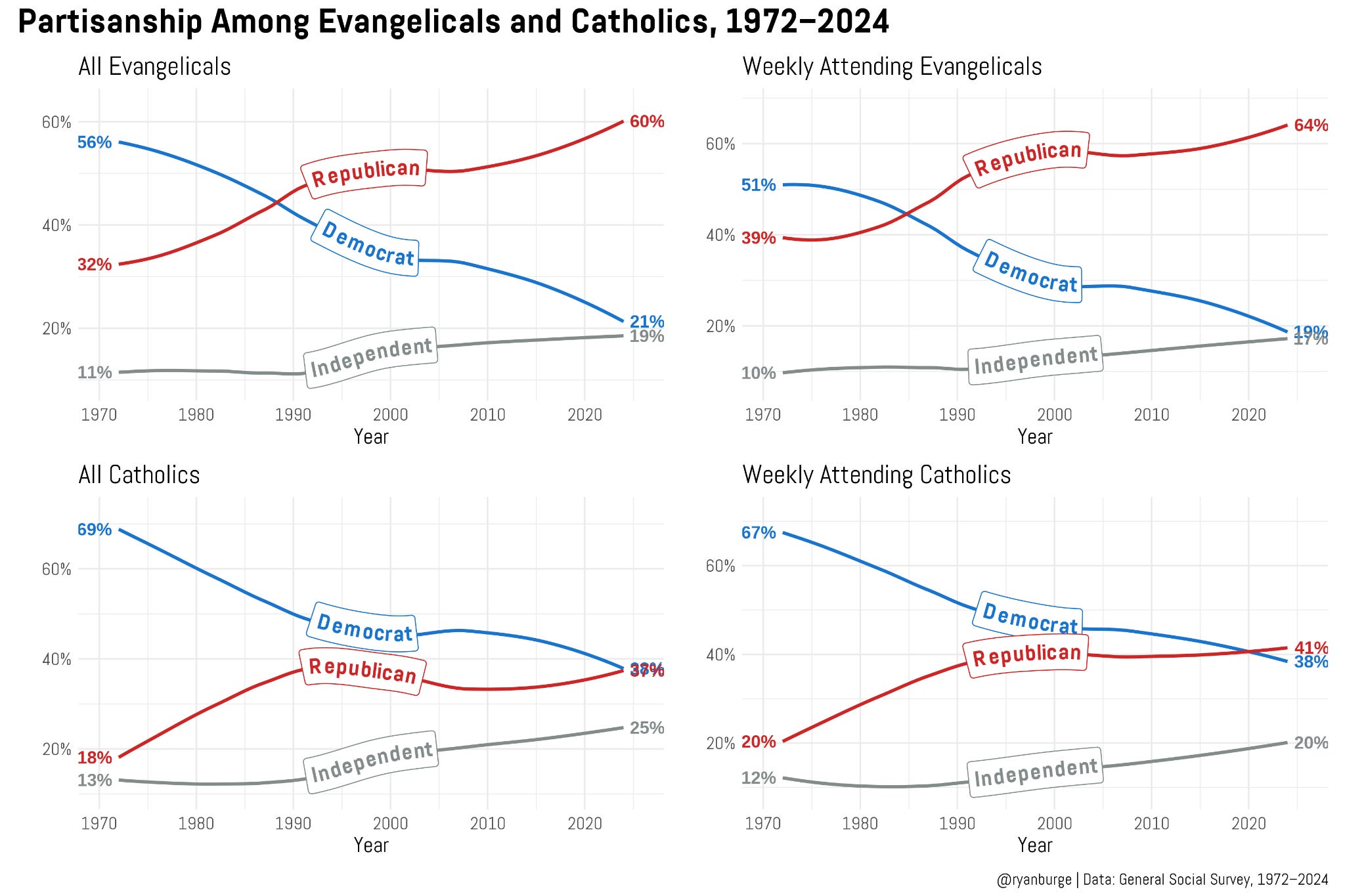
The first thing that jumps out is how little these graphs differ when comparing all levels of attendance vs. only weekly attenders. For instance, the top left panel is all evangelicals. Among this group, Republicans clearly outnumbered Democrats by 1990. In the 2024 data, 60% of evangelicals identify as Republicans and 21% are Democrats. When I just filter down to weekly attenders, the lines cross about five years earlier, and the Republican share is 64% in 2024 — four points higher than in the “all evangelicals” graph.
What's the Difference Between White Evangelicals and White Catholics on Election Day?

My new book releases on on January 13, 2026. It’s called The Vanishing Church: How the Hollowing Out of Moderate Congregations Is Hurting Democracy, Faith, and Us. Please pre-order a copy on Amazon or Baker Books (where it’s currently 40% off with free shipping).
What about Catholics? Again, the differences here are subtle. For all attendance levels, the lines have finally converged in the 2024 data, with Republicans and Democrats within a single percentage point of each other (38% vs. 37%). For weekly attenders, the crossing of the lines happened around 2021 or so — about three years earlier than in the left panel. The share who are Republicans is 41% — three points higher than the “all attenders” figure.
Are “real” Catholics as Republican as evangelicals? Absolutely not. Even if we compare all evangelicals to weekly attending Catholics, the former group is about 20 points more Republican than the latter. That’s not a small difference.
But what about issues like abortion? The question under study asks, “Do you think it should be possible for a woman to obtain a legal abortion if she wants one for any reason?”
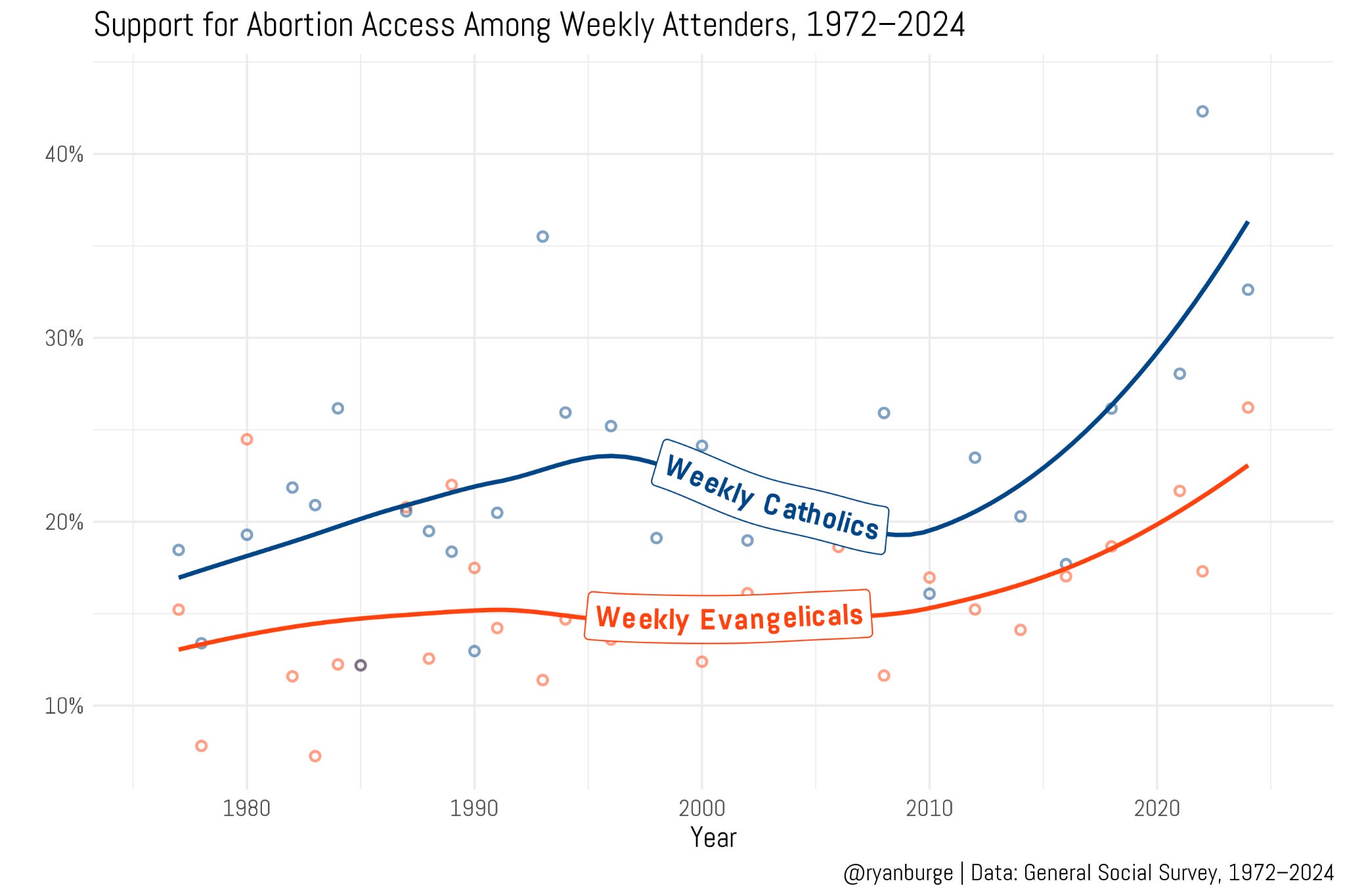
There has never been a time in the last fifty years in which a weekly attending Catholic was more opposed to abortion access than a weekly attending evangelical Protestant. There are time periods when the gap has been fairly small — about five percentage points back in the late 1970s and again around 2010. But the last fifteen years has seen a shift in the trend lines in the direction of abortion access.
In 2024, one third of Catholics who attend Mass nearly every week or more favored a woman’s right to obtain an abortion if she wants one for any reason. For frequently attending evangelicals, support was seven points lower than that. Catholics are just not as opposed to abortion as evangelicals. That was true in 1977 and it’s true today.
What about homosexuality? This question asks, “What about sexual relations between two adults of the same sex?” I am only visualizing the two endpoints — “always wrong” and “not wrong at all” — because these make up roughly 90% of total responses to this question. I also restricted this sample to only weekly attenders, so we can compare the most active members of each Christian group.
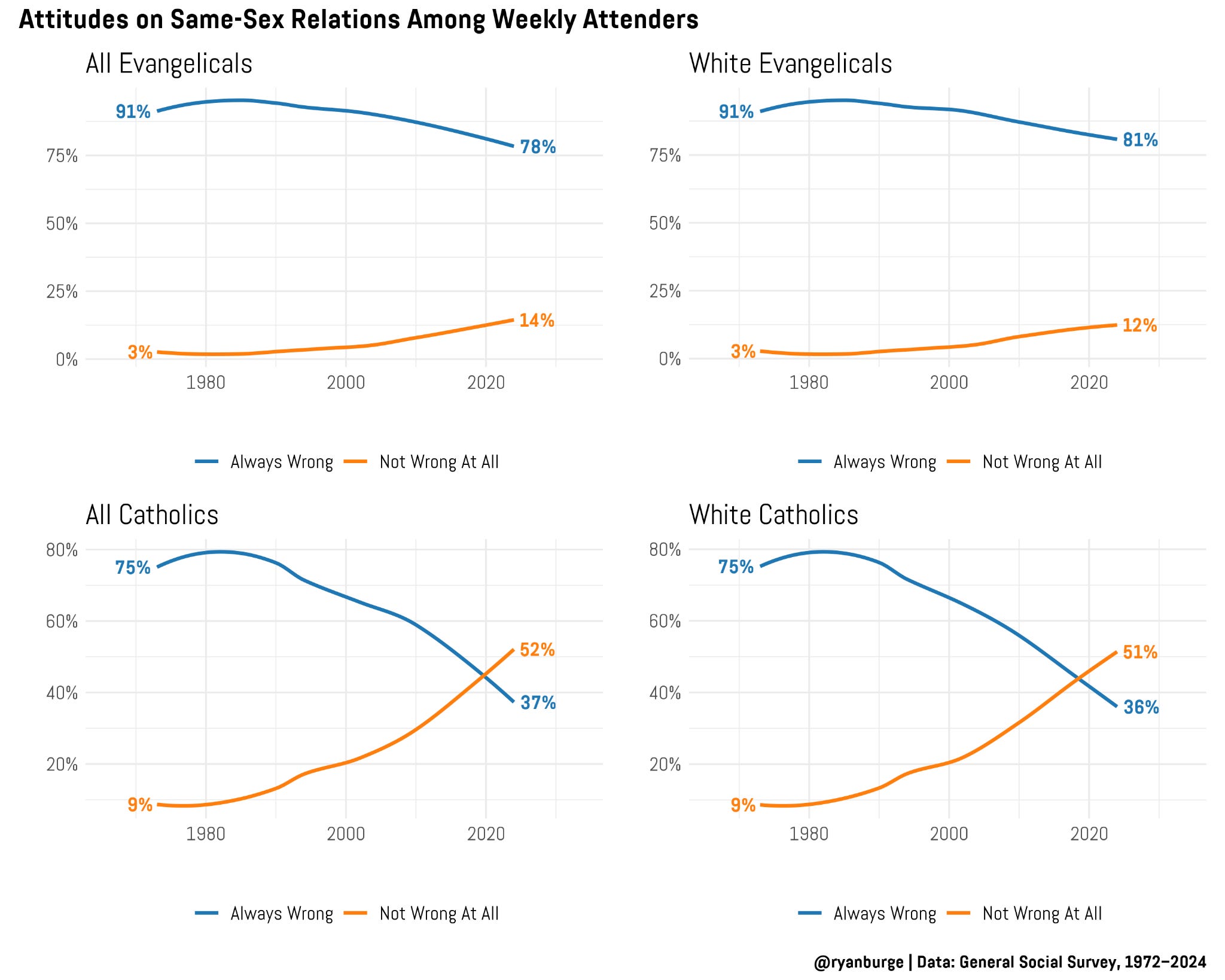
You can clearly see that the vast majority of evangelicals have always considered same-sex relations to be wrong. Back in 1973, 91% chose the “always wrong” option and only 3% said it was “not wrong at all.” Today, those numbers stand at 78% and 14% respectively. Among white evangelicals, the numbers are slightly different, with 81% choosing “always wrong” in 2024.
What about Catholics? Among all weekly attending Catholics, 75% said same-sex relations were wrong back in 1973. Today, that number stands at just 37%. Somewhere around 2020, the lines crossed, and in just the last couple of years, the “not wrong at all” responses rose above 50%. When we just look at white Catholics, the trend line is remarkably similar to when I discussed weekly attending Catholics of all races.
There’s just no way you can look at this data and say that “real” Catholics are as socially conservative as evangelicals. The gap is a chasm. A Catholic who goes to Mass every week is 38 percentage points more likely to believe that homosexuality is not wrong at all compared to a weekly attending evangelical.
What about vote choice? Again, we are only going to look at weekly attenders in this graph.
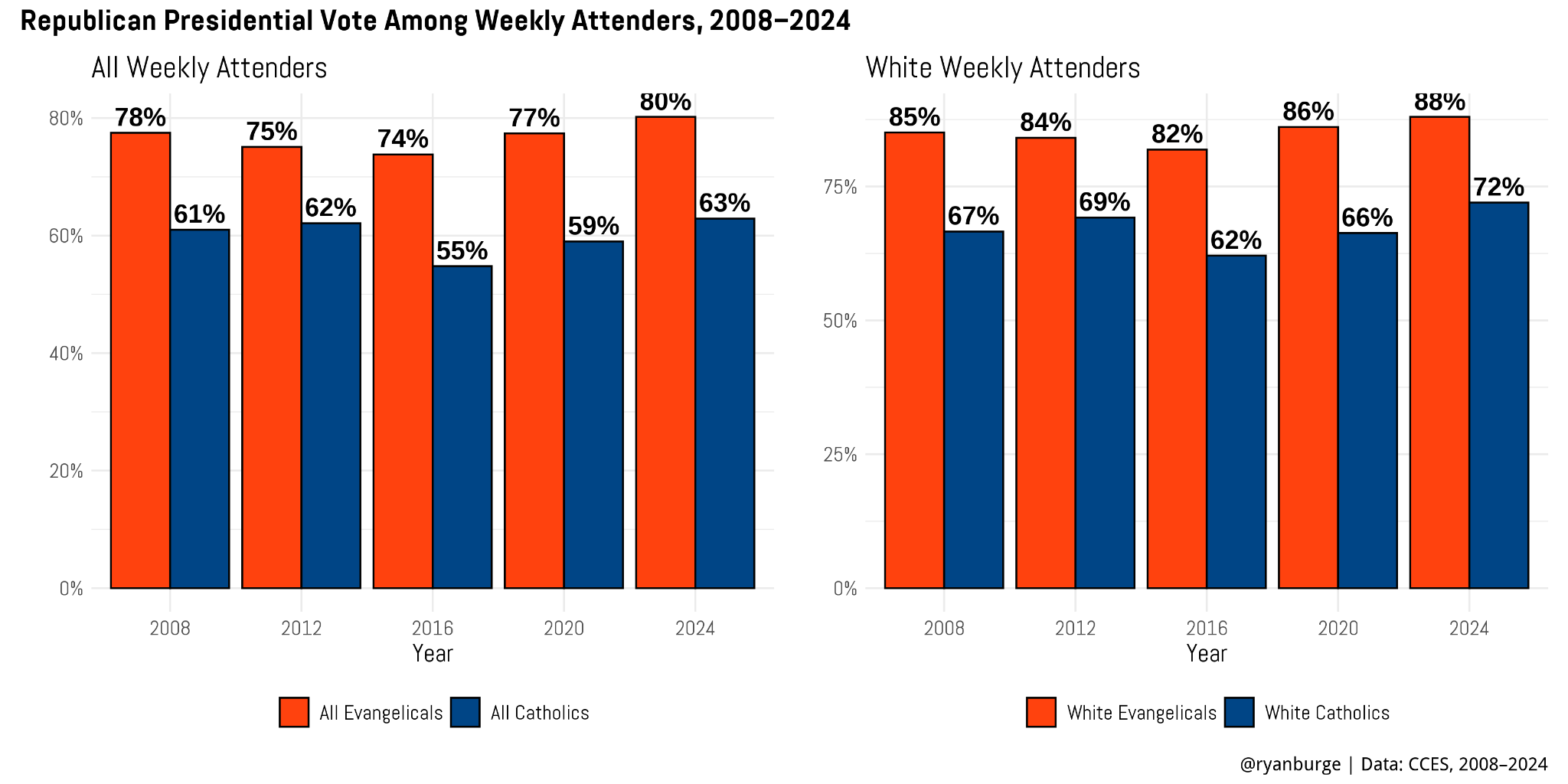
The panel on the left has no racial filter, so it includes a fair number of Hispanic Catholics and evangelicals. The data indicate that weekly attending evangelicals were 13 to 19 points more likely to vote Republican compared to weekly attending Roman Catholics. The gap was smallest in 2012 and largest in the 2016 contest.
The panel on the right restricts the sample to white respondents. Again, the gap between weekly attending evangelicals and Catholics is substantial — ranging from 15 points in the 2012 election to 20 points in the 2016 contest.
A white Catholic who goes to Mass every week is about 15 points less likely to vote for the GOP on Election Day compared to a white evangelical who goes to church every week. A Catholic is not as right-leaning as an evangelical.
To put this to the ultimate test, I compared the most devout white evangelicals to the most devout Roman Catholics — people who indicated that they attend church multiple times per week, which represents only 10–15% of each group. In the heatmap, I visualized how each group responded to questions about political ideology and political partisanship.
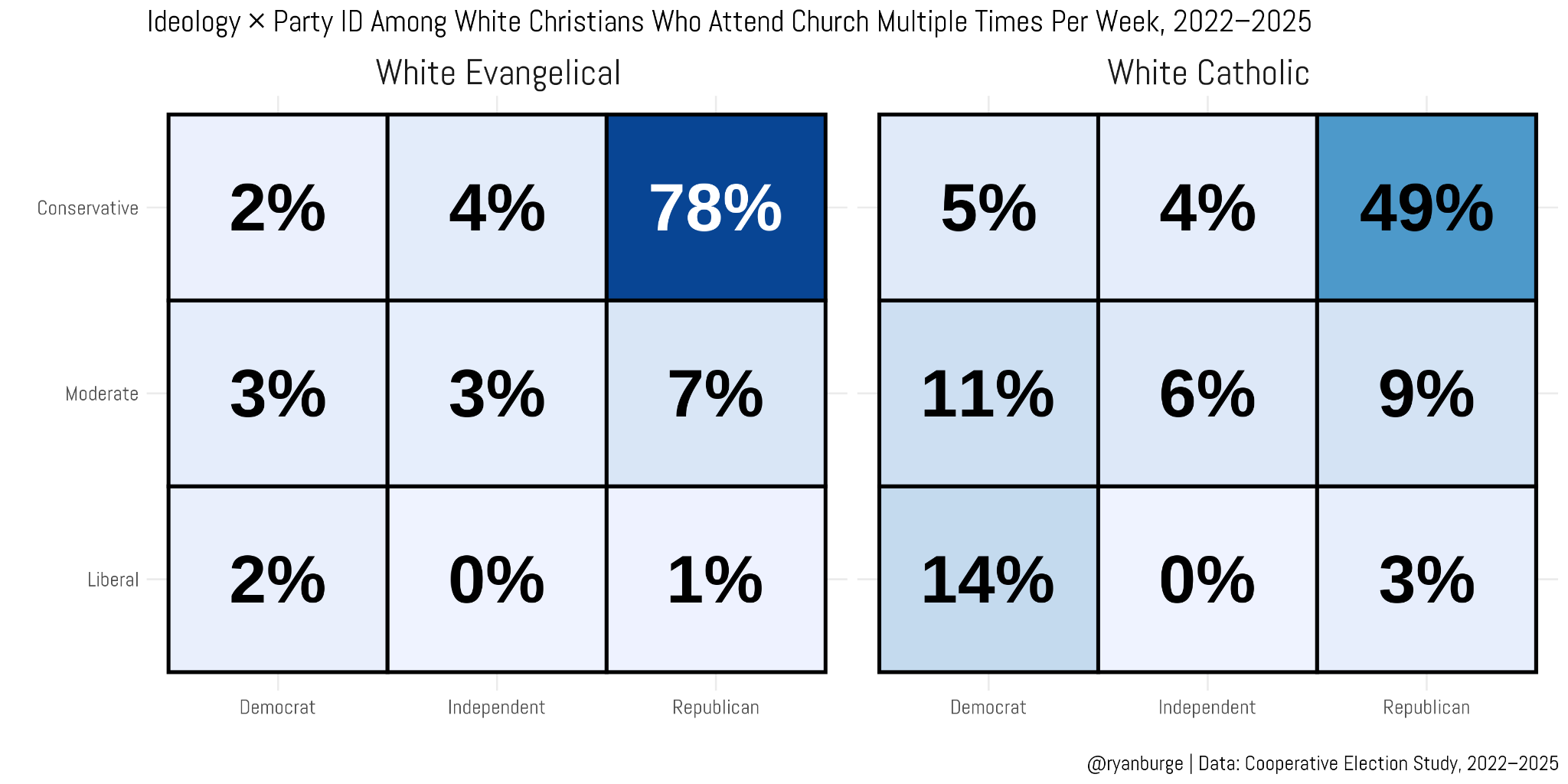
The top right corner tells the whole story. Among white evangelicals who attend church more than once per week, 78% identified as conservative Republicans. Among white Catholics who attend Mass more than weekly, only 49% are conservative Republicans. That’s a gap of 29 percentage points.
And look at the bottom left, too. That’s folks who said they were liberal Democrats. In the evangelical heatmap, just 2% of respondents put themselves in that square. It’s 14% of white Catholics. And remember — these are people who report going to church more than once a week. About 30% of this group of Catholics say they are Democrats and 17% are liberal. Those numbers for evangelicals? 7% and 3%, respectively.
Do you see my point now? There’s just no way that one can compare a Catholic to an evangelical and say that the two groups land in the same position in the political landscape.
But just to put a little bow on this, I pulled together a regression model where I controlled for all kinds of stuff: age, gender, income, and education. Then I predicted the share of white evangelicals and white Catholics who identify as Republican at each level of church attendance.
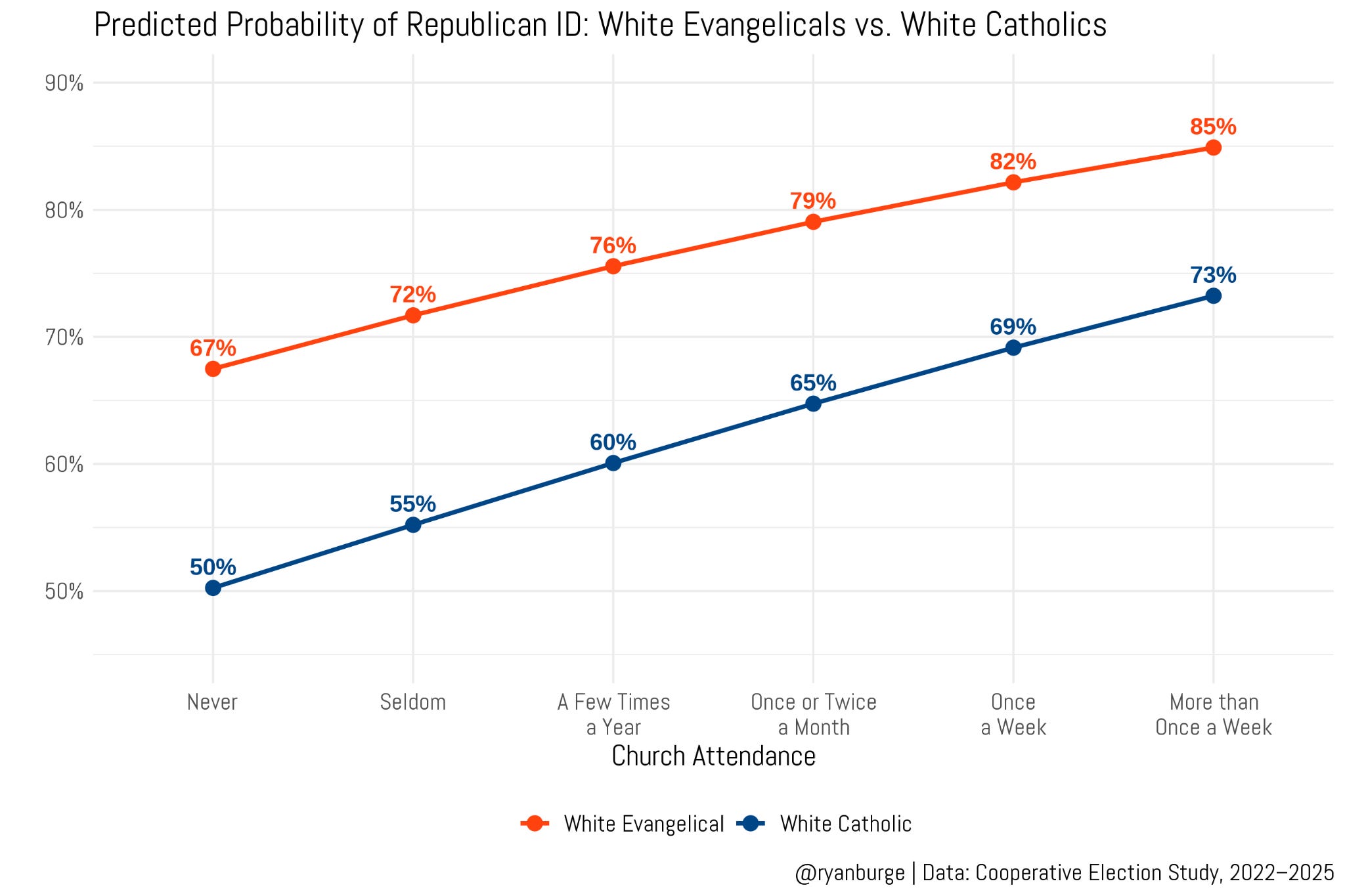
The gap among never attenders is huge: 17 percentage points. Among evangelicals, 67% say they are Republicans. It’s 50% of Catholics. The distance between the two lines does begin to narrow as attendance rises for both groups. Among respondents who attend church weekly, 82% of white evangelicals are Republicans compared to 69% of Catholics. But that’s still a 13-percentage-point gap.
The Myth of the White Catholic Democrat

The White Catholic vote may be one of the most consequential voting blocs in the modern political landscape. There are a couple of reasons that I believe this to be true.
Think of it like this: a white evangelical who seldom attends church is as likely to be a Republican as a white Catholic who attends Mass at least twice per week. That’s how big the partisan chasm is between the two groups.
Are Catholics conservative? Yes, certainly when compared to a group like the non-religious. Are they as conservative as evangelicals? The answer is unequivocal in this data: absolutely not. Even when we restrict our sample to the most engaged Catholics, they are still at least 10 points less conservative than their evangelical counterparts.
I know some people are going to read this and say, “That doesn’t match my experience — I’m a devout Catholic and all the people I know are too, and we are really conservative.” But this is another instance of where your world doesn’t equal the entire world. Our perspective is limited. Our experiences belong to us alone.
The data cuts through that. And it tells us a consistent story: evangelicals are more conservative than Catholics no matter how you compare the two groups.
Code for this post can be found here.
Ryan P. Burge is a professor of practice at the Danforth Center on Religion and Politics at Washington University.

I know it’s not the biggest thing but please consider using “Democratic” instead of “Democrat” in sentences like this:
“The upshot was simple: the Democrat and Republican lines crossed just recently.”
One of the things that longitudinal surveys that run decades do very poorly is account for the background history. Since the data begins in 1970, George Wallace had just been the last third party candidate to get electoral votes and was actively campaigning when shot in 1971. Dixie, the heart of the Bible Belt and evangelicalism, sent segregationists of long seniority to the Senate and elected governors critical of civil rights legislation. All were Democrats, which is what the people in survey checked when asked their affiliation at the time. They were not what we think as Democrats today. Even the interval between 1970 and the crossover in 1990, the overt segregationists were replaced by other democrats who were not segregationists: the defeat of Sen Fulbright in 1974, the rise of Bill Clinton and Jimmy Carter. Your professional state of Missouri from a swing state to solidly red came after I lived there in the 1970s. The party names are the same, but what they stand for have evolved more than the religious preferences of devoutly religious people have evolved.
I could say the same for gays. Evangelicals have a firm doctrine opposing the gay agenda. The timeline crosses the era of AIDS as a more lethal condition than it is now, which is where some of the Catholic acceptance of the place of LGBTQ in the larger culture takes place. Formal doctrine of the Catholic Church has not changed. Sensitivity of Catholics, not only as individuals but within the Catholic affiliated hospitals and universities, has run in the direction of acceptance. The small inflection point seems to occur in the era of AIDS recognition.
The graphs and surveys often don't capture the realities on the ground.