



This post has been unlocked through a generous grant from the Lilly Endowment for the Association of Religion Data Archives (ARDA). The graphs you see here use data that is publicly available for download and analysis through link(s) provided in the text below.
There’s this well-worn phrase you hear in Christian circles: “Going to church doesn’t make you a Christian any more than standing in a garage makes you a car.” It’s often used by pastors to remind people that simply showing up on Sunday isn’t enough to be a faithful Christian. The point is that authentic faith is more than just checking a box once a week.
But there’s another way to read that line—especially for people who don’t go to church much. I hear it all the time: “I don’t need to show up at some worship service to grow deeper in my faith.” They’ll say a walk through nature is more edifying than Sunday worship. From a social-scientific standpoint, that’s basically someone saying that religious behavior doesn’t matter much—they place more emphasis on belief or maybe belonging instead.
Can You Ever Really Leave Religion Behind?

Here’s a new phenomenon that I haven’t really discussed yet: always nones.
That’s something I’ve been thinking about a lot lately: people who say they’re religious but rarely (or never) go to church, mosque, or synagogue. More specifically, I wondered whether those who never attend services today are further removed from other measures of religiosity than people were twenty or thirty years ago.
Put simply—are never-attenders becoming more secular each year? I can actually answer that question using data from the General Social Survey, hosted by the Association of Religion Data Archives (ARDA). They just posted the 2024 GSS data, which makes this analysis as up-to-date as possible.
Let’s start by looking at how the share of “never attenders” has changed over time, using the GSS question on religious attendance.
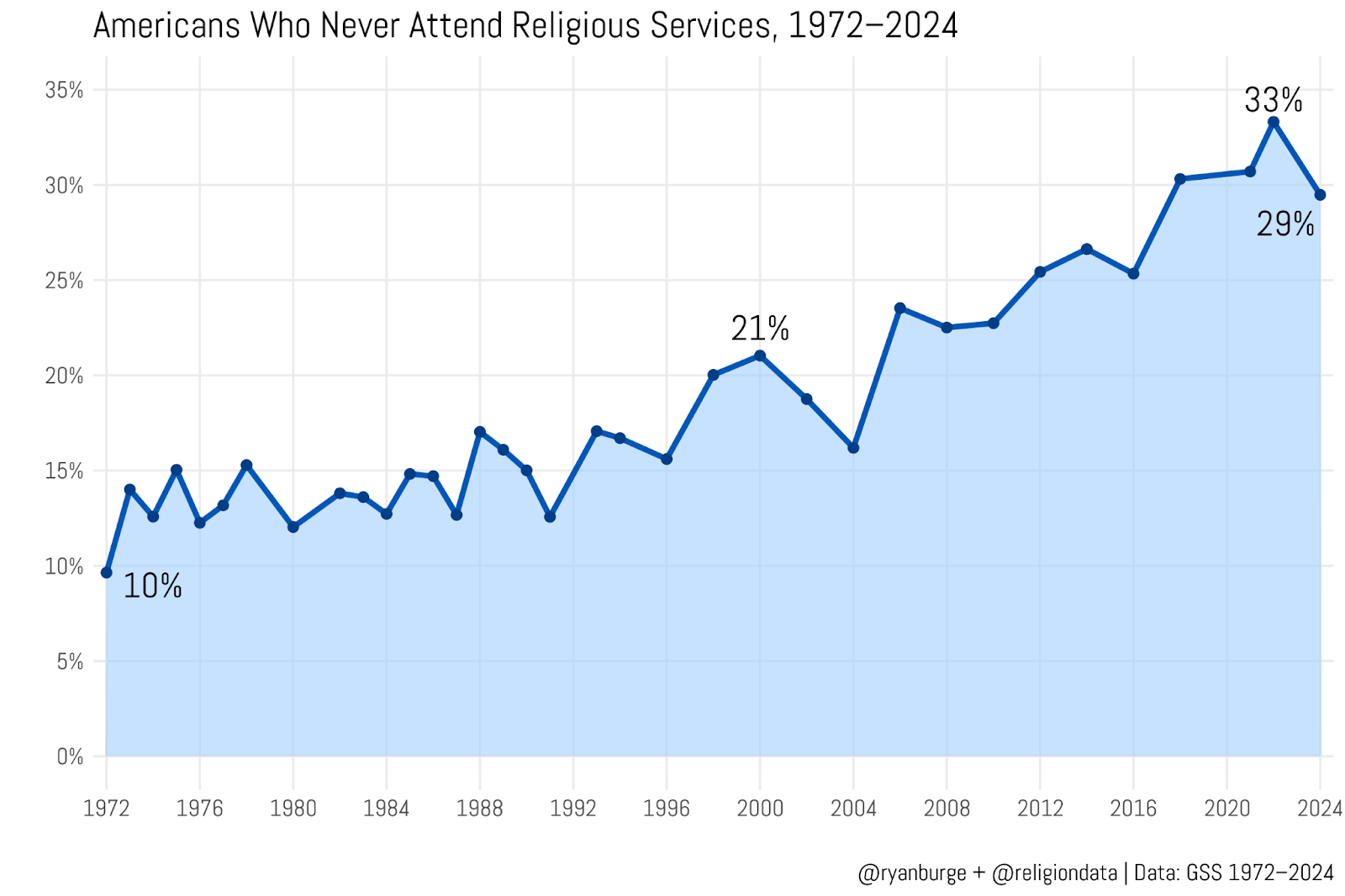
It’s pretty wild to think that in 1972, only about one in ten American adults said they never attended religious services. In contrast, more than 40% were going nearly every week or more. Think about that—in the early 1970s, weekly attenders outnumbered never-attenders by roughly four to one. But that gap didn’t last long. By the early 1990s, the share of never-attenders had climbed above 15%.
It hit 20% for the first time around 2000 and was clearly above 25% by 2012. In the last four waves of the GSS, more than 30% of adults reported never attending in three of those years. In the most recent data, that number slipped slightly to 29%—a bit lower than in 2016 and 2018. But let’s not go calling that a revival, okay? For comparison, about 25% of Americans reported weekly attendance in 2024.
Now, let’s zoom in on those never-attenders for a moment. I wanted to see how they respond to questions about religion that aren’t specifically about attendance. For instance, what about the standard question on religious affiliation? After all, just because someone never goes to church doesn’t mean they can’t still identify as Protestant, Catholic, or Jewish, right?
So, I calculated the percentage of never-attenders who also said they have no religious affiliation.
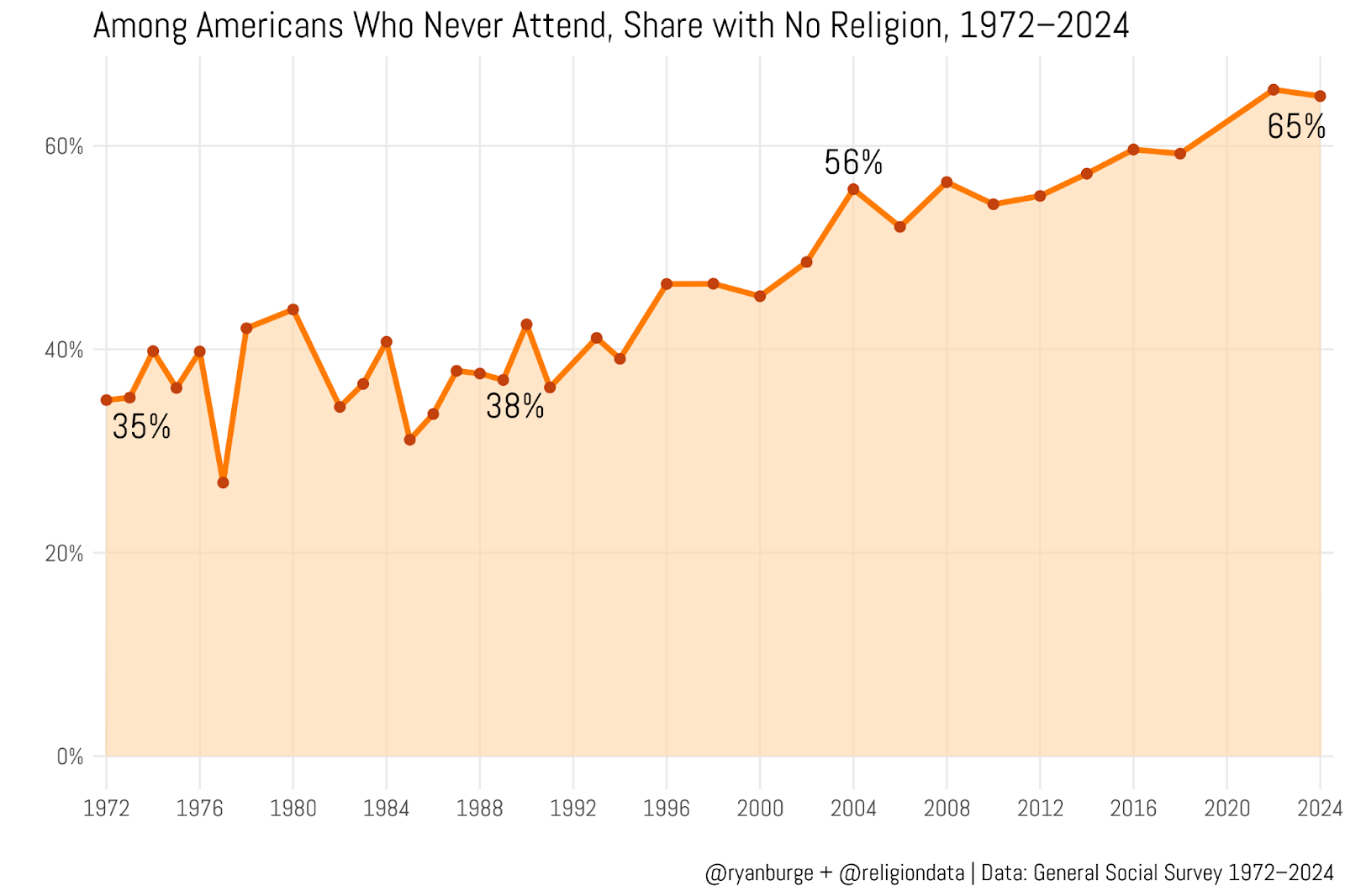
I think this might surprise a lot of people: in 1972, a majority of those who never attended religious services still said they belonged to some kind of religious tradition. In fact, only about 35% of never-attenders indicated that they had no religious affiliation. And that number stayed fairly low for the next couple of decades—it didn’t clearly rise above 40% until the mid-1990s.
But things changed quickly in the last twenty years or so. By the late 2000s, the data showed that a majority of never-attenders were now religiously unaffiliated. And in the most recent surveys from 2022 and 2024, nearly two-thirds of never-attenders identified as religious “nones.” That’s an all-time high.
If you compare the start and end of this time series, the shift is striking. In 1972, about one-third of never-attenders were nones and two-thirds still claimed a religious affiliation. By 2024, it had completely flipped—two-thirds were nones, and only one-third said they belonged to a religious tradition. That’s pretty compelling evidence that the composition of never-attenders has changed dramatically over time.
Now, let’s turn to a measure of religious belief. The GSS asks respondents what they believe about God, offering six options ranging from “don’t believe in God” to “believe in God with no doubts.” Here’s how never-attenders have answered that question over time.
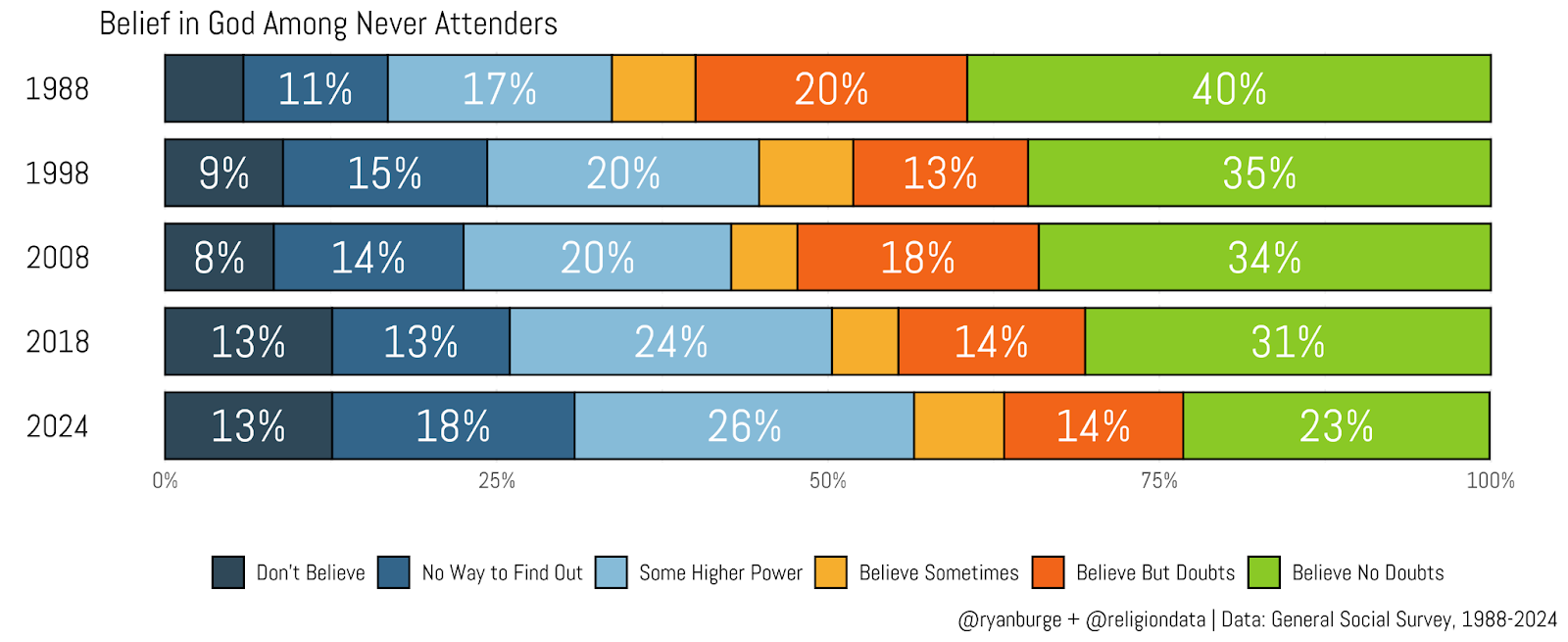
Among never-attenders back in 1988, a plurality—about 40%—said they believed in God without any doubts. Another 20% said they believed in God but sometimes had doubts. The takeaway is pretty clear: even those who never went to church still had a significant level of religious belief. Only about 15% described their beliefs as atheist or agnostic.
But over time, that certainty began to fade while nonbelief grew. By 2018, just 31% of never-attenders expressed a firm belief in God, while 26% identified as atheist or agnostic. That trend continued in the most recent data from 2024. In that sample, only 23% said they believed in God without doubts, while 31% were atheist or agnostic.
The conclusion here is hard to miss—it used to be that large shares of never-attenders still held a robust religious belief system. That’s becoming less and less true with each passing year. In other words, never-attenders are secularizing on this measure as well.
But there’s one more question worth looking at. The GSS also asks, “To what extent do you consider yourself a spiritual person?” Respondents can answer very spiritual, moderately spiritual, slightly spiritual, or not at all spiritual.
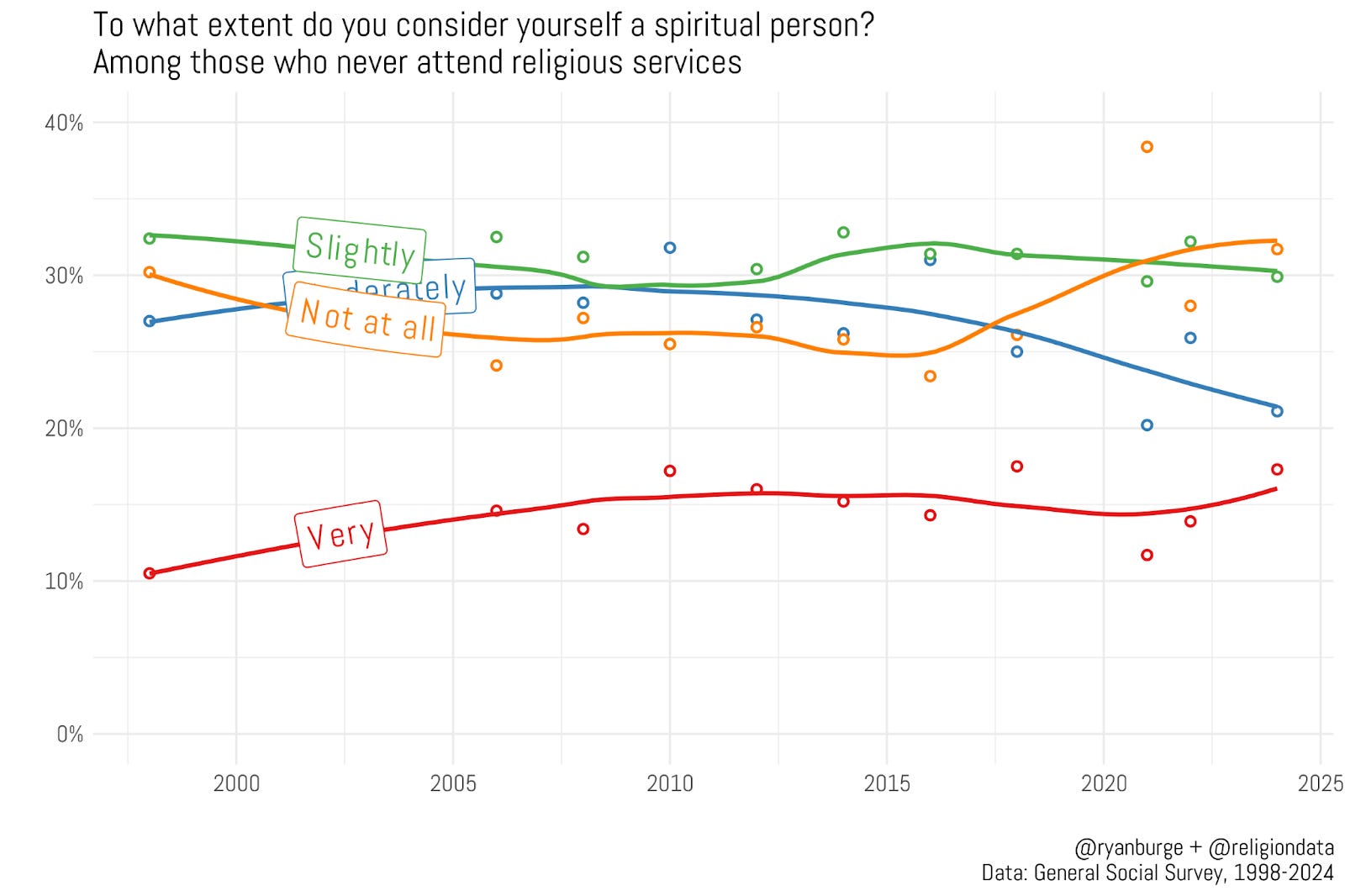
The one thing that really jumps out at me is the “very spiritual” trend line. It’s always been the least popular option among never-attenders. In 1988, just 10% chose it. That number has crept up slightly over time, but even today, only about 15% of people who never set foot in a house of worship describe themselves as very spiritual.
The other three trend lines weave in and out of each other. Generally speaking, each has hovered somewhere between 25% and 35% of never-attenders. But a subtle shift has appeared in the last decade. Among those who never attend church, 25% said they were “not at all” spiritual in 2016—that’s climbed to roughly 33% in the 2024 data. At the same time, the share who said they were “moderately spiritual” dropped by about eight points.
Looking at the big picture, there’s really no evidence that never-attenders have ever been particularly spiritual. That wasn’t true in 1988, and it’s certainly not true in 2024. In fact, the rise in “not at all spiritual” responses suggests that secularization is continuing to deepen.
To tie it all together, I built a composite “secularity index” using the previous three questions—religious belonging, religious belief, and spirituality. Each counts for one-third of the total, and the scale runs from 0 (completely religious) to 1 (completely secular). For example, a never-attender who reported no religious affiliation, said they don’t believe in God, and described themselves as not at all spiritual would score a 1 on this index.
Here’s the mean score for never-attenders over the last few decades. I calculated it both for the overall sample and for each generation with a large enough sample size.
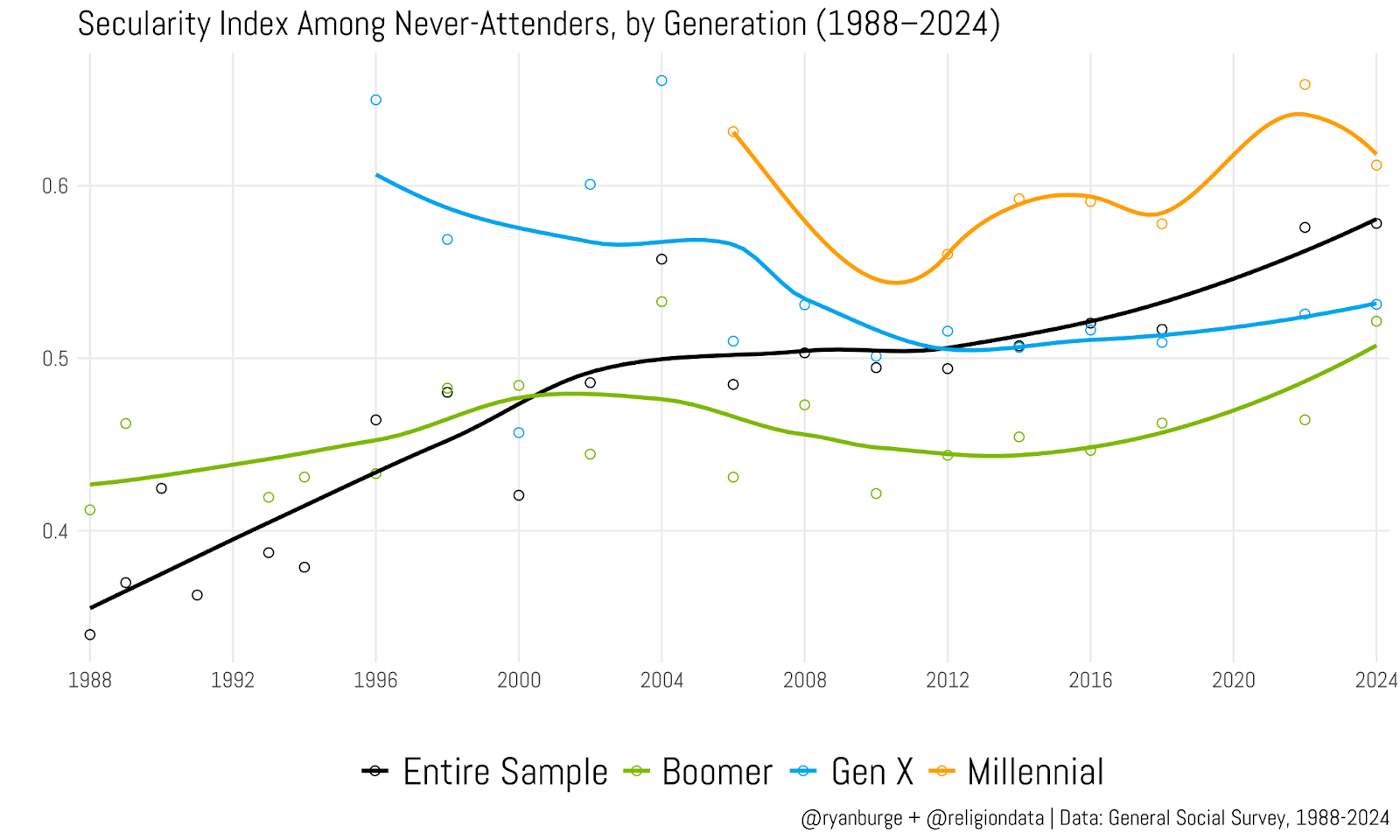
The black line tells a pretty interesting story. Secularism among never-attenders rose rapidly between 1988 and 2002, climbing from 0.35 to 0.50. Then it plateaued for about fifteen years. But in the most recent data, the index has started creeping upward again and now sits at 0.58 in 2024—an all-time high. So yes, never-attenders today are significantly more secular than those from 35 years ago.
Are The Nones Replacing Religion With Spirituality?

One of the things that we often hear when we tell folks that we are working on a project that is studying the growing number of nones in the United States is something along the lines of, “Oh, I’m not that religious, but I consider myself highly spiritual.” It’s a concept that we talk about a lot in social science. So much so that we have a term for it:…
But why is that number rising? It’s not because of Boomers. Their secularity score is about the same today as it was in 2000—and it even dipped slightly between 2014 and 2020. For Gen X never-attenders, the pattern is similar. Their secularism level has actually edged down over time: it was around 0.61 in 1996 and stands at about 0.52 today, just a bit higher than Boomers.
So what’s pushing the overall average up? Millennials. Among those who never attend, their secularity has always been higher than any other group. It was nearly 0.65 back in 2006. It’s dipped a bit since then but still sits above 0.60 today. In other words, generational replacement explains much of the rise—Silents and Boomers are aging out, and younger, more secular never-attenders from Millennials and Gen Z are taking their place, pulling the overall average higher.
That brings us back to the original question: are never-attenders further from religion today than in years past? The answer is unmistakable—yes, they are. By every metric, and by a substantial margin.
As for why that’s happening, the explanation is less clear. One possible factor is social desirability bias. In other words, decades ago, never-attenders may have been honest about skipping church but less forthcoming about their true beliefs regarding God or spirituality. Today, people may simply feel more comfortable expressing what they really think.
Whatever the reason, the conclusion is the same: never-attenders are far more secular now than ever before.
Code for this post can be found here.
Ryan P. Burge is a professor of practice at the Danforth Center on Religion and Politics at Washington University.

In my research on Catholic schools and disaffiliation, I have long speculated that social desirability bias has played a significant role not only in survey responses but also in the broader ways individuals have lived out their religious lives. In earlier social contexts, religious practice, particularly church attendance, was often shaped by strong social expectations. Participation in religious life was frequently regarded as normative, and absence from church could carry social or even professional consequences. This is no longer the prevailing reality. Today, individuals generally feel far freer to express their beliefs, or lack thereof, without comparable social pressure to conform to religious norms. It could be argued, in fact, that social pressure has not disappeared but has instead shifted, from an expectation of religious participation to an assumption of secular identity.
Additionally, I would hypothesize that the contemporary movement away from religious belief and practice reflected in current data is not entirely new. Similar periods of pronounced secularization have occurred at other points in history. For example, events such as the French Revolution may have coincided with significant shifts toward secular worldviews and less defined or less practiced religious belief. Viewed in this light, present trends may represent not an unprecedented rupture, but a recurring pattern in the relationship between religion, culture, and social expectation.
“Going to church doesn’t make you a Christian any more than standing in a garage makes you a car.”
Well, no, but if I'm playing a game of 20 questions, and the answer to the query "Does this item spend a lot of its time in a garage?" is "Yes," then "Car" is a pretty reasonable answer, right? And if learned that the correct answer was actually "No, it's not a car, it's this guy Brad who is also not a mechanic and really doesn't have any association with cars in any way he just really likes to spend all his time in the garage for no reason" that would be weird and I wouldn't play 20 questions with that person anymore.