

Classifying American religion is hard. It’s nearly impossible, really. There are hundreds of denominations, and that doesn’t even include all the variations of non-denominational churches that are popping up all over the United States. But part of the role of social science is to try and bring some order and structure to such a messy landscape. And there’s no way to do it in a way that makes everyone happy.
The system empirical social science has coalesced around is called RELTRAD, and it was first introduced in 2000 in a paper by Steensland et al. called “The Measure of American Religion: Toward Improving the State of the Art.” It uses the General Social Survey’s question structure to create a seven-part typology of American religion. I wanted to focus on just the first four categories in RELTRAD for today’s post: evangelicals, mainline Protestants, Black Protestants, and Catholics. Those four groups together encompass about 60% of the American population.
I don’t want to take a whole lot of time explaining all the contours of each of those three Protestant groups and justifying why they are distinct categories because it would take up too much space in this post. But I have written (with the help of Claude) a pretty nice little one-page website that describes and visualizes the three Protestant groups. For those who are new around my corner of the world, I would strongly urge you to take ten minutes to read it over. There’s also a fun little widget that lets you type in the name of a denomination, and it will tell you how RELTRAD classifies it.
With that out of the way, let’s get to the point of this post. I actually think that if social scientists were only concerned with measuring religiosity when it came to creating a typology of Christianity, then there would be just two groups – not four. My argument is that evangelical Protestants and Black Protestants are almost exactly alike and form one cluster of American religion, while the other category consists of mainline Protestants and Roman Catholics.
Let me just show you what it looks like by taking all of us on a tour of a number of questions that are featured in Pew’s Religious Landscape Survey that focused on religious beliefs and behaviors of those four groups mentioned above.
To begin, we have a really basic question about the existence of God that is asked in two separate parts. The first one is a simple yes/no query: do you believe in God or a universal spirit? Once they answer that, they are asked to express how much certainty they have in that belief, ranging from absolute certainty to being not at all certain.
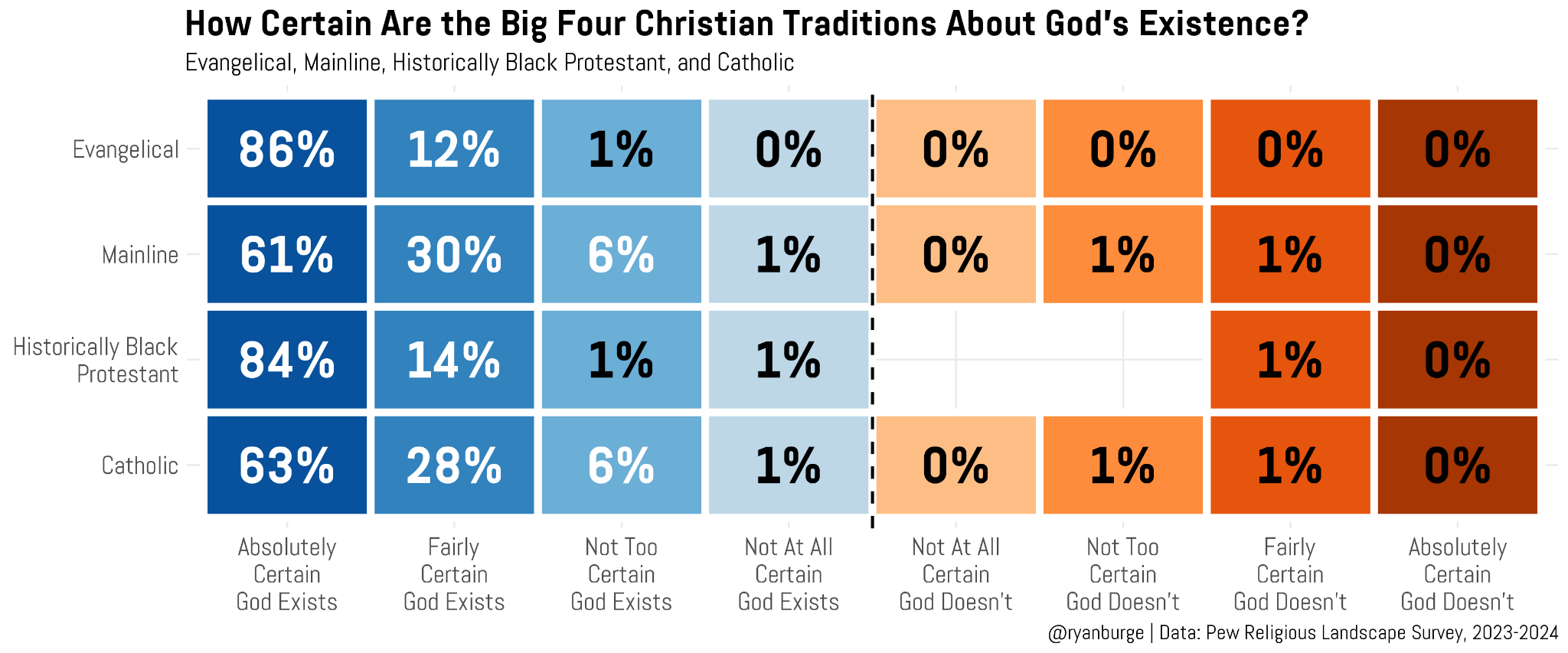
After taking just a quick glance at the heatmap, you can already pretty easily figure out that two camps are starting to form. The share of evangelicals who say that they believe in God with absolute certainty is 86%, and for Black Protestants it’s 84%. If you combine the top two categories, you get 98% for both. You get the point here, right? Nearly everyone in both traditions expressed a highly certain belief in God. Less than 1% can be found on the right-hand side of the visualization.
But contrast that with the folks who identify as mainline Protestants or Catholics. Just looking at the far left-hand column tells a big part of the story. The share who believe in God with complete certainty is about 20 points lower than the first two groups we just discussed. For mainliners, that figure is 61%, and it’s nearly the same for Catholics at 63%. Instead, there are much bigger shares of these two traditions who slide down the scale just a bit. About 30% of both groups end up in the “fairly certain God exists” category, which is double the rate for evangelicals and Black Protestants.
There are also two questions about respondents’ views of heaven and hell.
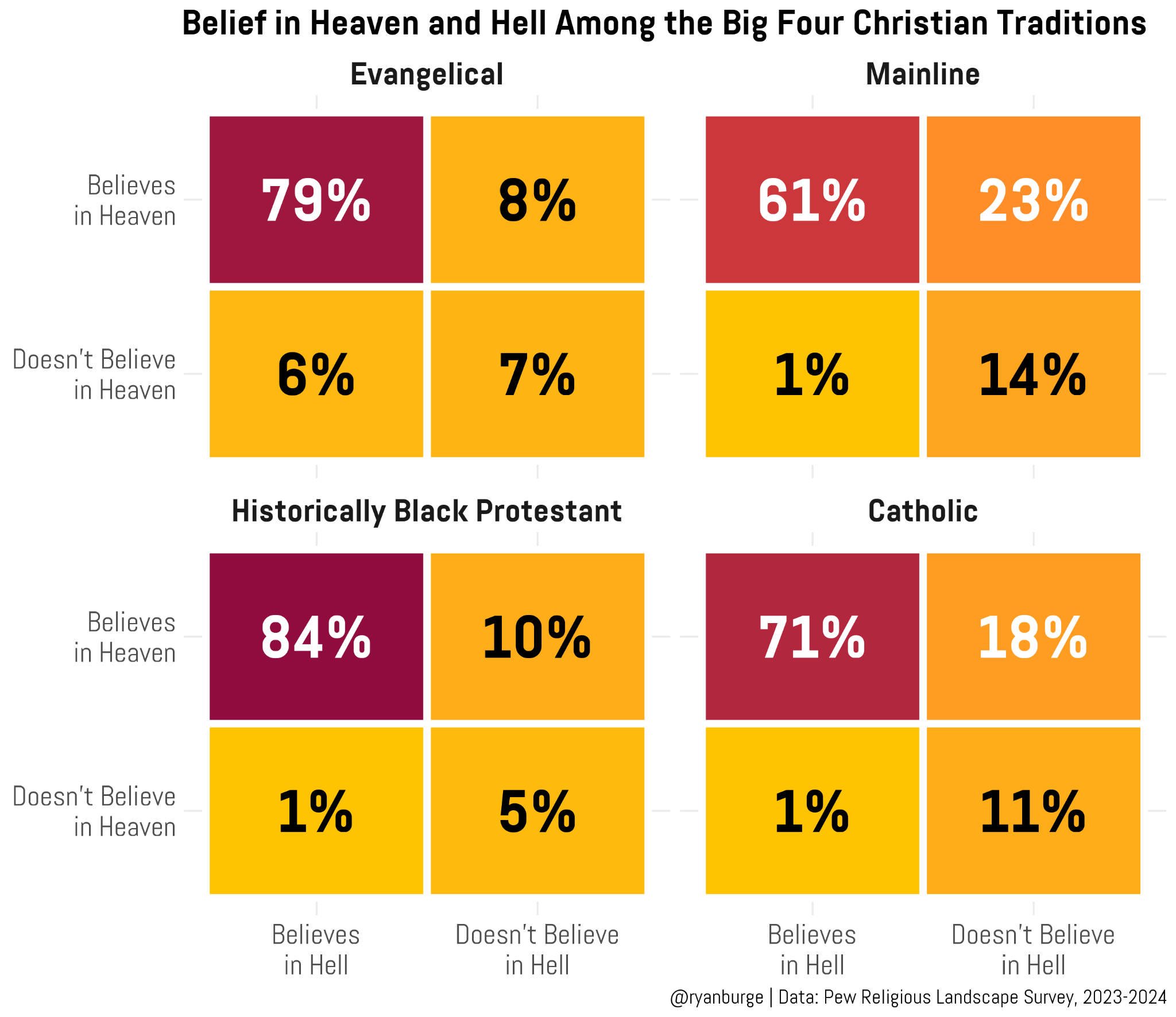
And, again, you can see that two really clear typologies begin to emerge here. The group that is the most likely to believe in the existence of both heaven and hell are historically black Protestants – 84% of them can be found in the top left hand corner. Among evangelicals, the top left square is a bit smaller but not by that much – 79%. It is interesting to me that evangelicals are the group that is the most likely to believe in hell but not heaven (6%) while every other group hovers around 1%.
You can see a bit of a break between mainline Protestants and Catholics on this one, though. Among the latter group, 71% indicate a belief in both heaven and hell. That’s a full ten percentage points higher than their mainline cousins and it’s only 8 percentage points lower than evangelicals. So, the Catholics sit in a sort of middle ground on these afterlife questions. I do also need to flag the fact that nearly a quarter of mainliners believe in heaven but not hell—that’s five points higher than Catholics and 15 points higher than evangelicals.
There were also some questions on the Pew Landscape survey that focused on how people made decisions about right and wrong. There were four sources to come to a decision: logic and reason, practical experience, religious teachings, and scientific information. I calculated the share of each tradition who said that each source was “extremely important.”
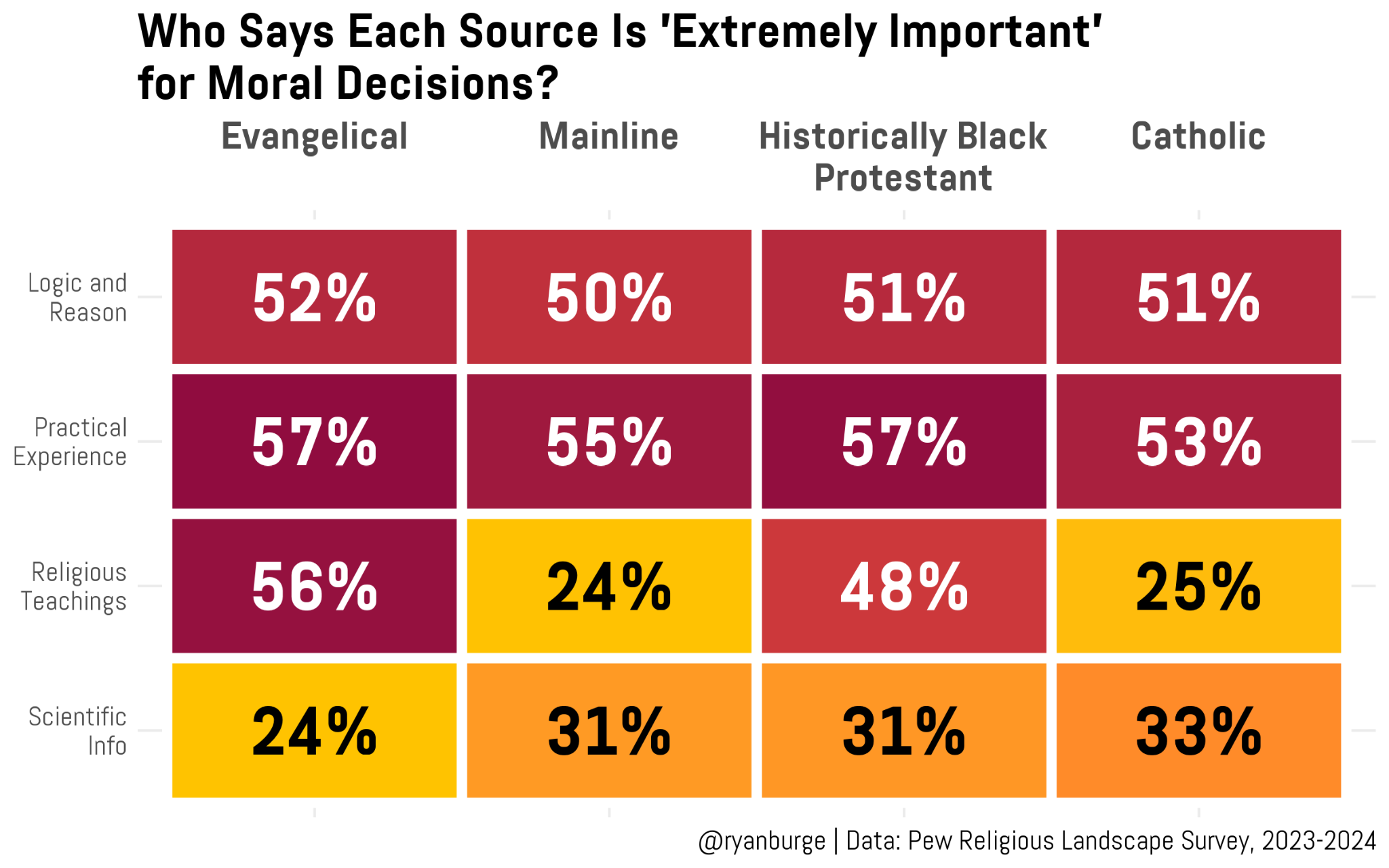
The first thing that should jump out to you is that the top two categories are extremely popular with all four religious groups. Whether someone is an evangelical or a Catholic, they tend to rely on both logic and reason alongside practical experience to puzzle their way through difficult decisions in their lives. It’s kind of amazing how rock-steady those figures are across all four columns, really. There is some deviation across the bottom row in the question about using scientific information, but it’s really only among evangelicals. They are about 7 points lower than the other three groups.
The big divergence emerges when you take a look at the column that focuses on religious teachings. Among evangelicals, 56% say it’s an extremely important source of guidance for them. It’s 48% among Black Protestants. Then you have mainliners and Catholics at 25%. That’s about half the rate of the other two groups. You can see those two camps becoming even more justified here, right?
Let me show you just one more question on religious beliefs to drive that point home. It asked people to indicate how important the Bible was to them.
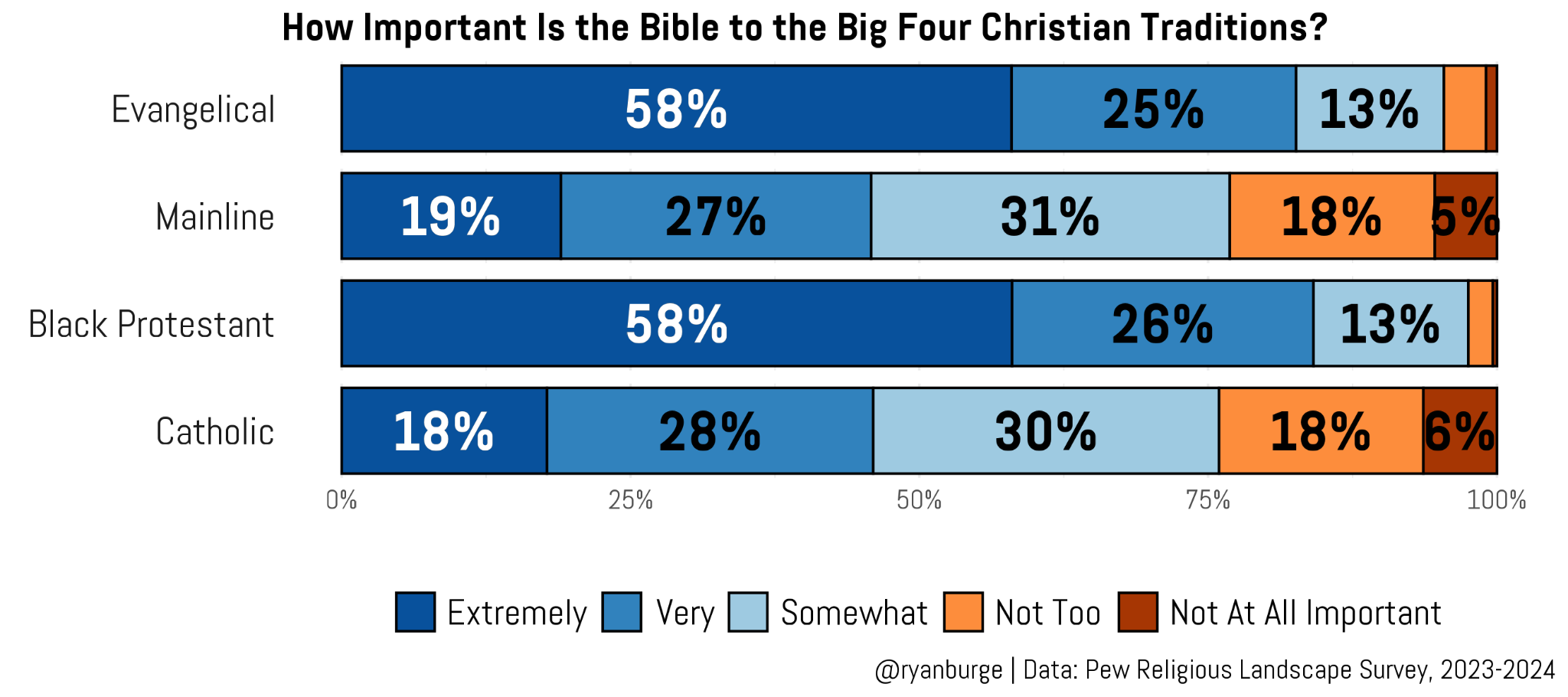
And this bar graph is about as clean as it gets in reinforcing the idea that there are two types of Christians. For both evangelicals and Black Protestants, 58% said that the Bible was extremely important to them. And if you add the top two categories together, it’s 83-84% for both as well. This data was so clean I had to check it twice, but these numbers are accurate. Evangelicals and Black Protestants put almost exactly the same weight on the Bible in their faith traditions.
Meanwhile the breakdown for mainline Protestants and Roman Catholics is eerily similar, too. For mainliners, the top two categories comprise 46% of the sample. It’s the exact same share for Roman Catholics, too. Among both groups, 18% say that it’s “not too important” as well. It’s eerie how much these two groups look alike.
I don’t want to belabor the point much more. Evangelicals and Black Protestants have a very similar posture toward their faith. They have a very high level of belief in God, and place a lot of emphasis on the Bible. They lean on the teachings of their religion to help them make difficult decisions. On the other hand, mainliners and Catholics just score lower on all of these metrics, and often in a pretty significant way.
But what about metrics related to religious behavior like church attendance, prayer frequency, saying grace before meals, and reading scripture? That’s what I calculated in the graph below.
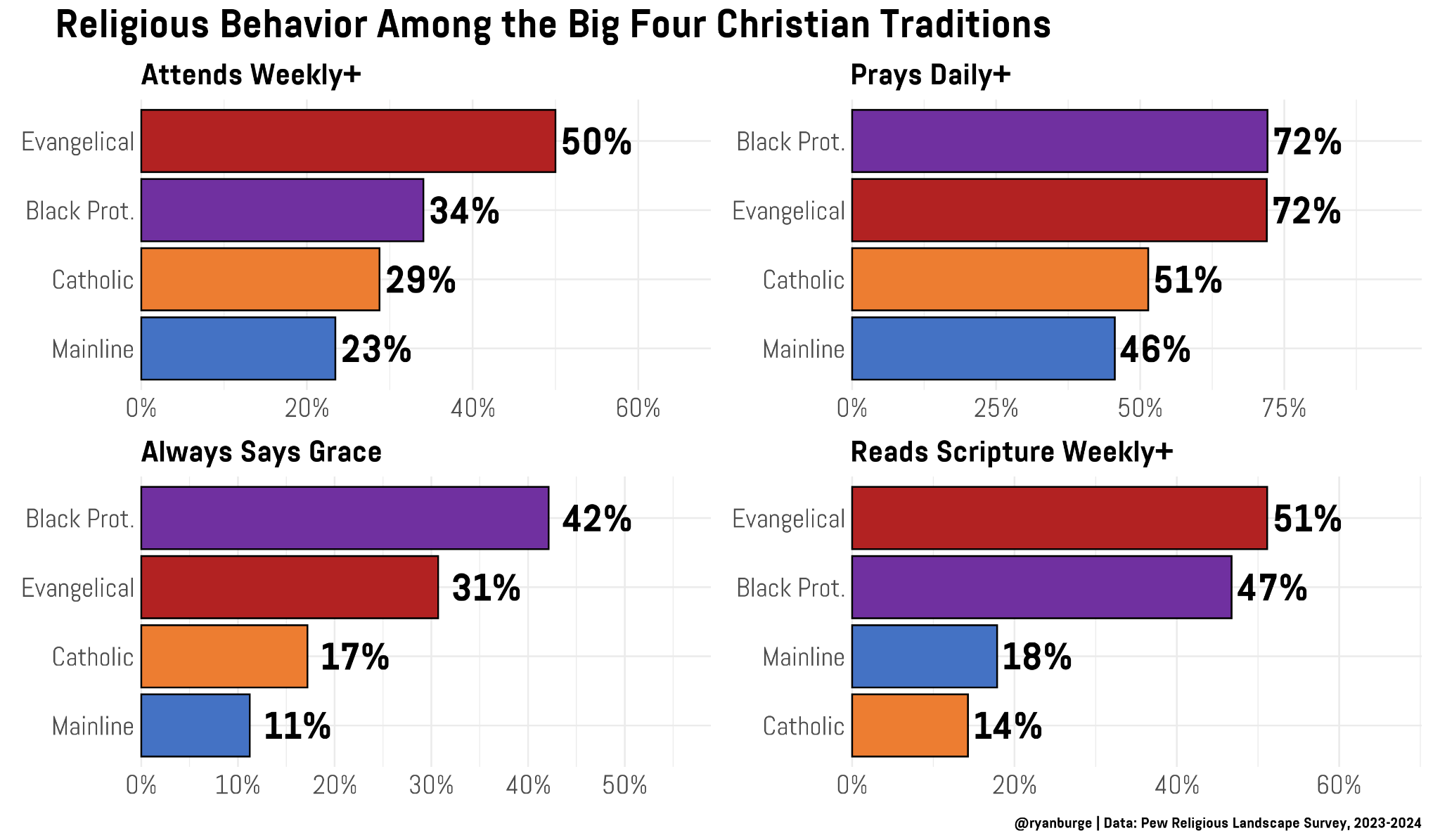
The top two categories are always the same: Black Protestants and evangelicals are more likely to engage in religious activities than mainliners or Catholics. Sometimes the gaps between the first two groups are pretty small. For instance, 72% of Black Protestants and evangelicals pray every day and the share who read scripture weekly or more is just about the same, too. But evangelicals are much more likely to go to church weekly (50% vs 34%), while Black Protestants are eleven points more likely to say grace before meals.
In most of these graphs you can also see that clear break between the top two and bottom two groups. On prayer frequency, mainliners and Catholics are at least twenty points lower than evangelicals and Black Protestants. On reading the Bible weekly, the gap is thirty percentage points. There’s no other way to say this: mainline Protestants and Roman Catholics just don’t do as much “religious stuff” compared to their evangelical and Black Protestant cousins.
To drive that point home in a single graph, I just wanted to visualize all four groups of Christians on two axes. The horizontal one focuses on religious behavior and includes the four items we just discussed. The vertical axis is a composite metric of the belief items that have been previously described in this post.
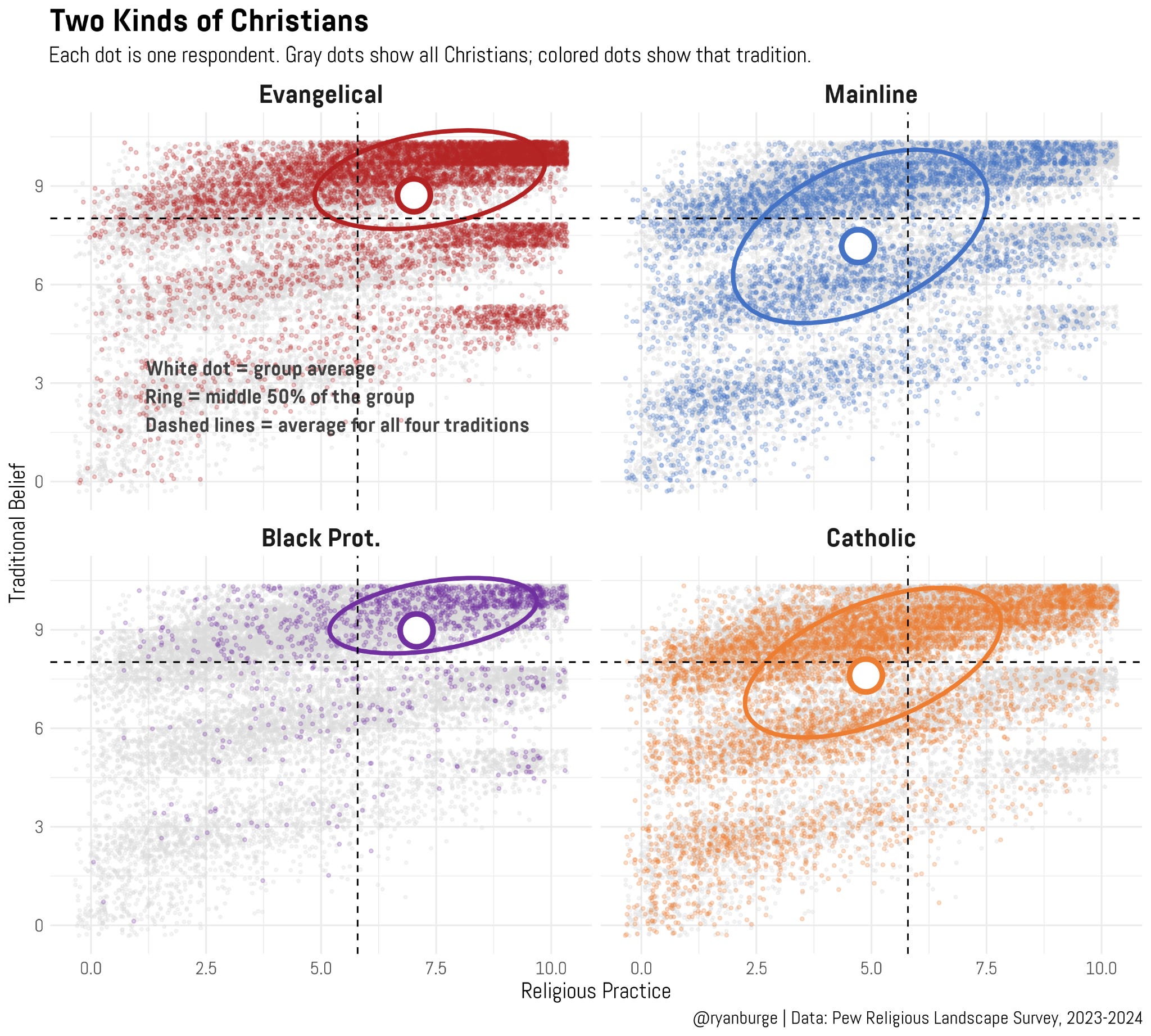
The white dot that appears in each scatterplot is the group average on both dimensions and the ring indicates where 50% of each tradition falls on both dimensions. Where the two dashed lines cross is where the average Christian fell on both dimensions. So anyone in the top right quadrant scored higher on both religious behavior and belief than the average. Someone on the bottom left is below average on both metrics.
I think this makes it pretty plain—the average evangelical and Black Protestant are in that top right corner while mainliners and Catholics are typically found in the bottom left corner. But I also wanted you to take note of the size of the circles. A larger circle denotes less concentration of respondents in one single spot on the scatter plot. That’s certainly the case for mainliners and Catholics. There’s just a whole lot more diversity of beliefs and behaviors there. For Black Protestants and evangelicals, conformity is way more widespread. For both groups, over half of all respondents are in the top right corner.
And just for fun, a little game which is pretty interesting to play if you are a big time religion nerd. I pulled all the evangelicals and Black Protestants from the dataset and built a simple web app that displays their gender and age along with how they answered a bunch of questions about their religious belief and behaviors. Your task is simple – guess if they are an evangelical or a Black Protestant based on the information provided.
So, if Black Protestants and evangelicals are so incredibly similar on all these religiosity measures, then why do we separate them out? I bet you can probably guess why: it’s politics. RELTRAD tries to recognize all the differences between groups, not just religiosity. The fact that 90% of Black Protestants voted for Harris in 2024 compared to 80% of white evangelicals who supported Trump makes it pretty hard to justify collapsing them into one category. That would obfuscate more than it would reveal.
But, as you can pretty easily tell – evangelicals and Black Protestants may strongly disagree at the ballot box but they often walk in lockstep during Sunday services and midweek Bible study.
Code for this post can be found here.
Ryan P. Burge is a professor of practice at the Danforth Center on Religion and Politics at Washington University.