


When I was in graduate school our program required each student to have two majors and a minor field. I knew one of my major fields was going to be American politics – that was an easy choice. I was also made aware that it was easier to get a job teaching public administration than traditional political science because the positions were relatively plentiful and the number of grad students with training in PA were low, so I picked that up as a second major.
And, for reasons that still escape me to this day, my third field became comparative politics. I have no earthly idea why I chose it because at that time the only other country I had visited in the world was Canada. But, I think I took about nine hours in comparative politics. The most memorable course was taught by the brilliant Fred Solt and was titled, “Comparative Political Behavior.” It was basically a class about how different societies engage with the government of their countries. And after poking around in my Dropbox, I found the syllabus. I still remember reading about elections in the Soviet Union that had a number of spoiled ballots, because every citizen had to vote and there was only one choice on the ballot. It was their form of protest.
What Countries Are the Most Religious? Which Ones Are The Least?

One thing I’m going to try and be intentional about in the new year is focusing on religion data outside the United States. Any casual reader of this Substack knows that almost all the posts here are focused on religion and politics in the this part of the world. But I have tried to branch out and try something different. For instance, this one uses the…
Well, for the final project, I knew I wanted to write about religion and I knew I wanted to write an empirical paper. My only option was to use the World Values Survey. But here’s what I distinctly remember about the project – my little Dell laptop could not load the entire data file without crashing. There just wasn’t enough RAM to do the job. So I had to ask Dr. Solt to send me a curated dataset that only contained a handful of countries for analysis.
I don’t have that problem now, of course. I can load the full file. The most recent version of the survey is Wave 7, and it was fielded between 2017 and 2022. It contains 64 total countries, but some don’t have responses to religion questions, so we are left with 54 countries. Which is still a lot.
What follows is me just giving you all a whole bunch of “here’s some cool stuff I found in the World Values Survey when it comes to religion.”
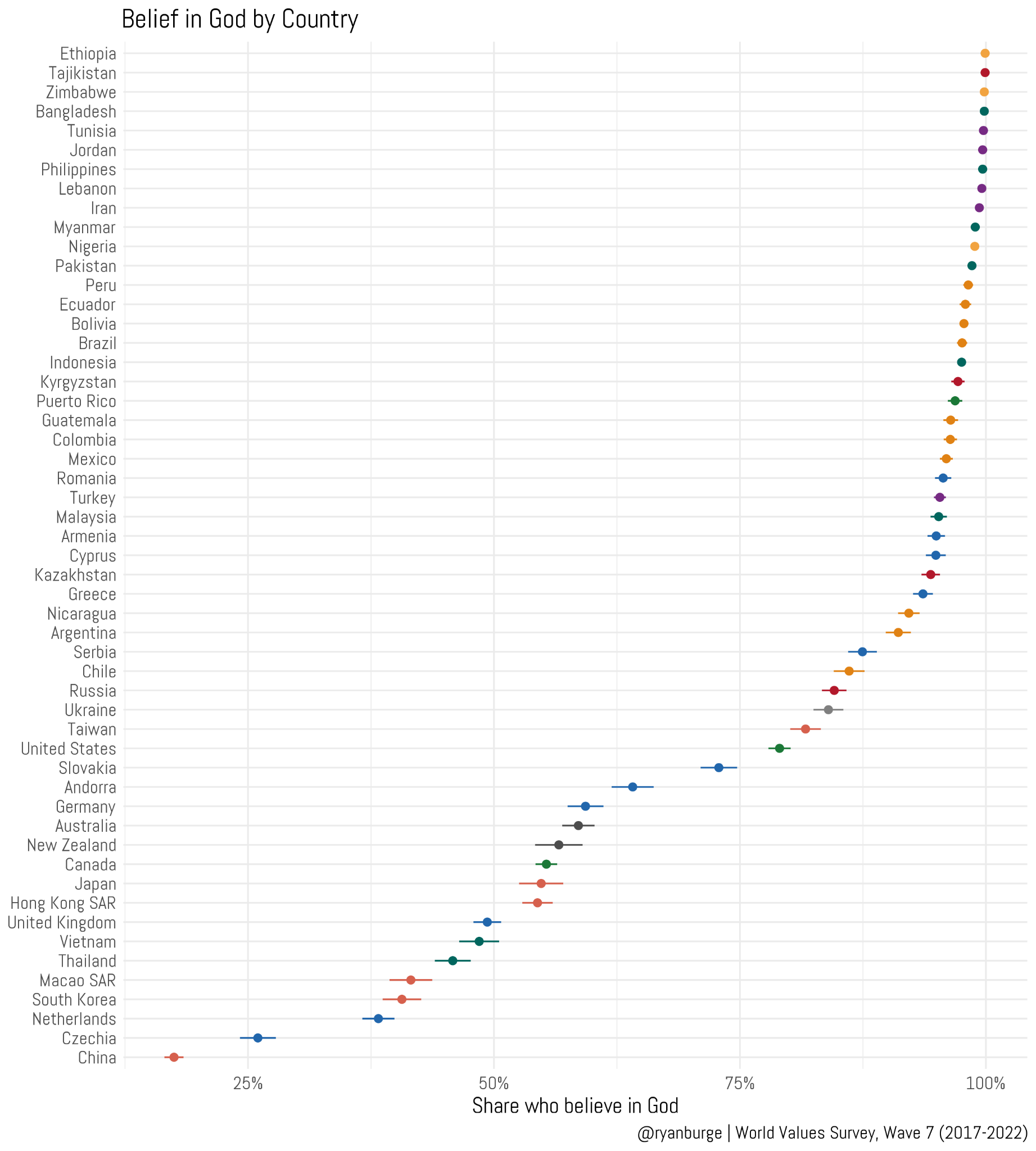
One simple question in the WVS was: Do you believe in God? As you can clearly see above, there are a lot of countries in the dataset where almost everyone believes in God. In fact, there were a dozen countries where belief was at least 99%. There were 31 where belief was at least 90%, as well. The countries represented here are concentrated in several regions: Sub-Saharan Africa, Southeast Asia, and the Middle East/N. Africa shows up a whole lot on the top of the list.
What about the least “believing” countries? There are two that stand out on the bottom of the graph. Just 26% of people living in Czechia said that they believed in God and it was even lower in China, a paltry 17%. The regions that tend to appear down at the bottom are Europe and East Asia, with countries/territories like Macao, South Korea, Hong Kong, and Japan, all of which have pretty low belief in God.
There was another set of belief items on the survey that I always enjoy exploring that were focused on the existence of heaven and hell. They were asked independently, so we can actually parse out people who believe in both, neither or just one of the two. I made heatmaps of all 53 countries where respondents answered both queries.
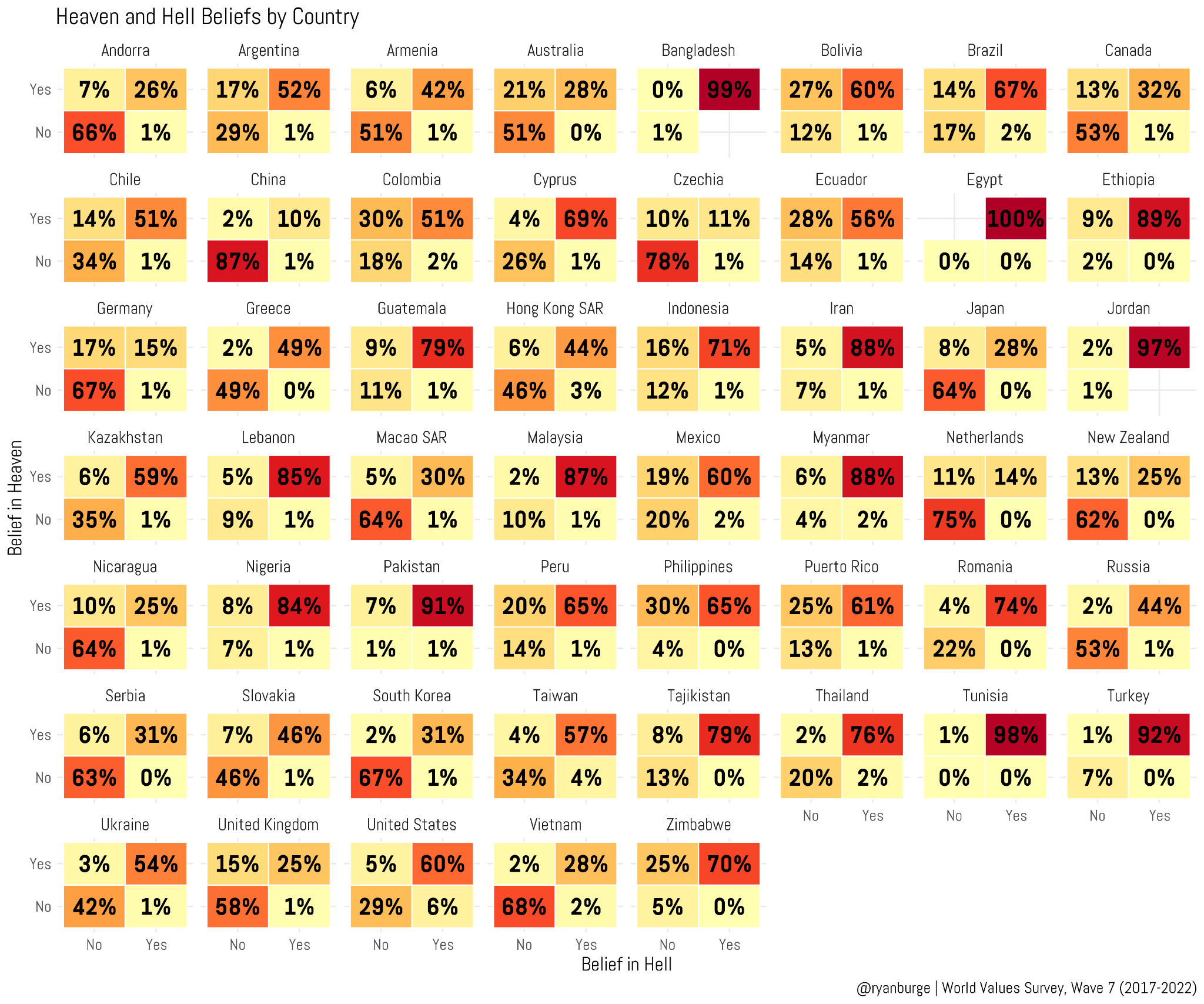
In a lot of the countries that appeared at the top of the belief graph, almost everyone believes in both heaven and hell. It’s 100% of people living in Egypt, 99% of those living in Bangladesh, and 98% of Tunisians. But there are some interesting outliers when comparing belief in God to belief in the afterlife.
One that jumped out was Bolivia. In that country, 98% of people believe in God but only 60% of Bolivians believe in both heaven and hell. Nicaragua is even weirder: 92% of people believe in God but 64% of folks believe in neither heaven nor hell. I’m sure you guys can find other interesting examples like that, please point them out in the comments.
Of course, China scores the lowest on this graph – just 10% of Chinese people believe in both heaven and hell. Czechia is at 11%, but then Germany is only a few points higher than Czechia at 15% belief in both heaven and hell, even though over 60% of Germans believe in God.
You don’t see a whole lot of folks believing in heaven or hell but not both, but there are some countries where this figure is pretty high. For instance, 30% of respondents from the Philippines are in the top left square, and it’s the same share of Colombians. Puerto Rico is right behind at 25%.
There was also a question of how important God was to each respondent and they were given a scale that ran from 1 to 10. I futzed around with this question and it was frustrating because in a huge number of countries the vast majority of people who took the WVS chose 10/10. I was more interested in countries where there were large populations of people who chose 1 or 10. In other words, the countries below had the highest level of religious polarization.
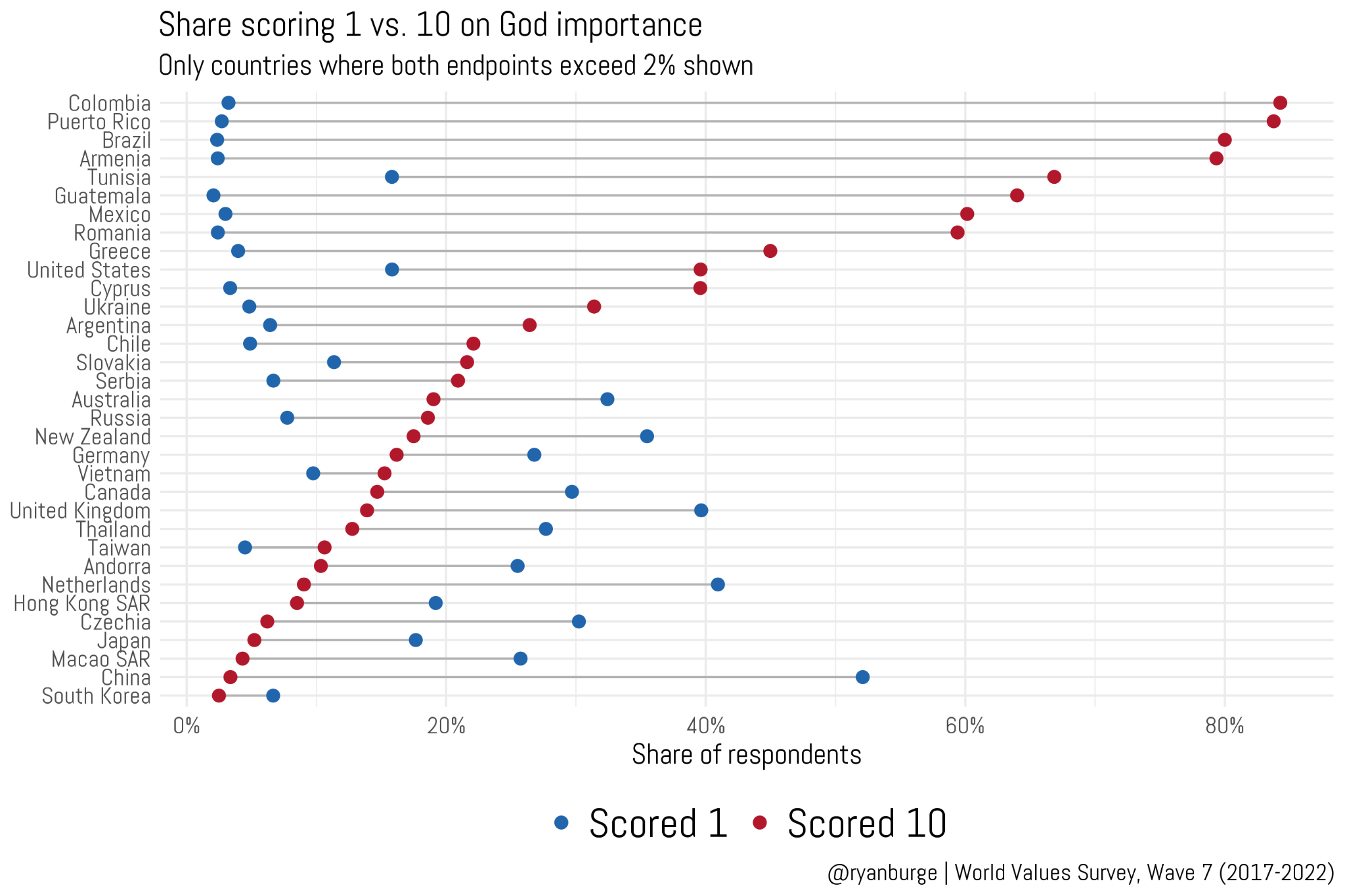
The country with the highest ratio on this graph? It’s China. For every one Chinese respondent who said that their “God importance” score was 10, there were 15 who scored it 1 out of 10. The ratio in Czechia was about 5 to 1. So, there were five non-religious folks for every one deeply religious person. But in lots of other large countries the ratio was pretty modest: 3 to 1 in Japan and the United Kingdom, for instance.
Now there were places where the ratio went the other direction, almost all of them are at the top of the graph. For instance, in the country of Brazil for every person who scored themselves a 1, there were 34 who chose ten out of ten on the “God importance” question. It was 33 to 1 in Armenia and 31 to 1 in both Guatemala and Puerto Rico.
In other words, a deeply non-religious person is far more likely to be outnumbered in their country than a deeply religious one. That holds for almost every part of the world. Even in a largely secular country like Germany, 16% scored themselves as 10/10 and 26% were 1/10. So, it’s certainly possible to find a religiously like-minded individual in a place like that.
Moving on from belief, my curiosity was especially piqued by a statement included in the WVS: “The only acceptable religion is my religion.” I love this one because it’s basically asking people to make an exclusivist claim about their own faith group.
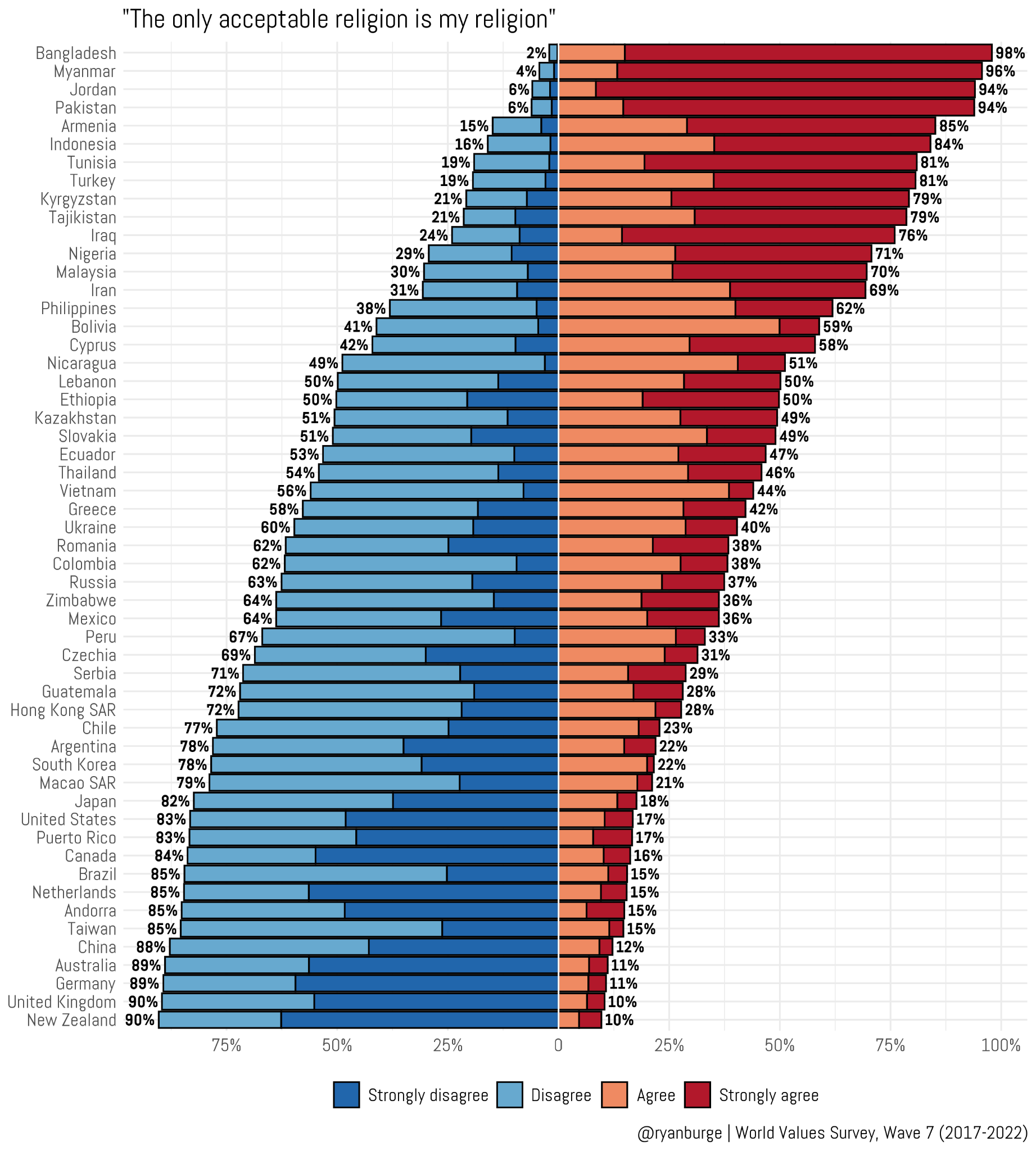
You can see that there are a lot of countries where pluralism is not super robust. In places like Bangladesh, Myanmar, Jordan and Pakistan, the vast majority (90%+) of respondents agreed that the only religion was their own religion. It should come as no surprise that the countries that appear at the top of this graph tend to be the most religiously homogeneous, by the way. It’s pretty easy to make the claim that your religion is the only acceptable one when it’s the only game in town.
What about the countries at the bottom? I think it’s fair to say that it’s a whole lot of first-world countries. Places like New Zealand, the United Kingdom, Germany, and Australia show up in this part of the graph. These are countries where religious pluralism is pervasive. Someone claiming that their particular faith is the only acceptable one is just incredibly rare, often being held by 10% of the population.
I am fascinated, though, by the countries where answers to this question are evenly divided. It’s an eclectic mix: Nicaragua, Lebanon, Ethiopia, Kazakhstan, Slovakia, etc. I certainly can’t make some kind of sweeping claim about divided countries being in one region of the world.
But that got me thinking about what factors led to more exclusivist thinking. To do that I made two simple calculations. The first was the mean score on the “God importance” question from earlier for each country. The second was the share of each country that agreed that their religion was the only acceptable one. I wondered if countries with higher levels of religiosity were also more likely to be exclusivist in their approach to other faith groups.
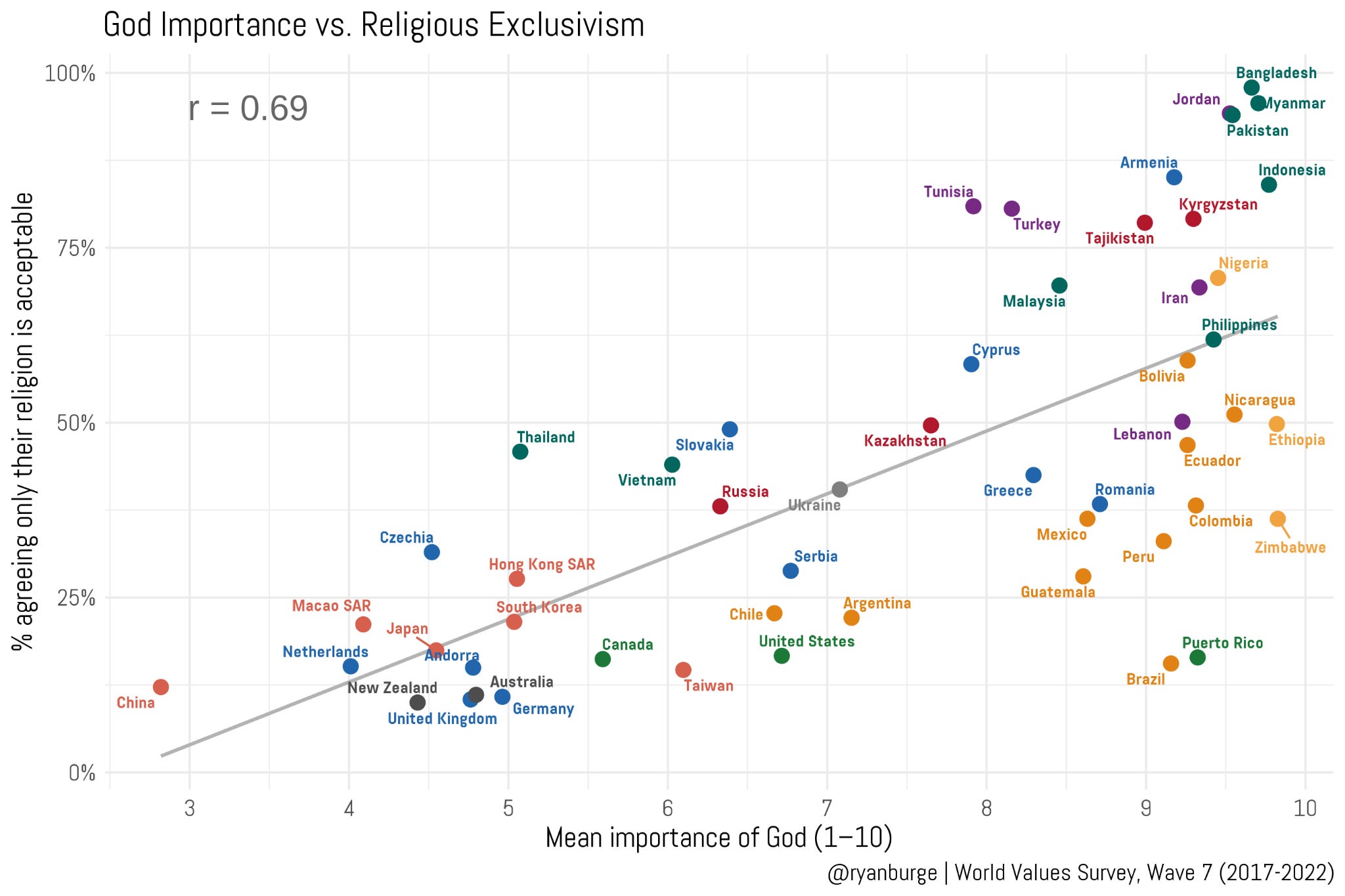
There is a strong positive relationship between national religiosity and religious exclusivism (r = 0.69), meaning that countries where God is seen as more central to daily life also tend to have higher shares of residents who view their own religion as the only acceptable one. However, the R2 value is just .48, which means that the God importance variable only explains about half the variance.
Notice which countries are below the line consistently – it’s places in Latin America. For a country like Brazil, the importance of God is incredibly high (over 9/10). However, at the same time, just 15% of Brazilians agreed that their religion was the only acceptable one. These are people who are deeply devout but have an incredible tolerance for other faith groups. Other countries in the region are in this quadrant of the graph, too: Peru, Colombia, and Guatemala are high on religiosity and high on pluralism.
But then look at the countries where the opposite is true: overall religiosity is low but exclusivism is relatively high. For instance, in Thailand, average score on God importance is 5/10 but almost half the country takes an exclusivist view. Vietnam is in a similar spot on the graph. Tunisia and Turkey also jump out to me. They are fairly religious but not at the top of the scale, but also very exclusivistic.
One final scatterplot before I close up today. This one is just a simple replication that is widespread in my corner of the world: specifically, the secularization hypothesis. This is the idea that as a country becomes educationally advanced and economically prosperous, it will be less religious. I created a composite index of religiosity based on a number of questions about religious belief, belonging, and behavior. Then I grabbed a measure of GDP per capita to assess economic prosperity.
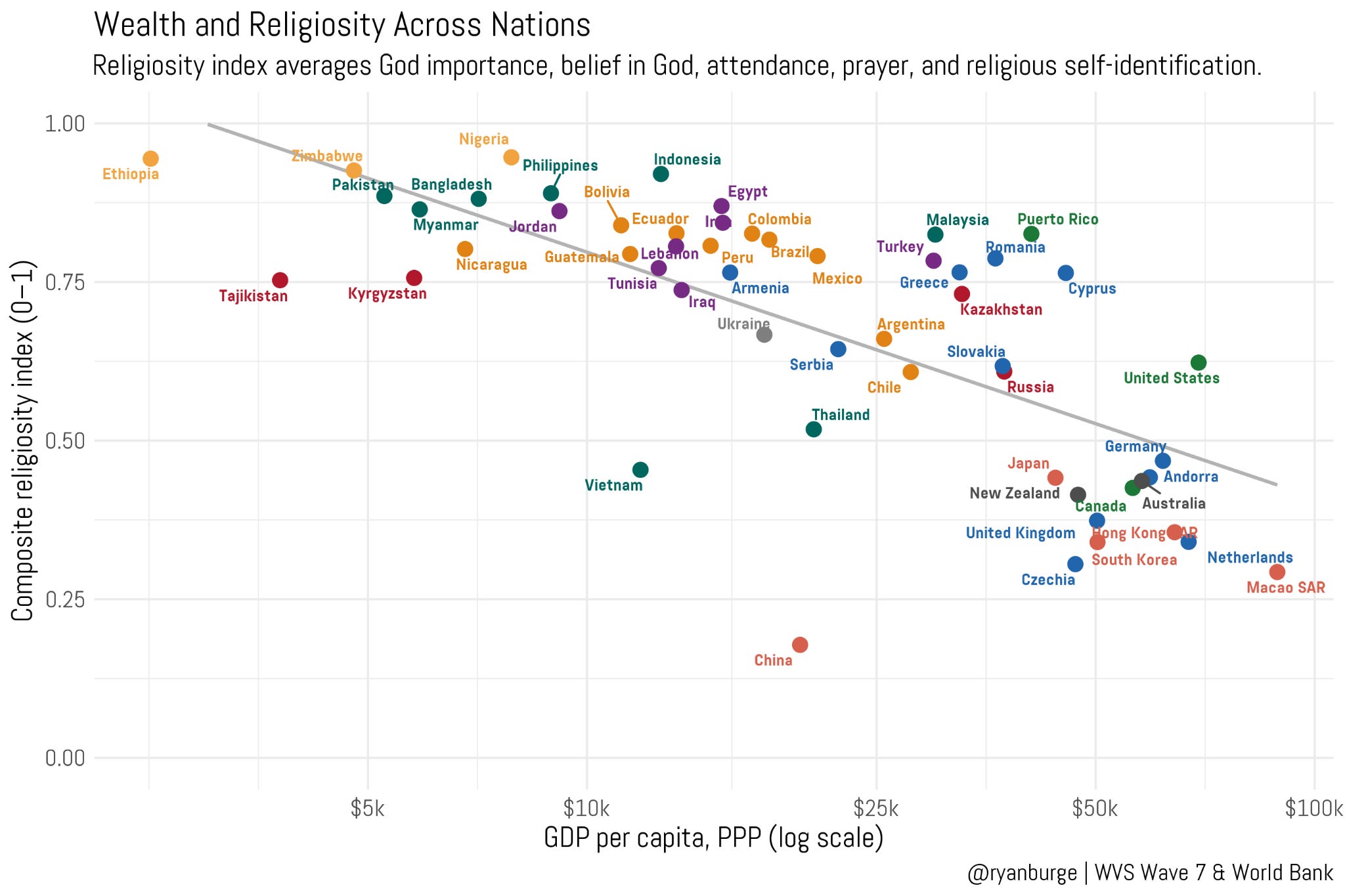
As you can probably guess, the poorest countries tend to be the most religious and the most economically prosperous ones score the lowest on my composite index of religiosity. The correlation coefficient is r = -.70, which is strong but not completely determinative. The R2 is right around .50, which means that only half the variance can be explained by simple GDP.
The outliers are always worth flagging. The biggest one is, without a doubt, China. It scores the absolute lowest on the religiosity index of any country, yet its GDP is solidly in the middle of the pack. If China’s GDP were to actually reflect its religiosity score based on this simple model, it would need to be nearly $400,000. That’s over four times higher than any other country in the sample. The obvious explanation is not poverty but politics: decades of state-enforced atheism under the Communist Party have suppressed religious expression in ways that wealth and development simply cannot replicate.
What Countries Are Most Involved in Religious Organizations?

I have been asked several times in the last couple of weeks if I could write more about religion outside the United States. This is my attempt to do something like that. That’s not to say that I have not written about international religion before. Just a few months ago I put together a post about religious importance in over sixty countries using the
What about outliers above the line? One big surprise is Puerto Rico. Its GDP is $40K but their religiosity index is .83. The combination of a strong Catholic Church and the rise of Pentecostalism probably explains a lot of that. Then you’ve got a bunch of Eastern Orthodox countries who are more religious than they should be based on their GDP: Cyprus, Greece, and Romania all fit this pattern.
Where does the United States fit? Well, it’s still an outlier. The religiosity index is .62, and GDP is nearly $70K. In order to fit the trend line in this scatterplot, GDP would need to drop to just $28,000 or religiosity would need to dip to .47.
When it comes to religion, no two countries are the same — not even two countries that share a border, or two regions within the same nation. This kind of work humbles me. I could spend my entire career studying the religiosity of a single country and still not fully understand it. The idea of doing that for 200 more countries is almost incomprehensible.
I will spend my entire life studying religion and still grasp only a fraction of it. That’s not a discouraging thought. It’s the reason I keep coming back.
Code for this post can be found here.
But, wait…there’s more. Someone asked me a while ago if I would occasionally drop in book recommendations. I just finished a book that I am still thinking about. It’s called Hell is a World Without You by Jason Kirk. It’s a novel about a kid who grew up deeply enmeshed in evangelicalism in the early 2000s.

The main character is basically a slightly fictionalized version of the author, you can pretty easily tell that after reading just a couple of dozen pages. And let me tell — Jason Kirk understands the world of Millennial evangelicals better than anyone I’ve ever read. He gets all the weird nuances, culture, and oddities that consumed my teenage years.
For instance:
Anyway, Wednesday church was usually fun. Obstacle courses! Eating live goldfish! A pretend funeral? This kid Zack read his friend’s suicide note, which listed times Zack should’ve shared the gospel. After Zack cried, “Why didn’t I tell him about Jesus?” the casket burst open. The dead kid screamed, “I’m burning in Hell, thanks to you,” and then we played red rover.
That last sentence made me laugh out loud because stuff like that happened ALL THE TIME when I was in youth group. You would have the most emotionally traumatizing moment of your life, then go to the fellowship hall and eat cold Domino’s pizza.
It gets a bit too cliche in a couple spots near the end, but I can easily overlook that in the name of drama and closure. If you grew up evangelical and are between the ages of 35 and 45, this book will hit like a sledge hammer of nostalgia.
Ryan P. Burge is a professor of practice at the Danforth Center on Religion and Politics at Washington University.

I don't think I've ever read a book recommendation that feels more targeted at me... 😅
Do Pakistani doctors taking care of patients in America and Britain, of which there are a lot, still think their religion remains the only acceptable one? At both extremes, the poll reflects places that are largely insular. While China has a lot of ethnicities, they have a unified culture, much of it mandated by their government. The poorer Islamic nations now have a fair number of their citizens migrating to Europe and America. Do their views remain what they were or does the inevitable exposure to others in school, employment, or shopping malls change that? It would be interesting to see how a immigrants to Canada, US, Britain compare to the responses of their native country and how the next generation of native born become more like the only place they have lived.
There are countries not on the list that might also offer insight. Some Buddhist countries appear. Technically Buddhism has no God. Neither does Confucianism or Taoism which still have a presence in China. And India has a polytheistic religion, though with a dominant God. Not part of the survey. The concept of the Abrahamic faiths in monotheism is not shared by everyone, yet the survey question seems to present it as if it was.